
MELC-105 · Lesson 3 of 12 · 24 min
Transformers under Section 26
▶ Video coming soon A video version of this lesson is on the way.
MELC-102 covered the arithmetic of transformer protection: rated currents, the 125% thresholds and the combined rules for primary and secondary protection. This lesson looks at the rest of what Section 26 says about transformers, because exams ask about installation as often as about calculation. Where can a dry-type transformer go? What clearances does it need? When does an oil-filled transformer need a vault? How are the secondary conductors protected when they leave the transformer? How do you ground the secondary of a separately derived system? Each of these is a short lookup if you know where Section 26 keeps it.
The example is the Gaetz Avenue dental clinic from MELC-102, where a 75 kVA dry-type transformer steps the building's 600 V supply down to 208Y/120 V for the clinic's equipment, and the Hartley Farms shop, where a small single-phase transformer feeds 120/240 V tools from the farm's 347/600 V service. As always, Code text and tables are not reproduced, and values that would come from a table are illustrative. Check every rule in your own 2024 CE Code.
Where transformers fit in Section 26
Section 26 covers installation of electrical equipment in general: switchboards and panelboards, capacitors, transformers, and rules about working space, ventilation and location. The transformer rules occupy a block of the section, roughly the 26-240 to 26-270 range in the pattern of recent editions, with protection in the middle of the block and installation, vaults and grounding around it. Section 26 is a general section, so it applies everywhere unless a supplementary section modifies it. Priya tabs the start of the transformer block in blue, matching her other general-section tabs.
| Topic | What the rules address | Exam angle |
|---|---|---|
| Scope and definitions | Which transformers the rules cover; terms such as dry-type and liquid-filled | Whether a small control transformer is covered |
| Overcurrent protection | Primary and secondary protection limits as a share of rated current | Maximum device ratings (MELC-102) |
| Secondary conductors | Ampacity relative to rated current and length conditions | Whether unprotected secondary conductors comply |
| Location and accessibility | Where dry-type and liquid-filled units may be installed | Clearances from combustible material and walls |
| Ventilation | Air flow for heat removal | Whether a closet installation is allowed |
| Vaults | When liquid-filled transformers need a vault and how it is built | Construction and door requirements |
| Grounding and bonding | Grounding the secondary and bonding the enclosure | Where the system bonding jumper goes |
Dry-type and liquid-filled transformers
Most transformers inside commercial buildings are dry-type: the windings are cooled by air, with no oil. They are allowed indoors in ordinary locations under conditions about ventilation, separation from combustible material, and accessibility. Larger dry-type units, and those above certain voltages, have stricter location rules, such as a minimum distance from combustible surfaces or installation in a fire-resistant room. Liquid-filled transformers use mineral oil or a less-flammable liquid for cooling and insulation. Mineral-oil units indoors generally need a vault built to the Code's construction requirements, with curbs or sills to contain a spill and doors that are fire-rated. Less-flammable-liquid units have relaxed requirements, depending on the liquid's listing and the size of the transformer.
On exams, the question usually gives you a transformer type, a rating and a location, and asks whether the installation complies or what additional measure is needed. The answer turns on reading the location rules for that type and size. Priya's lookup sheet has a small matrix: dry-type or liquid-filled, indoor or outdoor, small or large, with the rule numbers that apply in each cell.
Clearances, ventilation and accessibility
A transformer gives off heat equal to its losses, which for a 75 kVA dry-type unit might be a couple of kilowatts at full load, the output of a large space heater. If that heat cannot escape, the windings run hot and the insulation ages quickly. The rules require transformers to be installed where ventilation is adequate, with the clearance from walls and other obstructions marked on the transformer nameplate or given in the manufacturer's instructions. Rule 2-024 makes those instructions part of the installation requirements. A transformer shoved into a storage closet with the door closed fails both the ventilation rule and, usually, the working space and accessibility rules.
Accessibility matters too. Transformers must be readily accessible for inspection and maintenance, with some exceptions for small units mounted above a suspended ceiling or on a wall, under conditions. Working space in front of the transformer's terminal compartment follows the general working space rules of Section 2. At the dental clinic, the original design put the transformer on a platform above the sterilization room's ceiling; the inspector questioned access for a 75 kVA unit, and Parkland Valley moved it to a floor pad in the electrical room.
Worked problem
Heat from the clinic transformer (illustrative losses)
Suppose the 75 kVA transformer is 98% efficient at its typical load of 50 kVA at unity power factor. Roughly how much heat does it give off at that load?
Show solution
- Output power: 50 kW.
- Input power: 50 / 0.98 = 51.02 kW.
- Losses: 51.02 − 50 = 1.02 kW, released as heat into the room.
Answer: About 1 kW of heat, which the electrical room's ventilation must remove.
Protection in practice
MELC-102 worked the protection limits numerically: primary-only protection limited to a stated share of rated primary current, and primary-plus-secondary protection allowing a higher primary device when the secondary is also protected. In practice, the decision about which arrangement to use depends on the secondary conductors and what they feed. If the transformer secondary feeds a panelboard right beside it, a secondary main breaker in the panel can provide the secondary protection, allowing the primary device to be sized to ride through the transformer's inrush current when it is energized. Inrush can reach many times rated current for a fraction of a second, and a primary breaker sized too close to rated current may trip every time the transformer is switched on.
The secondary conductors are a separate concern. Conductors leaving a transformer secondary are not protected by the primary device in the way that branch circuit conductors are protected by their breaker, because the primary device sees the secondary current divided by the turns ratio. The rules therefore require secondary conductors to have an ampacity at least equal to a stated share of the rated secondary current, to be as short as practicable, often within a length limit, and to end at a single overcurrent device that protects them. Exams love the length condition.
Worked problem
Secondary conductors at the clinic (illustrative values)
The 75 kVA, 208Y/120 V transformer has a rated secondary current of 208.2 A. The secondary conductors run 4 m to a panelboard with a 225 A main breaker. Suppose the rule requires secondary conductor ampacity of at least 125% of rated secondary current. What minimum ampacity is needed, and what else does Priya check?
Show solution
- Minimum ampacity: 1.25 × 208.2 = 260.25 A (multiplier as stated in the problem).
- Check the length against the rule's limit for unprotected secondary conductors.
- Check that the conductors end at a single overcurrent device whose rating does not exceed their ampacity.
Answer: At least 260 A of ampacity, plus the length and termination conditions.
Grounding the secondary
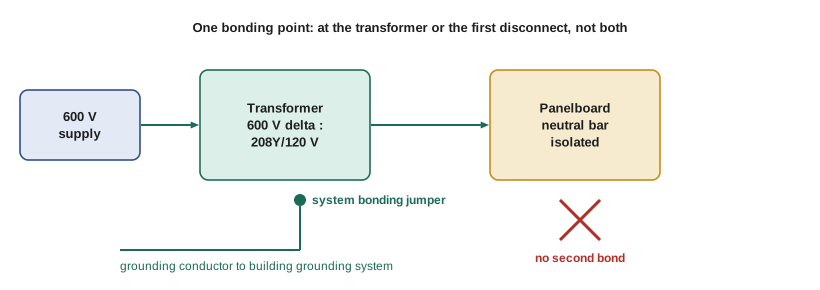
A transformer with no direct electrical connection between primary and secondary windings creates a separately derived system. Its secondary needs its own grounding: a system bonding jumper connecting the secondary neutral to the transformer enclosure and the grounding conductor, and a grounding conductor connecting the system to a grounding electrode or to the building's grounding system as the rules allow. The bonding jumper is made at one point only, either at the transformer or at the first disconnecting means, never at both, because two bonding points create a parallel path that puts neutral current on the bonding conductors and enclosures. MELC-104 covers Section 10 in detail; for this lesson, the key exam fact is one bonding point, at the source or the first disconnect.
At the dental clinic, the inspector's second note was that the electrician who roughed in the panel had installed the neutral-to-ground bonding screw in the panelboard and the transformer also had its factory bonding jumper fitted. Priya removed the panel's bonding screw so that the only connection was at the transformer, and the neutral bus in the panel was isolated from the enclosure as the rules require for a panel downstream of the bonding point.
Autotransformers and special transformers
An autotransformer has a single winding with a tap, so primary and secondary share part of the winding and are electrically connected. It is not a separately derived system, and the rules limit where autotransformers can be used, particularly for supplying branch circuits, because a fault on the common winding can put the higher voltage on the lower-voltage side. Buck-boost transformers, small units wired as autotransformers to raise or lower voltage by a small amount, typically 5 to 10%, are common for correcting low voltage at the end of a long farm feeder; at Hartley Farms, a buck-boost arrangement on the old shop circuit raised 208 V to near 230 V for a welder.
Other special transformers have their own rules elsewhere in the Code: Class 2 transformers for low-energy circuits in Section 16, sign transformers in Section 34, and transformers for swimming pool lighting in Section 68. Control transformers inside motor control equipment are covered by the motor control circuit rules in Section 28. On exams, a question that names one of these is pointing you to a different section; the general transformer rules in Section 26 may not be the ones that apply.
Worked problem
Buck-boost at the shop
A welder needs 230 V but the shop supply measures 208 V. A buck-boost arrangement adds 10% to the voltage. What is the output voltage?
Show solution
- Output = 208 × 1.10 = 228.8 V.
Answer: About 229 V, close to the welder's rating.
Transformers for the farm shop
The Hartley Farms shop gets a 25 kVA, 600 V to 120/240 V single-phase dry-type transformer, mounted on the shop wall. Priya works through the checklist she would use on an exam question: rated currents (primary 41.7 A, secondary 104.2 A), protection arrangement, secondary conductor ampacity and length, grounding of the 120/240 V secondary as a separately derived system, clearances and ventilation from the nameplate, and accessibility. The shop is dusty during harvest, so she also checks whether the transformer's enclosure is suitable for the location, which is a question for the location rules in Section 22 and the equipment's markings rather than for the transformer rules themselves.
# Rated currents and secondary conductor minimum (multiplier as stated in the lesson's example).
def rated_currents(kva, v_primary, v_secondary, phases=1):
    k = 1.732 if phases == 3 else 1.0
    return kva * 1000 / (k * v_primary), kva * 1000 / (k * v_secondary)

for name, kva, vp, vs, ph in [('clinic', 75, 600, 208, 3), ('shop', 25, 600, 240, 1)]:
    ip, is_ = rated_currents(kva, vp, vs, ph)
print(f'{name:7s} primary {ip:6.1f} A secondary {is_:6.1f} A secondary conductors >= {1.25 * is_:6.1f} A')clinic primary 72.2 A secondary 208.2 A secondary conductors >= 260.2 A shop primary 41.7 A secondary 104.2 A secondary conductors >= 130.2 A
Exam-style transformer questions
Transformer questions on master exams fall into a handful of patterns, and recognizing the pattern tells you which part of Section 26 to open. The first pattern gives a kVA rating and voltages and asks for rated current or the maximum protective device; that is arithmetic plus the protection rules from MELC-102. The second gives a transformer type and location and asks what is required; that is the location and vault rules. The third describes secondary conductors with a length and ampacity and asks whether they comply; that is the secondary conductor rule with its conditions read together. The fourth describes the grounding of a transformer-supplied panel and asks what is wrong; nine times out of ten the answer is a second bonding point or a missing grounding conductor.
Denise has the study group write one question of each pattern for each other, using jobs they have done. Tyler writes one about a transformer in a car wash equipment room and discovers, while checking his own answer, that the room is a wet location and the transformer's enclosure rating matters as much as its protection. Marcus writes one about a 500 kVA liquid-filled unit at a plant, and the group spends twenty minutes on the vault rules, which none of them had read closely before. Priya writes the clinic's double-bonding problem as a question, because it is the mistake she is most likely to see in the field after she gets her certificate and starts signing permits.
A last point about transformers concerns available fault current. A transformer limits the fault current on its secondary according to its kVA and impedance (marked as % Z), and MELC-102 estimated the clinic's secondary fault current at about 6 kA. Equipment on the secondary must have an interrupting rating at least equal to the fault current available at its terminals, which Section 14 requires. When a transformer is replaced with a larger or lower-impedance unit, the fault current rises, and existing panelboards and breakers may no longer be adequate. Exams test this by giving the old and new transformers and asking what else must be checked.
Common mistakes
MistakeBonding the neutral at both the transformer and the downstream panel.
InsteadMake the system bonding connection at one point only.
MistakeTreating an autotransformer as a separately derived system.
InsteadIts windings are connected; it is not separately derived and has use restrictions.
MistakeInstalling a mineral-oil transformer indoors without a vault.
InsteadCheck the vault requirements for liquid-filled transformers indoors.
MistakeIgnoring the nameplate clearances.
InsteadVentilation clearances in the manufacturer's instructions are part of the installation requirements.
MistakeForgetting the length condition on unprotected secondary conductors.
InsteadCheck ampacity, length and termination together.
Summary and key terms
- The Section 26 transformer rules cover protection, secondary conductors, location, ventilation, vaults and grounding.
- Dry-type units are common indoors with clearance and ventilation conditions; mineral-oil units indoors generally need vaults.
- Inrush current and the secondary arrangement drive the choice of primary-only or primary-plus-secondary protection.
- Secondary conductors need adequate ampacity, limited length and a single protective device at the end.
- A separately derived system is bonded at one point, at the transformer or the first disconnect; autotransformers are not separately derived.
- Dry-type transformer
- A transformer cooled by air without a liquid.
- Separately derived system
- A system supplied by a source, such as a transformer, with no direct connection to the supply conductors.
- System bonding jumper
- The connection between the neutral and the equipment grounding system at the source of a separately derived system.
- Inrush current
- The brief high current drawn when a transformer is energized.
- Buck-boost transformer
- A small transformer wired as an autotransformer to raise or lower voltage slightly.
Practice problems
Work each problem on paper first, then reveal the answer to check.
25 kVA single-phase, 240 V secondary: rated secondary current?
Show answer
104.2 A.
Where may the system bonding jumper of a separately derived system be installed?
Show answer
At the transformer or at the first disconnecting means, but not both.
Is an autotransformer separately derived?
Show answer
No.
A 98% efficient transformer delivers 40 kW. Losses?
Show answer
40 / 0.98 − 40 = 0.82 kW.
Lesson quiz · 5 questions
Score 60% or more to complete this lesson.
Create a free account to save your progress, take quizzes and earn a certificate.