
MELC-105 · Lesson 8 of 12 · 22 min
Pools, hot tubs and fountains in Section 68
▶ Video coming soon A video version of this lesson is on the way.
Water and electricity are a bad combination everywhere, but a swimming pool makes it worse in three ways. People are wet, with low skin resistance. They are immersed, so current can flow through the whole body rather than hand to hand. And the water, the wet deck and the metal around the pool can all be at slightly different voltages, so a person moving from one to another can feel a shock, or worse, from a voltage difference that would be harmless in a dry kitchen. Section 68 addresses all three with rules on bonding, ground fault protection, the location of electrical equipment, and the special equipment used in and around pools.
The 2024 edition added new disconnecting means and bonding requirements for conductive pool infrastructure, so this is a section where an older study guide can mislead you. This lesson covers the scope of Section 68, equipotential bonding, ground fault circuit interrupter requirements, the placement of receptacles, luminaires and overhead conductors, underwater lighting, pumps and heaters, hot tubs and hydromassage bathtubs, and fountains. The running example is a backyard renovation that Parkland Valley is wiring for a customer in Red Deer: an inground pool, a hot tub on the deck and a small decorative fountain. Distances and other values are described but not quoted; read the actual figures in your own 2024 CE Code.
Scope of Section 68
Section 68 covers permanently installed swimming pools, storable pools, hot tubs and spas, hydromassage bathtubs, and fountains and reflecting pools, along with the equipment associated with them: pumps, filters, heaters, lighting, and the wiring that serves them. Each kind of installation has its own group of rules, and some general rules apply to all of them. The definitions matter: a hot tub is not a hydromassage bathtub, because a hydromassage bathtub is drained after each use and a hot tub is not, and the rules for each differ. A storable pool is one that can be disassembled, and it has lighter requirements than a permanent pool.
Exams test the definitions by describing an installation and asking which rules apply. The customer's hot tub is a self-contained unit on the deck, filled once and kept heated, so it is a hot tub under the definitions. The master bathroom inside the house has a jetted tub that is drained after each use, which makes it a hydromassage bathtub, with fewer requirements than the hot tub. Priya writes both classifications on the job's permit application.
Equipotential bonding
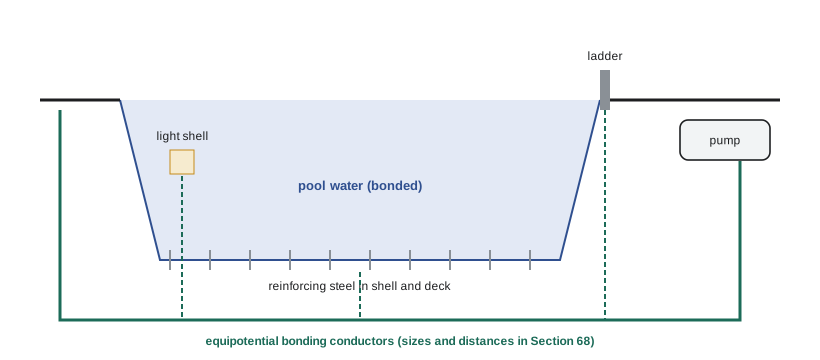
The heart of Section 68 is bonding. The goal is not primarily to clear faults, which is the job of overcurrent devices and GFCIs, but to keep every conductive part a swimmer might touch at the same voltage, so that no current flows through a person moving between them. That includes the pool's reinforcing steel, metal ladders and handrails, the pump motor, the pool light's forming shell, metal fences and other metal within a stated distance of the pool, and, under the rules, the pool water itself. Bonding conductors of a minimum copper size connect all of these to form an equipotential bonding grid. For a pool without conductive reinforcement, such as a vinyl-lined pool, the rules describe an alternative grid installed around the pool perimeter under the deck.
The 2024 edition added requirements for conductive pool infrastructure, including a disconnecting means and specific bonding provisions, reflecting incidents where buried metal around pools was found at different potentials. Priya reads the new rules carefully because they are exactly the kind of change that appears on the first exams after an edition changes. She notes that the bonding grid is not the same as the system's grounding electrode: the grid equalizes voltage around the pool, and it is connected to the equipment bonding system through the pump motor and other equipment, but it is not a substitute for grounding.
Worked problem
What needs bonding at the customer's pool?
The inground pool has a concrete shell with reinforcing steel, a stainless ladder, a stainless handrail, a wet-niche underwater light, a pump and heater on a pad near the pool, and an aluminium fence. Priya lists what must be bonded.
Show solution
- Reinforcing steel in the shell and deck, as the rules describe.
- The ladder, the handrail and the light's forming shell.
- The pump motor and the heater's metal parts, through their bonding lugs.
- The fence, if it is within the distance from the pool edge that the rules set.
- A means of bonding the water itself, as the rules require.
Answer: Every conductive item in the list is bonded into one grid, with the fence included if it falls within the rule's distance.
Ground fault protection
Ground fault circuit interrupters cut off a circuit when current leaks to ground through a path other than the circuit conductors, which may be a person. Section 68 requires GFCI protection for many circuits associated with pools: receptacles within a stated distance of the pool, underwater luminaires operating above a low voltage, pool pump motors in many cases, hot tub and hydromassage bathtub circuits, and fountain equipment. The details vary by equipment type and voltage, and recent editions have extended GFCI coverage, so read the current rules rather than relying on memory. The common exam question gives a piece of equipment and asks whether it needs GFCI protection; the answer is almost always yes within the pool area, but check the conditions.
GFCIs come in Class A, which trips at about 5 mA and is used for personnel protection on ordinary circuits, and in other classes for equipment protection or higher voltages. For pool equipment at 240 V, such as a large pump or heater, the GFCI breaker must be of a type approved for that application. On the customer's job, the pool pump, the heater and the hot tub each get a GFCI breaker of the right rating and class in the backyard sub-panel, and the receptacles near the pool are GFCI protected and weatherproof.
| Equipment (examples) | Typical Section 68 concern | Where Priya looks |
|---|---|---|
| Receptacles near the pool | Minimum distance from the water, GFCI protection, weatherproof covers | Receptacle rules in Section 68 |
| Underwater luminaires | Low voltage or GFCI, approved forming shell, bonding | Luminaire rules and the luminaire listing |
| Pump motor | GFCI, bonding lug, cord or fixed wiring rules | Pump and motor rules |
| Hot tub | GFCI, disconnect within sight, bonding of metal parts | Hot tub subsection |
| Overhead conductors | Minimum clearance above the water and deck | Overhead conductor rule in Section 68 |
Where equipment can go
Section 68 sets minimum horizontal distances from the inside wall of the pool for receptacles, switches and luminaires, and minimum vertical clearances for overhead conductors above the water and the area around it. The principle is simple: keep things that might fail or be touched with wet hands away from the water, and keep overhead lines high enough that a pool skimmer pole or a swimmer on a diving board cannot reach them. Some equipment must be farther away than other equipment; a general-purpose receptacle has one minimum distance and a receptacle for the pump motor may be allowed closer, under conditions. Overhead clearances depend on voltage and on whether the conductors are communication lines, insulated service drops or bare conductors.
A practical point that catches homeowners and some contractors is that the house's existing outdoor receptacles and lights may be too close to a new pool. Priya walks the backyard with the customer before the pool is dug, marks the minimum distances on the ground with spray paint, and finds that an existing receptacle on the house wall falls inside the distance. It is moved, and a new GFCI receptacle is installed at the required distance for the pool equipment area. The overhead service drop to the house runs across a corner of the yard; she checks its height above the planned deck against the rule and confirms with the utility that it clears.
Underwater lighting
Underwater luminaires are installed in wet-niche, dry-niche or no-niche forms. A wet-niche luminaire sits in a forming shell set in the pool wall, with the space around the lamp filled with pool water; the luminaire is cord-connected so that it can be lifted out onto the deck for service without draining the pool. The rules require underwater luminaires to operate at a low voltage supplied through an isolating transformer approved for the purpose, or, if at higher voltage, to be GFCI protected, and they limit the voltage that may be used. The forming shell, the luminaire's metal parts and the cord's bonding conductor all connect to the bonding grid. Junction boxes for wet-niche luminaires must be installed at a stated height above the water and distance from the pool edge, so that pool water cannot reach the connections.
The customer's pool uses a low-voltage LED wet-niche light supplied through an isolating transformer in a box on the pool equipment pad. Low-voltage LED lighting has made underwater lighting much safer than the old line-voltage incandescent fixtures, but the bonding and junction box rules still apply in full.
Pumps, heaters, hot tubs and hydromassage bathtubs
Pool pump motors may be cord-connected under conditions or permanently wired, and they need bonding lugs connected to the grid and GFCI protection as the rules require. Heaters, whether electric or gas-fired with electric controls, need bonding of their metal parts and protection appropriate to their rating. Equipment pads are often wet, so the enclosures must be suitable for the location.
Hot tubs have their own subsection. Packaged units are often supplied as listed assemblies with their own GFCI and control panel, but the rules still require a disconnecting means within sight of the tub and at a minimum distance from it, so that a person in the tub cannot reach it, along with bonding of metal parts and GFCI protection of the supply. Hydromassage bathtubs indoors need GFCI protection for their pump circuit, a means of access to the pump for service, and bonding of metal piping and the pump motor as the rules describe. A common exam question asks for the location of a hot tub disconnect, and the answer has two parts: within sight, and beyond the minimum distance.
Worked problem
The hot tub supply (illustrative values)
The customer's hot tub is rated 240 V, 7.5 kW with a nameplate full-load current of 32 A, treated as a continuous load. Priya needs the minimum conductor ampacity and the location for the disconnect.
Show solution
- Continuous load at 125%: 1.25 × 32 = 40 A minimum conductor ampacity.
- GFCI breaker of the right rating in the backyard sub-panel.
- Disconnect within sight of the tub and farther from it than the minimum distance in the rules.
Answer: At least 40 A of ampacity, a GFCI-protected supply, and a disconnect within sight but beyond the minimum distance.
Fountains
Fountains and reflecting pools that people are not meant to enter still have water in contact with pumps and lights, and the public may reach in. Section 68 requires fountain equipment to be GFCI protected, bonded, and installed so that luminaires and submersible pumps are of a type approved for the purpose and cannot be reached in operation where the rules require. The customer's small decorative fountain uses a low-voltage submersible pump powered from a plug-in transformer on a GFCI receptacle, which is the simplest compliant arrangement; Priya checks that the receptacle's location meets the distance rules for the fountain as well as the pool.
A pool checklist
# Pool and hot tub supply checklist (loads illustrative).
loads = {'pool pump': 11.2, 'pool heater controls': 2.0, 'hot tub': 32.0, 'pool light transformer': 1.5}
continuous = {'pool pump', 'hot tub'}
for name, amps in loads.items():
    mult = 1.25 if name in continuous else 1.0
    print(f'{name:24s} {amps:5.1f} A -> conductors >= {mult * amps:5.1f} A, GFCI required: check Section 68')
print('bond: steel, ladder, rail, light shell, pump, heater, fence within distance, water')pool pump 11.2 A -> conductors >= 14.0 A, GFCI required: check Section 68 pool heater controls 2.0 A -> conductors >= 2.0 A, GFCI required: check Section 68 hot tub 32.0 A -> conductors >= 40.0 A, GFCI required: check Section 68 pool light transformer 1.5 A -> conductors >= 1.5 A, GFCI required: check Section 68 bond: steel, ladder, rail, light shell, pump, heater, fence within distance, water
Common mistakes
MistakeTreating a hot tub as a hydromassage bathtub.
InsteadA hot tub is not drained after each use; it has its own rules.
MistakeRelying on the grounding electrode to make the pool safe.
InsteadThe equipotential bonding grid equalizes voltage; grounding is a separate function.
MistakeLeaving existing receptacles in place after a pool is added.
InsteadCheck every receptacle and luminaire against the distance rules for the new pool.
MistakePutting the hot tub disconnect within reach of the tub.
InsteadIt must be within sight but beyond the minimum distance.
MistakeUsing an older edition's bonding rules.
InsteadThe 2024 edition added requirements for conductive pool infrastructure.
Summary and key terms
- Section 68 covers pools, storable pools, hot tubs, hydromassage bathtubs and fountains, with definitions that decide which rules apply.
- An equipotential bonding grid ties together steel, metal fittings, equipment and the water; the 2024 edition added conductive infrastructure rules.
- GFCI protection is required for most pool-area receptacles and equipment, with distance rules for receptacles, luminaires and overhead conductors.
- Underwater luminaires use low voltage through approved transformers or GFCI protection, with bonded shells and elevated junction boxes.
- Hot tubs need a disconnect within sight but beyond a minimum distance; fountains need GFCI protection and approved equipment.
- Equipotential bonding
- Bonding that keeps conductive parts at the same voltage so no current flows between them through a person.
- Wet-niche luminaire
- An underwater luminaire in a forming shell filled with pool water, removable for service.
- Hydromassage bathtub
- A bathtub with jets that is drained after each use.
- Storable pool
- A pool that can be disassembled and stored.
- Class A GFCI
- A ground fault circuit interrupter that trips at about 5 mA for personnel protection.
Practice problems
Work each problem on paper first, then reveal the answer to check.
Is a jetted tub drained after each use a hot tub?
Show answer
No; it is a hydromassage bathtub.
Name three items bonded into a pool's grid.
Show answer
Any of: reinforcing steel, ladder, handrail, light shell, pump motor, heater, nearby fence, the water.
Hot tub 40 A nameplate, continuous: minimum conductor ampacity?
Show answer
50 A.
Where must a hot tub disconnect be?
Show answer
Within sight of the tub and beyond the minimum distance.
Lesson quiz · 5 questions
Score 60% or more to complete this lesson.
Create a free account to save your progress, take quizzes and earn a certificate.