
MELC-105 · Lesson 7 of 12 · 22 min
Healthcare facilities in Section 24
▶ Video coming soon A video version of this lesson is on the way.
A hospital patient is not like a person standing in a kitchen. They may be unconscious, sedated or unable to move away from a shock. Their skin may be broken or wet. They may have electrodes taped to the chest or a catheter leading close to the heart, which gives current a low-resistance path to the place where a few milliamperes can stop it. And the equipment keeping them alive may depend on the building's supply. Section 24 exists because these conditions make ordinary electrical safety rules inadequate. It sets extra requirements for wiring in patient care areas, and it connects to CSA Z32, the standard for electrical safety and essential electrical systems in health care facilities.
Master exams test Section 24 on a handful of points: how patient care areas are categorized, what receptacles and bonding are required in each, when isolated power systems are used, and how the essential electrical system is divided into branches fed by the emergency supply. This lesson covers each, using the Gaetz Avenue dental clinic as the main example, with a look at hospital installations through a job that Marcus once worked on. Code text is not reproduced, and CSA Z32 is referenced but not quoted. Check the rules in your own 2024 CE Code and the edition of CSA Z32 adopted in your province.
Scope and the role of CSA Z32
Section 24 applies to patient care areas in health care facilities, which include hospitals, long-term care homes, clinics, medical and dental offices, and other places where patients are examined or treated, depending on the definitions in the Code. It supplements the general sections. CSA Z32 fills in design requirements that the Code references, particularly the categorization of areas and the essential electrical system. In practice, the facility's owner and designer decide the category of each area, usually on the drawings, and the electrical contractor installs to that category. On an exam, you will usually be told the category, or given a description from which it can be deduced.
The study group's first question is whether a dental clinic counts at all. Denise answers by sending them to the definitions: a dental operatory where patients are treated is a patient care area under the definitions, and the clinic is therefore subject to Section 24 for those areas, even though it is far smaller than a hospital. The reception area and staff room are not patient care areas and follow the ordinary rules.
Categories of patient care areas
Patient care areas are divided into categories by the kind of care and the degree of contact between patients and electrical equipment. The current approach recognizes basic care areas, where patients have only casual contact with electrical equipment, such as examination rooms and most dental operatories; intermediate care areas, where patients are routinely connected to electromedical devices, such as general hospital wards; and critical care areas, where patients undergo invasive procedures or are connected to devices that may create a direct path to the heart, such as operating rooms, intensive care units and cardiac catheterization labs. The Code also defines a patient care environment around the patient, a volume within which extra bonding and receptacle requirements apply.
| Category | Typical areas (examples) | Main electrical concerns |
|---|---|---|
| Basic care | Examination rooms, many dental operatories, physiotherapy | Ordinary safety plus hospital-grade receptacles and bonding as required |
| Intermediate care | General wards, emergency department beds | More receptacles, bonding of equipment, essential power to some receptacles |
| Critical care | Operating rooms, intensive care, catheterization labs | Bonding to a common point, essential power, possibly isolated power systems |
Receptacles
Receptacles in patient care areas must generally be of a type approved for hospital use, often called hospital grade, which have stronger contact retention and more robust construction because equipment plugs are pulled out and pushed in constantly. The rules set minimum numbers of receptacles at each bed location in intermediate and critical care areas, require some to be supplied from the essential electrical system, and require receptacles on the essential system to be identified, commonly by colour, so that staff know which ones stay live during an outage. In critical care areas, the receptacles at a bed location are typically supplied from at least two different branch circuits, so that one tripped breaker does not take out every device at the bed.
Ground fault circuit interrupters raise a special issue in healthcare. A GFCI protects people by cutting off the circuit on a small ground fault, but cutting off a life support device can be more dangerous than the fault itself. The rules therefore restrict or prohibit GFCI protection on receptacles that supply life support equipment in critical care areas, and rely instead on isolated power systems or careful bonding where wet procedures make shock risk high. Exams like this contrast: in a dwelling bathroom, GFCI protection is required; in an operating room, it may be prohibited for the receptacles feeding life support.
Worked problem
Receptacles in the dental operatories
Each of the clinic's four dental operatories has a dental chair with a built-in delivery unit, a compressor-fed handpiece system, an X-ray unit on the wall and a computer at the counter. Priya needs to plan receptacles and circuits.
Show solution
- Confirm the category of the operatories on the designer's drawings: basic care.
- Use hospital-grade receptacles within the patient care environment as the rules require for that category.
- Give the dental chair and X-ray unit the dedicated circuits their manufacturers' instructions call for.
- Check whether any receptacle needs essential power under the category and the owner's requirements.
Answer: Hospital-grade receptacles near the chair, dedicated circuits for the chair and X-ray, and essential power only where the category or owner requires it.
Bonding in patient care areas
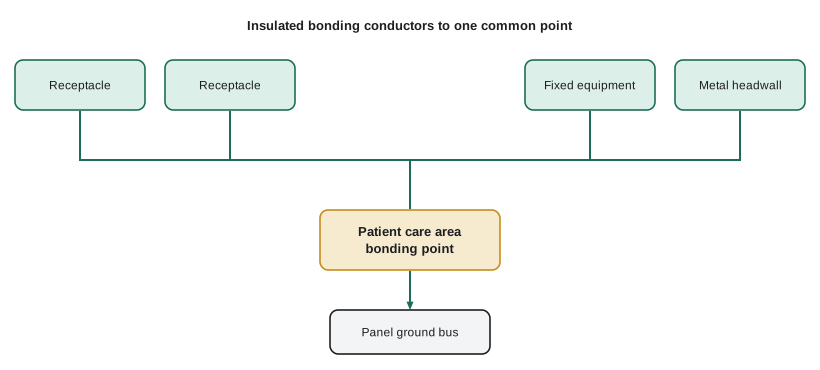
Bonding is the core of patient protection. If two pieces of metal near the patient are at different voltages because of fault current or leakage current flowing on the bonding conductors, a patient touching both, or connected to a device that touches one, can receive a current through the body. In critical care areas, a current of only microamperes through a catheter to the heart can cause fibrillation, so the voltage differences allowed are tiny. The rules therefore require bonding conductors from receptacles and fixed equipment in patient care areas to be run to a common bonding point in the area, with insulated copper conductors of a minimum size, and require the bonding point itself to be connected back to the panel's ground bus.
Ordinary wiring often relies on a metal raceway as the bonding path. In patient care areas, the rules generally require a separate insulated bonding conductor in addition to the raceway, so that the bonding path does not depend on raceway joints that may loosen or corrode. Exams test this: a question describing EMT as the only bonding path to a receptacle in a critical care area is describing a non-compliant installation.
Isolated power systems
In some critical care areas, especially where procedures are wet and an interruption is unacceptable, power is supplied through an isolated power system: an isolation transformer whose secondary is not grounded, with a line isolation monitor that continuously measures how much current would flow if a person touched one conductor while grounded. Because the secondary is ungrounded, a single fault to ground does not trip anything; the system keeps running and the monitor raises an alarm, so staff can finish the procedure and then have the fault repaired. Isolated power is used where the designer or the owner requires it, guided by CSA Z32, rather than in every critical care area.
On an exam, the key facts are that the secondary of an isolated power system is ungrounded, that the line isolation monitor alarms rather than trips, and that the system lets equipment keep running after a first fault. Tyler finds the idea strange after learning that systems are normally grounded. Denise points out that the dental clinic's isolated power question never arises, but a hospital operating room might be the first job he sees after he finishes his apprenticeship.
The essential electrical system
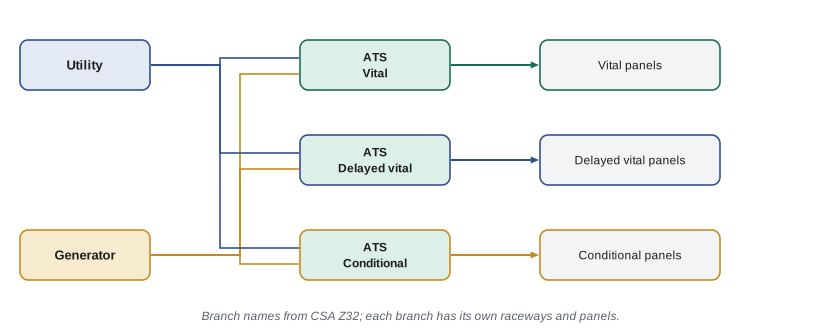
A hospital cannot simply go dark during a utility outage. The essential electrical system is the part of the facility's wiring supplied from an emergency source, normally generators installed to CSA C282, through automatic transfer switches. CSA Z32 divides it into branches by how quickly power must be restored and what it feeds. The vital branch supplies the loads that must be restored within seconds, such as egress lighting, critical care receptacles and life support. The delayed vital branch supplies loads that can wait a little longer, such as some equipment and heating. The conditional branch supplies loads that the facility chooses to keep running if the emergency source has capacity, such as some receptacles and equipment. The Code requires the branches to be kept separate from each other and from normal wiring, in their own raceways and panelboards, so that a fault on one does not take out another.
Worked problem
Transfer time and load priority (illustrative values)
Suppose a facility's generator starts and reaches rated voltage in 8 s, the vital branch transfers as soon as the generator is ready, and the delayed vital branch transfers 20 s later to let the generator recover from the first load step. How long after the outage does each branch get power?
Show solution
- Vital branch: about 8 s.
- Delayed vital branch: 8 + 20 = 28 s.
- The conditional branch transfers last, if the generator has spare capacity.
Answer: About 8 s for the vital branch and about 28 s for the delayed vital branch, with these illustrative times.
The dental clinic does not have an essential electrical system in the hospital sense; its sedation equipment has its own battery backup and the building's unit equipment provides egress lighting. Marcus, however, once worked on a hospital expansion where the vital branch panels were in a separate locked room, each feeder in its own raceway, and the inspectors checked that no normal-power circuit had been run through an essential-branch box. He says the separation rules were the ones that most often caught the electricians from commercial work.
Planning the clinic
# Clinic operatory circuit plan (counts and loads illustrative; follow the drawings and manufacturers).
operatories = 4
per_room = {'dental chair (dedicated)': 1, 'X-ray unit (dedicated)': 1, 'general receptacles': 1}
circuits = {k: v * operatories for k, v in per_room.items()}
for k, v in circuits.items():
    print(f'{k:28s} {v} circuits')
print('total operatory circuits:', sum(circuits.values()))
print('hospital-grade receptacles near each chair: as Section 24 requires for basic care')dental chair (dedicated) 4 circuits X-ray unit (dedicated) 4 circuits general receptacles 4 circuits total operatory circuits: 12 hospital-grade receptacles near each chair: as Section 24 requires for basic care
Testing and documentation
Healthcare installations are tested more thoroughly than ordinary ones, and the electrical contractor's documentation matters. Before a patient care area is used, CSA Z32 and the facility's own requirements typically call for tests of receptacle polarity and retention force, of the bonding between each receptacle or fixed item and the bonding point, and of the voltage difference between bonded parts under normal conditions. The essential electrical system is tested by transferring loads to the generator under the conditions the standards set, and the results are recorded. The facility's biomedical engineering staff test medical equipment separately. Inspectors in many provinces ask to see the test records before final approval.
Priya's study notes include a short list of what she would expect to hand over on a healthcare job: the category designation from the drawings for each area, the receptacle and bonding test results, the transfer switch test results if there is an essential system, the panel schedules showing which circuits are on which branch, and the as-built drawings. For the dental clinic, the list is shorter: the operatory receptacle tests, the dedicated circuit schedule for the chairs and X-ray units, and the unit equipment test. Gord says that a clean handover package is what gets a contractor invited back by the next clinic down the street.
Exams rarely ask about specific test values, which are in the standards rather than the Code, but they do ask who designates the category of an area and what the electrical contractor must provide. The answer to the first is the facility and its designer; the answer to the second is an installation that matches the designated category, with the records the inspector and the standards require.
Common mistakes
MistakeTreating a dental operatory as an ordinary office.
InsteadIf it is a patient care area, Section 24 applies to it.
MistakeInstalling GFCIs on life support receptacles in critical care areas.
InsteadThe rules restrict GFCIs there; isolated power or bonding are used instead.
MistakeRelying on EMT as the only bonding path in a patient care area.
InsteadRun a separate insulated bonding conductor to the common bonding point.
MistakeThinking an isolated power system trips on the first ground fault.
InsteadThe line isolation monitor alarms; the system keeps running.
MistakeMixing essential branch and normal wiring in one raceway or box.
InsteadKeep the branches separate from each other and from normal wiring.
Summary and key terms
- Section 24 adds requirements for patient care areas, working with CSA Z32.
- Areas are categorized as basic, intermediate or critical care; the patient care environment around the patient has extra rules.
- Hospital-grade receptacles, minimum receptacle counts, essential power identification and restricted GFCI use apply by category.
- Insulated bonding conductors run to a common bonding point; isolated power systems with line isolation monitors serve some critical areas.
- The essential electrical system is divided into vital, delayed vital and conditional branches, kept separate and supplied through transfer switches.
- Patient care area
- An area of a health care facility where patients are examined or treated.
- Patient care environment
- The volume around a patient within which extra bonding and receptacle rules apply.
- Isolated power system
- A supply from an isolation transformer with an ungrounded secondary and a line isolation monitor.
- Line isolation monitor
- An instrument that measures the hazard current of an isolated system and alarms when it is too high.
- Essential electrical system
- The part of a facility supplied from the emergency source, divided into branches.
Practice problems
Work each problem on paper first, then reveal the answer to check.
Name the three categories of patient care areas.
Show answer
Basic, intermediate and critical care.
What does a line isolation monitor do on the first ground fault?
Show answer
It alarms; it does not trip the circuit.
Which branch of the essential system is restored first?
Show answer
The vital branch.
Why use a separate insulated bonding conductor?
Show answer
So the bonding path does not depend on raceway joints.
Lesson quiz · 5 questions
Score 60% or more to complete this lesson.
Create a free account to save your progress, take quizzes and earn a certificate.