
MELC-105 · Lesson 12 of 12 · 47 min
Special installations practice set
▶ Video coming soon A video version of this lesson is on the way.
Four weeks before her exam, Priya sits a timed practice set on the specialized sections: motors, transformers, capacitors, hazardous locations, life safety systems, healthcare, pools, generators, solar and storage, and EV charging. Denise built it from the study group's own job files, so every question is realistic, and she times it at the pace of the real exam: about 90 seconds per question on average, which means quick lookups for the easy ones to save time for the calculations. This lesson walks through the set as Priya works it, with the strategy she uses, the lookups she makes, the calculations and the reasons behind each answer.
The goal is not to memorize these answers, which depend on illustrative values and on the rules as summarised here, but to practise the pattern: read the question to the end, decide which section it belongs to, decide whether it is a lookup or a calculation, find the rule, apply it, and check the answer for size and units. No Code text or tables are reproduced. Where a question would need a Code table value, it gives an illustrative value, as exam questions often do when they want to test method rather than lookup.
Strategy for a mixed set
Priya's first pass through the set takes about a third of the time. She answers every question she can do from memory or with a single quick lookup, marks the calculations, and skips anything that would need a long search. On the second pass, she does the marked calculations in order of how sure she is of the method. On the third pass, if time remains, she tackles the long searches. This order makes sure the easy marks are banked before the clock runs down, which matters more than any single hard question. Her lookup sheet, with a line for each specialized section and the key rule numbers, sits open beside the code book.
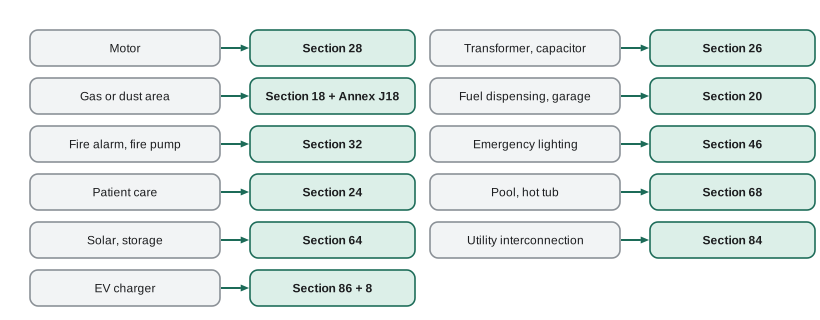
She also uses the section map in her head from this course. A question that mentions a capacitor goes to the capacitor rules in Section 26; one that mentions a gas or dust area goes to Section 18 or Annex J18, or Section 20 for fuel dispensing; a hospital or clinic goes to Section 24; water goes to Section 68; a generator or transfer switch goes to the interconnection and transfer rules, or Section 46 for emergency systems; solar and batteries go to Section 64 with Section 84 for the utility connection; and chargers go to Section 86 with Section 8 for the loads.
Questions 1 to 4: motors and transformers
Worked problem
Question 1: feeder for three motors
A feeder supplies three continuous-duty motors with table full-load currents of 65 A, 27 A and 14 A. Find the minimum feeder ampacity.
Show solution
- Largest motor at 125%: 1.25 × 65 = 81.25 A.
- Others at 100%: 27 + 14 = 41 A.
- Total: 122.25 A.
Answer: 122.25 A. A pure calculation from lesson 1; about 60 seconds.
Worked problem
Question 2: overload setting
A motor's nameplate shows 41 A and a service factor of 1.0, with no marked temperature rise. What is the maximum overload setting under the normal rule?
Show solution
- Service factor below 1.15 and no qualifying temperature rise, so 115%.
- 1.15 × 41 = 47.15 A, from the nameplate current.
Answer: 47.15 A. The trap is using 125%; lesson 2.
Worked problem
Question 3: transformer heat
A 112.5 kVA dry-type transformer supplies 90 kW at unity power factor with an efficiency of 98.2%. How much heat does it release?
Show solution
- Input: 90 / 0.982 = 91.65 kW.
- Losses: 91.65 − 90 = 1.65 kW.
Answer: About 1.65 kW, which the room's ventilation must remove; lesson 3.
Worked problem
Question 4: bonding a separately derived system
A transformer-supplied panel has the neutral bonded to ground at both the transformer and the panel. What is wrong?
Show solution
- A separately derived system is bonded at one point only.
- Two bonding points put neutral current on the bonding conductors and enclosures.
Answer: Remove one bond, normally keeping the bond at the transformer or the first disconnect; lesson 3.
Questions 5 to 7: capacitors and hazardous locations
Worked problem
Question 5: capacitor kvar
A plant draws 300 kVA at 0.78 power factor. How many kvar are needed to raise the power factor to 0.95?
Show solution
- Real power: 300 × 0.78 = 234 kW. Do not use the kVA directly.
- tan(cos⁻¹ 0.78) = 0.8023; tan(cos⁻¹ 0.95) = 0.3287.
- Q_C = 234 × (0.8023 − 0.3287) = 234 × 0.4736 = 110.8 kvar.
Answer: About 111 kvar. The trap is starting from kVA; lesson 4.
Worked problem
Question 6: protection level
A junction box is to be installed in a Zone 1 gas area. Which equipment protection level is the minimum acceptable?
Show solution
- Zone 1 requires Gb or better.
- Ga equipment would also be acceptable; Gc would not.
Answer: Gb; lesson 5.
Worked problem
Question 7: temperature code
A gas with an autoignition temperature of 160 °C is present. Which is the highest temperature code (the hottest permitted class) that equipment can have?
Show solution
- T3 allows 200 °C, too hot.
- T4 allows 135 °C, below 160 °C.
Answer: T4 (or any cooler code: T5, T6); lesson 5.
Questions 8 to 10: life safety and healthcare
Worked problem
Question 8: emergency battery
Unit equipment supplies 54 W of lamp heads from a 6 V battery for 30 minutes. What capacity is needed, before margin?
Show solution
- Current: 54 / 6 = 9 A.
- Capacity: 9 × 0.5 = 4.5 Ah.
Answer: 4.5 Ah, plus the designer's margin for ageing; lesson 6.
Worked problem
Question 9: fire pump protection
An installer proposes ordinary motor overload protection for a fire pump. Is it acceptable?
Show solution
- Fire pump protection must carry locked-rotor current indefinitely so the pump keeps running.
- Overload protection that stops the pump is not used on the supply.
Answer: No; lesson 6.
Worked problem
Question 10: isolated power
In an operating room on an isolated power system, a ground fault occurs on one conductor. What happens?
Show solution
- The secondary is ungrounded, so there is no trip.
- The line isolation monitor alarms, and the fault is repaired after the procedure.
Answer: The monitor alarms and the circuit keeps running; lesson 7.
Questions 11 to 13: pools and generators
Worked problem
Question 11: hot tub circuit
A hot tub nameplate shows 48 A at 240 V, treated as continuous. What is the minimum conductor ampacity, and where does the disconnect go?
Show solution
- 1.25 × 48 = 60 A.
- Disconnect within sight of the tub, beyond the minimum distance in Section 68.
Answer: 60 A, and a visible disconnect out of reach of a person in the tub; lesson 8.
Worked problem
Question 12: generator kVA and current
A standby generator is rated 150 kW at 0.8 power factor, 347/600 V three-phase. Find its kVA and rated current.
Show solution
- kVA = 150 / 0.8 = 187.5 kVA.
- Current = 187 500 / (1.732 × 600) = 180.4 A.
Answer: 187.5 kVA and about 180 A; lesson 9.
Worked problem
Question 13: transfer switch grounding
A generator feeds a building through a four-pole transfer switch that switches the neutral. Where is the generator's neutral bonded?
Show solution
- A switched neutral makes the generator a separately derived system.
- Its neutral is bonded to ground at the generator, with its own grounding conductor.
Answer: At the generator; lesson 9.
Questions 14 to 16: solar, storage and EV
Worked problem
Question 14: cold string voltage
A string of 16 modules has an open-circuit voltage of 51 V per module at 25 °C, with a coefficient of −0.28% per °C. Find the string voltage at −40 °C.
Show solution
- Factor: 1 + 0.0028 × 65 = 1.182.
- Per module: 51 × 1.182 = 60.28 V.
- String: 16 × 60.28 = 964.5 V.
Answer: About 964 V, which must be within the inverter and equipment ratings; lesson 10.
Worked problem
Question 15: busbar check
A 225 A busbar has a 225 A main. An inverter needs a 40 A breaker on the load side. Using an illustrative 120% limit, does it comply?
Show solution
- Allowed: 1.2 × 225 = 270 A.
- Actual: 225 + 40 = 265 A.
Answer: Yes, with these illustrative values, provided the breaker placement rules are also met; lesson 10.
Worked problem
Question 16: managed parkade feeder
Thirty chargers at 208 V three-phase are managed by an approved EVEMS to 80 kVA. Find the minimum feeder ampacity as a continuous load.
Show solution
- Managed current: 80 000 / (1.732 × 208) = 222.1 A.
- Continuous: 1.25 × 222.1 = 277.6 A.
Answer: About 278 A; lesson 11.
Reviewing the set
Priya scores 15 out of 16 on her first timed attempt. The one she misses is question 5: she started from 300 kVA instead of 234 kW, the same trap Tyler fell into weeks earlier. Denise's comment is that a mistake you have already made once is the easiest kind to fix: she adds a line to her checklist, "kVA given? Multiply by pf first", and gets it right on the next mock. Her time is 21 minutes for 16 questions, a little over the 90-second average, mostly spent on the cold-voltage calculation and the capacitor question. She practises those two patterns until each takes under two minutes.
Marcus scores 13, missing the healthcare questions and one pool question, all areas he has never worked in. Tyler scores 10, which Denise says is excellent for a third-year apprentice and a sign that he is learning the Code's structure early. The group's shared lesson is that the specialized sections are less about deep knowledge than about recognizing which section a question belongs to and knowing the handful of rules that section always tests.
import math
answers = {
    'Q1 feeder A': 1.25 * 65 + 27 + 14,
    'Q2 overload A': 1.15 * 41,
    'Q3 losses kW': 90 / 0.982 - 90,
    'Q5 kvar': 300 * 0.78 * (math.tan(math.acos(0.78)) - math.tan(math.acos(0.95))),
    'Q8 Ah': 54 / 6 * 0.5,
    'Q11 A': 1.25 * 48,
    'Q12 A': 150 / 0.8 * 1000 / (math.sqrt(3) * 600),
    'Q14 V': 16 * 51 * (1 + 0.0028 * 65),
    'Q16 A': 1.25 * 80000 / (math.sqrt(3) * 208),
}
for k, v in answers.items():
print(f'{k:16s} {v:8.2f}')Q1 feeder A 122.25 Q2 overload A 47.15 Q3 losses kW 1.65 Q5 kvar 110.82 Q8 Ah 4.50 Q11 A 60.00 Q12 A 180.42 Q14 V 964.51 Q16 A 277.57
The script checks the arithmetic of the calculation questions. Change a value and rerun it to make your own variations, then time yourself.
Building your own practice questions
The best practice questions come from your own work. Denise asks each member of the study group to write three questions a week from jobs they have done or seen, in the same pattern as the set: a short scenario, a question with one right answer, and a one-line explanation with the rule number. Writing a question forces you to find the rule and read it closely, which is better study than answering someone else's question. Priya writes one from the Riverbend parkade about the managed feeder, one from the clinic about the double-bonded transformer, and one from the Hartley dryer about overload settings with a capacitor at the motor. Marcus writes one about a 600 V motor control centre in a Zone 2 area at a plant, which forces the group to combine Section 28 and Section 18 in one answer.
Mixing sections in one question is how the hardest exam questions are built. A pool pump in a hazardous location is unlikely, but a motor in a dusty grain building, a generator feeding a fire pump, or an EV charger in a parkade with a fire alarm system are all real combinations. When a question mixes topics, take each part to its own section and answer them in turn, then check that the answers fit together. Priya's last week of study is mostly mixed questions, timed, with her lookup sheet as her only aid apart from the code book.
Common mistakes
MistakeSpending five minutes on one hard question in the first pass.
InsteadBank the easy marks first; come back to long searches last.
MistakeStarting a capacitor or generator calculation from kVA when kW is needed.
InsteadConvert with the power factor first.
MistakeUsing the 25 °C voltage for a PV string.
InsteadCorrect for the coldest expected temperature.
MistakeApplying ordinary motor rules to a fire pump.
InsteadFire pumps reverse the protection priority.
MistakeOpening the wrong section for a keyword.
InsteadUse a keyword-to-section map: pools to 68, patient care to 24, chargers to 86 and 8.
Summary and key terms
- Work a mixed set in passes: quick answers first, then calculations, then long searches.
- Map each question's keywords to its section before looking anything up.
- Motor, transformer, capacitor and generator questions are mostly calculations with a known pattern and a known trap.
- Hazardous location, healthcare, pool and life safety questions are mostly rule recognition: zones and protection levels, categories and branches, bonding and distances, supply and protection.
- PV and EV questions combine both: cold voltage, short-circuit current multipliers, busbar limits and managed loads.
- Lookup sheet
- A candidate's own one-page list of rule numbers and patterns, kept with the code book.
- First pass
- A quick run through an exam answering only questions that need no long search.
- Keyword map
- A mental or written link from question keywords to Code sections.
- Managed load
- A load whose maximum is set by an approved energy management system.
- Trap
- A common mistake an exam question is designed to catch.
Practice problems
Work each problem on paper first, then reveal the answer to check.
Motors 50, 30, 10 A table FLC: feeder ampacity?
Show answer
1.25 × 50 + 40 = 102.5 A.
Generator 200 kW at 0.8 pf, 600 V: rated current?
Show answer
240.6 A.
Zone 21: minimum equipment protection level?
Show answer
Db.
Hot tub 30 A continuous: conductor ampacity?
Show answer
37.5 A.
Lesson quiz · 5 questions
Score 60% or more to complete this lesson.
Create a free account to save your progress, take quizzes and earn a certificate.