
MELC-105 · Lesson 11 of 12 · 25 min
Electric vehicle charging
▶ Video coming soon A video version of this lesson is on the way.
Electric vehicle charging is the fastest-growing kind of electrical work in Canada, and it has changed the Code in two places. Section 86 covers the installation of electric vehicle supply equipment, the chargers themselves and their circuits, and Section 8 covers how EV loads are counted in service and feeder calculations. The 2024 edition revised the EV load calculation rules in Section 8 and deleted Table 38, so EV questions are among the most likely to differ from older exams and study guides. Energy management systems, which let many chargers share a service that could not supply them all at full power, are central to both sections and to almost every multi-unit project.
This lesson covers the levels and types of charging equipment, Section 86's requirements for EV circuits, EV loads in dwelling and apartment calculations, electric vehicle energy management systems, and the practical side of parkade and farm installations. The examples are the Aspen Ridge bungalow, which is getting a home charger, and the Riverbend Condos parkade from MELC-102, where Parkland Valley is installing 24 chargers on a managed feeder. Code text is not reproduced; read Section 86 and the EV rules of Section 8 in your own 2024 CE Code.
Kinds of charging
EV charging is usually described by level. Level 1 charging uses a standard 120 V receptacle and the cord set supplied with the vehicle, drawing about 12 A; it adds only a few kilometres of range per hour but is adequate for some drivers. Level 2 charging uses 208 V or 240 V and a fixed charger, often called EVSE, rated from about 16 A to 80 A; a 32 A, 240 V charger delivers about 7.7 kW. DC fast charging uses a large off-board charger that supplies DC directly to the battery at 50 kW to 350 kW or more, fed from a three-phase supply at 480 V or 600 V. Most residential and parkade installations are Level 2; DC fast chargers are found along highways and at commercial sites.
The term electric vehicle supply equipment covers the charger and its cord and connector, but the charging circuitry that actually controls the battery is in the vehicle for Level 1 and Level 2. The EVSE communicates with the vehicle through the control pilot signal, telling the vehicle how much current it may draw, and that signal is how energy management systems adjust charging current. Exams sometimes ask what the pilot signal does, and the answer is that it tells the vehicle the maximum current available.
| Level | Typical supply | Typical power | Typical use |
|---|---|---|---|
| Level 1 | 120 V, 15 A or 20 A receptacle | About 1.4 kW | Overnight top-up at home |
| Level 2 | 208 V or 240 V, dedicated circuit | About 3.3 kW to 19 kW | Homes, parkades, workplaces |
| DC fast | 480 V or 600 V three-phase | About 50 kW to 350 kW | Highway corridors and commercial sites |
Section 86 requirements for EV circuits
Section 86 treats EV charging as a continuous load, because a car may charge at full current for many hours. Each EVSE is generally supplied by its own branch circuit, and the conductors and overcurrent device are sized from the EVSE's rated current with the continuous-load rules, giving the familiar 125% relationship: a charger rated 32 A needs a circuit of at least 40 A. Where the EVSE is part of an energy management system, the rules allow the circuit to be sized from the maximum current the management system will permit, under conditions. The section also covers receptacles for EV charging, GFCI protection where required, disconnecting means for larger EVSE, and the location of EVSE in garages and outdoors, including protection from vehicle impact.
Worked problem
The Aspen Ridge home charger
The owners of the Aspen Ridge bungalow buy a Level 2 charger rated 40 A at 240 V for their garage. What branch circuit is needed, and what else does Priya check?
Show solution
- Continuous load: 1.25 × 40 = 50 A, so a 50 A circuit with conductors of at least 50 A ampacity.
- Check the house service capacity: add the EV load to the dwelling calculation (next section) and compare with the 200 A service.
- Mount the charger where the cord reaches the car without crossing a walkway, and check the manufacturer's instructions for height and protection.
Answer: A 50 A circuit, subject to the service having capacity for the added load.
EV loads in dwelling calculations
When an EV charger is added to a house, the dwelling calculation of Rule 8-200 counts it differently from ordinary appliances. MELC-102 noted that EVSE is generally counted at 100% of its rating rather than at the 25% applied to other loads over 1500 W, because it runs for hours at full current, unless it is controlled by an energy management system as the rules allow. The 2024 edition revised these load calculation rules for EVSE, so read the current version of Rule 8-200 and the related rules in your Code before trusting any older worked example. In apartment calculations under Rule 8-202, EV loads are also handled separately from the stepped demand factors.
Worked problem
Can the Aspen Ridge service take the charger? (values from MELC-102)
MELC-102 found the bungalow with its secondary suite had a calculated load of 53 825 W, which led to a 400 A service. Before the suite, the calculated load was 40 225 W on a 200 A service. Suppose the owners are adding the charger to the house before the suite is built. Counting the 40 A, 240 V charger at 100%, what is the new calculated current?
Show solution
- EV load: 40 × 240 = 9600 W at 100%.
- New calculated load: 40 225 + 9600 = 49 825 W.
- Current: 49 825 / 240 = 207.6 A, which exceeds the 200 A service.
Answer: About 208 A, so the charger needs an energy management system or a service upgrade under these assumptions.
This is the most common EV question in the field and on exams: the charger fits on the panel, but the service does not have the capacity at full rating. The two answers are a bigger service or an energy management system that limits the charger so that the total load stays within the service rating.
Electric vehicle energy management systems
An electric vehicle energy management system, often shortened to EVEMS, monitors load and controls EVSE so that the total stays within a set limit. A simple residential system measures the house's main current and reduces or pauses the charger when other loads, such as the range or the heat, push the total toward the service rating. A parkade system controls many chargers, sharing a fixed feeder capacity among the vehicles plugged in, by lowering each charger's pilot signal as more cars connect. Rule 8-106 includes provisions that let the calculated load for EVSE controlled by an EVEMS be based on the system's setting rather than the sum of the chargers' ratings, under conditions on the system's approval and settings.
The rules require the EVEMS to be approved for the purpose, set so that the controlled load does not exceed the limit used in the calculation, and protected against unauthorized changes to the setting. The calculation then uses the EVEMS limit. On an exam, a question that describes many chargers and a management system is testing whether you size the feeder from the managed limit, not the sum of the nameplates.
Worked problem
The Riverbend parkade feeder (values from MELC-102)
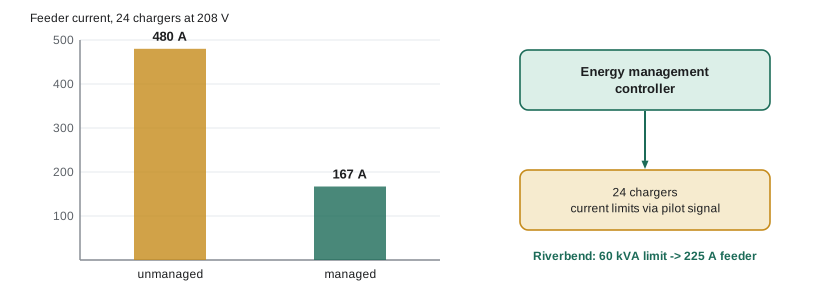
Riverbend Condos is installing 24 chargers of 7.2 kW each at 208 V three-phase, controlled by an approved EVEMS set to a maximum of 60 kVA. Compare the unmanaged load with the managed load and find the managed current.
Show solution
- Unmanaged: 24 × 7.2 = 172.8 kW, about 480 A at 208 V three-phase.
- Managed limit: 60 kVA.
- Managed current: 60 000 / (1.732 × 208) = 166.5 A; as a continuous load, the feeder needs at least 1.25 × 166.5 = 208.2 A, so a 225 A feeder.
Answer: The EVEMS reduces the feeder from about 480 A to 225 A, which the building's existing service can supply.
Each owner charges more slowly when many cars are plugged in at once, but every car gets a full charge overnight in practice. With 60 kVA shared among 24 cars over ten hours, each car can receive about 25 kWh, enough for well over 100 km of driving, even if all are plugged in at once.
Parkades, farms and fast chargers
Parkade installations bring practical issues that exams touch on: protection of EVSE and conduits from vehicle impact, the location of disconnecting means, separate metering for each owner if the condominium bills for energy, load calculations for future chargers when only some stalls are being equipped now, and the fire safety concerns that fire codes raise about vehicles charging in enclosed garages. Many municipalities now require new residential buildings to have conduit or energized outlets ready for EV charging at a share of stalls, through building bylaws rather than the electrical code.
On farms, EV charging is starting to include electric utility vehicles and, soon, electric tractors and trucks, which will need large chargers at the shop. Hartley Farms is already asking about a DC charger for a future electric loader. Priya's answer is that a DC fast charger at 600 V three-phase is essentially a large three-phase load, sized from its rated input current as a continuous load, with its own disconnect, and it would need an energy management arrangement or service upgrade to share capacity with the grain dryer. The farm's peak demand during harvest decides how large a charger the service can support without a new service.
Worked problem
A DC charger at the farm shop (illustrative values)
A 50 kW DC charger has a rated input of 56 kVA at 600 V three-phase. What is its input current, and what minimum conductor ampacity applies as a continuous load?
Show solution
- Input current: 56 000 / (1.732 × 600) = 53.9 A.
- Continuous load: 1.25 × 53.9 = 67.4 A.
Answer: About 54 A input; at least 67.4 A of conductor ampacity.
Receptacles, cords and existing garages
Not every EV installation uses a wall-mounted charger. Many owners plug a portable Level 2 cord set into a 240 V receptacle, often a 14-50 type receptacle installed for the purpose. Section 86 has rules for receptacles intended for EV charging, including the circuit rating relative to the cord set's current, GFCI protection where the rules require it, and the receptacle's location so that the cord does not become a trip hazard or get driven over. Because a portable cord set can be set to different currents, the circuit must suit the highest setting the owner might use, unless the cord set is fixed at a lower current. Inspectors increasingly ask what the owner will plug in, and the answer goes on the permit.
Existing garages raise their own issues. A detached garage fed by a small feeder from the house may not have the capacity for a 40 A charger on top of its lights and receptacles, and the feeder may need replacing. An attached garage often shares a wall with the main panel, which makes the circuit easy, but the dwelling calculation still decides whether the service can carry it. Priya's standard approach for residential EV quotes is to do the dwelling calculation first, then offer the customer the choice between a load-managed charger on the existing service and a service upgrade, with prices for both. Most choose the managed charger, which costs far less than an upgrade.
At Hartley Farms, the farm's electric utility vehicle charges from an ordinary 120 V receptacle in the shop overnight, which is Level 1 charging. Priya checks that the receptacle is GFCI protected as the shop's location requires, that it is on a circuit with capacity for a continuous load of the cord set's current, and that the cord route does not cross the loader's path.
An EV load calculator
import math

def managed_feeder(n, kw_each, limit_kva, volts=208):
    unmanaged = n * kw_each * 1000 / (math.sqrt(3) * volts)
    managed = limit_kva * 1000 / (math.sqrt(3) * volts)
    return round(unmanaged, 1), round(managed, 1), round(1.25 * managed, 1)

print('Riverbend:', managed_feeder(24, 7.2, 60))
print('Aspen Ridge with 40 A charger at 100%:', round((40225 + 40 * 240) / 240, 1), 'A on a 200 A service')
per_car = 60 * 10 / 24
print('energy per car over 10 h with 24 cars:', per_car, 'kWh')Riverbend: (479.6, 166.5, 208.2) Aspen Ridge with 40 A charger at 100%: 207.6 A on a 200 A service energy per car over 10 h with 24 cars: 25.0 kWh
Common mistakes
MistakeSizing an EV circuit at the charger's rated current.
InsteadEV charging is continuous: use 125% of the rating unless a managed setting applies.
MistakeCounting EVSE at 25% like other loads over 1500 W in a dwelling calculation.
InsteadCount it as the current rules for EVSE direct, generally at full rating unless managed.
MistakeSizing a parkade feeder from the sum of all charger nameplates when an EVEMS is installed.
InsteadUse the approved EVEMS limit as the rules allow.
MistakeRelying on older EV calculation examples.
InsteadThe 2024 edition revised EVSE load calculations in Section 8 and deleted Table 38.
MistakeIgnoring vehicle impact protection in garages and parkades.
InsteadLocate and protect EVSE and wiring as Section 86 requires.
Summary and key terms
- Section 86 covers EV supply equipment; Section 8 covers EV loads in calculations, revised in 2024.
- Level 1 uses 120 V receptacles; Level 2 uses dedicated 208 V or 240 V circuits; DC fast chargers are large three-phase loads.
- EV charging is a continuous load: circuits are at least 125% of the EVSE rating unless an approved management setting applies.
- Adding a charger often exceeds a dwelling's service capacity; the answer is an upgrade or an energy management system.
- An approved EVEMS lets feeders and services be sized from its managed limit rather than the sum of the chargers.
- EVSE
- Electric vehicle supply equipment: the charger, cord and connector that supply a vehicle.
- Control pilot
- The signal by which EVSE tells a vehicle the maximum current it may draw.
- EVEMS
- An electric vehicle energy management system that controls charging to stay within a set limit.
- DC fast charger
- An off-board charger that supplies DC directly to a vehicle battery at high power.
- Continuous load
- A load expected to run at maximum current for an extended time.
Practice problems
Work each problem on paper first, then reveal the answer to check.
A 48 A Level 2 charger: minimum circuit rating?
Show answer
60 A.
12 chargers of 7.2 kW at 208 V three-phase managed to 30 kVA: managed current?
Show answer
83.3 A.
What tells a vehicle how much current it may draw?
Show answer
The EVSE's control pilot signal.
Name two answers when a charger exceeds the service capacity.
Show answer
Upgrade the service or install an energy management system.
Lesson quiz · 5 questions
Score 60% or more to complete this lesson.
Create a free account to save your progress, take quizzes and earn a certificate.