
MELC-104 · Lesson 8 of 12 · 21 min
Bonding of raceways, cables and metal piping
▶ Video coming soon A video version of this lesson is on the way.
Lesson 7 dealt with the joints in a bonding path. This lesson deals with the path itself: which raceways and cable armours can serve as the bonding means for the circuits inside them, which wiring methods need a separate bonding conductor, and how the metal that is not part of the electrical system at all, such as water piping, gas piping and building steel, is bonded so that it cannot become a hazard during a fault.
The non-electrical metal is where many people are surprised. A building is full of conductive systems that run everywhere: copper water lines, steel gas pipe, ductwork, structural steel, sprinkler piping. None of them is part of an electrical circuit, but any of them could be contacted by a faulted conductor, and all of them are touched by people. If one became energized and nothing connected it to the bonding system, it could hold a dangerous voltage indefinitely. The Code's bonding rules for non-electrical equipment make sure that cannot happen.
As in the other lessons, requirements are paraphrased. Read the bonding rules in Section 10 and the wiring method rules in Section 12 of your 2024 CE Code Part I for the actual conditions, lengths and sizes.
The renovation at Gaetz Avenue
The Gaetz Avenue dental clinic is being fitted out in an old strip-mall unit, and Priya is walking the space with the general contractor. The ceiling is crowded: new EMT runs, an old run of flexible metal conduit to a rooftop unit, sprinkler piping, a steel gas line to the water heater, copper domestic water, and a new run of PEX that the plumber has spliced into the copper with a plastic fitting. She makes a list of the bonding questions on her clipboard. Can the old flexible conduit serve as the bonding path? Does the gas line need bonding? Is the copper water piping still electrically continuous now that a plastic section has been cut into it?
At the Tuesday group, Denise turns Priya's list into the lesson. Every item on it, she says, is a question that has appeared on a licensing exam in some form.
Raceways as bonding conductors
Many metal raceways are acceptable as the bonding means for the circuits they enclose, provided they are installed with suitable fittings and kept continuous. Rigid metal conduit and electrical metallic tubing, properly coupled and connected, are the usual examples. The Code's bonding method rules and the raceway rules in Section 12 describe the conditions. Where the raceway serves as the bonding path, no separate bonding conductor is required, although one may be added, and in many situations should be.
Flexible raceways are a different matter. Flexible metal conduit and liquid-tight flexible metal conduit have spiral joints along their length, and the contact between turns is not reliable for carrying fault current over long runs. The Code limits when they may serve as the bonding means, typically by length, size and the rating of the circuit, and requires a separate bonding conductor beyond those limits. Read those conditions in your book; they are a favourite exam question, and the limits are specific.
Non-metallic raceways, such as rigid PVC conduit and flexible non-metallic tubing, provide no bonding path at all. Every circuit in a non-metallic raceway needs a separate bonding conductor, sized from Table 16, unless the circuit requires none for a specific reason the Code recognizes.
Cables and their armour
Cables carry their bonding in different ways, and the differences matter on exams:
- Non-metallic sheathed cable, such as NMD90, includes a bare bonding conductor inside the jacket. That conductor is the circuit's bonding path, and it must be connected at every box and device.
- Armoured cable of the AC90 type has a spiral metal armour and an internal bonding strip in contact with it. The armour, with its bonding strip and approved connectors, can serve as the bonding means under the conditions the Code sets.
- Armoured cable of the TECK90 type has an interlocking armour under an outer jacket and an internal bonding conductor. The internal conductor provides the bonding path, and the armour is bonded through the cable connectors at each end.
- Mineral-insulated and other specialty cables each have their own bonding arrangements, set out in the wiring method rules.
A question that describes a cable type and asks whether a separate bonding conductor is needed is testing whether you know how that cable carries its bond. The answer is in the cable's construction and in the Code's wiring method rules, not in Section 10 alone.
| Wiring method | Bonding path | Separate bonding conductor needed? |
|---|---|---|
| Rigid metal conduit, properly installed | The raceway | No (may be added) |
| EMT with approved fittings | The raceway | No (may be added) |
| Flexible metal conduit | The raceway, within limits | Yes beyond the limits in the rules |
| Rigid PVC conduit | None from the raceway | Yes |
| NMD90 cable | Internal bare bonding conductor | It is already in the cable |
| AC90 armoured cable | Armour with bonding strip | No, under the stated conditions |
| TECK90 armoured cable | Internal bonding conductor | It is already in the cable |
Metal water piping
Metal water piping runs throughout a building and connects to fixtures that people touch while standing in water. The Code requires metal water piping systems to be bonded to the electrical bonding system, so that a fault from any appliance, heater or wiring onto the piping clears the overcurrent device instead of leaving the pipes live. The bonding conductor is connected at a point the rule specifies, often near where the piping enters the building, and sized according to the method the rule gives.
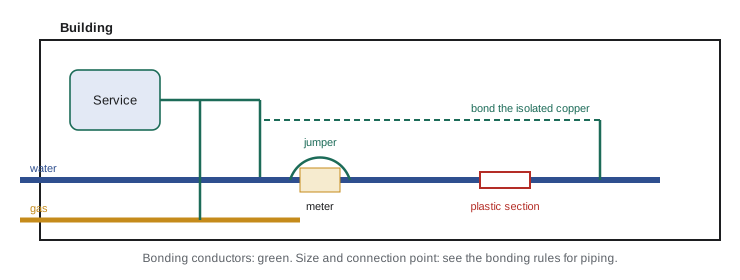
Two practical problems come up constantly. First, removable equipment in the piping, such as water meters, filters and softeners, can break continuity when it is taken out for service. The Code requires a bonding jumper around such equipment so the piping stays bonded when it is removed. Second, plastic sections, which renovations introduce all the time, break the metal path. Every isolated section of metal piping downstream of a plastic segment is no longer bonded through the piping and may need its own bonding arrangement.
Worked problem
The plastic splice
At Gaetz Avenue, a section of copper hot-water piping in the clinic's treatment rooms has been isolated by a plastic union and a run of PEX. A heater element in a sterilizer faults to its metal case, which is connected to the isolated copper. The sterilizer is cord-connected with a proper bonding conductor. Explain what happens, and what would happen if the sterilizer's cord bonding conductor were broken.
Show solution
- With the cord bonding conductor intact, the fault current returns through the cord's bonding conductor and the breaker opens. The isolated copper is briefly at a small voltage.
- With the cord bonding conductor broken, the fault current has no low-impedance path. The sterilizer case and the isolated copper piping are energized at nearly 120 V, and the piping runs to sinks where staff and patients wash their hands.
- Bonding the isolated copper back to the bonding system removes that hazard regardless of what happens to the cord.
Answer: The isolated piping becomes a hidden shock hazard unless it is bonded.
Gas piping
Gas piping is bonded for the same reason as water piping, with an extra concern: a fault arcing to a gas pipe could damage it and cause a leak. The CE Code requires metal gas piping to be bonded, and the gas code, CSA B149.1, has related requirements, including for corrugated stainless steel tubing, which is thin-walled and more vulnerable to arcing damage from nearby lightning. Where both codes apply, the electrical contractor and the gas fitter need to agree on who installs the bond and where. On an exam, the electrical question is usually whether the piping must be bonded and how; the answer is yes, by the method and conductor size the rules give.
Building steel and other metal
Structural steel, metal siding, ductwork, sprinkler piping and other metal systems may also need bonding where they could become energized. The rules on bonding non-electrical equipment set out which systems must be bonded and how. Building steel that is bonded can also be used as part of the grounding electrode system or as a grounding point for separately derived systems under the conditions the Code sets, which lesson 9 returns to.
A common misunderstanding is that bonding steel makes it a fault-clearing path for equipment mounted on it. It does not, as lesson 7 explained. Bonding non-electrical metal is about making sure it cannot become a lasting hazard; the circuits still need their own bonding paths.
Pools and conductive infrastructure
Pools, hot tubs and spas have their own bonding requirements in Section 68, which amends Section 10. Around a pool, the concern is not just clearing faults but keeping everything a swimmer might touch at the same potential, because a wet body in water is far more sensitive to small voltage differences than a dry one on land. The 2024 edition revised the requirements for bonding conductive pool infrastructure and related equipment. On an exam, any pool question should send you to Section 68 first; Section 10 supplies only the general methods.
Voltage on unbonded metal
It helps to see why an unbonded metal system is so dangerous. If a faulted conductor contacts a metal pipe that is connected to nothing but the soil it passes through, the pipe's voltage depends on the ratio between the fault's resistance and the pipe's resistance to earth. Because a pipe's contact with earth is usually poor, most of the source voltage appears on the pipe, and very little current flows.
Worked problem
An unbonded gas line
A 120 V conductor rubs through its insulation and contacts a steel gas line that, through a fault in its bonding, is connected to nothing except a short buried section with a resistance to earth of 60 Ω. The fault itself has a resistance of 2 Ω, and the source, service and earth return add 18 Ω on the earth-return path. Estimate the current and the pipe's voltage to earth.
Show solution
- Total circuit resistance: 2 + 60 + 18 = 80 Ω. Current = 120 / 80 = 1.5 A, far below any breaker's trip level.
- The pipe's voltage to earth is the drop across its 60 Ω contact: 1.5 × 60 = 90 V.
- The pipe sits at about 90 V indefinitely. Properly bonded, the fault would draw hundreds of amperes and clear in milliseconds.
Answer: About 1.5 A and 90 V on the pipe.
def pipe_voltage(v, r_fault, r_pipe, r_return):
    i = v / (r_fault + r_pipe + r_return)
    return i, i * r_pipe

for r_pipe in (10, 30, 60, 200):
    i, vp = pipe_voltage(120, 2, r_pipe, 18)
print(f'pipe to earth {r_pipe:4d} ohm: {i:5.2f} A, pipe at {vp:5.1f} V')pipe to earth 10 ohm: 4.00 A, pipe at 40.0 V pipe to earth 30 ohm: 2.40 A, pipe at 72.0 V pipe to earth 60 ohm: 1.50 A, pipe at 90.0 V pipe to earth 200 ohm: 0.55 A, pipe at 109.1 V
As the pipe's contact with earth gets worse, the current falls and the pipe's voltage rises toward the full 120 V. An unbonded metal system in dry soil is the worst case: almost no current, almost full voltage.
Checking continuity in the field
Bonding that cannot be verified is bonding that cannot be trusted. Many electricians test the continuity of bonding paths with a low-resistance ohmmeter before energizing a system, and some specifications require it. A reading that is not close to zero between a piece of equipment and the service bonding point means a broken or high-resistance joint somewhere. On renovation work like Gaetz Avenue, Priya's habit is to check the continuity of metal piping from the far end of each run back to the bonding point, which finds plastic sections the plumber did not mention.
Common mistakes
MistakeAssuming flexible metal conduit can always serve as the bonding path.
InsteadCheck the length, size and circuit rating limits; beyond them, add a bonding conductor.
MistakeRunning circuits in PVC conduit without a bonding conductor.
InsteadNon-metallic raceway provides no bonding path; add a bonding conductor sized from Table 16.
MistakeForgetting the jumper around a water meter or filter.
InsteadBond around removable equipment so the piping stays bonded when it is removed.
MistakeIgnoring metal piping isolated by a plastic section.
InsteadBond isolated metal sections that could become energized.
MistakeAnswering a pool bonding question from Section 10 alone.
InsteadGo to Section 68 first; it amends Section 10.
Summary and key terms
- Properly installed rigid conduit and EMT can serve as bonding paths; flexible metal conduit only within set limits; non-metallic raceway never.
- Cables carry their bonding by an internal conductor (NMD90, TECK90) or by armour with a bonding strip (AC90), under the Code's conditions.
- Metal water and gas piping must be bonded, with jumpers around removable equipment and attention to plastic sections.
- Unbonded metal in poor contact with earth can hold nearly full voltage during a fault while drawing almost no current.
- Pools have their own bonding rules in Section 68, revised in the 2024 edition.
- Bonding means
- The raceway, armour or conductor that provides a circuit's bonding path.
- Bonding strip
- A conductor inside AC90 armoured cable in contact with the armour.
- Non-electrical equipment
- Metal systems such as piping and building steel that are not part of a circuit but must be bonded.
- Dielectric union
- A pipe fitting that electrically isolates two sections of metal piping.
- Continuity test
- A low-resistance measurement confirming a bonding path is unbroken.
Practice problems
Work each problem on paper first, then reveal the answer to check.
Does a circuit in rigid PVC conduit need a bonding conductor?
Show answer
Yes; PVC provides no bonding path.
Why is a jumper installed around a water meter?
Show answer
So the piping stays bonded when the meter is removed.
A fault puts 1.2 A through a pipe with 75 Ω to earth. What is the pipe's voltage?
Show answer
1.2 × 75 = 90 V.
Where do you look first for the bonding requirements around a hot tub?
Show answer
Section 68.
Lesson quiz · 5 questions
Score 60% or more to complete this lesson.
Create a free account to save your progress, take quizzes and earn a certificate.