
MELC-104 · Lesson 7 of 12 · 20 min
Equipment bonding methods
▶ Video coming soon A video version of this lesson is on the way.
Knowing that a piece of equipment must be bonded is only half the problem. The other half is how. A bonding path is only as good as its weakest joint, and an installation can have perfectly sized bonding conductors and still fail to clear a fault because a locknut was loose, a knockout ring was left in place, or a paint film sat between a fitting and an enclosure. Section 10's rules on bonding methods exist to make every joint in the path reliable for the life of the installation.
This lesson works through the methods: how bonding is carried out at the service equipment, where the strictest requirements apply; how it is carried out elsewhere in the building; how fixed, portable and cord-connected equipment is bonded; and what the Code says about connecting bonding to the grounded conductor. It ends with the special case of isolated bonding for sensitive electronic equipment.
The specific requirements are paraphrased here. Read the bonding method rules in Section 10 of your 2024 CE Code Part I, and the Appendix B notes and figures that illustrate them.
A loose locknut
Denise brings an old service box to the Tuesday group, rescued from a renovation. The service raceway enters through a set of concentric knockouts, and only the smallest ring was removed. The installer used an ordinary locknut. She asks the group to estimate how good the bond between the raceway and the box was. Tyler says it looks fine; the locknut is tight. Marcus points out that the locknut is clamping against the thin, partly punched knockout rings, not against solid metal, and that the rings are attached to the box only by small tabs. Under a large fault current, those tabs can burn open in a flash, and the bonding path disappears just when it is needed.
That is exactly why the Code sets stricter bonding methods at the service. The service conductors carry the largest available fault current in the building, with no overcurrent device in the building ahead of them to limit it, and the joints in their bonding path must survive it.
Bonding at the service equipment
Rule 10-604 and the related bonding method rules set out how the non-current-carrying metal of service equipment, such as service raceways, cable armour, meter bases and service boxes, is bonded. The idea is that every joint in the service bonding path must be made with a method whose continuity does not depend on a loose fit. Typical approved methods include:
- Bonding the service raceway to the grounded conductor or to the bonding system through threaded couplings or hubs that are made up tight.
- Threadless couplings and connectors made up tight, of a type suitable for the purpose.
- Bonding locknuts or bonding bushings, with a bonding jumper from the bushing to the grounded conductor terminal or the bonding terminal, especially where the raceway enters through concentric or eccentric knockouts that impair the contact, or where the opening is oversized.
- Other approved devices, such as bonding wedges, that make a reliable connection.
A standard locknut against a smooth, solid enclosure wall may or may not be acceptable at the service, depending on the conditions in the rule. Against concentric knockout rings, it is not. Read the service bonding rule carefully, because exam questions often describe a service with concentric knockouts and ask what is required.
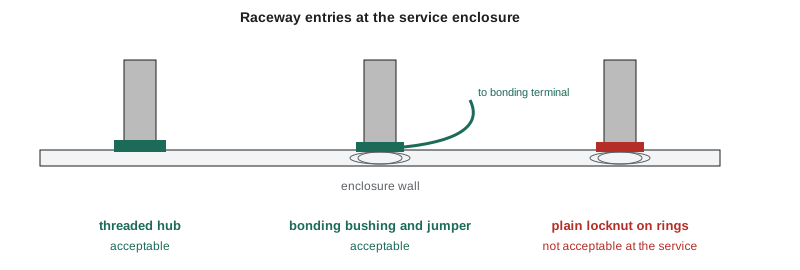
The bonding jumper from a bonding bushing is sized like any bonding conductor at the service, from the ampacity of the largest ungrounded service conductor, using Table 16 as lesson 6 described. Where several raceways enter the same service enclosure, each needs its own bonding arrangement, and the jumpers may be run to a common bonding terminal.
Bonding away from the service
Once you move past the service equipment into feeders and branch circuits, the available fault current is limited by the upstream overcurrent devices, and the Code allows simpler methods. Read the rule on bonding at locations other than service equipment: in general, raceways and cables connected to boxes and enclosures with the fittings designed for them, made up tight, provide an acceptable bonding path, and standard locknuts can be acceptable. The exceptions involve conditions such as concentric knockouts with rings left in place, oversized openings and certain hazardous locations, where bonding jumpers are required regardless.
That difference, strict at the service and more relaxed beyond it, is one of the most commonly tested points in the bonding method rules. A question that describes a locknut on a feeder raceway at a sub-panel is testing something different from a question that describes the same locknut at the service.
| Location | Raceway enters through solid wall | Raceway enters through concentric rings left in place |
|---|---|---|
| Service equipment | Use an approved service bonding method (check whether a locknut alone qualifies) | Bonding bushing or locknut with bonding jumper required |
| Feeder or branch circuit enclosure | Fittings made up tight generally provide the bond | Bonding jumper required, as the rule describes |
| Hazardous location | Follow Section 18: bonding jumpers may be required | Follow Section 18 |
Paint, coatings and good contact
Bonding is a metal-to-metal connection, and anything that insulates the joint defeats it. Paint, powder coat, enamel and corrosion all have to be removed where a bonding connection is made, unless the fitting is designed to cut through them. Many enclosures are painted, and installers sometimes fasten a bonding lug over the paint. That connection may measure a low resistance with a meter at installation and fail under fault current, because the actual metal contact is a few tiny points. Denise's inspection habit was to look closely at every bonding lug on a painted surface.
The same applies to bonding conductors terminated on enclosures. A bonding conductor must be connected with a lug, a terminal or a screw intended for the purpose, never by a sheet metal screw that only has a thread or two in thin metal. Many panelboards include a bonding terminal bar for exactly this reason.
Bonding fixed equipment
Fixed equipment, such as motors, heaters, luminaires, panelboards and appliances that are permanently connected, is bonded through the wiring method that supplies it: by the bonding conductor in the cable, by a metal raceway that serves as the bonding means, or by a separate bonding conductor run with the circuit. The equipment's frame or enclosure must be bonded unless one of the Code's specific exceptions applies, such as certain equipment that is double insulated or out of reach and isolated.
A frequent field question concerns equipment mounted on bonded building steel or metal structures. Being bolted to bonded steel is not, in general, a substitute for a proper bonding connection through the circuit. The steel is not designed as part of the circuit's fault path, and its joints are not made for electrical continuity.
Worked problem
Comparing two bonding paths
A 20 A branch circuit runs 30 m to a motor at the Clearview car wash. In option A, the circuit is in EMT, which serves as the bonding path; the EMT run, with its fittings, has a resistance of about 0.10 Ω. In option B, a No. 12 copper bonding conductor of about 0.16 Ω for the run is added inside the EMT, and it is connected in parallel with the raceway. The phase conductor and source together are 0.20 Ω, at 120 V. Find the fault current in each option.
Show solution
- Option A: loop = 0.20 + 0.10 = 0.30 Ω; I = 120 / 0.30 = 400 A.
- Option B: the raceway and the conductor in parallel: 0.10 × 0.16 / (0.10 + 0.16) ≈ 0.0615 Ω. Loop = 0.20 + 0.0615 = 0.2615 Ω; I = 120 / 0.2615 ≈ 459 A.
- Both clear a 20 A breaker quickly. The added conductor helps, but its real value is reliability: the circuit stays bonded even if a fitting loosens or corrodes in the wet car-wash environment.
Answer: About 400 A with the raceway alone; about 459 A with the added conductor.
Portable and cord-connected equipment
Portable equipment and cord-and-plug-connected appliances are bonded through the bonding conductor in the cord and the bonding contact of the plug and receptacle. That is why the third prong matters, and why removing it or using a two-prong adapter defeats the protection. The receptacle in turn must be bonded to the circuit's bonding path, either through its mounting yoke to a bonded metal box under the conditions the Code allows, or with a bonding jumper from the receptacle's bonding terminal to the box or bonding conductor.
Some equipment is double insulated, constructed so that no accessible metal can become live even if the basic insulation fails, and is marked accordingly. Double-insulated tools and appliances are not required to have a bonding conductor in their cords. On an exam, a question about a two-prong tool may be testing whether you recognize double insulation as the exception.
Bonding to the grounded conductor
One rule appears again and again in Section 10, in different forms: the grounded conductor and the bonding system are connected at one point only for each system, at the service or at the source of a separately derived system. On the load side of that point, the Code generally prohibits using the grounded conductor to bond equipment, and prohibits connecting the neutral to enclosures, raceways or bonding conductors. Read the rule on bonding equipment to the grounded conductor to see the limited situations where any exception applies.
The reason is objectionable current. If the neutral is connected to the bonding system at a sub-panel as well as at the service, the normal neutral current divides between the neutral conductor and every parallel path through raceways, cable armour, piping and building steel. Those paths were never intended to carry current. They heat joints, corrode connections, create magnetic fields that disturb electronics, and can put a voltage on metal that people touch. Lesson 11 calculates an example.
Isolated bonding for sensitive equipment
Some electronic equipment, such as computers, medical instruments and audio systems, can be disturbed by small voltages on the bonding system caused by currents flowing in raceways and enclosures. To reduce that noise, the Code permits an isolated bonding arrangement in which the receptacle's bonding terminal is connected by an insulated bonding conductor run back to the panel or to the service, insulated from the box and raceway along the way. These isolated-ground receptacles are usually identified by an orange colour or a triangle marking.
An isolated bonding conductor is still a bonding conductor. It must be continuous back to the point the Code allows it to terminate, it must be sized from Table 16 like any other, and the box and raceway must still be bonded through their own path. A common error is to install an isolated-ground receptacle and run its bonding conductor to a separate ground rod, which removes the low-impedance fault path entirely and recreates the problem of lesson 1. Another is to bond the isolated conductor to the box after all, which defeats its purpose without anyone noticing.
Equipment the Code treats specially
A few equipment types have their own bonding rules in Section 10 or elsewhere: instrument transformer secondary circuits and cases, meters and relays, electrolytic-type water heaters, and equipment in patient care areas, hazardous locations and pools. Each has its own reason. Instrument transformer secondaries are bonded so that a primary-to-secondary insulation failure cannot put high voltage on meters and the people reading them. Patient care areas need tighter equipotential bonding because a patient connected to equipment can be harmed by very small currents. When an exam question names one of these, go to its specific rule.
def parallel(*rs):
    return 1 / sum(1 / r for r in rs)

source_and_line = 0.20
paths = {
    'EMT only': [0.10],
    'EMT plus No. 12 bonding conductor': [0.10, 0.16],
    'EMT with a corroded fitting': [1.50],
    'Corroded EMT plus bonding conductor': [1.50, 0.16],
}
for name, rs in paths.items():
    i = 120 / (source_and_line + parallel(*rs))
print(f'{name:36s} {i:6.0f} A')EMT only 400 A EMT plus No. 12 bonding conductor 459 A EMT with a corroded fitting 71 A Corroded EMT plus bonding conductor 348 A
Run the script and look at the corroded-fitting case. A single bad joint in a raceway used as the only bonding path cuts the fault current sharply. The added bonding conductor restores it. That is the practical case for a bonding conductor in wet or corrosive locations even where the raceway could legally serve.
Common mistakes
MistakeRelying on a standard locknut over concentric knockout rings at the service.
InsteadUse a bonding bushing or locknut with a bonding jumper, or another approved service bonding method.
MistakeFastening a bonding lug over paint.
InsteadRemove the coating or use a fitting designed to cut through it.
MistakeBonding the neutral to the enclosure at a sub-panel.
InsteadIsolate the neutral at sub-panels; bond only at the service or source.
MistakeRunning an isolated-ground receptacle's bonding conductor to a separate rod.
InsteadRun it back, insulated and continuous, to the panel or service as the Code permits.
MistakeAssuming equipment bolted to building steel is bonded.
InsteadBond it through the circuit's bonding path.
Summary and key terms
- Service equipment needs the strictest bonding methods because it carries the largest fault current with no upstream device in the building.
- Concentric or eccentric knockouts left in place require a bonding bushing or locknut with a jumper at the service.
- Away from the service, raceway fittings made up tight generally provide the bond, with stated exceptions.
- Fixed equipment is bonded through the circuit's wiring method; portable equipment through the cord's bonding conductor.
- The grounded conductor is connected to the bonding system at one point only per system; isolated bonding conductors still return to the panel.
- Bonding bushing
- A raceway bushing with a terminal for a bonding jumper.
- Concentric knockouts
- Knockouts with removable rings for different raceway sizes; the rings impair bonding.
- Objectionable current
- Normal current flowing on bonding paths because of an improper neutral-to-bonding connection.
- Isolated bonding conductor
- An insulated bonding conductor run from a receptacle back to the panel, separate from the raceway.
- Double insulation
- Construction that prevents accessible metal from becoming live even if basic insulation fails.
Practice problems
Work each problem on paper first, then reveal the answer to check.
A service raceway enters through concentric rings with only the smallest removed. What is required?
Show answer
A bonding bushing or locknut with a bonding jumper sized for the service.
Two bonding paths of 0.10 Ω and 0.16 Ω are in parallel. Find the combined resistance.
Show answer
0.016 / 0.26 ≈ 0.062 Ω.
Why is the neutral isolated from the enclosure at a sub-panel?
Show answer
To prevent normal neutral current flowing on raceways and bonding paths.
Does a double-insulated drill need a bonding conductor in its cord?
Show answer
No, double-insulated equipment is an exception.
Lesson quiz · 5 questions
Score 60% or more to complete this lesson.
Create a free account to save your progress, take quizzes and earn a certificate.