
MELC-104 · Lesson 12 of 12 · 41 min
Grounding and bonding practice set
▶ Video coming soon A video version of this lesson is on the way.
This final lesson is a practice set. It brings together the whole course in the form exam questions actually take: short scenarios that test whether you can identify the conductor, choose the right rule and table, enter the table with the right quantity, and reason through what happens during a fault. Each problem is worked in full, with the reasoning written out the way Denise wants it written on a study sheet, so you can check not only your answer but your method.
Work each problem yourself before reading the solution. Where a problem needs a table value, it uses the invented practice tables from this course, P-16 for bonding conductors and P-17 for grounding conductors, so that the method is clear without reproducing the Code's values. On the exam, you will use the real Table 16 and Table 17 from your 2024 CE Code Part I, and you should practise the same problems again with your own book open, finding the real values and the real rule numbers.
The last Tuesday
It is the last Tuesday night before the group moves on to MELC-105. Denise has written twelve problems on index cards and deals them out face down. The rule is that each person reads a card aloud, answers it in ninety seconds with the code book open, and then explains the answer to the group. Priya draws the first card. Marcus groans when he sees his, a separately derived system with a generator. Tyler, who has sat through every session, surprises everyone by answering three cards correctly before anyone else.
Denise's point is that the exam rewards a routine, not inspiration. Every grounding and bonding question can be broken into the same four steps, and the steps are what she wants the group to take into the exam room.
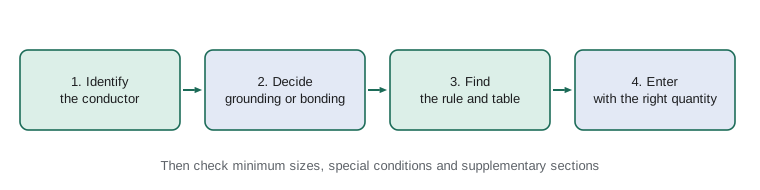
- Step 1: identify the conductor or connection. Is it a grounding conductor, a bonding conductor, a bonding jumper, a system bonding jumper or an electrode question?
- Step 2: decide which job it does. Grounding limits voltage and connects to earth; bonding carries fault current and equalizes metal. That tells you which table and what to size it from.
- Step 3: find the rule. Go to the right part of Section 10, or to the supplementary section if the installation is a pool, a hospital, a hazardous location, a high-voltage station or a renewable energy system.
- Step 4: enter the table with the correct quantity, and then check the minimum sizes, special conditions and exceptions before answering.
Practice tables used in this lesson
| Overcurrent device rating, or service conductor ampacity at the service | P-16 copper | P-16 aluminum |
|---|---|---|
| Up to 20 A | B1 | B2 |
| 21 to 30 A | B2 | B3 |
| 31 to 60 A | B3 | B4 |
| 61 to 100 A | B4 | B5 |
| 101 to 200 A | B5 | B6 |
| 201 to 300 A | B6 | B7 |
| 301 to 400 A | B7 | B8 |
| Over 400 A | B8 and up | B9 and up |
| Ampacity of largest service conductor (or equivalent) | P-17 copper | P-17 aluminum |
|---|---|---|
| Up to 165 A | G1 | G2 |
| 166 to 200 A | G2 | G3 |
| 201 to 260 A | G3 | G4 |
| 261 to 355 A | G4 | G5 |
| 356 to 475 A | G5 | G6 |
| Over 475 A | G6 | G6+ |
Problems on purpose and system type
Worked problem
Problem 1: the rod-only pump
A farm well pump on a 240 V circuit has its frame connected to a ground rod of 30 Ω, and no bonding conductor runs with the circuit. The service electrode is 20 Ω and the wiring adds 0.4 Ω. A conductor faults to the pump frame. Find the fault current and say whether a 20 A breaker trips.
Show solution
- Step 1 and 2: the rod is standing in for a bonding conductor; the question is about bonding's job, clearing the fault.
- The fault drives current from one 120 V line to the frame, through the earth back to the service neutral: I = 120 / (0.4 + 30 + 20) ≈ 2.4 A.
- A 20 A breaker does not trip. The frame stays energized. A bonding conductor run with the circuit is required.
Answer: About 2.4 A; the breaker does not trip.
Worked problem
Problem 2: must it be grounded?
For each system, say whether it must be solidly grounded: (a) 120/240 V single-phase three-wire; (b) 347/600 V four-wire wye; (c) 600 V three-phase three-wire supplying only motors.
Show solution
- Apply the two tests of 10-206(1): can it be grounded at 150 V or less to ground, and does it include a neutral?
- (a) 120 V to ground and a neutral: must be solidly grounded.
- (b) 347 V to ground, but it includes a neutral: must be solidly grounded.
- (c) Over 150 V to ground and no neutral: not required to be solidly grounded; it may be solidly grounded, impedance grounded or ungrounded with detection.
Answer: (a) yes; (b) yes; (c) not required.
Worked problem
Problem 3: the high-resistance grounded plant
A 600 V three-wire system is to be high-resistance grounded with ground fault current limited to 3 A. Find the resistor's resistance and the voltage to ground of the unfaulted phases during a solid fault on phase B.
Show solution
- V_LN = 600 / 1.732 ≈ 346 V; R = 346 / 3 ≈ 115 Ω.
- During a solid fault on phase B, phase B is at earth potential and phases A and C rise to the line-to-line voltage, about 600 V to ground.
Answer: About 115 Ω; about 600 V to ground on the unfaulted phases.
Problems on electrodes and grounding conductors
Worked problem
Problem 4: two rods
A single rod measures 36 Ω. A second identical rod is driven a short distance away and joined to the first. A candidate answers that the pair will measure 18 Ω. Explain why the real value will be higher.
Show solution
- The question tests the electrode concept from lesson 4.
- The current fields of two nearby rods overlap, so each pushes current into soil the other already uses.
- The combined resistance falls below 36 Ω but stays above 18 Ω unless the rods are widely spaced; the Code's minimum spacing exists to capture most of the benefit.
Answer: Higher than 18 Ω because of overlapping current fields.
Worked problem
Problem 5: a service grounding conductor
A 320 A service uses service conductors with an ampacity of 320 A. Find the copper grounding conductor size code from practice table P-17, and say which rule sets the absolute minimum.
Show solution
- Step 1: it is a grounding conductor. Step 2: grounding, so Table 17, entered with the service conductor ampacity.
- 320 A falls in the band 261 to 355 A: G4 copper.
- Check against the absolute minimum in 10-114(1), No. 6 AWG copper or No. 4 AWG aluminum; the table result is larger here.
Answer: G4 (practice); minimum set by 10-114(1).
Worked problem
Problem 6: parallel service conductors
A 1200 A service uses four parallel sets of 500 kcmil copper per phase. What equivalent do you use to enter Table 17?
Show solution
- Equivalent = 4 × 500 kcmil = 2000 kcmil per phase.
- Use the table notes to treat that equivalent correctly when reading the grounding conductor size.
Answer: 2000 kcmil equivalent.
Problems on bonding conductors and jumpers
Worked problem
Problem 7: a feeder bonding conductor
A 150 A feeder to a sub-panel at Riverbend Condos has conductors with an ampacity of 175 A and a calculated demand of 118 A. Find the copper bonding conductor size code from P-16.
Show solution
- Step 1: bonding conductor in a feeder. Step 2: bonding, so Table 16 with the overcurrent device rating.
- The breaker is 150 A, which falls in the band 101 to 200 A.
- Practice size: B5 copper. Neither the 175 A ampacity nor the 118 A demand is used.
Answer: B5 (practice).
Worked problem
Problem 8: parallel runs
A 600 A feeder runs as three parallel sets, each in its own PVC conduit. Each conduit needs a bonding conductor. What do you size each one from?
Show solution
- PVC provides no bonding path, so each conduit needs its own bonding conductor.
- Each is sized from the overcurrent device protecting the whole feeder, 600 A, not one third of it.
- Using P-16, 600 A is over 400 A, so each conduit gets B8 or larger (practice).
Answer: From the 600 A device, in each conduit.
Worked problem
Problem 9: the service raceway
A 400 A service raceway enters the service box through concentric knockouts with the rings left in. The service conductors have an ampacity of 400 A. What is required, and what size is the jumper (practice)?
Show solution
- Concentric rings at the service impair the bond: a bonding bushing or locknut with a bonding jumper is required, under the service bonding rules.
- At the service, the bonding conductor is sized from the ampacity of the largest ungrounded service conductor, under 10-616(2): 400 A.
- P-16: 301 to 400 A gives B7 copper.
Answer: Bonding bushing with a B7 jumper (practice).
Worked problem
Problem 10: fault duty
A bonding conductor must survive a 15 000 A fault cleared in 0.03 s. Using A = I√t / k with k = 143, find the minimum copper area.
Show solution
- √0.03 ≈ 0.1732.
- A = 15 000 × 0.1732 / 143 ≈ 18.2 mm².
- This is an engineering check behind Table 16, not a Code calculation, but it explains why fast clearing permits modest bonding conductors.
Answer: About 18.2 mm².
Problems on derived systems and separate buildings
Worked problem
Problem 11: the generator
A 100 kW standby generator connects to a building's service through a three-pole transfer switch that switches only the phase conductors. The generator arrived with its neutral bonded to its frame. What should the installer do?
Show solution
- With a three-pole switch, the neutral is solidly connected, so the generator is not separately derived.
- The system's single neutral-to-bonding connection is at the service.
- Remove the generator's neutral-to-frame bond according to the manufacturer's instructions; bond the frame through the feeder's bonding conductor.
Answer: Remove the neutral bond at the generator.
Worked problem
Problem 12: the detached shop
A detached shop is supplied by a 60 A feeder from the house service. How should the feeder and the shop panel be arranged, and what bonding conductor size applies (practice)?
Show solution
- Four-conductor feeder: two ungrounded conductors, a neutral and a bonding conductor.
- At the shop, isolate the neutral from the enclosure, land the bonding conductor on the enclosure's bonding bar, and install a local electrode bonded to the enclosure.
- Bonding conductor from Table 16 with the 60 A breaker: P-16 band 31 to 60 A gives B3 copper.
Answer: Four conductors, isolated neutral, local electrode, B3 bonding conductor (practice).
A calculator for the routine
The study group's last script is a small helper that applies the practice tables, so you can check the method on any number of examples. On the exam you will use the real tables, but the routine, which quantity goes into which table, is exactly the same.
P16 = [(20, 'B1'), (30, 'B2'), (60, 'B3'), (100, 'B4'), (200, 'B5'), (300, 'B6'), (400, 'B7')]
P17 = [(165, 'G1'), (200, 'G2'), (260, 'G3'), (355, 'G4'), (475, 'G5')]

def lookup(table, amps, top):
    for limit, size in table:
        if amps <= limit:
            return size
    return top

def bonding(ocpd_or_service_ampacity):
    return lookup(P16, ocpd_or_service_ampacity, 'B8 and up')

def grounding(service_conductor_ampacity):
    return lookup(P17, service_conductor_ampacity, 'G6')

print('150 A feeder breaker  ->', bonding(150))
print('400 A service bonding ->', bonding(400))
print('320 A service conds   ->', grounding(320))
print('60 A shop feeder ->', bonding(60))150 A feeder breaker -> B5 400 A service bonding -> B7 320 A service conds -> G4 60 A shop feeder -> B3
Try entering a feeder's conductor ampacity instead of its breaker rating and see how the answer can jump a band. That is the error the routine prevents.
Before the exam
Denise ends the course with three pieces of advice. First, redo every problem in this lesson with your own code book, writing in the real Table 16 and Table 17 values and the real rule numbers. Second, time yourself: ninety seconds is a realistic target for a grounding lookup question once your tabs and lookup sheet are in order. Third, when a question confuses you, go back to purpose. Ask whether it is about grounding or bonding, and which conductor carries what. Almost every trap in this topic is a confusion between the two, and the purpose line at the top of your Section 10 tab is the fastest way out of it.
Priya writes her own fourth piece of advice under Denise's three: read every word of the question, because grounding questions hide the crucial detail, at the service or at a sub-panel, copper or aluminum, breaker or conductor ampacity, in a single word.
Common mistakes
MistakeStarting with the table before identifying the conductor.
InsteadIdentify the conductor and its job first; the job tells you the table and the entry quantity.
MistakeUsing the feeder conductor ampacity or demand for a bonding conductor.
InsteadUse the overcurrent device rating, except at the service.
MistakeForgetting the absolute minimum grounding conductor size.
InsteadCheck 10-114(1) after reading Table 17.
MistakeAnswering a generator question without checking the transfer switch.
InsteadA switched neutral makes it separately derived; a solid neutral does not.
MistakeAnswering a pool or hospital question from Section 10 alone.
InsteadCheck the supplementary section first.
Summary and key terms
- Every grounding and bonding question follows four steps: identify, decide the job, find the rule, enter the table correctly.
- Grounding conductors use Table 17 with the largest service or derived-system conductor; bonding conductors use Table 16 with the overcurrent device, or the service conductor ampacity at the service.
- Systems with a neutral, or that can be grounded at 150 V or less, must be solidly grounded.
- Each system has exactly one neutral-to-bonding connection, at the service or the derived system's source or first disconnect.
- Separate buildings get a bonding conductor in the feeder, an isolated neutral and a local electrode.
- Practice table
- An invented table used in this course to teach the method without reproducing Code values.
- Entry quantity
- The value used to look up a table: overcurrent device rating, service conductor ampacity or derived-system conductor ampacity.
- Lookup sheet
- A personal page of rule numbers and table locations, written from your own code book.
- Four-step routine
- Identify the conductor, decide its job, find the rule, enter the table correctly.
- Supplementary section
- A Code section that amends Section 10 for particular installations.
Practice problems
Work each problem on paper first, then reveal the answer to check.
A 225 A feeder breaker protects conductors rated 255 A. Which P-16 band applies?
Show answer
201 to 300 A: B6 (practice), from the 225 A breaker.
A 175 A service has 175 A conductors. Find the P-17 copper size.
Show answer
Band 166 to 200 A: G2 (practice).
A 480 V three-wire system is high-resistance grounded at 2 A. Find the resistor.
Show answer
277 / 2 ≈ 139 Ω.
A transformer is installed with system bonding jumpers in both the transformer and the first panel. What is wrong?
Show answer
Two neutral-to-bonding connections create parallel paths for neutral current; remove one.
Lesson quiz · 5 questions
Score 60% or more to complete this lesson.
Create a free account to save your progress, take quizzes and earn a certificate.