
MELC-104 · Lesson 10 of 12 · 23 min
Grounding at separate buildings
▶ Video coming soon A video version of this lesson is on the way.
Farms, schools, industrial sites, campgrounds and many homes have more than one building supplied from a single service. A feeder runs from the main service equipment to a detached garage, a workshop, a barn or a second commercial building, and at the far end there is a panel serving that building's circuits. How should that second building be grounded and bonded? Should it have its own electrode? Should its neutral be bonded to its enclosure? What conductors does the feeder need?
These questions cause more confusion in the field than almost any other grounding topic, partly because older codes, and other countries' codes, answered them differently. The CE Code's rule on grounding connections for buildings supplied from a single service gives a clear answer, and it follows directly from the single-point principle you have met throughout this course. This lesson works through it using the Hartley Farms installation, then looks at the special concerns of agricultural buildings.
Requirements are paraphrased. Read the rule on two or more buildings supplied from a single service, and the Appendix B figures that illustrate it, in your own 2024 CE Code Part I.
The bin yard and the shop
Hartley Farms' main service is a 200 A, 120/240 V service at the farmhouse yard, with a pole-mounted meter and service equipment. From it, Parkland Valley has run a 100 A feeder to the grain-drying shop, about 60 m away, and a 60 A feeder to the bin yard, where aeration fans and a moisture monitoring system are housed in a small steel building. Each building has its own panel. Denise asks the group to sketch how they would ground and bond the shop.
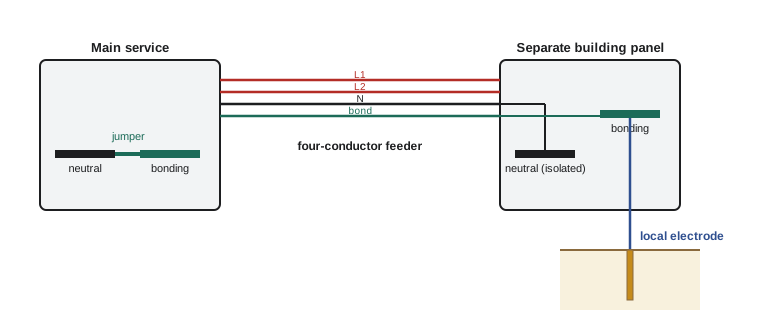
Tyler's sketch has three conductors in the feeder, two hots and a neutral, with the neutral bonded to the shop panel's enclosure and a ground rod at the shop. It looks like a miniature service, and it is the arrangement many older farm buildings still have. Marcus's sketch has four conductors: two hots, a neutral and a bonding conductor, with the neutral isolated at the shop panel, the bonding conductor connected to the panel enclosure, and a ground rod at the shop connected to the bonding system. Denise says Marcus has drawn what the current Code requires, and she spends the rest of the evening explaining why.
Why not bond the neutral at the second building?
If the shop's neutral is bonded to its enclosure, and the enclosure is connected to a ground rod and to everything else metallic in the shop, then the shop has a second neutral-to-bonding connection in the same system. The service is the first. Normal neutral current from the shop's loads now has two paths back to the service: along the feeder neutral, and through the shop's electrode, the earth, the service electrode and any metal paths that connect the two buildings, such as water lines, fences, communication cables or a metal conveyor. Some of the neutral current flows on those paths, which were never meant to carry it.
On a farm, that is more than an inefficiency. Neutral current flowing through the earth and through metal structures creates small voltages between metal objects and the ground around them. Livestock, especially dairy cattle, are very sensitive to such voltages through their hooves and mouths, and voltages a person would never notice can change their behaviour, their water intake and their milk production. Agricultural stray voltage has been investigated for decades, and improper neutral bonding at outbuildings is one of its classic causes.
What the Code requires, in outline
The CE Code's approach for a building supplied by a feeder from a single service, paraphrased:
- The feeder includes a bonding conductor, run with the circuit conductors, sized from Table 16 using the feeder's overcurrent device rating.
- At the second building, the grounded conductor (neutral) is isolated from the enclosure and from the bonding system. There is no second system bonding jumper.
- A grounding electrode is installed at the second building and connected to the bonding system there, so that the building's metal is tied to the local earth for surge and lightning purposes.
- Metal piping and other systems in the second building are bonded to its bonding system as in any building.
Read the rule carefully for any conditions and exceptions, such as arrangements for a building supplied by its own separately derived system, or for small structures. The principle, though, is constant: one system, one neutral-to-bonding connection, at the service.
Worked problem
Sizing the shop feeder's bonding conductor
The shop feeder is protected by a 100 A breaker at the main service. Using practice table P-16, find the copper bonding conductor size code.
Show solution
- Enter Table 16 with the feeder overcurrent device rating: 100 A.
- 100 A is in the practice band 61 to 100 A.
- Practice size: B4 copper, run in the same cable or raceway as the feeder conductors.
Answer: Practice size B4 (copper).
Why there is still an electrode at the second building
If the bonding conductor brings the fault path back to the service, why install an electrode at the shop at all? Because the shop is a long way from the service electrode, and lightning, surges and nearby faults on the utility system raise the local earth potential at the shop differently from at the house. A local electrode, bonded to the shop's metal, keeps the shop's metal close to the potential of the earth around it, which protects people and equipment inside during those events. It is the grounding job from lesson 1, done locally, while the bonding job is done by the conductor back to the service.
It also gives the surge protective devices at the shop a short path to earth. A surge protector with a long lead to a distant electrode is much less effective than one with a short connection to a local electrode, because the inductance of the long lead raises the voltage the protected equipment sees during a fast surge.
Neutral current and voltages on the farm
To see why the neutral bond at the outbuilding matters, put numbers on it. The voltage between the neutral at a building and the local earth, often called the neutral-to-earth voltage, depends on the neutral current and the resistance of the neutral path back to the source.
Worked problem
Neutral-to-earth voltage at the shop
The shop's 120 V loads are unbalanced, so the feeder neutral carries 25 A. The neutral conductor of the 60 m feeder has a resistance of about 0.10 Ω. With the neutral isolated at the shop as the Code requires, what is the voltage between the shop neutral bar and the shop's bonded enclosure?
Show solution
- With the neutral isolated, the bonding conductor carries no current, so the enclosure stays at the potential of the service's bonding system.
- The neutral bar at the shop is above the service neutral by the voltage drop along the feeder neutral: 25 × 0.10 = 2.5 V.
- That 2.5 V appears between the neutral bar and the enclosure, safely contained inside the panel, not on the shop's metal.
Answer: About 2.5 V, contained between the neutral and the enclosure.
Worked problem
If the neutral were bonded at the shop
Now suppose the neutral is bonded to the enclosure at the shop. The bonding conductor, of 0.16 Ω, is now in parallel with the 0.10 Ω neutral for the return current, and the earth path through the two electrodes, of about 40 Ω, is also in parallel. Estimate how the 25 A divides, and the voltage the shop's metal now sits at relative to the service.
Show solution
- Parallel combination of 0.10, 0.16 and 40 Ω ≈ 0.0615 Ω (the earth path barely changes it).
- Voltage across the parallel paths ≈ 25 × 0.0615 ≈ 1.54 V. Current on the neutral ≈ 1.54 / 0.10 ≈ 15.4 A; on the bonding conductor ≈ 1.54 / 0.16 ≈ 9.6 A; through the earth ≈ 1.54 / 40 ≈ 0.04 A.
- Nearly 10 A of normal current is flowing on the bonding conductor and the shop's metal is about 1.5 V above the service's metal and the remote earth, a level that dairy cattle can respond to.
Answer: About 9.6 A on the bonding conductor and roughly 1.5 V on the shop's metal.
def split(i_total, *paths):
    g = sum(1 / r for r in paths)
    v = i_total / g
    return v, [v / r for r in paths]

v, (neutral, bond, earth) = split(25, 0.10, 0.16, 40)
print(f'voltage across the paths: {v:.2f} V')
print(f'neutral {neutral:5.1f} A bonding conductor {bond:5.1f} A earth {earth:5.2f} A')voltage across the paths: 1.54 V neutral 15.4 A bonding conductor 9.6 A earth 0.04 A
Change the bonding conductor's resistance and see how much normal current it picks up. In the Code-compliant arrangement, the bonding conductor is not a parallel neutral at all, because the neutral is isolated at the shop, and the calculation does not apply. That is the whole point.
Equipotential planes in livestock buildings
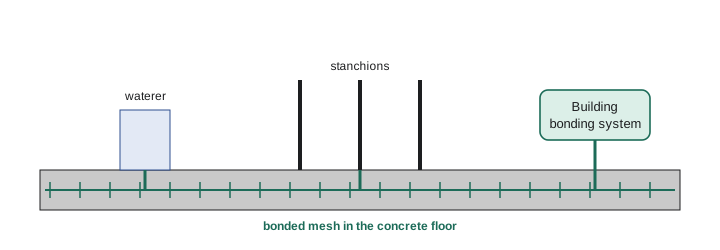
Agricultural buildings that house livestock raise one more issue. Even with perfect neutral practice on the farm's own wiring, some neutral-to-earth voltage can come from the utility's distribution system, because the utility's primary neutral is grounded at many points along the line. To protect animals in areas where they stand and drink, the Code has requirements for equipotential planes in certain livestock areas: a wire mesh or other conductive element in the concrete floor, bonded to the building's bonding system and to the metal equipment the animals touch, so that the floor, the waterers, the stanchions and the feeders are all at the same potential. Read the agricultural bonding requirements in your code book; they are a frequent exam topic for candidates in farm provinces.
The idea is the same one that governs bonding everywhere: if everything an animal or person can touch at once is at the same voltage, no current flows through them, however that voltage relates to remote earth. An equipotential plane makes the floor itself part of the bonded system.
Other separate-building situations
The same principles apply well beyond farms. A detached garage with a sub-panel, a pool house, a school portable, a second building on an industrial site, or a campground's washroom building supplied from the main service all follow the same pattern: bonding conductor in the feeder, neutral isolated at the building, local electrode bonded to the building's metal. Where the second building is supplied by its own separately derived system, such as a transformer in that building, lesson 9's rules apply to the derived system instead.
A few situations have their own rules: buildings supplied by their own service from the utility are not supplied from a single service and are grounded as services; mobile and modular structures may have specific requirements; and some supplementary sections modify the approach. On an exam, read the question carefully to see whether the building is supplied by a feeder from another building's service, by its own service, or by a derived system. The answer depends on it.
Upgrading an old outbuilding
Many existing outbuildings were wired under older codes with three-conductor feeders and the neutral bonded at the outbuilding. When such a building is extended or its panel replaced, the upgrade question arises: can the old feeder stay? The answer depends on the extent of the work, the inspector, any provincial direction and the rules on existing installations. In practice, adding a bonding conductor to the feeder, isolating the neutral at the outbuilding and bonding the local electrode to the enclosure brings it into line with current requirements. Denise's view from her inspection days was simple: on a dairy farm, it is worth doing whether or not anyone requires it.
Common mistakes
MistakeRunning a three-conductor feeder to a separate building and bonding the neutral there.
InsteadRun a bonding conductor with the feeder and isolate the neutral at the building.
MistakeOmitting the electrode at the second building because the bonding conductor runs back to the service.
InsteadInstall a local electrode bonded to the building's metal for surge and lightning protection.
MistakeSizing the feeder bonding conductor from the feeder conductor ampacity.
InsteadSize it from the feeder overcurrent device rating with Table 16.
MistakeIgnoring equipotential bonding in livestock areas.
InsteadCheck the Code's requirements for equipotential planes and bond the floor and the equipment animals touch.
MistakeTreating a building with its own utility service as a feeder-supplied building.
InsteadA building with its own service is grounded as a service, not under the separate-building rule.
Summary and key terms
- A building supplied by a feeder from another building's service is part of the same system, so it gets no second neutral-to-bonding connection.
- The feeder includes a bonding conductor sized from Table 16 using the feeder's overcurrent device.
- The neutral is isolated at the second building, and a local electrode is bonded to that building's metal.
- Bonding the neutral at an outbuilding puts normal current on bonding paths and the earth, a classic cause of farm stray voltage.
- Livestock areas may need equipotential planes so the floor and equipment are at the same potential.
- Separate building
- A building supplied by a feeder from the service equipment of another building.
- Neutral-to-earth voltage
- The voltage between the neutral at a location and the local earth, caused by neutral current.
- Stray voltage
- Small voltages between metal objects and the earth, often from neutral current, that can affect livestock.
- Equipotential plane
- A bonded conductive grid in a floor that keeps the floor and connected equipment at the same potential.
- Four-conductor feeder
- A feeder with two ungrounded conductors, a neutral and a separate bonding conductor.
Practice problems
Work each problem on paper first, then reveal the answer to check.
A feeder neutral of 0.12 Ω carries 30 A. What voltage appears between the neutral bar and the enclosure at an isolated outbuilding panel?
Show answer
30 × 0.12 = 3.6 V, contained inside the panel.
What conductors should a 120/240 V feeder to a detached shop include?
Show answer
Two ungrounded conductors, a neutral and a bonding conductor.
Why does the shop still need its own electrode?
Show answer
To keep its metal near local earth potential during surges and lightning.
What does an equipotential plane bond together?
Show answer
The floor mesh and the metal equipment animals touch, tied to the building's bonding system.
Lesson quiz · 5 questions
Score 60% or more to complete this lesson.
Create a free account to save your progress, take quizzes and earn a certificate.