
MELC-104 · Lesson 2 of 12 · 21 min
Section 10 structure and key definitions
▶ Video coming soon A video version of this lesson is on the way.
Section 10 is one of the general sections of the CE Code Part I. That means it applies to every installation unless a supplementary section amends or adds to it. Section 36 adds requirements for high-voltage stations, Section 68 changes the bonding rules around pools, Section 64 adds rules for renewable energy and storage systems, and several other sections make their own adjustments. But the starting point for any grounding or bonding question is always Section 10, and the starting point for Section 10 is knowing where things are and what the words mean.
This lesson has two halves. The first walks through how Section 10 is organized, so that when a question names a topic you can go straight to the right part of the section. The second works through the definitions, most of which live in Section 0, that every grounding question depends on. The section was substantially rewritten for the 2018 edition, and that structure carried through 2021 into the 2024 edition. If you learned grounding from an older code book, some of the rule numbers you remember no longer mean what they used to.
As always in this series, the lesson describes the organization and paraphrases the meaning. It does not reproduce Code text, and you should read every rule mentioned here in your own copy of the 2024 CE Code Part I.
Denise's two rules for Section 10
Denise opens the evening with two rules she says will save the group an hour on exam day. Rule one: read the scope and the object of the section once, properly, before you ever need them, so you know what the section is trying to achieve. Rule two: every time a rule uses a defined term, go back to Section 0 and read the definition, because in Section 10 the definitions do half the work. She has watched candidates read a rule about a bonding conductor and apply it to a grounding conductor, and she has marked the resulting answers wrong for twenty years.
Tyler asks why the Code needs so many similar terms. Marcus answers before Denise can: because the conductors do different jobs, carry different currents and get sized from different things. The grounded conductor carries normal current. The grounding conductor connects to an electrode. The bonding conductor carries fault current. Use the wrong name and you will size the wrong wire.
How Section 10 is organized
The 2024 Section 10 is arranged in a sequence that mirrors the way you would actually design a system: first the general requirements, then how the system itself is grounded, then the electrodes and the conductors that connect to them, then the different kinds of system (solidly grounded, impedance grounded, ungrounded), and finally the bonding requirements for equipment and the methods and conductors used to achieve them. The exact rule numbers are in your book; what matters here is the shape.
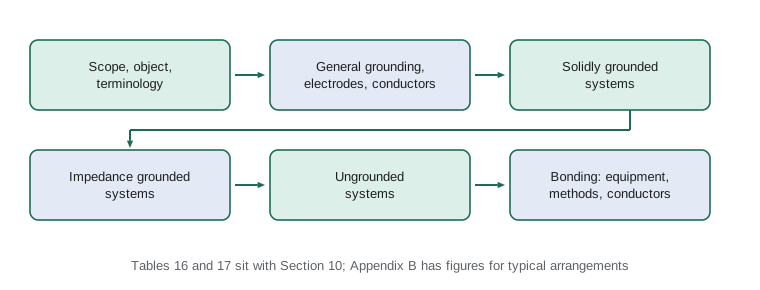
- Scope, object and special terminology. The opening rules set out what the section covers and what it is trying to achieve, and add any terms used only in this section.
- General grounding requirements. These rules cover where current may and may not flow on grounding conductors, the grounding electrodes themselves, how they are installed and interconnected, and the material, size and installation of grounding conductors, including the minimum size rule.
- Solidly grounded systems. These rules say which systems must be solidly grounded and how the connection to ground is made, both for systems supplied by the utility and for separately derived systems such as transformers and generators.
- Impedance grounded systems. These rules cover systems grounded through a resistor or reactor, including the neutral grounding device, its rating and the ground fault detection that goes with it.
- Ungrounded systems. These rules say when a system may be left ungrounded and what detection must be provided.
- Bonding. The final part covers which non-current-carrying metal must be bonded, the methods of bonding at the service and elsewhere, bonding jumpers, and the material and size of bonding conductors.
Two tables belong to Section 10 and appear on almost every exam. Table 16 gives the minimum size of bonding conductors and of field-installed system bonding jumpers. Table 17 gives the minimum size of the grounding conductor for an alternating-current system or a common grounding conductor. Both are covered in later lessons, and both are frequent lookup targets, so Priya has yellow tabs on each.
Appendix B, the informative notes, has a set of figures for Section 10 that illustrate typical arrangements: service grounding and bonding, separately derived systems, buildings supplied from a single service, and more. Those figures are not mandatory, but they are often the fastest way to confirm your understanding of a rule. Denise tells the group to look at every Section 10 figure in Appendix B at least once before the exam.
Finding a rule fast
Licensing exams are open book in most provinces, but they are timed, and a candidate who has to read Section 10 from the start for every question will run out of time. The fix is a lookup sheet. Priya's sheet for Section 10 lists the topics a question might name and the place in the section where she will find them. She writes the rule numbers herself from her own code book, which is both legal and the best possible way to learn the structure.
| If the question is about | Look in | Usual companion |
|---|---|---|
| Which systems must be solidly grounded | Solidly grounded systems part | Section 0 definitions |
| Connecting a utility-supplied system to ground | Solidly grounded systems part | Appendix B figures |
| A transformer or generator supplying a new system | Rule on separately derived systems | Table 16, Table 17 |
| Electrode type, number or spacing | Grounding electrode rules | Appendix B notes |
| Grounding conductor size | Grounding conductor size rule | Table 17 |
| Bonding conductor size | Bonding conductor size rule | Table 16 |
| Bonding at the service | Bonding methods at service equipment | Section 6 (services) |
| Pools, hot tubs, fountains | Section 68 | Section 10 for general methods |
| High-voltage stations | Section 36 | Section 10 for general methods |
Marcus points out that two of the rows send you outside Section 10. That is the point of the scope rule: Section 10 applies generally, but supplementary sections amend it. On an exam, a pool question answered only from Section 10 is very likely to be wrong.
The key definitions
Most of the vocabulary lives in Section 0, and some extra terms are added at the start of Section 10. The definitions below are paraphrased to show the idea; the official wording in your code book is what counts, and the exam may quote it.
| Term | The idea, in plain words | Does it carry normal current? |
|---|---|---|
| Grounded conductor | A system or circuit conductor intentionally connected to ground; usually the neutral | Yes |
| Grounding conductor | The conductor that connects equipment or the system grounded conductor to the grounding electrode | No |
| Grounding electrode | A conductive object in intimate contact with the earth, to which the grounding conductor connects | No |
| Bonding conductor | A conductor that connects non-current-carrying parts of equipment, raceways or enclosures to the service equipment or system grounded conductor | No (only fault current) |
| Bonding jumper | A short conductor that ensures conductivity between metal parts that must be electrically connected | No (except the system jumper path) |
| System bonding jumper | The connection between the grounded conductor and the bonding conductor at the service or source | No in normal operation |
| Ground fault | An unintentional connection between a live conductor and ground or a bonded part | Fault current only |
| Separately derived system | A system whose power comes from a source such as a transformer or generator with no direct electrical connection to the supply conductors of another system | Depends on the conductor |
The column on the right is Denise's favourite teaching tool. The grounded conductor carries current every time a load is on. The grounding conductor and the bonding conductor carry essentially no current in normal operation. If you find a situation where a grounding or bonding conductor is carrying normal load current, something is wired wrong, usually a neutral connected to a bonded enclosure in the wrong place. Lesson 11 comes back to that.
Grounded versus grounding
The pair candidates confuse most is grounded conductor and grounding conductor. The grounded conductor is part of the circuit: on a 120 V branch circuit, it is the white wire that carries current back to the panel. The grounding conductor is the conductor that runs from the service, or from a separately derived system, to the grounding electrode. On a house service, it is the conductor from the neutral bar or grounding terminal to the ground rods or other electrode.
A good memory hook: grounded ends in -ed, like a finished job; the conductor already is connected to ground at the service and goes about its business of carrying current. Grounding ends in -ing, like an action; its whole job is the act of connecting something to the ground.
Worked problem
Name the conductor
At the Aspen Ridge bungalow service, identify each of these: (a) the white conductor of a kitchen circuit; (b) the bare copper conductor running from the panel's grounding terminal to the two rods outside; (c) the bare copper conductor inside the NMD90 cable feeding the kitchen counter receptacles; (d) the short green screw that connects the neutral bar to the panel enclosure.
Show solution
- (a) The white conductor carries the circuit current back to the panel: it is a grounded conductor (the neutral).
- (b) The conductor to the electrodes is the grounding conductor.
- (c) The bare conductor in the cable connects the receptacle boxes and device yokes back to the panel: it is a bonding conductor.
- (d) The screw that connects the neutral bar to the enclosure is the system bonding jumper at the service (often called the main bonding jumper in everyday speech).
Answer: (a) grounded conductor; (b) grounding conductor; (c) bonding conductor; (d) system bonding jumper.
Terms that changed with the rewrite
When Section 10 was rewritten for the 2018 edition, the committee aligned the terminology more closely with how the conductors actually behave, and it reorganized the rules into the sequence described above. The change caught many experienced electricians, because rule numbers they had used for decades moved, and some familiar phrases were replaced. The concepts did not change much: a fault still needs a low-impedance path, a system still needs a single point of connection between its grounded conductor and the bonding system, and electrodes still need to be installed so they make good contact with the earth.
For exam purposes, the lesson is simple: use the 2024 edition and nothing else. Study notes from the 2015 edition or earlier will send you to the wrong rules. Old exam preparation books are particularly dangerous. If a practice question quotes a rule number that does not match your book, assume the question is out of date, not your book.
Section 10 and the supplementary sections
The scope rule matters because many specialized installations change the general grounding and bonding requirements. A few to keep in mind:
- Section 18, hazardous locations, adds bonding requirements for raceways and equipment in classified areas, where bonding jumpers may be required around certain fittings.
- Section 24, patient care areas, adds requirements for bonding in areas where patients may be connected to equipment, including the bonding of fixed and portable equipment.
- Section 36, high-voltage installations, adds requirements for station grounding electrodes and their conductors, which are sized and installed differently from Section 10.
- Section 64, renewable energy and storage, adds requirements for photovoltaic arrays, inverters and battery systems.
- Section 68, pools, tubs and spas, adds the bonding of conductive pool infrastructure and the equipotential bonding around pools, which the 2024 edition revised.
On an exam, if a question mentions one of these installations, check the supplementary section first and then go back to Section 10 for the general methods. MELC-105 covers several of these sections in more depth.
terms = {
    'grounded conductor': ('neutral of a circuit', True),
    'grounding conductor': ('to the electrode', False),
    'bonding conductor': ('ties metal back to the source', False),
    'system bonding jumper': ('neutral to bonding at one point', False),
}
for name, (job, carries) in terms.items():
    normal = 'carries normal current' if carries else 'no normal current'
print(f'{name:22s} {job:32s} {normal}')grounded conductor neutral of a circuit carries normal current grounding conductor to the electrode no normal current bonding conductor ties metal back to the source no normal current system bonding jumper neutral to bonding at one point no normal current
Edit the list to add terms as you meet them in Section 0. Building your own glossary like this, in your own words, is far more effective than rereading the official one.
Practising the structure
Denise ends the evening with a speed drill. She calls out a topic, and the group has thirty seconds to find the rule in their code books and call out its number. Bonding conductor size. Grounding electrode spacing. Which systems must be grounded. Separately derived system. Bonding at the service. The first time, nobody finishes all five. By the third round, Priya is finding most of them in under fifteen seconds, because she has stopped searching the whole section and started going to the part of it where the topic lives.
That is the skill this lesson is meant to build. You will not memorize Section 10, and you should not try. You will learn its shape so well that finding a rule is quick, and you will learn its definitions so well that reading a rule is accurate.
Common mistakes
MistakeConfusing the grounded conductor with the grounding conductor.
InsteadThe grounded conductor carries circuit current; the grounding conductor connects to the electrode.
MistakeUsing rule numbers from an older code book.
InsteadSection 10 was restructured for 2018; use only the 2024 edition and your own lookup sheet.
MistakeAnswering a pool or hospital question from Section 10 alone.
InsteadCheck the supplementary section first; it amends Section 10.
MistakeSkipping the Section 0 definitions when reading a Section 10 rule.
InsteadRead every defined term in the rule; the definitions decide which conductor the rule applies to.
MistakeIgnoring the Appendix B figures.
InsteadUse them to confirm your reading of a rule, while remembering they are informative only.
Summary and key terms
- Section 10 is a general section that applies to all installations unless a supplementary section amends it.
- The section runs from general grounding through electrodes and grounding conductors, then system types, then bonding.
- Table 16 sizes bonding conductors and field-installed system bonding jumpers; Table 17 sizes grounding conductors.
- Only the grounded conductor carries normal current; grounding and bonding conductors carry none in normal operation.
- A personal lookup sheet with rule numbers from your own book turns slow searches into fast ones.
- General section
- A Code section that applies to all installations unless amended by a supplementary section.
- Supplementary section
- A Code section that amends or adds to the general sections for particular installations.
- Grounding electrode
- A conductive object in intimate contact with the earth, to which the grounding conductor connects.
- Bonding jumper
- A short conductor that ensures conductivity between metal parts.
- Separately derived system
- A system supplied by a source such as a transformer or generator with no direct connection to another system's supply conductors.
Practice problems
Work each problem on paper first, then reveal the answer to check.
Which conductor carries normal current: grounded, grounding or bonding?
Show answer
Only the grounded conductor.
Name the table used to size a bonding conductor.
Show answer
Table 16.
Name the table used to size the grounding conductor for an AC system.
Show answer
Table 17.
A practice question cites a Section 10 rule number that does not exist in your book. What should you suspect?
Show answer
The question was written for an older edition; work from the 2024 Code.
Lesson quiz · 5 questions
Score 60% or more to complete this lesson.
Create a free account to save your progress, take quizzes and earn a certificate.