
MELC-103 · Lesson 9 of 12 · 22 min
Ground fault and arc fault protection
▶ Video coming soon A video version of this lesson is on the way.
Overcurrent devices protect conductors from heat. They do not protect people from shock, because the current that can kill a person is far smaller than the current needed to trip a 15 A breaker. They also do not reliably detect the kind of low-level, intermittent arcing that starts many electrical fires. Two further kinds of protection fill these gaps: ground fault protection, which detects current leaking to ground, and arc fault protection, which detects the electrical signature of dangerous arcing. The rules for both are spread across Section 14, Section 26 and the sections for particular installations such as pools, heating cables and electric vehicle charging.
This lesson explains how each device works, the difference between protecting people and protecting equipment, and where the Code requires each type. As always, the locations and conditions are summarized in general terms; the exact requirements, distances and exceptions are in the rules of your 2024 copy, and provincial amendments sometimes add to them.
How a ground fault circuit interrupter works
In a healthy circuit, all the current that goes out on the line conductor comes back on the neutral. A ground fault circuit interrupter (GFCI) passes both conductors through a small current transformer that measures the difference between them. If some current is leaking to ground, for example through a person touching a faulty appliance while standing on a wet floor, the outgoing and returning currents no longer match. When the difference exceeds the device's trip threshold, the GFCI opens the circuit within a fraction of a second.
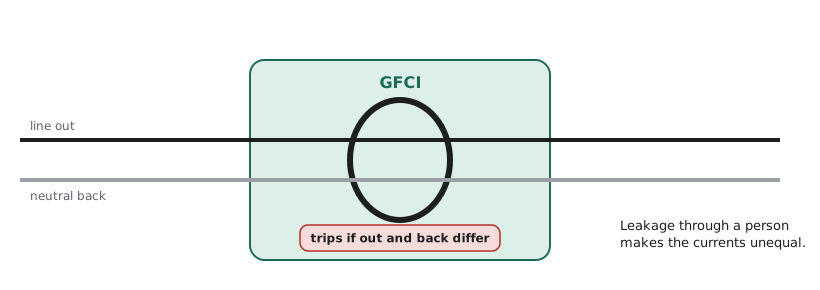
A Class A GFCI, the type used to protect people, trips at a very low leakage current, about 5 milliamperes, which is below the level at which most adults lose the ability to let go of a live conductor. It does not limit how much current flows through a person in the first instant, but it stops the shock quickly enough to prevent ventricular fibrillation in most cases. A GFCI does not protect against a shock between line and neutral, because that current returns normally and the device sees no imbalance; that is why it is not a substitute for proper insulation and bonding.
Worked problem
Would the GFCI trip?
A Class A GFCI protects the washdown area receptacles at Hartley Farms. A pressure washer develops an insulation fault. The current going out on the line conductor is measured at 11.420 A and the current returning on the neutral is 11.412 A. Using a trip threshold of about 5 mA, will the GFCI trip?
Show solution
- Find the difference: 11.420 - 11.412 = 0.008 A.
- Convert to milliamperes: 0.008 A = 8 mA.
- Compare with the threshold: 8 mA is above about 5 mA.
- The GFCI trips, cutting off the leakage path.
Answer: Yes; the 8 mA imbalance exceeds the Class A threshold.
Personnel protection versus equipment protection
Not all ground fault devices are meant to protect people. Ground fault protection for equipment (often written GFP) trips at higher leakage currents, commonly in the range of tens of milliamperes for heating cables and much higher for large services. Its purpose is to stop a low-level fault from burning down equipment or a building, not to save a person from a shock. The Code uses each type where it fits. Heating cables and some equipment require equipment ground fault protection; bathroom and outdoor receptacles require Class A personnel protection.
At the service level, large solidly grounded wye services above a certain current and voltage require ground fault protection of equipment on the main disconnect, because an arcing ground fault on such a system can draw a current too low to trip the main overcurrent device while still destroying the switchgear. Find this rule in Section 14 of your copy (Rule 14-102 in recent editions) and note the size and voltage thresholds. The Hartley Farms 347/600 V service at 400 A is below the size threshold the group finds in their copies, so the requirement does not apply, but the dryer heating cables on the grain bin floors will need equipment ground fault protection under Section 62.
| Type (general description) | Approximate trip level | Purpose | Typical Code uses |
|---|---|---|---|
| Class A GFCI | About 5 mA | Protect people from shock | Receptacles near sinks and tubs, outdoors, some other locations |
| Equipment GFP for heating cables | Tens of mA | Prevent fire and equipment damage | Heat tracing, de-icing cables, floor heating (Section 62) |
| Service or feeder GFP | Hundreds of amperes, adjustable | Protect large switchgear from arcing ground faults | Large solidly grounded wye services (Section 14) |
| Special GFCI types for pools and spas | As required by the section | Protect people near water | Section 68 |
Where the Code requires GFCI protection
The receptacle rules in Section 26 require Class A GFCI protection in places where people are likely to be in contact with water or ground while using portable equipment. In dwelling units, this generally includes receptacles within a set distance of sinks, bathtubs and shower stalls, outdoor receptacles within reach of grade, and some others; in other occupancies, receptacles in washrooms, near sinks in certain rooms, and outdoors. Section 68 adds requirements for pools, hot tubs and fountains, Section 66 for amusement parks and temporary installations (including the 2024 change for temporary outdoor receptacles), and other sections for specific equipment.
Because the exact distances and occupancies matter, Priya builds a table on her lookup sheet: location, occupancy, rule number, and the condition that triggers GFCI protection. Denise checks it each Tuesday and adds one question: does this location also require arc fault protection, tamper-resistant receptacles or a weatherproof cover? On the exam, receptacle questions often combine several of these requirements in one scenario.
Hartley Farms is not a dwelling, so the dwelling rules do not apply, but the washdown area, the outdoor receptacles at the bin yard, and the receptacles near the shop's wash sink all fall within the GFCI requirements for other occupancies. The group also notes that GFCI protection may be provided either by a GFCI receptacle at the outlet or by a GFCI breaker protecting the whole circuit. Each approach has advantages: a breaker protects all downstream outlets and keeps the reset in the panel, while a receptacle lets workers reset it where they are.
How arc fault protection works
Many electrical fires begin with arcing at a damaged conductor or a loose connection: a cord crushed under furniture, a nail driven through a cable, a back-stabbed receptacle that has worked loose. These arcs often draw too little current to trip a breaker, but they produce enough heat to ignite nearby material. An arc fault circuit interrupter (AFCI) monitors the current waveform for the irregular, high-frequency signatures that arcing produces, and trips when it recognizes them. Combination-type AFCIs detect both series arcs, along one conductor, and parallel arcs, between conductors.
AFCIs have to distinguish dangerous arcing from the harmless arcing of normal operation, such as a switch opening or a brush motor running. Early devices were prone to nuisance trips; modern combination-type devices are much better, but nuisance tripping still happens with some equipment, and troubleshooting it is part of a master electrician's job. On the exam, AFCI questions generally test where the protection is required and what type is required, not the internal electronics.
Where the Code requires AFCI protection
Section 26 requires arc fault protection for branch circuits supplying receptacles in dwelling units, with the details depending on the edition and on provincial amendments. In recent editions the requirement covers most 125 V branch circuits rated 20 A or less that supply receptacles in dwellings, with listed exceptions, for example some receptacles for specific appliances and some circuits in particular rooms. The rule also allows certain alternatives, such as an outlet branch circuit type AFCI at the first outlet where the wiring from the panel meets specific conditions. Read the current rule carefully, because its scope has changed more than once and older study material may be out of date.
At the Aspen Ridge bungalow with its secondary suite, the group applies the AFCI rule to both units. They list each branch circuit, decide whether it supplies receptacles, check whether it falls within an exception, and choose combination-type AFCI breakers for all the circuits that need them. Tyler asks whether a GFCI and an AFCI can be combined. Denise points out that dual-function devices exist that provide both, and that the kitchen counter receptacles in the suite may need both kinds of protection depending on the rules in their copies.
Other receptacle protections that travel with GFCI and AFCI
Receptacle questions rarely test one protection alone. Section 26 also requires tamper-resistant receptacles in dwelling units and some other occupancies, so that children cannot insert objects into a single slot; weatherproof covers for outdoor receptacles, including covers that remain weatherproof while a plug is inserted where the rules call for them; and particular receptacle configurations for circuits of specific voltages and ratings, found in the diagrams after the tables. A good habit is to treat every receptacle in a scenario as a small checklist: location, occupancy, GFCI, AFCI, tamper resistance, weatherproofing, configuration and circuit rating.
Priya turns this into a practice drill. Denise describes a receptacle, such as an outdoor receptacle on the deck of the Aspen Ridge secondary suite, and Priya lists every protection it needs with the rule number for each. The deck receptacle, she decides, needs Class A GFCI protection, a tamper-resistant receptacle, a weatherproof cover suitable for use while a plug is inserted, and arc fault protection if the circuit falls within the AFCI rule. She checks each answer against her copy before moving on, because the point of the drill is to build the habit of checking every item, not to guess.
Worked problem
Choosing protection for a mixed circuit
At the Aspen Ridge suite, one 20 A, 125 V circuit supplies two kitchen counter receptacles within the sink distance in the rule and one receptacle on the dining room wall. Which protections should Priya check for?
Show solution
- GFCI: the counter receptacles within the sink distance need Class A GFCI protection, which a GFCI breaker or a GFCI receptacle at the first counter outlet can provide.
- AFCI: the circuit supplies receptacles in a dwelling unit, so check whether the AFCI rule or one of its exceptions applies to kitchen counter circuits in your copy.
- Tamper resistance: dwelling receptacles generally must be tamper-resistant.
- Configuration: confirm that the receptacles match the circuit rating, including the rules on 20 A receptacles on kitchen counters.
- A dual-function GFCI and AFCI breaker can satisfy both protections if both are required.
Answer: GFCI, AFCI (subject to exceptions), tamper resistance and configuration all need checking; one dual-function breaker may cover both kinds of protection.
Testing and maintenance
GFCIs and AFCIs have test buttons, and manufacturers recommend testing them regularly, typically monthly for GFCIs. A GFCI that has failed may fail in a way that leaves power on without protection; newer devices are designed to indicate end of life or deny power when they fail, but the test button remains the check. When troubleshooting nuisance trips, the usual causes are genuine leakage in old appliances, moisture in outdoor boxes, shared neutrals between circuits, and long cable runs with high capacitance to ground. Shared neutrals are a particular trap: a GFCI or AFCI that sees one circuit's neutral current returning on another circuit's neutral will trip, because the currents do not balance.
def gfci_trips(out_amps, back_amps, threshold_ma=5.0):
    leakage_ma = abs(out_amps - back_amps) * 1000
    return round(leakage_ma, 1), leakage_ma > threshold_ma

readings = [(11.420, 11.412), (7.500, 7.497), (15.000, 14.990), (3.210, 3.210)]
for out, back in readings:
    leak, trips = gfci_trips(out, back)
print(f'out {out:.3f} A, back {back:.3f} A: leakage {leak} mA ->', 'trips' if trips else 'holds')out 11.420 A, back 11.412 A: leakage 8.0 mA -> trips out 7.500 A, back 7.497 A: leakage 3.0 mA -> holds out 15.000 A, back 14.990 A: leakage 10.0 mA -> trips out 3.210 A, back 3.210 A: leakage 0.0 mA -> holds
The script shows why a 3 mA leakage is tolerated while an 8 mA or 10 mA leakage is not. Real devices also have a time component: larger leakage currents trip faster. The exam usually keeps to the simple comparison.
Common mistakes
MistakeExpecting a breaker to protect people from shock.
InsteadShock currents are far below breaker ratings; GFCIs provide personnel protection.
MistakeUsing equipment GFP where personnel protection is required.
InsteadOnly Class A GFCIs, at about 5 mA, protect people.
MistakeAssuming a GFCI protects against line-to-neutral shock.
InsteadIt only detects current leaking to ground.
MistakeRelying on older notes for the AFCI rule.
InsteadIts scope has changed between editions; read the current rule.
MistakeSharing a neutral between a GFCI or AFCI circuit and another circuit.
InsteadUnbalanced neutral currents cause nuisance trips.
Summary and key terms
- GFCIs compare outgoing and returning current; Class A devices trip at about 5 mA to protect people.
- Equipment ground fault protection trips at higher levels to prevent fires and equipment damage.
- Large solidly grounded wye services need ground fault protection of equipment on the main disconnect.
- Section 26 and the installation sections set where GFCI and AFCI protection are required.
- AFCIs detect arcing signatures; combination types detect series and parallel arcs.
- GFCI
- A device that opens a circuit when current leaking to ground exceeds its threshold.
- Class A GFCI
- A GFCI for personnel protection with a trip level of about 5 mA.
- Equipment ground fault protection
- Ground fault protection with a higher trip level intended to protect equipment.
- AFCI
- A device that detects the electrical signature of dangerous arcing and opens the circuit.
- Combination-type AFCI
- An AFCI that detects both series and parallel arcing.
Practice problems
Work each problem on paper first, then reveal the answer to check.
Current out is 9.205 A and back is 9.199 A. What is the leakage?
Show answer
0.006 A, or 6 mA, which would trip a Class A GFCI.
Why is a 15 A breaker no protection against a fatal shock?
Show answer
A fatal current is a small fraction of an ampere, far below the breaker's trip level.
Which section covers heating cables that need equipment ground fault protection?
Show answer
Section 62.
Can a GFCI breaker protect several downstream receptacles?
Show answer
Yes; it protects the whole circuit.
What causes many nuisance trips on GFCI and AFCI circuits?
Show answer
Shared neutrals, moisture, leakage in old equipment, and long runs with high capacitance.
Lesson quiz · 5 questions
Score 60% or more to complete this lesson.
Create a free account to save your progress, take quizzes and earn a certificate.