
MELC-103 · Lesson 12 of 12 · 45 min
Wiring methods practice set
▶ Video coming soon A video version of this lesson is on the way.
This final lesson is a practice set. It mixes every topic in the course, the way a master electrician exam does: conductors and their markings, ampacity and corrections, wiring methods by location, raceway fill and bends, cables, boxes, overcurrent protection, coordination, ground fault and arc fault protection, disconnects and services. Each problem is set on one of Parkland Valley Electric's jobs, mostly Hartley Farms. Work each one before reading the solution, with your own 2024 Code open, and time yourself.
All numeric values that would normally come from Code tables are invented and labelled illustrative, as throughout the course. The point is to practise the method: identify the rule, read it fully, apply each step, and check your arithmetic. In your own copy, repeat each problem with the real tables and compare.
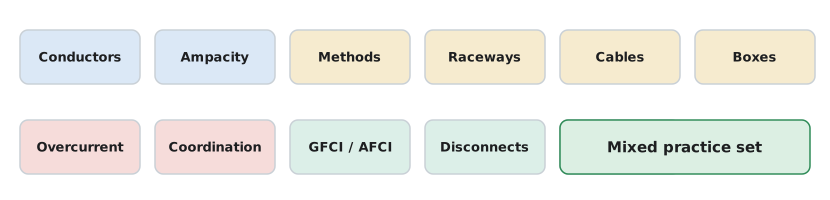
How to use the practice set
Priya runs the set in three passes, the same way she plans to sit the real exam. On the first pass she answers anything she can solve in under a minute and marks the rest. On the second pass she works the calculations. On the third she returns to anything she is unsure of and checks the rule wording. Denise times the group: about two minutes per problem on average, which matches the pace of a typical open-book code exam. Use the same approach here, and keep a note of which topics cost you time, so that your last weeks of study go where they are needed.
Problem 1: reading a marking
Worked problem
Conductor marking
A conductor in the Hartley Farms dryer room is marked RW90, 600 V, 6 AWG copper. The room is damp. What does the marking tell you, and what must you check?
Show solution
- RW identifies the insulation family, with W indicating suitability for wet locations; 90 is the temperature rating in degrees C.
- 600 V is the voltage rating, 6 AWG the size, copper the material.
- Check Table 19 to confirm RW90 is permitted in a damp location in the chosen wiring method.
- For ampacity, use the copper tables and the 90 C column as a starting point, then apply corrections and the termination limit of Rule 4-006.
Answer: Type, temperature, voltage, size and material; confirm use in Table 19 and size it with Rules 4-004 and 4-006.
Problem 2: ampacity with corrections
Worked problem
Corrected ampacity
A size E conductor (invented values: 56 A at 60 C, 67 A at 75 C, 75 A at 90 C) with 90 C insulation runs through a hot space (illustrative ambient factor 0.87) with five other current-carrying conductors (illustrative grouping factor 0.80). Terminations are rated 75 C. What is the usable ampacity?
Show solution
- Base value from the 90 C column: 75 A.
- Apply the factors: 75 x 0.87 x 0.80 = 52.2 A.
- Termination cap at 75 C: 67 A.
- Usable ampacity is the smaller value: 52.2 A.
Answer: About 52.2 A; the corrections govern, not the termination limit.
Problem 3: continuous load and breaker size
Worked problem
Continuous load
An EV charger at the Riverbend Condos parkade draws 32 A continuously. The breaker is not marked for continuous duty at full rating. Using an illustrative factor of 0.8, what minimum breaker rating is needed?
Show solution
- Divide the continuous load by the factor: 32 / 0.8 = 40 A.
- Choose a 40 A breaker, the next standard rating at or above 40 A.
- Confirm the conductor ampacity suits a 40 A device after corrections.
- Check Section 86 and Rule 8-104 in your copy for EV-specific requirements and the 2024 load calculation changes.
Answer: A 40 A breaker with the illustrative factor.
Problem 4: voltage drop
Worked problem
Voltage drop on a branch circuit
A 120 V circuit to the Hartley Farms bin yard light is 60 m long and carries 9 A. The conductor resistance is 0.0052 ohm per metre (invented). What is the drop, and what share of 120 V is it?
Show solution
- Single-phase drop: 2 x 60 x 0.0052 x 9.
- 2 x 60 = 120 m; 120 x 0.0052 = 0.624 ohm.
- 0.624 x 9 = 5.62 V.
- Share: 5.62 / 120 = 0.047, which exceeds typical branch circuit limits in Rule 8-102; choose a larger conductor.
Answer: About 5.6 V, or 0.047 of 120 V; compare with Rule 8-102 and upsize.
Problem 5: choosing a wiring method
Worked problem
Wiring method by location
Tyler proposes NMD90 for receptacles in the washdown area of the Hartley Farms shop, where the floor and walls are hosed down daily. Is this acceptable?
Show solution
- Classify the location: hosing down makes it a wet location under Section 0.
- Check Table 19 and the 12-500 series: NMD90 is generally limited to dry locations.
- Reject NMD90; choose a method suitable for wet locations, such as rigid PVC conduit with wet-location conductors, or a suitable jacketed cable.
- Use wet-location boxes and covers, and Class A GFCI protection for the receptacles.
Answer: Not acceptable; use a wet-location method, wet-location boxes and GFCI protection.
Problem 6: conduit fill
Worked problem
Fill check
Four size D conductors (invented area 24.0 mm2 each) and one size B bonding conductor (11.0 mm2) go into a raceway with an internal area of 340 mm2 (invented). With an illustrative limit of 0.40, does it comply?
Show solution
- Total area: 4 x 24.0 + 11.0 = 107.0 mm2.
- Fill: 107.0 / 340 = 0.315.
- 0.315 is under 0.40.
- The raceway complies with the illustrative limit.
Answer: Fill of about 0.31; complies.
Problem 7: bends
Worked problem
Counting bends
A conduit run has two 90 degree bends, an offset made of two 22.5 degree bends, and a saddle made of 45 + 22.5 + 22.5 degree bends, all between the same two boxes. Is it within an illustrative limit of 360 degrees?
Show solution
- Bends: 90 + 90 = 180 degrees.
- Offset: 22.5 + 22.5 = 45 degrees.
- Saddle: 45 + 22.5 + 22.5 = 90 degrees.
- Total: 180 + 45 + 90 = 315 degrees, within 360.
Answer: 315 degrees; within the illustrative limit.
Problem 8: box fill
Worked problem
Box fill
A 295 mL box (invented) holds three size A conductors (33 mL each), two size B conductors (37 mL each), one device yoke (two allowances of the largest conductor), clamps (one allowance) and bonding conductors (one allowance). Does it comply?
Show solution
- Conductors: 3 x 33 + 2 x 37 = 99 + 74 = 173 mL.
- Largest conductor allowance: 37 mL.
- Yoke 74 mL, clamps 37 mL, bonds 37 mL: 148 mL.
- Total: 173 + 148 = 321 mL, which exceeds 295 mL; use a larger box or an extension ring.
Answer: Requires 321 mL against 295 mL; does not comply.
Problem 9: fault current and interrupting rating
Worked problem
Interrupting rating
A 300 kVA three-phase transformer at 208 V has an impedance of 0.05 per unit (illustrative). The proposed panel breakers are rated 10 kA. Are they adequate at the transformer secondary?
Show solution
- Full-load current: 300 000 / (1.732 x 208) = 832.7 A.
- Fault current: 832.7 / 0.05 = 16 654 A.
- 10 kA is less than about 16.7 kA.
- Not adequate; choose devices rated at least 18 kA, unless a tested and marked series rating applies.
Answer: About 16.7 kA available; 10 kA breakers are not adequate.
Problem 10: coordination
Worked problem
Selectivity ratio
A 225 A fuse feeds a panel with 100 A fuses of a compatible class. The manufacturer gives an illustrative selectivity ratio of 2:1. Is the pair selective?
Show solution
- Ratio: 225 / 100 = 2.25.
- 2.25 is at least 2.
- The pair is selective under the stated ratio.
- Coordination is required by the Code only for specified systems; elsewhere it is good practice.
Answer: Selective at 2.25:1.
Problem 11: GFCI and disconnects
Worked problem
Protection and isolation
The rooftop air-conditioning unit at the Gaetz Avenue clinic has its disconnect in the electrical room two floors below, with no lock. The roof receptacle beside the unit is not GFCI protected. What must change?
Show solution
- The disconnect must be within sight of the unit or lockable in the open position; the usual solution is a weatherproof disconnect beside the unit.
- The rooftop receptacle is outdoors and must have Class A GFCI protection and a suitable weatherproof cover.
- Check the air-conditioning disconnect rules and the Section 26 receptacle rules in your copy.
- Confirm the enclosure type suits the outdoor location.
Answer: Add a disconnect within sight of the unit (or make the existing one lockable) and GFCI-protect the rooftop receptacle.
Problem 12: services
Worked problem
Service current
A new strip-mall unit has a calculated demand of 96 kVA at 120/208 V three-phase. What is the service current, and which standard rating from 100, 200, 400 A suits it?
Show solution
- Three-phase current: 96 000 / (1.732 x 208).
- 1.732 x 208 = 360.3.
- 96 000 / 360.3 = 266.5 A.
- Choose a 400 A service, since 200 A is too small.
Answer: About 267 A; a 400 A service.
Problem 13: parallel conductors and identification
Worked problem
Parallel sets
The 400 A feeder to the Hartley Farms motor control centre uses two parallel sets of copper conductors, each 22 m long, in two conduits. Conduit 1 holds the phase A and phase B conductors of both sets; conduit 2 holds the phase C conductors of both sets and the two neutrals. What is wrong?
Show solution
- Check the parallel conductor conditions: matching length, material, size, insulation and termination are met.
- Each raceway must contain one conductor of every phase and the neutral of its set.
- Here the phases are split between the conduits, so magnetic fields do not cancel and the steel conduits would heat by induction.
- Fix: put one complete set (A, B, C and neutral) in each conduit.
Answer: The phases are split between conduits; each conduit must carry a complete set.
Problem 14: cable support and bending
Worked problem
Armoured cable details
An AC90 cable with an overall diameter of 14 mm turns a corner into a panel at the Gaetz Avenue clinic. Using an illustrative minimum bending radius of 6 times the diameter, what is the minimum radius, and what fitting detail must not be forgotten where the armour is cut?
Show solution
- Bending radius: 6 x 14 = 84 mm.
- Form the bend with at least an 84 mm inside radius.
- Where the armour is cut at the connector, insert an anti-short bushing.
- Use a connector suitable for AC90 that maintains the bonding path to the panel.
Answer: At least 84 mm radius, plus an anti-short bushing and a bonding connector.
Checking your score
Priya keeps a record of each practice set: how many problems she got right, how long she took, and which topics she missed. A short script turns the record into a summary so that she can see her trend from one mock exam to the next.
results = {  # problem number: (topic, correct, minutes)
    1: ('conductors', True, 1.5), 2: ('ampacity', True, 2.5), 3: ('loads', True, 1.0),
    4: ('voltage drop', False, 3.5), 5: ('methods', True, 1.0), 6: ('fill', True, 2.0),
    7: ('bends', True, 1.0), 8: ('boxes', False, 3.0), 9: ('fault current', True, 3.0),
    10: ('coordination', True, 1.0), 11: ('protection', True, 2.0), 12: ('services', True, 2.0),
}
right = sum(1 for t, ok, m in results.values() if ok)
minutes = sum(m for t, ok, m in results.values())
print(f'Score: {right} of {len(results)}; time {minutes} min; average {minutes / len(results):.1f} min per problem')
print('Review:', ', '.join(t for t, ok, m in results.values() if not ok))Score: 10 of 12; time 23.5 min; average 2.0 min per problem Review: voltage drop, boxes
Her record shows voltage drop and box fill as the two topics to review, and both were the problems where she spent the most time. That is a common pattern: the topics that slow you down are often the ones you get wrong, because time pressure pushes you to cut corners in the arithmetic. Her plan for the next week is a short drill on each, with the real tables, before the next full mock exam.
Final advice for this course
Denise's closing advice to the study group has three parts. First, never answer from memory when the book is open: confirm the rule, even when you are sure. Second, write down intermediate numbers in calculations, because answer choices are built from the mistakes people make when they skip steps. Third, read the whole scenario before you decide what topic the question is about, because a box fill question may really be a wet location question, and a breaker question may really be a disconnect question. The next course, MELC-104, takes the same approach to Section 10 grounding and bonding.
Common mistakes
MistakeAnswering from memory with the Code open.
InsteadConfirm every rule, even when you are confident.
MistakeSkipping intermediate numbers in calculations.
InsteadWrite each step; answer choices are built from skipped steps.
MistakeStopping at the first problem you find in a scenario.
InsteadWalk the whole installation; questions often hide more than one problem.
MistakeIgnoring time spent per problem.
InsteadTrack time by topic so that your study goes where it is needed.
MistakePractising only with real tables from memory.
InsteadPractise the method with invented values, then repeat with your own copy.
Summary and key terms
- Mixed practice is the best preparation for a mixed exam.
- Use three passes: quick questions, calculations, then checks.
- For every problem, identify the rule, read it fully and apply each step in order.
- Track your score and time by topic to direct your final study.
- Treat every value here as illustrative and repeat each problem with your own 2024 Code.
- Practice set
- A mixed group of exam-style problems covering several topics.
- Three-pass method
- Answering quick questions first, then calculations, then reviewing uncertain answers.
- Usable ampacity
- The ampacity after corrections, limited by terminations.
- Selectivity ratio
- The manufacturer's ratio of upstream to downstream fuse ratings that gives coordination.
- Calculated demand
- The load used to size a service or feeder, found by the Section 8 methods.
Practice problems
Work each problem on paper first, then reveal the answer to check.
Size C (invented 90 C value 39 A) has factors 0.87 and 0.80 and 75 C lugs (35 A). What is the usable ampacity?
Show answer
39 x 0.87 x 0.80 = 27.1 A, below the 35 A cap, so 27.1 A.
A continuous load is 24 A with an illustrative factor of 0.8. What rating is needed?
Show answer
24 / 0.8 = 30 A.
What is the three-phase current for 96 kVA at 208 V?
Show answer
96 000 / (1.732 x 208) = about 266.5 A.
A 300 kVA, 208 V transformer has 0.05 per-unit impedance. What is the approximate fault current?
Show answer
About 16 650 A.
Is a 150 A fuse over a 60 A fuse selective at 2:1?
Show answer
Yes; 150 / 60 = 2.5.
Lesson quiz · 5 questions
Score 60% or more to complete this lesson.
Create a free account to save your progress, take quizzes and earn a certificate.