
MELC-103 · Lesson 6 of 12 · 22 min
Boxes, fittings and cabinets
▶ Video coming soon A video version of this lesson is on the way.
Every splice, outlet, switch and junction in a wiring system ends up in a box, a fitting or a cabinet. The 12-3000 series of Section 12 governs these enclosures: where they are required, what they must be made of, how big they must be for the conductors and devices inside, how they are mounted and covered, and how they stay accessible. Box questions are among the most predictable on the exam. Most are either a box fill calculation or a question about whether a box is required, accessible or suitable for its location.
The box fill method in the Code uses box volumes and allowances for each conductor size, set out in tables referred to by the box fill rule (Rule 12-3034 in recent editions; confirm the number in your copy). As with earlier lessons, all volumes and allowances below are invented so that you practise the method without memorizing anything incorrect. Look up the real values in your own Code as you work through the examples.
When a box is required
The basic principle is that every joint, splice or tap, every outlet, and every switch or other device must be in a box or fitting suitable for the purpose, unless the wiring method or equipment is specifically approved without one. Where a cable or raceway system changes to another method, a box or fitting is usually required at the transition. Boxes protect the connections mechanically, contain any heat or arcing from a failed connection, and keep live parts out of reach.
Exam questions in this area often describe a splice that has been made inside a wall without a box, a cable that has been extended by splicing in the middle of a run, or a light fixture that has been connected directly without an outlet box. The answer is almost always that a box is required. The exceptions are specific: certain luminaires and equipment with their own approved wiring compartments, splices in some underground or industrial methods made with approved kits, and similar cases listed in the rules.
Accessibility of boxes
A box that contains splices must remain accessible without damaging the building finish. In practical terms, it must not be buried behind drywall, plaster or permanent panelling. This rule exists because connections are the weak points of a wiring system. If a connection loosens and overheats, someone must be able to find and repair it without cutting into walls. Junction boxes above suspended ceilings are acceptable because the ceiling tiles can be removed; boxes above fixed drywall ceilings are not, unless an access panel is provided.
At the Aspen Ridge bungalow, the homeowner wants a hallway junction box hidden behind new drywall for appearance. Gord explains that the box must stay accessible, and offers a blank cover plate or an access panel in a closet instead. Denise uses the example in the study group to make a broader point: when a scenario includes a request from the owner that conflicts with a rule, the exam answer follows the rule. The owner's preference never overrides the Code.
Box fill
A box must be large enough for the conductors, devices, clamps and fittings inside it. Too many conductors in a small box damage insulation as they are folded in, make loose connections more likely, and trap heat. The Code's method works with the box's usable volume and a volume allowance for each conductor depending on its size, with extra allowances for devices, internal clamps and similar items. The rule tells you which conductors count: conductors that pass through without a splice may count differently from those that terminate, conductors that originate and end within the box (such as pigtails) may not count, and bonding conductors are treated in a particular way.
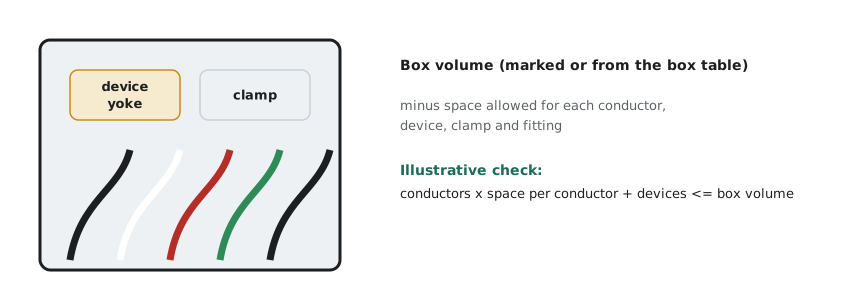
| Item (illustrative) | Volume allowance (mL) |
|---|---|
| Conductor size A (smallest branch circuit size) | 33 |
| Conductor size B | 37 |
| Conductor size C | 41 |
| Each device yoke (illustrative rule: counts as two of the largest conductor connected) | 2 x largest |
| Internal cable clamps, all together (illustrative: counts as one of the largest conductor) | 1 x largest |
| Device box, 3 in deep, marked volume | 295 |
| Square box with plaster ring, marked volume | 480 |
Worked problem
Box fill for a kitchen receptacle
At the Aspen Ridge bungalow, a 295 mL device box holds a duplex receptacle on one yoke, with two NMD90 cables of size B conductors entering (two insulated conductors each, plus bare bonding conductors), and internal clamps. Using the invented allowances and an illustrative rule that all bonding conductors together count as one conductor of the largest size, does the box comply?
Show solution
- Count insulated conductors: 2 cables x 2 = 4 conductors of size B: 4 x 37 = 148 mL.
- Bonding conductors together: 1 x 37 = 37 mL.
- Device yoke: 2 x 37 = 74 mL.
- Internal clamps: 1 x 37 = 37 mL.
- Total: 148 + 37 + 74 + 37 = 296 mL, which exceeds the 295 mL box by 1 mL, so it does not comply; use a deeper box or add an extension ring.
Answer: Required 296 mL against 295 mL available: the box is too small by a hair.
Priya likes this example because it fails by one millilitre. Real exam questions are often built to fail narrowly, so that a candidate who rounds, forgets the clamps or miscounts the bonding conductors gets the wrong answer. Write out every line of the calculation.
allow = {'A': 33, 'B': 37, 'C': 41}   # invented allowances, mL per conductor

def required(conductors, yokes=0, clamps=False, bonds=False):
    largest = max(allow[c] for c in conductors)
    total = sum(allow[c] for c in conductors)
    total += yokes * 2 * largest          # illustrative: each yoke counts as two
    total += largest if clamps else 0     # illustrative: clamps count as one
    total += largest if bonds else 0      # illustrative: all bonds count as one
    return total

need = required(['B'] * 4, yokes=1, clamps=True, bonds=True)
print('Kitchen receptacle box needs', need, 'mL; box has 295 mL; fits:', need <= 295)
need2 = required(['B'] * 6, yokes=1, clamps=False, bonds=True)
print('Square box job needs', need2, 'mL; box has 480 mL; fits:', need2 <= 480)Kitchen receptacle box needs 296 mL; box has 295 mL; fits: False Square box job needs 333 mL; box has 480 mL; fits: True
Boxes in different locations
Boxes must suit their environment just as wiring methods do. Outdoor and wet-location boxes must be weatherproof or suitable for wet locations, and receptacle covers in wet locations must keep water out when a plug is inserted where the rules require it. Boxes in damp, dusty or corrosive locations need suitable materials and gaskets. Boxes in fire separations must not reduce the rating, which can limit the size of boxes, require spacing between boxes on opposite sides of a wall, or require fire-rated pads. Boxes in concrete must be suitable for embedding.
In the Hartley Farms dryer room, dust and dampness mean the group chooses non-metallic boxes with gasketed covers and connectors suited to the location. In the washdown area of the shop, where the floor is hosed down, they choose wet-location boxes and covers. Each choice comes from reading the location rules in the 12-3000 series alongside the wiring method rules from earlier lessons.
Mounting, covers and luminaire support
Boxes must be securely fastened to the building structure or supported by the raceway system as the rules allow. Every box must have a cover, a device plate or a luminaire canopy that closes it completely. Unused openings must be closed. Boxes that support luminaires or ceiling fans must be rated for the weight, and ceiling fan boxes have specific requirements because of the vibration and torque a fan produces. Questions on mounting and covers are often about a box left without a cover, a ceiling fan hung from an ordinary outlet box, or a box supported only by the cable entering it.
Conduit bodies and fittings
Conduit bodies are the short fittings with removable covers, often called LBs, LLs, LRs, Ts and Cs after their shapes, that let a conduit run turn a corner or provide a pull point. They are useful but limited. Most conduit bodies are too small to hold splices, and the rules allow splices in them only if the body is marked with a volume and the fill calculation passes. A conduit body used only as a pull point counts as a pull point for the bend limit from Lesson 4, which is one reason installers use them on long runs. Conduit bodies also have size requirements related to the raceways entering them and the conductors passing through.
Fittings in general, such as couplings, connectors, locknuts and bushings, must be suitable for the raceway or cable and for the location. Bushings protect conductors where they leave a raceway into a box. Insulated bushings are required on larger conductors so that the conductor insulation is not damaged by the edge of the raceway. Where fittings form part of a bonding path, they must be made up tight and be of a type that maintains bonding continuity.
Common box deficiencies from inspections
Denise keeps a list of the box deficiencies she wrote most often in her years as an inspector, and she gives it to every study group. Overfilled device boxes in kitchens, where several circuits meet. Missing covers on junction boxes in attics and crawl spaces. Splices outside boxes, usually where a cable was extended after drywall was installed. Boxes set back too far from the finished wall surface, leaving combustible material exposed around the device. Unused knockouts left open. Ordinary boxes in wet or damp locations. Ceiling fans on unrated boxes.
Each item on her list maps to a rule in the 12-3000 series, and each one has appeared, in one form or another, on licensing exams she has seen. Priya turns the list into a self-test: for each deficiency she finds the rule, writes its number on a card, and quizzes herself until she can name the rule without looking. It takes two evenings and pays off on her second mock exam, where three questions turn out to be deficiencies from the list.
Worked problem
How many conductors fit?
Gord asks Tyler how many size C conductors could go in the 480 mL square box at the Gaetz Avenue dental clinic, with no devices, internal clamps present and bonding conductors present, using the invented allowances.
Show solution
- Clamps take one allowance of the largest conductor: 41 mL.
- Bonding conductors together take one allowance: 41 mL.
- Volume left for insulated conductors: 480 - 41 - 41 = 398 mL.
- Divide by the allowance per conductor: 398 / 41 = 9.7.
- Round down: 9 insulated conductors of size C.
Answer: Nine insulated size C conductors with the invented values; always round down.
Cabinets, cutout boxes and panelboards
Cabinets and cutout boxes are larger enclosures that house panelboards, terminal blocks and similar equipment. Their rules add requirements for wire bending space at terminals, so that large conductors are not forced into tight bends where they enter lugs; for the space available for conductors that pass through; and for deflecting conductors away from sharp edges. Panelboards also have rules on working space, from Rule 2-308 in Section 2, which MELC-101 covered, and on the number of circuits and the arrangement of the neutral and bonding bars.
At Hartley Farms the new 400 A distribution panel sits in the electrical room. The group checks the working space in front of it under Rule 2-308, the wire bending space for the large feeder conductors entering the main lugs, and the location of the panel relative to the service entrance. Marcus points out that the bending space at the lugs is one of the most common deficiencies he has seen on industrial panel installations: conductors jammed into the gutter at a sharp angle because the panel was too small or mounted too close to the conduit entry.
| Enclosure question | Where to look |
|---|---|
| Is a box required here? | General box rules in the 12-3000 series |
| Is the box big enough? | Box fill rule and its tables (12-3034 in recent editions) |
| Can the box be concealed? | Accessibility rule for boxes with splices |
| Is the box suitable for the location? | Location rules for boxes and Table 19 for the wiring method |
| Can the box hold a ceiling fan? | Luminaire and fan support rules |
| Is there enough bending space at the panel lugs? | Cabinet and cutout box rules |
| Is there enough working space in front? | Rule 2-308 |
Common mistakes
MistakeLeaving out internal clamps or devices in box fill.
InsteadEvery item the rule lists adds to the required volume.
MistakeBurying a junction box behind drywall.
InsteadBoxes containing splices must remain accessible.
MistakeUsing an ordinary outlet box for a ceiling fan.
InsteadFan support boxes must be rated for the fan's weight and motion.
MistakeCounting pigtails as conductors in box fill.
InsteadCheck the rule; conductors that start and end in the box may not count.
MistakeIgnoring wire bending space at large lugs.
InsteadCabinet rules require space for conductors to bend into terminals.
Summary and key terms
- Every splice, outlet and device needs a suitable box or fitting unless an exception applies.
- Boxes containing splices must stay accessible without damaging the building finish.
- Box fill compares the required volume for conductors, devices and clamps with the box's volume.
- Boxes must suit their location: wet, damp, dusty, corrosive or in a fire separation.
- Cabinets need wire bending space at terminals; panelboards need working space under Rule 2-308.
- Box fill
- The volume required by the conductors, devices and fittings in a box, compared with the box volume.
- Device yoke
- The mounting strap of a switch or receptacle, counted in box fill.
- Accessible (box)
- Able to be reached by removing a cover or panel without damaging the building finish.
- Cutout box
- An enclosure designed for surface mounting with swinging doors, used for equipment.
- Wire bending space
- The space required at terminals so large conductors can bend without damage.
Practice problems
Work each problem on paper first, then reveal the answer to check.
Using the invented allowances, what volume do six size A conductors need?
Show answer
6 x 33 = 198 mL.
A box needs 296 mL and is marked 295 mL. Does it comply?
Show answer
No; it is 1 mL short.
May a junction box with splices be concealed above a fixed drywall ceiling?
Show answer
Not unless an access panel keeps it accessible.
Using the invented values, four size C conductors, one yoke and clamps need how much volume?
Show answer
4 x 41 + 2 x 41 + 41 = 287 mL.
Which rule covers working space in front of a panelboard?
Show answer
Rule 2-308.
Lesson quiz · 5 questions
Score 60% or more to complete this lesson.
Create a free account to save your progress, take quizzes and earn a certificate.