
MELC-103 · Lesson 5 of 12 · 22 min
Cables: NMD90, armoured and others
▶ Video coming soon A video version of this lesson is on the way.
Cables are factory assemblies of conductors with a common covering. They save labour compared with pulling conductors into raceways, and they dominate residential and much light commercial work. Each cable type has its own series of rules in Section 12, and Table 19 lists the conditions in which it may be used. This lesson covers the cable types a master electrician meets most: non-metallic sheathed cable (NMD90), armoured cable (AC90 and ACWU90), armoured cable with an overall jacket (TECK90), and mineral-insulated cable. For each one, the exam questions follow the same pattern as for raceways: where it may be used, where it may not, how it is supported and protected, and how it is terminated and bonded.
The descriptions of permitted uses below are general summaries. Building types, construction classes and locations interact with the cable rules in detail, and provincial amendments sometimes change them, so treat every statement here as a pointer to the rule you must read in your own copy.
Non-metallic sheathed cable (NMD90)
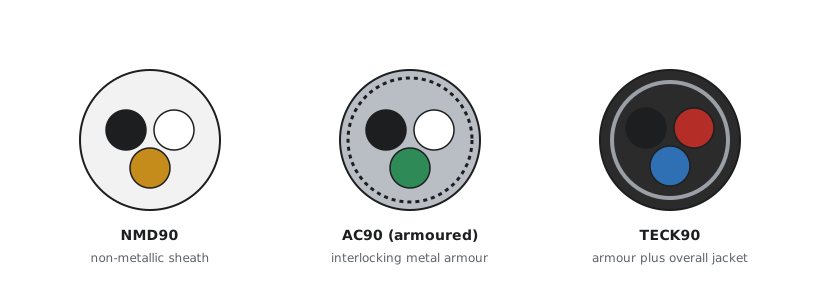
NMD90 is the familiar house wire: two or three insulated copper conductors and a bare bonding conductor inside a non-metallic outer sheath. Its rules are in the 12-500 series. It is used mainly in buildings of combustible (wood-frame) construction, concealed in walls, floors and ceilings or run exposed in some places where it is not subject to damage. It is generally limited to dry locations, and it may not be used where it would be exposed to mechanical damage, in wet or corrosive locations, embedded in concrete, or in hollow spaces used for air handling, among other prohibitions. The 2024 edition updates the requirements for non-metallic jacketed cables, so check the current wording rather than relying on older notes.
The installation rules focus on protecting the cable from the building's finishes and fasteners. NMD90 must be supported at intervals and near each box, protected where it passes through framing close to the edge of a stud or joist, protected where it runs along the side of framing or across the underside of joists in unfinished basements, and kept away from heating ducts and other heat sources. Questions on NMD90 usually test one of these installation details or one of the prohibited locations.
Worked problem
Support count for a basement run
Tyler is running NMD90 along a basement wall at the Aspen Ridge bungalow, a 9.6 m straight run from the panel to a box. Using an illustrative maximum support spacing of 1.5 m and a requirement for a support within 300 mm of each box and the panel, how many supports does the run need at minimum?
Show solution
- Place a support within 300 mm of the panel and within 300 mm of the box: 2 supports.
- The distance between those two supports is at most 9.6 - 0.3 - 0.3 = 9.0 m.
- Divide by the maximum spacing: 9.0 / 1.5 = 6 spaces.
- Six spaces need seven supports in total, including the two end supports.
- Check the real spacing and end-distance values in the 12-500 series of your copy.
Answer: Seven supports with the illustrative values.
Support questions come up often enough that Priya writes a small function to check her counts. It takes the run length, the end distance and the maximum spacing, and returns the minimum number of supports. Change the illustrative values to match the rules in your copy and try runs of different lengths.
import math

def supports(run_m, end_m, spacing_m):
    middle = run_m - 2 * end_m          # distance between the two end supports
    spaces = math.ceil(round(middle / spacing_m, 9))
    return spaces + 1

for run in (2.0, 6.6, 9.6, 12.1):
print(f'{run:>5} m run: {supports(run, 0.3, 1.5)} supports (illustrative spacing)')2.0 m run: 2 supports (illustrative spacing) 6.6 m run: 5 supports (illustrative spacing) 9.6 m run: 7 supports (illustrative spacing) 12.1 m run: 9 supports (illustrative spacing)
Watch the rounding: a middle distance that is an exact multiple of the spacing needs no extra support, but anything even slightly longer needs one more. The 12.1 m run shows this: its middle section is 11.5 m, which needs eight spaces rather than seven and a bit, so nine supports. Exam answers often include the number you would get by rounding down.
Cables and building construction
Whether a cable may be used in a building often depends on the building itself as well as on the location within it. The building code classifies buildings by occupancy and by construction type, combustible or non-combustible, and the CE Code's cable rules refer to those classifications. Historically, NMD90 was tied closely to combustible construction, and armoured cable or raceways were expected in non-combustible buildings, though the rules have changed over successive editions and provincial amendments add their own conditions. Read the current 12-500 and 12-600 series carefully for the construction and occupancy conditions, and note any Alberta amendments next to them.
Cables in hollow spaces raise a related issue: combustibility of the cable jacket. In some non-combustible buildings, cables with combustible jackets may need to meet flame-spread ratings or be enclosed, and cables in spaces used for air handling face stricter limits. The Code refers to flame-spread ratings marked on cables, such as FT1, FT4 and FT6, which describe how a cable behaves in a fire test. On an exam, a question that mentions a return air plenum, a high-rise or a non-combustible building is often testing whether the cable's flame-spread rating is suitable.
Priya notes a trap here. A cable type can be permitted by its own series in Section 12 and still be unacceptable because the building code or a flame-spread requirement rules it out. When a question describes the building in detail, the detail is there for a reason: check the construction type, the occupancy and any air-handling spaces before you approve the cable.
Armoured cable (AC90 and ACWU90)
Armoured cable has insulated conductors wrapped in interlocking metal armour, usually aluminum, with a small bare bonding strip or conductor in contact with the armour. Its rules are in the 12-600 series. AC90 is used widely in commercial and some residential work where its mechanical protection is valued, generally in dry locations. ACWU90 adds a moisture-resistant overall jacket and conductors suited to wet locations, which extends its use to wet and underground installations as Table 19 allows.
Two installation details are unique to armoured cable and appear on exams. First, where the armour is cut, an anti-short bushing must be inserted between the conductors and the cut edge so that the sharp armour cannot damage the insulation. Second, the armour and its bonding strip together form the bonding path in many armoured cables, so the connector at each box must be of a type that bonds the armour properly. The rules also set minimum bending radii, support spacing, and the distance from boxes within which the cable must be secured.
| Cable (general description) | Construction | Typical locations | Exam points |
|---|---|---|---|
| NMD90 | Insulated conductors and bare bond in non-metallic sheath | Dry locations in combustible buildings | Prohibited locations; protection through framing; support spacing |
| AC90 | Insulated conductors in interlocking metal armour | Dry locations, commercial and residential | Anti-short bushings; bonding through armour; bending radius |
| ACWU90 | AC90 with an overall moisture-resistant jacket | Wet and underground locations as permitted | Jacket integrity at fittings; burial depth |
| TECK90 | Armour with an overall jacket and an insulated or bare bonding conductor | Industrial, wet, underground, many hazardous locations | Connectors; bonding conductor; tray use |
| Mineral-insulated | Conductors in compressed mineral insulation inside a metal sheath | Fire-rated and high-temperature circuits | Moisture sealing at ends; terminations |
TECK90
TECK90 is the industrial workhorse in Canada: insulated conductors with a bonding conductor, inner jacket, interlocking armour and an overall PVC jacket. The overall jacket protects the armour from corrosion and moisture, so TECK90 can be used in many wet, underground and corrosive locations, in cable trays, and in some hazardous locations with the right connectors. Because the armour is not relied on as the only bonding path, the connector must still bond the armour, but the internal bonding conductor carries fault current.
Marcus's industrial background makes TECK90 his default choice, and at Hartley Farms it makes sense for the motor feeders in the dusty dryer room and for the bin yard feeder, where an ACWU90 or TECK90 rated for direct burial avoids digging a conduit trench. The group checks Table 19 for TECK90's conditions of use, the connector requirements for the damp, dusty area, and the bending radius where the cable turns down into the motor control centre.
Worked problem
Minimum bending radius
A TECK90 cable at Hartley Farms has an overall diameter of 32 mm. Using an illustrative minimum bending radius of 12 times the overall diameter for this cable type, what is the minimum inside radius of any bend?
Show solution
- Find the multiplier for the cable type in the rule (illustrative value: 12).
- Multiply by the overall diameter: 12 x 32 = 384 mm.
- Allow at least 384 mm inside radius at the turn into the motor control centre.
- Check the real multiplier for the cable type and size in your copy; different cables have different multipliers.
Answer: At least 384 mm with the illustrative multiplier.
Mineral-insulated cable and fire-rated circuits
Mineral-insulated (MI) cable has copper conductors embedded in compressed magnesium oxide inside a seamless copper or alloy sheath. It withstands very high temperatures, which makes it useful for circuits that must keep working during a fire, such as some fire pump and emergency circuits, and for high-temperature locations. Its weakness is moisture: the mineral insulation absorbs water from the air if the ends are left unsealed, so each termination needs a sealing pot or a factory seal. Exam questions on MI cable usually test its use for fire-rated circuits, the moisture sealing requirement, or where its bare sheath may be used.
Other cables appear in the Code too, such as flat conductor cable, service entrance cable and cables for specific systems like fire alarm and communications. You do not need to know them all in detail, but you should know that each has its own rules and limits, and that the system sections (such as those for fire alarm and Class 2 circuits) may require specific cable types. When a question names a cable you do not recognise, look it up in Table 19 first.
Cable connectors and terminations
Every cable entering a box or enclosure must be secured with a connector suitable for the cable type and the location. A connector for NMD90 in a dry location is different from a connector for TECK90 in a wet or hazardous location, and the wrong connector is a common deficiency on inspections. Connectors for armoured cables also provide the bonding connection to the box, so their suitability for bonding matters. Where cables enter equipment with factory knockouts, the connector size must match the knockout and the cable.
Denise tells the study group that, in her years as an inspector, connector problems outnumbered almost every other deficiency on commercial jobs: wrong type for the location, missing anti-short bushings on armoured cable, loose connectors that broke the bonding path, and dry-location connectors used outdoors. On the exam, any scenario that mentions a connector is checking whether you know the connector must suit the cable, the location and the bonding role.
Choosing between cable and raceway
The decision between a cable and a raceway system is partly technical and partly economic. Cable is faster to install and cheaper for most runs. Raceway allows conductors to be replaced or added without opening walls, gives better mechanical protection in some forms, and may be required in certain locations or buildings. On the exam, the technical side is what matters: is the chosen method permitted in the location, and does it meet the protection, support and bonding rules? Economic preferences only appear in business questions, which MELC-106 covers.
At Hartley Farms, the final wiring plan uses NMD90 only in the dry office, AC90 in the dry electrical room for small circuits, TECK90 for the motor feeders and the bin yard feeder, rigid PVC for the dusty and damp dryer area branch circuits, and liquid-tight flexible conduit for motor connections. Each choice traces back to a rule the group read in Section 12 and a line in Table 19.
Common mistakes
MistakeUsing NMD90 in a damp or wet location.
InsteadNMD90 is generally limited to dry locations; check Table 19 and the 12-500 series.
MistakeLeaving out the anti-short bushing on armoured cable.
InsteadInsert a bushing wherever AC90 armour is cut.
MistakeChoosing any connector that fits the knockout.
InsteadConnectors must suit the cable type, the location and the bonding role.
MistakeLeaving MI cable ends unsealed.
InsteadThe mineral insulation absorbs moisture; seal every termination.
MistakeAssuming ACWU90 and AC90 are interchangeable.
InsteadOnly the jacketed type with suitable conductors may be used in wet or buried locations.
Summary and key terms
- Each cable type has its own series in Section 12 and its conditions of use in Table 19.
- NMD90 is mainly for dry locations in combustible buildings, with protection from fasteners and damage.
- Armoured cable needs anti-short bushings and bonding connectors; ACWU90 adds a jacket for wet and buried use.
- TECK90's overall jacket suits it to wet, underground, tray and many industrial uses.
- MI cable resists fire and heat but must be sealed against moisture at its ends.
- NMD90
- Non-metallic sheathed cable with a bare bonding conductor, rated 90 C, for dry locations.
- AC90
- Armoured cable with interlocking metal armour, generally for dry locations.
- TECK90
- Armoured cable with an overall jacket and internal bonding conductor, widely used in industry.
- Anti-short bushing
- A fibre or plastic insert protecting conductors from the cut edge of cable armour.
- Mineral-insulated cable
- Cable with conductors in compressed mineral insulation inside a metal sheath, used for fire-rated circuits.
Practice problems
Work each problem on paper first, then reveal the answer to check.
A 6.6 m NMD90 run needs supports within 0.3 m of each end and at most every 1.5 m (illustrative). How many supports?
Show answer
Ends leave 6.0 m; 6.0 / 1.5 = 4 spaces, so 5 supports.
What must be inserted where AC90 armour is cut?
Show answer
An anti-short bushing.
Which cable type would you choose for direct burial to a remote building?
Show answer
A jacketed armoured cable rated for direct burial, such as ACWU90 or TECK90, as Table 19 allows.
A cable is 25 mm in diameter and the illustrative multiplier is 12. What is the minimum bending radius?
Show answer
12 x 25 = 300 mm.
Why is MI cable used for fire pump circuits?
Show answer
Its mineral insulation lets the circuit keep working at fire temperatures.
Lesson quiz · 5 questions
Score 60% or more to complete this lesson.
Create a free account to save your progress, take quizzes and earn a certificate.