
MELC-103 · Lesson 11 of 12 · 22 min
Services and service equipment under Section 6
▶ Video coming soon A video version of this lesson is on the way.
Every electrical installation begins at its service: the point where the supply authority's conductors end and the consumer's installation begins. Section 6 of the CE Code governs the consumer's service, from the service conductors to the service box, and works together with the supply authority's own requirements for metering, connection and clearances. Service questions on the master exam combine many of the topics in this course: conductor selection, wiring methods, overcurrent protection and disconnecting means, plus the load calculations of MELC-102 and the grounding and bonding of MELC-104. This lesson pulls them together around the new 400 A service at Hartley Farms.
Remember that the supply authority, the local electrical utility, has its own rules that sit alongside the Code: where the meter goes, how the service is connected, which conductors the utility supplies and which the customer supplies, and what clearances must be kept. Exam questions sometimes test the boundary between the two. Rule numbers below are pointers; read Section 6 in your 2024 copy and your utility's service requirements.
Key definitions
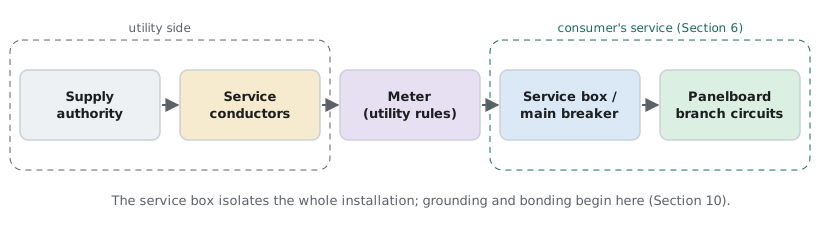
Section 0 defines the terms Section 6 relies on, and many service questions turn on them. The consumer's service is all the consumer's equipment from the point of connection to the supply authority up to and including the service box. The service box is the approved assembly, usually a main breaker or fused switch in an enclosure, through which the supply is connected and by which the whole installation can be disconnected. Service conductors are the conductors from the supply point to the service box. The supply authority is the utility or other body that supplies the electricity. Read these definitions in your copy and note how they draw the line between the utility's equipment and the consumer's.
Number of services
The general rule (Rule 6-102 in recent editions) is that a building is supplied by one consumer's service, so that firefighters and workers know there is one point at which the building can be isolated. The rule allows additional services under listed conditions, for example where the load is too large for one service, where there are separate occupancies or buildings, where different voltages or characteristics are needed, or for fire pumps and emergency supplies. Where more than one service supplies a building, the Code requires a permanent sign or directory at each service showing the location of the others.
At Hartley Farms, the farm already has a 200 A single-phase service to the house and old shop. The new grain-drying operation needs three-phase power, which the utility will bring in on a new transformer. The group checks whether the new building can have its own three-phase service while the house keeps its single-phase service. The answer depends on whether they are separate buildings and on the different characteristics, both of which favour a second service here, with signs at each one. On the exam, read the scenario for separate buildings, different voltages and fire pumps.
Location of service equipment
Service equipment must be located as close as practicable to the point where the service conductors enter the building, so that the length of unprotected service conductor inside the building is short. It must be readily accessible, kept clear of storage, and not located in hazardous areas, bathrooms, clothes closets or over stairs, among other places listed in the rules (Rule 6-206 in recent editions). These rules exist because service conductors have no overcurrent protection on the consumer's side until they reach the service box; a fault inside the building on those conductors is limited only by the utility's protection upstream.
The group places the Hartley Farms service box on the inside of the electrical room wall where the underground service conductors enter, with the utility meter outside on the same wall. That keeps the unprotected conductor inside the building to a short run through the wall into the service box. Denise asks what they would do if the electrical room had to be on the far side of the building. Marcus's answer, which matches the rules the group found, is to install the service box outside or near the entry point and run a feeder, which is protected, to the electrical room.
Service conductors: overhead and underground
Service conductors may arrive overhead or underground. Overhead services involve a service mast or attachment point, drip loops, clearances above ground, roofs, windows and driveways, and the mechanical strength of the mast. Underground services involve burial depths from Table 53, protection where conductors rise out of the ground, sealing of raceways entering the building, and provision for frost movement. Section 6 contains rules for both, and the 2024 edition updated the overhead sag and span rules in Section 12 that support them.
Because service conductors are unprotected on the consumer's side, the rules on their wiring methods are strict. They must be of types suitable for service entrance use, protected from damage, and kept separate from other conductors in the building. Conductors of other circuits generally may not share a raceway or enclosure with service conductors, apart from limited exceptions such as some control conductors. On the exam, any scenario that runs a branch circuit through a service conduit or service enclosure is likely to be wrong.
| Overhead service checks | Underground service checks |
|---|---|
| Clearance above grade, roads, driveways and walkways | Cover depth from Table 53 for each part of the route |
| Clearance from windows, doors and roofs | Protection where conductors rise out of the ground |
| Service mast strength and support | Sealing raceways entering the building |
| Drip loops and weatherhead | Allowance for frost movement |
| Point of attachment height | Marking and separation from other underground services |
Sizing the service
The service must be large enough for the calculated load from Section 8, which MELC-102 covers in detail: demand loads for dwellings, apartments and other occupancies, with demand factors and continuous-load considerations. Once the calculated load is known in watts or volt-amperes, the service current follows from the supply voltage and phase arrangement. The service conductors are then sized for that current under the Section 4 rules from Lesson 2, and the service box rating is chosen from the standard ratings. The service box must also have an interrupting rating adequate for the available fault current from Lesson 7.
Worked problem
Service current for Hartley Farms
The calculated demand load for the new grain-drying building, using the Section 8 methods (illustrative result), is 280 kVA at 347/600 V three-phase. What is the service current, and is a 400 A service box adequate?
Show solution
- Apply the three-phase formula: 280 000 / (1.732 x 600).
- 1.732 x 600 = 1039.2.
- 280 000 / 1039.2 = 269.4 A.
- A 400 A service box exceeds 269.4 A with room for growth.
- Check the conductor ampacity, the continuous-load limits of Rule 8-104 and the interrupting rating for the actual service.
Answer: About 269 A, so a 400 A service is adequate on this illustrative load.
import math

def service_amps(kva, volts, three_phase=True):
    va = kva * 1000
    return round(va / (math.sqrt(3) * volts) if three_phase else va / volts, 1)

ratings = [100, 200, 400, 600, 800]

def service_rating(kva, volts, three_phase=True):
    amps = service_amps(kva, volts, three_phase)
    return amps, next(r for r in ratings if r >= amps)

print('Hartley Farms dryer building:', service_rating(280, 600))
print('Farmhouse, 38.4 kVA at 240 V single-phase:', service_rating(38.4, 240, False))
print('If the dryer load grows to 420 kVA:', service_rating(420, 600))Hartley Farms dryer building: (269.4, 400) Farmhouse, 38.4 kVA at 240 V single-phase: (160.0, 200) If the dryer load grows to 420 kVA: (404.1, 600)
The last line shows what Gord is worried about. If the farm adds a second dryer and the demand load rises to 420 kVA, the current of about 404 A would exceed a 400 A service. Gord asks the group to size the service conductors and raceway so that a 600 A service box could be installed later without replacing them, a design choice that goes beyond the Code minimum but saves the customer money.
Service box, metering and bonding
The service box must disconnect all ungrounded conductors of the service at once, must be rated for the service current and the available fault current, and must be marked as suitable for use as service equipment. Section 6 also deals with meter locations and meter mounting devices, though the supply authority's rules usually control the details. The service is also where the grounding and bonding system begins: the system neutral is connected to the grounding electrode conductor and bonded to the service equipment enclosures at the service box, and nowhere else on the consumer's side of the installation in a normal system. MELC-104 covers Section 10 in depth, but service questions frequently include one bonding item, so keep it in mind.
Large services may need ground fault protection of equipment on the main disconnect, as Lesson 9 described, depending on the size and voltage of the system. The Hartley Farms service at 400 A falls below the threshold the group finds in their copies, but a larger future service might not, so Gord notes it in the design file.
Reading a service scenario
Service questions on the master exam are often long. They describe a building, a utility supply, a proposed service arrangement and sometimes a drawing, then ask what is wrong or what is required. The fastest way through them is to walk the service in the direction power flows and check each element against the rules: the number of services, the point of entry, the service conductors and their wiring method, the meter arrangement, the service box location and rating, the interrupting rating, the neutral bonding, and the feeders leaving the service. Each item has a rule, and the question usually hides one or two problems among several items that comply.
Worked problem
What is wrong with this service?
A proposal for the Gaetz Avenue dental clinic shows: a second service added for a new X-ray room because the owner wants separate billing; the service box located in a storage room at the back of the unit, 18 m from where the service conductors enter; a branch circuit for an exterior sign run through the service conduit; and the neutral bonded to the enclosure at both the service box and the X-ray room subpanel. Identify the problems.
Show solution
- Second service: separate billing alone is not one of the listed conditions for an additional service; check Rule 6-102.
- Service box location: 18 m of unprotected service conductor inside the unit is not as close as practicable to the point of entry, and a storage room may not keep the equipment readily accessible and clear.
- Sign circuit: other conductors generally may not share a raceway with service conductors.
- Neutral bonding: in a normal system the neutral is bonded to enclosures only at the service box, not at downstream panels.
- Each problem points to a specific rule; find all four in your copy.
Answer: Four problems: the unjustified second service, the remote service box, the shared service raceway, and the second neutral bond.
Priya finds that she gets these questions right when she resists the urge to answer as soon as she spots the first problem. The answer choices often include an option that names one real problem and an option that names all of them, or a choice that names a real problem plus an invented one. Walking the whole service before looking at the choices protects her from both traps.
Temporary services and construction power
Construction sites need power before the permanent service is built. Section 76 covers temporary wiring, including temporary services, and the supply authority has its own rules for temporary connections. Temporary installations must still meet the basic safety requirements: suitable overcurrent protection, GFCI protection for receptacles as Section 76 and the 2024 changes to temporary outdoor receptacles require, protection of cords and conductors from damage, and removal when construction ends. On the exam, temporary wiring questions usually test whether a relaxation applies only during construction and whether GFCI protection is required.
Common mistakes
MistakeAssuming a building can have as many services as the owner wants.
InsteadOne service is the general rule; additional services need a listed condition and signs.
MistakeLocating the service box far inside the building.
InsteadKeep unprotected service conductors short; locate the box near the entry point.
MistakeRunning branch circuits through service raceways.
InsteadService conductors are generally kept separate from other conductors.
MistakeForgetting the supply authority's rules.
InsteadMetering and connection details often come from the utility, not the Code.
MistakeBonding the neutral at a downstream panel as well as at the service.
InsteadThe neutral is bonded at the service box only, in a normal system.
Summary and key terms
- Section 6 governs the consumer's service from the supply point to the service box.
- One service per building is the general rule, with listed exceptions and required signs.
- Service equipment goes near the point of entry because service conductors are unprotected on the consumer's side.
- Service size follows from the Section 8 calculated load, the voltage and the phase arrangement.
- The service box disconnects everything, is rated for the fault current, and is where neutral bonding occurs.
- Consumer's service
- The consumer's equipment from the supply point up to and including the service box.
- Service box
- The approved assembly through which the supply is connected and the whole installation can be disconnected.
- Service conductors
- The conductors from the supply point to the service box, unprotected on the consumer side.
- Supply authority
- The utility or other body that supplies electricity and sets connection and metering rules.
- Point of entry
- Where the service conductors enter the building, near which the service box should be located.
Practice problems
Work each problem on paper first, then reveal the answer to check.
A dwelling's calculated load is 38.4 kVA at 240 V single-phase. What is the service current?
Show answer
38 400 / 240 = 160 A, so a 200 A service.
What is the current for 280 kVA at 600 V three-phase?
Show answer
280 000 / (1.732 x 600) = about 269 A.
Why must service conductors inside a building be kept short?
Show answer
They have no overcurrent protection on the consumer's side until the service box.
What must be posted when a building has more than one service?
Show answer
A permanent sign or directory at each service showing where the others are.
Which section covers temporary wiring on construction sites?
Show answer
Section 76.
Lesson quiz · 5 questions
Score 60% or more to complete this lesson.
Create a free account to save your progress, take quizzes and earn a certificate.