
MELC-103 · Lesson 1 of 12 · 21 min
Conductor types, insulation and markings
▶ Video coming soon A video version of this lesson is on the way.
Every wiring method question on a master electrician exam eventually comes down to a conductor: what it is made of, what its insulation allows, where it may be installed and how it must be identified. Section 4 of the CE Code Part I governs conductors in general, and Table 19 sets out the conditions of use for the wires and cables that the rest of the Code refers to. This course works through Sections 4, 12 and 14, plus the service rules of Section 6, in the order a candidate meets them on a real job: choose the conductor, size it, pick the wiring method, protect it and disconnect it.
As in MELC-101, nothing here reproduces the Code. Rule and table numbers are cited so you can find them, and the requirements are described in our own words. Any numbers in worked tables are invented for practice and are labelled illustrative. Keep your own copy of the 2024 CE Code (the 26th edition) open while you study, read each rule as it comes up, and check your province's amendments.
The cast and the job
Priya Raman is now six weeks into her fourteen-week study plan for the Alberta Master Electrician Certificate exam. Her navigation drills are paying off: she can open Section 4, Section 12 or Table 19 in seconds. What she wants now is depth, because the questions that cost her marks on her first mock exam were not lookup questions. They were judgment questions about conductors and wiring methods, the kind where two answers look right until you read the conditions of use carefully.
Denise Lafleur, the retired safety codes officer who runs the Tuesday study group, has a suggestion. Instead of studying Section 12 in rule order, the group will follow one real job from conductor selection to final inspection. Gord Tremblay, Priya's boss at Parkland Valley Electric, has just signed a contract that fits perfectly: the Hartley Farms grain-drying shop and bin yard near Red Deer, with motors, damp and dusty areas, an underground feeder to the bins, and a new 400 A service. Marcus Okafor, who knows motors from his oil sands years, and Tyler Chen, the third-year apprentice, will work on it too.
Each lesson in this course uses Hartley Farms, or one of Parkland Valley's other jobs from MELC-101, as its worked example. By the end, the group will have chosen every conductor, wiring method and protective device on the job, and Priya will have a practice set built from her own decisions.
What a conductor is made of
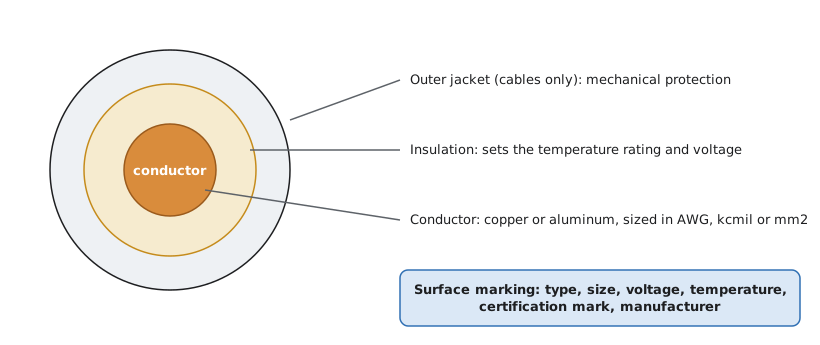
A conductor in the Code's sense is the metal path that carries current. In building wiring it is almost always copper or aluminum. Copper has lower resistance for a given size, is easier to terminate reliably, and dominates branch circuit wiring. Aluminum is lighter and cheaper for the same ampacity and is common in larger feeders and service conductors, but it needs terminations rated for it and installation practices that prevent loosening and oxidation over time. When a question gives you an aluminum conductor, check that every termination in the scenario is marked for aluminum, and use the aluminum ampacity tables rather than the copper ones.
Conductors may be solid or stranded. Small branch circuit conductors are often solid. Larger conductors are stranded so they can be bent and pulled. Flexible cords and some equipment wiring use finely stranded conductors, which need terminals suitable for fine stranding. The Code also sets a minimum conductor size for general wiring, with exceptions for things like control circuits and fixture wires. Look up the minimum size rule in Section 4 of your copy and note which items it lists as exceptions.
Sizes are given in the American Wire Gauge (AWG) for smaller conductors, in thousands of circular mils (kcmil) for larger ones, and, since the 2024 edition, square millimetres are also recognized. Remember that in AWG a larger number means a smaller conductor: a 14 AWG conductor is smaller than a 12 AWG conductor. Once sizes pass 4/0 AWG, the kcmil series takes over and larger numbers mean larger conductors again. Exam questions sometimes test this reversal directly, and it trips up people who are tired.
Insulation and what it tells you
The insulation around a conductor does two jobs. It keeps the current where it belongs, and it defines the limits within which the conductor may be used: the maximum operating temperature, the maximum voltage, and the kinds of locations and conditions the insulation can survive. Those limits are what Table 19 summarises. The insulation type is identified by letters such as RW90, RWU90, T90 Nylon or TWN75, followed by the temperature rating in degrees Celsius. Cables are identified the same way, for example NMD90, AC90, ACWU90 and TECK90.
The letters are not random. Most carry a meaning: R for cross-linked polyethylene or rubber-like insulation, W for suitability in wet locations, U for underground use, T for thermoplastic, and N for a nylon jacket. You do not need to memorize every code, but you should know how to read one quickly and, more importantly, how to check what Table 19 says about where that insulation may be used. The temperature rating at the end is what links the conductor to the ampacity tables in the next lesson.
| Marking element | What it tells you | Where it matters on the exam |
|---|---|---|
| Type letters (for example RW, T90 Nylon, NMD) | Insulation or cable family and its basic properties | Table 19 conditions of use |
| Temperature rating (60, 75, 90, 105 C and so on) | Highest conductor temperature allowed in service | Choosing the ampacity column; Rule 4-006 terminations |
| Voltage rating (300 V, 600 V, 1000 V) | Highest voltage the insulation is rated for | Mixing circuits of different voltages in one raceway or box |
| Size (AWG, kcmil, mm2) | Cross-sectional area of the conductor | Ampacity, voltage drop, fill and terminations |
| Material (copper or aluminum) | Which ampacity table applies | Tables 1 and 2 versus 3 and 4; termination ratings |
| Certification mark | That the product is certified to a Part II standard | Approval of equipment under Section 2 |
Priya's habit, borrowed from Denise, is to treat every conductor in an exam scenario as an unknown until she has read its marking. A question that says only ‘a 90 C conductor’ is telling her the temperature rating and nothing else. A question that says ‘RWU90 in a buried raceway’ is telling her the insulation family, its wet and underground suitability, and its temperature rating, and inviting her to check Table 19 to confirm the use is permitted.
Voltage ratings and mixing circuits
Insulation voltage ratings matter whenever conductors of different circuits share a raceway, cable tray, box or enclosure. The general principle in the Code is that conductors of different systems may share an enclosure only under conditions, and one of the most common conditions is that every conductor is insulated for the highest voltage present. Some systems, such as Class 2 control and communication circuits, have their own sections and stricter separation requirements. Fire alarm conductors also have special rules.
Marcus raises a practical case at the study group. At Hartley Farms, a 600 V motor feeder and the 24 V controls for the dryer will both run from the same motor control centre. Can the control wiring share a raceway with the 600 V conductors? Denise sends the group to the rules on conductors of different systems, and to the rules on Class 2 circuits, and asks them to find the answer themselves. The short version is that the answer depends on how the control circuit is classified and on the insulation ratings involved, and that separation is the default for Class 2 wiring. On the exam, the scenario will usually give you the classification. Your job is to find the rule that applies to it.
Identification: neutrals, bonding conductors and phases
Section 4 also tells you how conductors must be identified. The broad scheme is familiar to every journeyperson: an identified (neutral) conductor is white or grey, a bonding conductor is green, green with a yellow stripe, or bare, and ungrounded conductors may be black, red, blue or other colours, but not the colours reserved for neutrals and bonding conductors. The details are in the identification rules of Section 4, including Rule 4-032 for identified conductors and Rule 4-036 for colour coding.
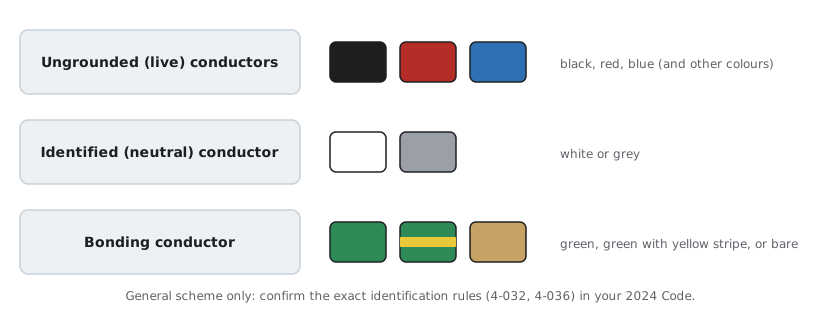
The exam likes the exceptions. Larger conductors that are not available in white or grey may be identified by other means, such as marking at terminations. A white conductor in a cable may be re-identified for use as an ungrounded conductor in certain switch loop and similar situations, provided it is permanently marked. In three-phase systems, there are rules on which phase is identified in which way and on the high-leg of a delta system. Read Rules 4-032 and 4-036, and the rules near them, and list every exception you find on your lookup sheet. Questions about identification are usually answered by one exception that the candidate forgot to read.
Tyler asks why any of this matters if the electrician knows which conductor is which. Denise's answer is that identification is for the next person: the electrician who opens the box ten years later, the inspector checking the work, and the firefighter isolating a building. A mis-identified neutral is one of the classic causes of shocks during maintenance. On the exam it is also one of the easiest topics to lose marks on, because the rules are short and the exceptions are specific.
Conductors in parallel
When a single conductor would be too large to handle, conductors may be run in parallel: two or more conductors connected together at both ends to act as one. The Code allows this only for larger sizes and under strict conditions so that the current divides evenly. In general terms, each parallel set must be the same length, the same material, the same size and the same insulation type, and terminated in the same way. Where parallel conductors run in separate raceways or cables, each raceway or cable must contain one conductor of each phase and the neutral, if there is one, so that magnetic effects balance.
Parallel conductors appear on the exam mostly in service and feeder questions. A typical question gives you a 400 A service like the one at Hartley Farms and asks what is wrong with a proposed parallel arrangement: one set longer than the other, a mix of copper and aluminum, or all the phase A conductors in one conduit and all the phase B conductors in another. Find the parallel conductor rules in Section 12 of your copy (they are with the general conductor installation rules) and check each condition against the scenario.
Worked problem
Checking a proposed parallel feeder
For the Hartley Farms service, Marcus proposes two parallel sets of aluminum conductors in two conduits. Set 1 is 28 m long; set 2 is 31 m because it follows a different route around a column. Conduit 1 carries all three phase conductors of set 1 plus a neutral; conduit 2 carries the same for set 2. Is anything wrong?
Show solution
- List the conditions for parallel conductors from the rule in your copy: same material, size, insulation, length and termination, and each raceway containing all phases (and the neutral if present).
- Material, size and insulation are the same: these conditions are met.
- Each conduit contains all three phases and a neutral: this condition is met.
- The lengths differ by 3 m: the sets must be the same length, so this condition is not met.
- The fix: cut both sets to the same length, coiling or routing the shorter run so the lengths match.
Answer: The unequal lengths fail the parallel conductor conditions; everything else in the proposal complies.
A conductor checklist for exam scenarios
Pull the lesson together into a checklist. For every conductor in a question, ask: copper or aluminum; solid or stranded; what size; what insulation type and temperature rating; what voltage rating; what location and condition (dry, damp, wet, corrosive, buried, exposed to sunlight or mechanical damage); how it is identified; whether it shares an enclosure with other systems; and whether it is part of a parallel set. Most questions only test one or two of these, but you will not know which ones until you have checked them all.
Priya writes the checklist inside the front cover of her code book in pencil. Under Alberta's exam rules, plain notes that only point to Code content are allowed in many jurisdictions, but rules vary, so check your own province's materials policy before you write anything in the book you plan to bring. If notes are not allowed, practise the checklist until you can run it from memory.
Common mistakes
MistakeReading AWG sizes as if larger numbers meant larger conductors.
InsteadIn AWG, a larger number is a smaller conductor; the kcmil series above 4/0 runs the other way.
MistakeAssuming a 90 C conductor may always be used at its 90 C ampacity.
InsteadInsulation sets an upper limit; terminations and conditions can force a lower column.
MistakeTreating Table 19 as optional reading.
InsteadTable 19 decides where each insulation and cable type may be used; check it for every location.
MistakeForgetting the exceptions to colour coding.
InsteadLarge conductors and re-identified conductors have specific rules in 4-032 and 4-036.
MistakeAccepting parallel sets of different lengths.
InsteadParallel conductors must match in length, material, size, insulation and termination.
Summary and key terms
- Section 4 governs conductors; Table 19 sets the conditions of use for wires and cables.
- The marking on a conductor tells you its type, temperature rating, voltage rating, size and material.
- Insulation voltage ratings matter when circuits share an enclosure; Class 2 circuits have separate rules.
- Identified conductors are white or grey, bonding conductors are green, green-yellow or bare, with listed exceptions.
- Parallel conductors are allowed only for larger sizes and only when every set matches.
- Conductor
- The metal path, usually copper or aluminum, that carries current.
- Insulation type
- The letter designation, such as RW90 or T90 Nylon, that identifies the insulation and its properties.
- Temperature rating
- The highest conductor temperature the insulation is rated to withstand in service.
- Identified conductor
- A conductor, normally the neutral, identified by white or grey insulation or another permitted method.
- Parallel conductors
- Two or more conductors joined at both ends to act as one, permitted only under strict conditions.
Practice problems
Work each problem on paper first, then reveal the answer to check.
Which is larger, a 10 AWG or a 6 AWG copper conductor?
Show answer
6 AWG; in the AWG series, smaller numbers are larger conductors.
What does the 90 in RW90 tell you?
Show answer
The insulation is rated for a conductor temperature of 90 C.
Where do you check whether an insulation type may be used in a wet location?
Show answer
Table 19, together with the Section 4 and Section 12 rules that refer to it.
Name three conditions for conductors in parallel.
Show answer
Any three of: same length, same material, same size, same insulation type, same termination method, and each raceway containing all phases.
Why must conductors of different systems usually share an enclosure only under conditions?
Show answer
To prevent a fault in the higher-voltage system from reaching conductors insulated or designed for a lower voltage, and to keep separated systems like Class 2 isolated.
Lesson quiz · 5 questions
Score 60% or more to complete this lesson.
Create a free account to save your progress, take quizzes and earn a certificate.