
MELC-103 · Lesson 10 of 12 · 20 min
Disconnecting means and control devices
▶ Video coming soon A video version of this lesson is on the way.
Protection opens a circuit automatically when something goes wrong. A disconnecting means opens it deliberately, so that a person can isolate equipment for maintenance, repair or emergency. Control devices, such as switches, contactors and controllers, open and close circuits in normal operation. These three functions overlap, and one device sometimes serves more than one, but the Code treats them separately, and exam questions frequently test whether a device that does one job is allowed to do another.
The general rules on disconnecting means and control devices are in Section 14. Equipment-specific rules sit in the sections for that equipment: motors in Section 28, heating equipment in Section 62, air-conditioning and refrigeration equipment in Section 26 and related rules, and so on. Find each in your 2024 copy as it comes up. All ratings and factors below are illustrative.
What a disconnecting means must do
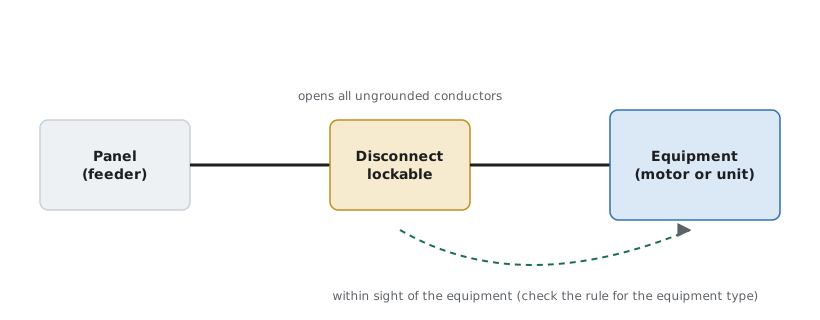
A disconnecting means must open all ungrounded conductors of the circuit at the same time, so that no part of the equipment remains energized from that circuit. It must clearly show whether it is open or closed, either by the handle position or by an indicator. It must be rated for the circuit voltage and for the current or horsepower it will interrupt. And it must be located where a person working on the equipment can reach and operate it, which usually means within sight of the equipment or capable of being locked in the open position, depending on the rule for that equipment.
The idea of within sight matters because it protects the worker. If you can see the disconnect from where you are working, you can see whether someone is about to switch it back on. If the disconnect is out of sight, the rules generally require that it be lockable in the open position so that the worker can apply a personal lock. Section 0 and the equipment sections explain what within sight means in each context; read them rather than assuming a distance.
Types of switches
Switches come in families with different ratings and permitted uses. General-use snap switches, the ordinary wall switches in buildings, are rated in amperes and volts and are suitable for lighting and general loads within their ratings, with limits on motor loads. Some are rated for alternating current only and may control motor loads up to a share of their rating. Motor-circuit switches are rated in horsepower and are designed to interrupt the high current of a stalled or starting motor. Isolating switches are designed to be operated only when the circuit is not carrying current, and must be interlocked or marked accordingly.
The exam likes questions where a switch with an ampere rating is proposed as the disconnect for a motor. The rules in Section 28 require the motor disconnect to be horsepower rated or to meet other conditions, such as being a circuit breaker or a molded case switch of adequate rating. A general-use switch may serve as the disconnect for small motors under specific conditions. Read the Section 28 disconnect rules (the 28-600 series in recent editions) and list the conditions on your lookup sheet.
| Device (general description) | Rated in | May interrupt load current? | Typical use |
|---|---|---|---|
| General-use snap switch | Amperes and volts | Yes, within its rating; limits for motors | Lighting and general receptacle loads |
| AC general-use snap switch | Amperes and volts (AC only) | Yes, including some motor loads | Lighting and small motors |
| Motor-circuit switch | Horsepower | Yes, including starting and stalled current | Motor disconnects |
| Circuit breaker | Amperes, with interrupting rating | Yes | Protection and, often, disconnecting means |
| Isolating switch | Amperes and volts | No; operate only with no current flowing | Isolation in high-voltage and some industrial systems |
| Contactor or magnetic starter | Amperes or horsepower | Yes, by remote control | Motor control; not a disconnecting means by itself |
Motor disconnects
Motors are the most common subject of disconnect questions. In general terms, every motor and its controller must have a disconnecting means that opens all ungrounded conductors, is rated adequately for the motor, and is located within sight of the motor and controller or is lockable in the open position under the conditions the rules allow. One disconnect may serve several motors in some situations, such as a group of motors driving parts of a single machine. The controller itself, such as a magnetic starter, is generally not acceptable as the disconnecting means, because it can be closed by a remote signal or a failed control circuit.
At Hartley Farms the dryer has three motors: a 15 hp fan motor, a 5 hp auger motor and a 2 hp discharge motor, all on one machine and controlled from one panel. Marcus proposes one disconnect for the group at the control panel, plus a lockable local disconnect at the fan motor because it sits on the roof of the drying bin, out of sight of the panel. The group checks the Section 28 rules for grouped motors and for disconnects out of sight, and decides the arrangement complies if the disconnects are horsepower rated for the loads they serve.
Worked problem
Rating a motor disconnect
The dryer fan motor has a nameplate full-load current of 18.5 A at 600 V. Using an illustrative rule that a motor disconnect must be rated at not less than 1.15 times the motor full-load current (and horsepower rated for the motor), what minimum current rating should the disconnect have?
Show solution
- Multiply the full-load current by the illustrative factor: 18.5 x 1.15 = 21.3 A.
- Choose a disconnect with a current rating of at least 21.3 A, such as a 30 A switch.
- Confirm the switch is horsepower rated at 600 V for at least the motor horsepower.
- Check the real factor and conditions in the Section 28 disconnect rules in your copy.
Answer: At least about 21.3 A with the illustrative factor; a 30 A horsepower-rated switch would be typical.
def disconnect_minimum(fla, factor=1.15):
    return round(fla * factor, 1)

standard = [30, 60, 100, 200, 400]

def choose(fla):
    need = disconnect_minimum(fla)
    return need, next(s for s in standard if s >= need)

for name, fla in [('dryer fan', 18.5), ('auger', 7.0), ('discharge', 2.9), ('grain leg', 52.0)]:
    need, size = choose(fla)
print(f'{name}: full-load {fla} A, minimum {need} A, choose a {size} A switch (illustrative)')dryer fan: full-load 18.5 A, minimum 21.3 A, choose a 30 A switch (illustrative) auger: full-load 7.0 A, minimum 8.0 A, choose a 30 A switch (illustrative) discharge: full-load 2.9 A, minimum 3.3 A, choose a 30 A switch (illustrative) grain leg: full-load 52.0 A, minimum 59.8 A, choose a 60 A switch (illustrative)
The grain leg motor in the last line has a full-load current of 52 A, so its minimum works out to just under 60 A and a 60 A switch is enough. A full-load current of 53 A would push the minimum past 60 A and require a 100 A switch. Exam writers build questions around exactly these boundaries.
Disconnects for other equipment
Heating equipment, air-conditioning and refrigeration units, water heaters, and many appliances also need disconnecting means, with rules in their own sections. Typical requirements include a disconnect within sight of the equipment or lockable in the open position, a disconnect that opens all ungrounded conductors, and in some cases a disconnect that is part of the equipment itself, such as a unit switch marked as such. For electric heating, Section 62 has its own rules, including the case where the branch circuit breaker serves as the disconnect if it is lockable. For air-conditioning equipment, the rules generally require a disconnect within sight of the unit, which is why outdoor condensing units have a small disconnect beside them.
At the Gaetz Avenue dental clinic, Gord's crew installs a rooftop air-conditioning unit, electric baseboard heaters in two offices and an instantaneous water heater. Each needs its own disconnect decision. The rooftop unit gets a weatherproof disconnect beside it; the baseboard heaters use lockable branch circuit breakers in the panel, as the heating rules allow; and the water heater gets a disconnect within sight, because the panel is in another room. Priya uses the clinic as a practice scenario and finds the rule for each choice.
Disconnects in harsh locations
A disconnect must suit its location as well as its load. Outdoors and in wet locations, the enclosure must be rain-tight or suitable for wet locations, and its handle mechanism must keep working after ice and snow. In dusty agricultural buildings and grain handling areas, dust can enter ordinary enclosures and coat the contacts, and some grain dust atmospheres are classified as hazardous locations under Section 18, which MELC-105 covers. In corrosive locations, such as livestock barns, stainless steel or non-metallic enclosures resist the ammonia and moisture that destroy painted steel within a few years.
Enclosure ratings help with these choices. Enclosures are marked with a type number that describes the conditions they are designed for: indoor general purpose, rain-tight, dust-tight, watertight and corrosion-resistant, among others. The Code requires the enclosure to be suitable for the location, and the type marking is how you demonstrate that. On the exam, a question that describes a washdown area, an outdoor pole or a dusty grain room and offers several enclosures is testing whether you match the enclosure type to the conditions.
At the Hartley Farms bin yard, the group chooses a rain-tight, padlockable fused disconnect on the pole for the bin fans, with a non-metallic enclosure because of the dust and the fertilizer stored nearby. In the dryer room, after checking whether the grain dust atmosphere is classified, they choose dust-tight enclosures for the motor disconnects. Tyler asks why they cannot just use the cheapest enclosure and replace it when it fails. Gord's answer is the one Denise wanted to hear: a corroded disconnect that will not open is not a disconnecting means at all, and the person who discovers that is usually the one trying to isolate a motor in an emergency.
Control devices and emergency stops
Control devices such as switches, relays, contactors and programmable controllers turn equipment on and off in normal operation. The Code's rules on control circuits deal with their protection, their wiring methods, and how they must fail. A key principle is that a ground fault or open circuit in a control circuit must not start the equipment unexpectedly or prevent it from being stopped. That is why stop buttons are usually wired normally closed in series with the control circuit, so that a broken wire stops the machine rather than leaving it running, and why the grounded side of a control circuit is arranged so that a fault to ground opens rather than closes the control.
Emergency stops are a special case. Where a machine has an emergency stop, it must be readily accessible, clearly marked, and must stop the hazardous motion. An emergency stop is not a substitute for a disconnecting means, because it acts through the control circuit and does not isolate the power conductors. Marcus, who has written lockout procedures in industry, makes this point strongly at the study group: never treat a pressed emergency stop as a safe isolation for maintenance. The disconnect, with a personal lock applied, is the isolation point.
Lockout and isolation
The workplace side of disconnecting means is lockout: the procedure by which a worker isolates equipment, locks the disconnect in the open position, tests to confirm the absence of voltage, and only then begins work. CSA Z460 sets out the principles of hazardous energy control in Canada, and provincial occupational health and safety rules make lockout mandatory. The Code supports lockout by requiring disconnects that can be locked open where they are out of sight. MELC-106 covers the business and safety duties of employers in more detail.
Denise ends the lesson with her favourite inspection memory: a disconnect for a rooftop unit mounted beside the unit, as required, but on the far side of a parapet where a worker on the roof could not see it or reach it without climbing. It met the letter of within sight from the ground and failed the purpose entirely. Her advice for the exam is to read disconnect questions with the worker in mind: where will they stand, what can they see, and can they lock the device off?
Common mistakes
MistakeUsing a magnetic starter as the motor disconnecting means.
InsteadControllers can be closed remotely; a separate disconnect is generally required.
MistakeChoosing an ampere-rated switch for a motor disconnect.
InsteadMotor disconnects must generally be horsepower rated or meet the Section 28 conditions.
MistakeTreating an emergency stop as isolation for maintenance.
InsteadE-stops act through controls; isolate and lock the disconnect.
MistakeForgetting that out-of-sight disconnects must be lockable.
InsteadIf the worker cannot see the disconnect, it must lock in the open position.
MistakeAssuming a disconnect may open only one conductor.
InsteadA disconnect must open all ungrounded conductors at the same time.
Summary and key terms
- A disconnecting means opens all ungrounded conductors together, shows its position and is rated for the load.
- Disconnects must be within sight of the equipment or lockable open, as each rule specifies.
- Motor disconnects are generally horsepower rated; controllers alone are not disconnecting means.
- Heating, air-conditioning and other equipment have their own disconnect rules in their sections.
- Control circuits must fail safe; emergency stops do not replace isolation and lockout.
- Disconnecting means
- A device that opens all ungrounded conductors of a circuit so equipment can be isolated.
- Within sight
- Visible from the equipment and within the distance the Code specifies for that context.
- Motor-circuit switch
- A switch rated in horsepower, able to interrupt motor starting and stalled current.
- Controller
- A device that starts and stops equipment in normal operation, such as a magnetic starter.
- Lockout
- Isolating equipment and locking the disconnect open before work, as required by safety rules.
Practice problems
Work each problem on paper first, then reveal the answer to check.
A motor's full-load current is 24 A. With an illustrative factor of 1.15, what is the minimum disconnect rating?
Show answer
24 x 1.15 = 27.6 A, so a 30 A horsepower-rated switch.
Can a contactor serve as the disconnecting means for a motor?
Show answer
Generally no; it can be closed remotely and does not provide isolation.
What must an out-of-sight disconnect be able to do?
Show answer
Be locked in the open position.
Why are stop buttons usually wired normally closed?
Show answer
So a broken wire stops the machine instead of leaving it running.
Which section has the rules for electric heating disconnects?
Show answer
Section 62.
Lesson quiz · 5 questions
Score 60% or more to complete this lesson.
Create a free account to save your progress, take quizzes and earn a certificate.