
MELC-103 · Lesson 3 of 12 · 23 min
General wiring method rules in Section 12
▶ Video coming soon A video version of this lesson is on the way.
Section 12 of the CE Code is the longest general section and the one candidates find hardest to navigate. It covers every common wiring method: open wiring, non-metallic sheathed cable, armoured cable, mineral-insulated cable, raceways of all kinds, cable trays, busways, boxes and cabinets. The good news is that it is organized in a predictable way. A block of general rules at the start applies to every wiring method. Then each method has its own block of rules, numbered in a series, usually in the same order: where the method may be used, where it may not, how it is installed and supported, and how it is terminated.
This lesson covers the general rules and the habit of choosing a wiring method by location. The next three lessons cover raceways, cables, and boxes in detail. As always, the descriptions here are ours, not the Code's, and the location summary is illustrative. Read each rule in your 2024 copy as it comes up.
How Section 12 is organized
The general rules at the start of Section 12 deal with matters that every wiring method shares: the scope of the section, conductors in general, protection from mechanical damage, installation in damp, wet and corrosive locations, underground installations, wiring in hollow spaces and through framing, the effect of fire separations, and the connection and splicing of conductors. After the general rules, the numbered series for each method follow. Learn where the series start in your copy: for example, the 12-500 series for non-metallic sheathed cable, the 12-600 series for armoured cable, the 12-1000 series for rigid metal conduit, the 12-1100 series for rigid PVC conduit, the 12-1400 series for electrical metallic tubing, and the 12-3000 series for boxes and cabinets.
Priya tabs the start of each series with a small green tab and writes the method name on it. Her test is simple: Denise calls out a wiring method and a question type, such as ‘armoured cable, support spacing’, and Priya has to open the right series and find the support rule within thirty seconds. By week seven she can do it for every method on the list.
| Block of rules | What it covers (in general terms) |
|---|---|
| General rules at the start of Section 12 | Applies to all methods: protection, locations, underground, hollow spaces, splicing |
| 12-500 series | Non-metallic sheathed cable (NMD90) |
| 12-600 series | Armoured cable (AC90, ACWU90, TECK90 and similar) |
| 12-900 series | Raceways in general: fill, bends, pull points, conductors in raceways |
| 12-1000 to 12-1500 series | Individual raceway types: rigid metal, rigid PVC, flexible conduit, EMT and others |
| 12-2200 series | Cable trays |
| 12-3000 series | Boxes, cabinets, outlets and fittings |
Protection from mechanical damage
A recurring requirement in Section 12 is that conductors and cables be protected where they are exposed to mechanical damage. Each wiring method has its own rules, but the general principle is the same: if the cable could be struck, crushed, cut or abraded, it must either be of a type that can withstand that exposure or be protected by a raceway, a guard or its location. Exam scenarios often describe a cable run along the floor of a shop, down a column in a warehouse, or through an area where vehicles move. The question is usually whether the chosen method is acceptable there.
At Hartley Farms, the grain-drying shop has a skid steer that runs through the building several times a day. Any wiring on the walls below head height near the door is exposed to damage. Gord's preference is to run rigid PVC conduit up the walls in that zone, or to use TECK90 with additional guarding. The group checks the rules for each method and the general rules on protection and agrees that NMD90 is not acceptable in that location in any case.
Damp, wet and corrosive locations
Section 0 defines dry, damp and wet locations, and the definitions matter. A damp location is one subject to moderate moisture, such as some basements and partially protected outdoor areas. A wet location is one where liquids may drip, splash or flow on the equipment, or where the installation is outdoors and exposed to weather, or underground. Corrosive locations are those where the atmosphere or substances present may damage wiring, such as some agricultural buildings with manure gases, chemical storage areas and car washes.
Every wiring method has limits on these locations. Table 19 tells you which insulation and cable types are suitable for which conditions, and each method's rules repeat or add to those limits. For example, conductors in a raceway in a wet location must be of a type suited to wet locations, because water collects inside raceways even when the raceway itself is weatherproof. Cables with a non-metallic outer jacket over their armour are generally needed where a bare metal armour would corrode or where the cable is buried.
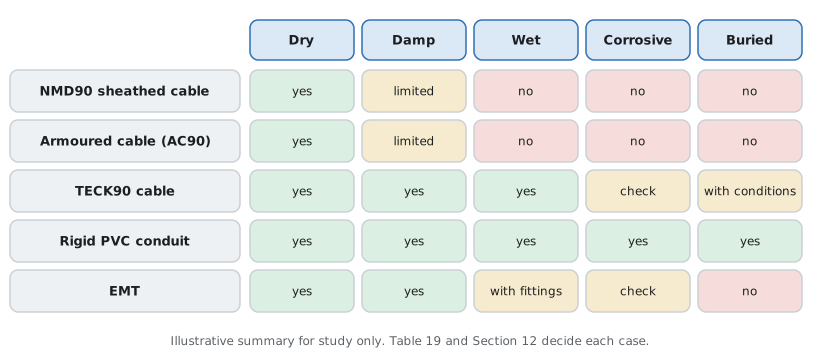
Use the figure as a memory aid, not as an answer key. The real answer always comes from Table 19 and the rules for the method. Questions about agricultural buildings are a favourite because they combine dampness, dust and corrosion, and because Section 12 and the farm building rules elsewhere in the Code add specific requirements. Hartley Farms' livestock barn, which Parkland Valley wired last year, is the example Denise uses to show how many rules can apply at once.
Underground installations
Wiring run underground must be of a type suitable for direct burial or be in a raceway suitable for burial, and it must be buried at least the minimum depth set out in the Code. Section 12 contains the general underground rules, and Table 53 sets minimum cover depths for different situations, such as under driveways, under lawns, and with or without protection. Other underground requirements include protection where the conductors emerge from the ground, allowances for frost movement, marking tape or warning means in some cases, and sealing of raceways that enter buildings to prevent moisture and gas entry.
The Hartley Farms bin yard feeder runs underground for most of its length, partly under a gravel lane that grain trucks use. The group finds the underground rules in Section 12, reads Table 53, and identifies three decisions: the burial method (direct burial cable or cable in conduit), the depth for each part of the route (the lane section needs more cover or protection than the field section), and the protection where the cable rises up the bin yard pole. On the exam, read the scenario for words like driveway, vehicles, under a building and riser, because each changes the depth or protection required.
Worked problem
Planning the underground feeder
The bin yard feeder is 95 m long: 20 m under the gravel lane, 70 m under open field and 5 m rising up a pole to a disconnect. What decisions does Section 12 require for each part?
Show solution
- Choose the method: an ACWU90 or TECK90 cable rated for direct burial, or conductors rated for wet locations in buried rigid PVC conduit.
- For the lane section, look up the cover depth in Table 53 for areas subject to vehicle traffic, which is greater than for open ground, or provide the protection the table allows.
- For the field section, use the depth for areas not subject to vehicles.
- For the riser, protect the cable where it leaves the ground and up the pole to a height where it is no longer exposed to damage.
- Allow for frost movement at the riser and seal the conduit if it enters a building.
Answer: Three depth or protection decisions, made from Table 53 and the underground rules, plus riser protection and sealing.
Hollow spaces, framing and fire separations
Cables run through walls and ceilings must be protected where they pass through framing members, so that nails and screws driven into the wall finish do not reach them. The rules for each cable type set minimum distances from the edge of studs and joists or require protective plates where those distances cannot be kept. Cables run in hollow spaces such as plenums and return air paths have additional restrictions, because a fire in the cable insulation there would spread smoke through the building. Read the rules on hollow spaces and on air-handling spaces before you allow any cable in a ceiling space used for air return.
Wiring that passes through a fire separation must not reduce the separation's fire resistance. The Code's rule on fire spread, together with the building code, requires that openings around cables and raceways be sealed with a fire stop system that restores the rating. On the exam, questions on fire stopping usually test whether you know that the electrical installer is responsible for keeping the separation intact, and which rule in Section 2 states the general requirement.
All conductors of a circuit together
Another general rule appears again and again in Section 12: where a circuit is run in a metal raceway or metal-armoured cable, all the conductors of that circuit, including the neutral and the bonding conductor where present, must be run in the same raceway or cable. If the phase conductor runs in one conduit and the neutral in another, the magnetic fields do not cancel, the metal raceway heats by induction, and the circuit can behave unpredictably. The same principle drives the rule for parallel conductors from Lesson 1, where each raceway must contain one conductor of every phase.
Marcus remembers an industrial job where a single conductor was pulled through a steel box knockout and the box became hot enough to discolour the paint. Denise uses the story to show that this rule is about physics, not paperwork. On the exam, any scenario that separates the conductors of one circuit into different metal enclosures is likely to be wrong.
Sunlight, temperature and expansion
Outdoor and rooftop wiring faces conditions that indoor wiring never sees. Ultraviolet light degrades many plastics, so cable jackets and non-metallic raceways exposed to direct sunlight must be of a type marked or listed as sunlight resistant. Rooftop runs also see high temperatures: a raceway lying on a dark roof in summer can be far hotter than the outdoor air, and the ampacity of the conductors inside must be corrected for that higher ambient. The 2024 edition adds attention to these conditions, and exam writers like rooftop photovoltaic and HVAC scenarios because they combine sunlight, heat and wet locations in one question.
Temperature change also makes raceways grow and shrink. Rigid PVC conduit in particular expands and contracts much more than metal conduit for the same change in temperature, so long straight runs exposed to temperature swings need expansion fittings. The rules for rigid PVC conduit address this, and the conduit manufacturer's data gives the expansion rate. A typical exam question gives a run length, a temperature range and an expansion rate, and asks how much movement the fitting must allow.
Worked problem
Expansion of a rigid PVC run
A 30 m rigid PVC conduit runs along the outside wall of the Hartley Farms shop. The temperature range over a year is 80 C (from winter lows to summer surface highs). Using an illustrative expansion rate of 0.052 mm per metre per degree C, how much will the run change in length?
Show solution
- Multiply length by temperature range by rate: 30 x 80 x 0.052.
- 30 x 80 = 2400 metre-degrees.
- 2400 x 0.052 = 124.8 mm.
- Choose expansion fittings that allow at least this movement, installed as the manufacturer directs.
Answer: About 125 mm of movement, which expansion fittings must accommodate.
Splices, connections and support
Section 12 also contains general rules on joints and splices: they must be made with approved connectors suitable for the conductors and conditions, they must be accessible unless the method used is approved for concealment, and they must be enclosed in boxes or fittings. Each wiring method then has rules on support spacing and securing near boxes. Questions on support usually give you a distance and ask whether it complies, or give you a method and ask for the maximum spacing. These are straightforward lookups once you have the series tabbed.
A method that Priya finds useful for any wiring method question is to read the method's series in this order: permitted uses, prohibited uses, installation and support, protection, terminations. If the scenario fails at the first step, you do not need to read the rest. If it passes the first two steps, the question is usually about the installation details.
Common mistakes
MistakeStarting in the middle of a wiring method series.
InsteadRead permitted and prohibited uses first; most wrong installations fail there.
MistakeAssuming a weatherproof raceway keeps its conductors dry.
InsteadConductors in raceways in wet locations must be rated for wet locations.
MistakeUsing one burial depth for the whole route.
InsteadTable 53 depths differ for vehicle areas, lawns and protected installations.
MistakeIgnoring fire separations when routing cables.
InsteadOpenings must be sealed to restore the separation's rating.
MistakeRunning the conductors of one circuit in different metal raceways.
InsteadAll conductors of a circuit belong in the same metal raceway or cable.
Summary and key terms
- Section 12 starts with general rules for all methods, then has a numbered series for each wiring method.
- Choose a wiring method by location: dry, damp, wet, corrosive, buried, exposed to damage.
- Underground wiring needs a suitable type, the depth from Table 53 and protection at risers.
- Cables through framing need protection from fasteners; fire separations must be resealed.
- All conductors of a circuit run together in the same metal raceway or cable.
- Wiring method
- A recognized way of installing conductors, such as a cable type or a raceway system.
- Damp location
- A location subject to moderate moisture, as defined in Section 0.
- Wet location
- A location where liquids may drip, splash or flow, or that is outdoors and exposed, or underground.
- Cover depth
- The minimum depth of earth or other cover over a buried conductor or raceway.
- Fire stop
- A system that seals an opening in a fire separation to restore its fire resistance.
Practice problems
Work each problem on paper first, then reveal the answer to check.
Where in Section 12 would you look for the rules on armoured cable?
Show answer
The 12-600 series.
Why must conductors in a weatherproof raceway outdoors be rated for wet locations?
Show answer
Moisture condenses and collects inside raceways, so the conductors are effectively in a wet location.
Which table sets minimum burial depths?
Show answer
Table 53.
What happens if a phase conductor and its neutral run in different steel conduits?
Show answer
The magnetic fields do not cancel, and the conduits heat by induction.
In what order should you read a wiring method's series?
Show answer
Permitted uses, prohibited uses, installation and support, protection, terminations.
Lesson quiz · 5 questions
Score 60% or more to complete this lesson.
Create a free account to save your progress, take quizzes and earn a certificate.