
MELC-103 · Lesson 4 of 12 · 22 min
Raceways: conduit, tubing and fill limits
▶ Video coming soon A video version of this lesson is on the way.
A raceway is an enclosed channel designed to hold conductors: conduit, tubing, flexible conduit, wireways, surface raceways and similar systems. Raceways protect conductors from damage, allow them to be replaced or added to later, and in metal form can serve as part of the bonding path. On the exam, raceway questions fall into a small number of types: which raceway may be used in a location, how many conductors fit, how many bends are allowed between pull points, how the raceway is supported and terminated, and how it is bonded. This lesson works through each type.
The general raceway rules are in the 12-900 series of Section 12, and each raceway type has its own series after that. The tables you need are the conductor dimension tables, the raceway dimension tables, and Table 8 on maximum conduit fill. All dimensions and areas in this lesson are invented for practice; use your own copy and the manufacturer's data for real work.
The raceway family
Rigid metal conduit is the toughest raceway, threaded at the joints, and suitable for most locations including many hazardous ones. Electrical metallic tubing (EMT) is a thin-wall steel or aluminum tubing joined with set-screw or compression fittings; it is the workhorse of commercial interiors. Rigid PVC conduit is non-metallic, light, immune to most corrosion and suitable for burial and wet locations, but it needs a separate bonding conductor and expansion fittings. Reinforced thermosetting resin conduit (RTRC) is a fibreglass relative used in some industrial and underground work. Electrical non-metallic tubing (ENT) is a flexible corrugated plastic tubing for concealed work in buildings. Flexible metal conduit and liquid-tight flexible conduit are used for short connections to vibrating or movable equipment such as motors.
Each type has permitted and prohibited uses. EMT, for example, is restricted where it would be subject to severe mechanical damage or certain corrosive conditions. ENT has limits on where it may be exposed and in which buildings it may be used. Liquid-tight flexible conduit has length limits in some uses and may or may not be acceptable as a bonding path depending on its size, length and fittings. The first step in any raceway question is to open the series for the raceway type and read the permitted and prohibited uses.
| Raceway (general description) | Typical uses | Points the exam likes |
|---|---|---|
| Rigid metal conduit | Industrial, exposed to damage, many hazardous locations | Threaded joints, support spacing, bonding |
| EMT | Commercial interiors, exposed or concealed | Not where severe damage or some corrosion; fittings for wet locations |
| Rigid PVC conduit | Underground, wet, corrosive, agricultural | Separate bonding conductor; expansion fittings; sunlight resistance |
| ENT | Concealed in walls and slabs | Limits on exposed use and building types |
| Liquid-tight flexible conduit | Short connections to motors and equipment | Length limits; bonding conductor needed in many cases |
| Flexible metal conduit | Short flexible connections in dry locations | Not in wet locations; bonding conditions |
Conduit fill
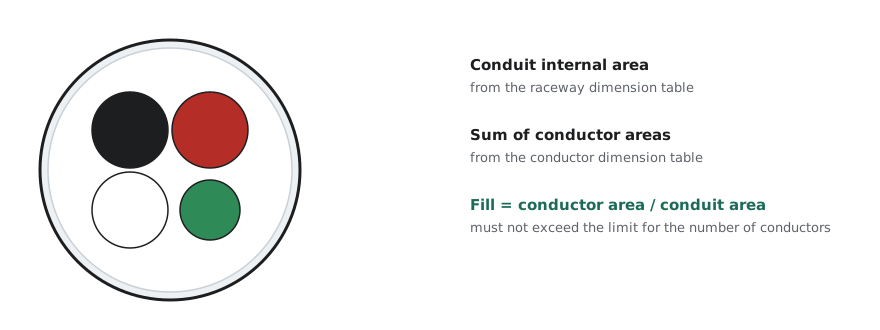
Conduit fill is the share of a raceway's internal cross-sectional area taken up by the conductors inside it. Too much fill makes conductors hard to pull, damages insulation during pulling, and traps heat. Table 8 sets the maximum fill, and the limit depends on the number of conductors: one conductor alone may occupy a larger share than two, and three or more conductors have their own limit. The conductor areas come from the conductor dimension tables for the insulation type, and the raceway areas come from the raceway dimension tables for the raceway type and trade size.
The method is always the same. Find the area of each conductor, including the bonding conductor if it is insulated. Add them up. Find the internal area of the raceway. Divide the total conductor area by the raceway area to get the fill share, and compare it with the limit from Table 8 for that number of conductors. Alternatively, multiply the raceway area by the allowed share to get the maximum total conductor area, and see whether your conductors fit under it.
| Item (illustrative) | Area each (mm2) |
|---|---|
| Conductor size B, T90 Nylon | 11.0 |
| Conductor size D, T90 Nylon | 24.0 |
| Conductor size F, T90 Nylon | 44.0 |
| Raceway trade size 21 (internal) | 340 |
| Raceway trade size 27 (internal) | 560 |
| Raceway trade size 35 (internal) | 960 |
Worked problem
Checking fill for the dryer feeder conduit
The dryer feeder at Hartley Farms needs three size D conductors and one size B insulated bonding conductor in one conduit. Using the invented areas and an illustrative fill limit of 0.40 for three or more conductors, will trade size 21 work? Will trade size 27?
Show solution
- Add the conductor areas: 3 x 24.0 + 11.0 = 83.0 mm2.
- Trade size 21: 83.0 / 340 = 0.244, which is under 0.40, so it complies with the illustrative limit.
- Trade size 27: 83.0 / 560 = 0.148, which also complies.
- Choose trade size 21 unless future conductors are planned, in which case the larger size leaves room.
- In the real Code, use Table 8 for the limit and the dimension tables for the areas.
Answer: Trade size 21 works at a fill of about 0.24 with the invented values.
Priya adds a fill function to her study calculator. It takes a list of conductor areas and a raceway area and reports the fill and whether it is under a limit she supplies. The point of the script is not to replace the tables but to check her arithmetic quickly while she practises with many invented combinations.
areas = {'B': 11.0, 'D': 24.0, 'F': 44.0}       # invented conductor areas, mm2
raceways = {'21': 340, '27': 560, '35': 960}     # invented internal areas, mm2

def fill(conductors, trade_size):
    total = sum(areas[c] for c in conductors)
    return round(total / raceways[trade_size], 3)

def smallest_raceway(conductors, limit):
    for size in raceways:
        if fill(conductors, size) <= limit:
            return size, fill(conductors, size)
    return None

dryer = ['D', 'D', 'D', 'B']
print('Dryer feeder fill in 21:', fill(dryer, '21'))
print('Smallest raceway at a 0.40 limit:', smallest_raceway(dryer, 0.40))
print('Six size F conductors:', smallest_raceway(['F'] * 6, 0.40))Dryer feeder fill in 21: 0.244
Smallest raceway at a 0.40 limit: ('21', 0.244)
Six size F conductors: ('35', 0.275)Look at the last line: six size F conductors total 264 mm2, which needs a raceway of at least 660 mm2 at a 0.40 limit, so the script skips size 27 and chooses size 35. Exam questions often give you a number of conductors that just fails at one trade size, to check that you actually do the division rather than estimate.
Mixed sizes, jam ratio and nipples
Real raceways often hold conductors of different sizes, and the method handles that naturally because you add the individual areas. Two refinements appear in some exam questions. First, short raceway sections, often called nipples, that connect two enclosures may be permitted a higher fill because there is little pulling and little heat build-up over a short length; read the rule and the Table 8 notes for the conditions. Second, when exactly three conductors of nearly the same size are pulled into a raceway whose internal diameter is just slightly larger than the combined conductors, the conductors can jam in a line across the raceway. Some references call this the jam ratio. It is a pulling issue rather than a Code limit in most cases, but you may see it in a practical question.
Bends and pull points
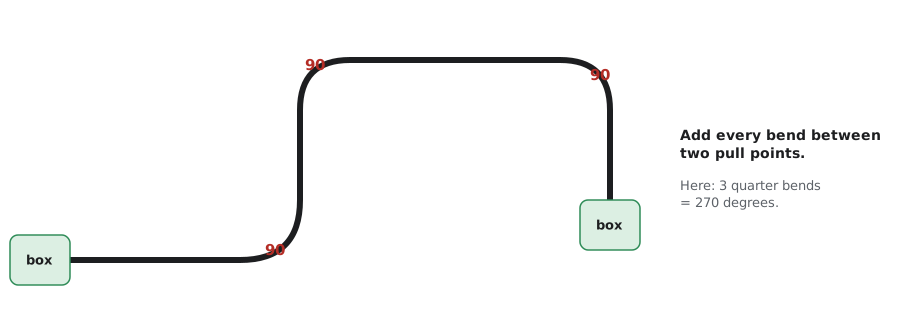
Every bend in a conduit run increases the force needed to pull conductors through. The Code limits the total amount of bending between pull points, such as boxes, conduit bodies and fittings that allow access. In general terms, the limit is equivalent to four quarter bends, or 360 degrees in total, between pull points; check the bend rule for each raceway type in your copy, because the wording and any exceptions differ. Offsets and saddles count too: an offset is usually two bends, and a saddle is usually three or four, depending on how it is made.
Worked problem
Counting bends on the shop wall
A conduit run on the Hartley Farms shop wall leaves a panel with a 90 degree bend, has an offset made of two 30 degree bends to clear a beam, a saddle made of one 45 degree and two 22.5 degree bends around a pipe, and ends with a 90 degree bend into a box. Is the total within an illustrative limit of 360 degrees?
Show solution
- First bend: 90 degrees.
- Offset: 30 + 30 = 60 degrees.
- Saddle: 45 + 22.5 + 22.5 = 90 degrees.
- Last bend: 90 degrees.
- Total: 90 + 60 + 90 + 90 = 330 degrees, under 360, so the run complies; one more offset would not.
Answer: 330 degrees, within the illustrative limit.
Pull boxes are sized by rules in the 12-3000 series that depend on whether the pull is straight or angled and on the trade size of the largest raceway entering. A common exam question gives you the raceways entering a pull box and asks for the minimum length or depth. Look up the rule and apply its multipliers to the largest raceway, then add the other raceways on the same wall as the rule directs.
Wireways, surface raceways and cable trays
Not every raceway is round. Wireways are sheet metal or non-metallic troughs with removable covers, used to run many conductors along a wall in an electrical room or above a row of motor starters. Their rules limit the total cross-sectional area of the conductors to a share of the wireway's interior area, limit the number of current-carrying conductors before ampacity corrections apply, and set rules for splices and taps inside the wireway. Surface raceways are smaller channels fixed to a wall for adding outlets in finished spaces; they come in metal and non-metallic versions and have their own permitted uses, fill limits and restrictions in damp or damage-prone areas.
Cable trays are not raceways in the strict sense, because they are open, but they are a common support system for cables in industrial and commercial buildings. The 12-2200 series sets out which cables may be installed in trays, how they are arranged, how ampacity is determined for cables in trays, and how the tray is bonded. A frequent exam theme is that only cable types identified for tray use may be placed in a tray, and that single conductors in trays are allowed only in larger sizes and under conditions.
Marcus knows trays well from the oil sands, where kilometres of TECK90 ran in ladder tray. At Hartley Farms the group considers a short run of ladder tray in the electrical room to carry the motor feeders to the motor control centre, then chooses a wireway instead because the run is short and the drop-outs to each starter are close together. The decision illustrates a pattern worth remembering for the exam: wireways suit short runs with many taps; trays suit long runs of cables; conduit suits protection and separation.
Support, termination and bonding of raceways
Each raceway series sets maximum distances between supports and requires a support within a set distance of each box or fitting. Metal raceways are generally acceptable as a bonding means if all joints and fittings are made up tight with fittings suitable for the purpose. Non-metallic raceways never serve as a bonding path, so a separate bonding conductor must be run inside them. Flexible metal and liquid-tight conduits are acceptable as bonding paths only under limited conditions. Questions in this area often combine with Section 10 grounding and bonding, covered in MELC-104.
At Hartley Farms the group chooses rigid PVC for the damp, dusty dryer area and for the underground bin yard feeder, EMT for the dry office and electrical room, and liquid-tight flexible conduit for the last metre to each motor. Each choice brings its own checks: a bonding conductor in every PVC run and every liquid-tight connection, expansion fittings on the long PVC runs on the exterior wall, and wet-location fittings for any EMT that passes through the washdown area.
Common mistakes
MistakeLeaving out the bonding conductor when calculating fill.
InsteadInclude every insulated conductor in the raceway, including an insulated bonding conductor.
MistakeUsing one fill limit for every number of conductors.
InsteadTable 8 sets different limits for one, two, and three or more conductors.
MistakeCounting an offset as one bend.
InsteadAn offset is two bends and a saddle is three or four; add the degrees.
MistakeAssuming rigid PVC can serve as a bonding path.
InsteadNon-metallic raceways need a separate bonding conductor.
MistakeIgnoring the permitted and prohibited uses of the raceway type.
InsteadOpen the series for the raceway and read its uses first.
Summary and key terms
- Raceways protect conductors and allow future changes; each type has its own series in Section 12.
- Fill is total conductor area divided by raceway area, compared with the Table 8 limit for that number of conductors.
- Bends between pull points are limited, in general to the equivalent of four quarter bends; offsets and saddles count.
- Metal raceways may serve as bonding paths with suitable fittings; non-metallic raceways never do.
- Pull boxes are sized from the largest raceway entering, using the rules in the 12-3000 series.
- Raceway
- An enclosed channel designed to hold conductors, such as conduit or tubing.
- Conduit fill
- The share of a raceway's internal area occupied by conductors.
- Pull point
- A box, fitting or conduit body that gives access for pulling conductors.
- Offset
- Two bends that shift a conduit run sideways to clear an obstruction.
- Nipple
- A short raceway connecting two enclosures, which may be permitted a higher fill.
Practice problems
Work each problem on paper first, then reveal the answer to check.
Three conductors of 24 mm2 and one of 11 mm2 go into a raceway of 340 mm2. What is the fill?
Show answer
83 / 340 = 0.244.
What is the largest total conductor area allowed in a 560 mm2 raceway at a 0.40 limit?
Show answer
560 x 0.40 = 224 mm2.
A run has two 90 degree bends and an offset of two 45 degree bends. What is the total?
Show answer
90 + 90 + 45 + 45 = 270 degrees.
Why do rigid PVC runs on an exterior wall need expansion fittings?
Show answer
PVC expands and contracts much more than metal with temperature changes.
Can liquid-tight flexible conduit always be used as the bonding path to a motor?
Show answer
No; only under limited conditions of size, length and fittings, so a bonding conductor is often required.
Lesson quiz · 5 questions
Score 60% or more to complete this lesson.
Create a free account to save your progress, take quizzes and earn a certificate.