
MELC-101 · Lesson 9 of 12 · 20 min
Variations, deviations and provincial amendments
▶ Video coming soon A video version of this lesson is on the way.
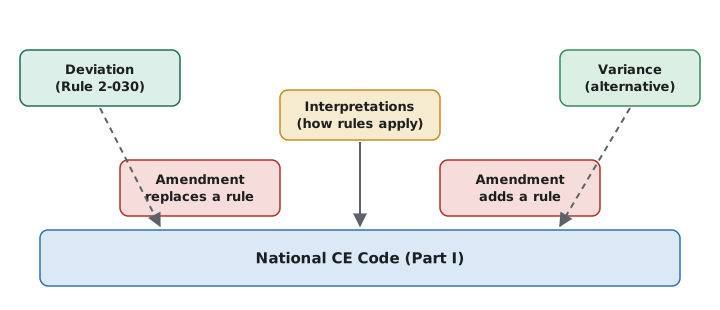
The CE Code is national, but the law that applies on a job site is provincial or territorial. Between the national text and the installation sit several kinds of local change: amendments made when a province adopts the Code, interpretations that explain how a rule is enforced, variances that allow an alternative for a particular situation, and deviations that an inspection authority may grant under the Code itself. For a provincial exam, these are not side issues. They are often where the marks are.
Gord has a story he tells every new apprentice. Years ago a contractor from another province bid a job in Alberta, wired it exactly to the national Code, and failed inspection on three items, each covered by an Alberta interpretation he had never read. The rework cost more than his profit on the job. The lesson he draws is the theme of this one: know your province's changes as well as you know the Code.
Four kinds of local change
It helps to separate the kinds of change, because each has a different legal effect and is found in a different place.
| Kind of change | What it is | Legal effect | Where to find it |
|---|---|---|---|
| Amendment | A change to the Code's text made when a province adopts it | Replaces the national rule in that province | The adopting regulation or a published list of amendments |
| Interpretation | An official explanation of how a rule is applied | Guides enforcement; its force depends on provincial law | Bulletins, STANDATA, directives, information notices |
| Variance | A provincial authorization of an alternative to a requirement | Allows the alternative, usually with conditions | Issued by the provincial authority; sometimes published |
| Deviation or postponement | Permission from the inspection authority under Rule 2-030 for a particular installation | Allows a departure for that installation, with conditions | Written permission from the inspection authority |
Amendments
When a province adopts the Code, it can adopt it as published or with amendments. An amendment may delete a rule, add a rule, or change the wording of a rule. Once adopted, the amended rule is the law in that province, and the national wording no longer applies there. Amendments are usually published in the adopting regulation or in a separate document listing the changes, often with the rule numbers they affect. Ontario, for example, publishes the Ontario amendments that turn the CE Code into the Ontario Electrical Safety Code. British Columbia adopts the Code with its own changes as the BC Electrical Code. Quebec incorporates the Code with its own modifications into Chapter V, Electricity, of its construction code.
Amendments are a favourite source of exam questions because they test whether you studied for the right jurisdiction. A provincial exam question about a rule that the province has amended expects the amended answer. If you answer from the national text, you will be wrong, and the national answer will be among the choices. The defence is simple: before the exam, mark every amended rule in your book so that you cannot read it without seeing the flag.
Interpretations
Provinces and their inspection agencies publish interpretations to explain how particular rules are applied. In Alberta, the electrical discipline publishes STANDATA documents, which include interpretations, variances and information bulletins. In Ontario, the Electrical Safety Authority publishes bulletins on the Ontario Electrical Safety Code. Technical Safety BC publishes directives and information bulletins. Other jurisdictions have their own equivalents.
An interpretation does not usually change the wording of a rule, but it tells you how the rule will be enforced, which in practice is what matters on site and often on the exam. Some exams allow candidates to bring certain interpretive documents; others expect you to know their content. Check your candidate information, and if interpretations are allowed, tab them the same way you tab the Code.
| Jurisdiction (examples) | Adopting form | Interpretive documents |
|---|---|---|
| Alberta | CE Code adopted under the Safety Codes Act; 26th edition in force April 1, 2025 | Electrical STANDATA (interpretations, variances, bulletins) |
| Ontario | Ontario Electrical Safety Code: CE Code with Ontario amendments | Electrical Safety Authority bulletins |
| British Columbia | BC Electrical Code: CE Code with BC changes | Technical Safety BC directives and information bulletins |
| Quebec | Chapter V, Electricity, of the construction code | Documents from the provincial building authority |
| Other provinces and territories | Own adopting legislation | Own bulletins and notices |
Variances
A variance is a provincial authorization that allows something other than what a rule requires, usually because the alternative provides an equivalent level of safety or because the rule cannot reasonably be applied. Some variances are issued for a particular installation; others apply more broadly and are published for everyone to use. In Alberta, variances are part of the Safety Codes Act system and some are published as STANDATA. A broadly applicable variance can effectively work like an amendment, so if your province publishes them, they belong in your exam preparation.
Variances almost always come with conditions. A variance that permits an alternative wiring method for a particular kind of building might require specific protection, labelling or documentation. On the exam, a question about a variance may hinge on whether the conditions are met, in the same way that a question about a permission in a rule does. Read a variance with the method from Lesson 8.
Deviations and postponements under Rule 2-030
The Code itself gives the inspection authority a way to deal with situations the rules do not handle well. Rule 2-030 deals with deviation or postponement. In general terms, it allows the inspection authority to permit a deviation from a requirement, or to postpone compliance, in special circumstances, provided that safety is maintained, and it typically requires the permission to be in writing. Read the exact conditions in your own copy and in any provincial amendment, because some provinces modify how deviations are granted.
Two points about deviations are commonly tested. First, the permission comes from the inspection authority, not from the contractor, the designer or the owner. A contractor cannot decide that an alternative is equally safe and proceed. Second, a deviation applies to the particular installation it was granted for. It is not a precedent that permits the same thing on the next job.
Worked problem
A deviation on the Hartley Farms job
The existing grain-drying shop has an old service where meeting a particular location requirement for new equipment would mean relocating the whole service. The owner asks Priya whether she can just install the new equipment in the most practical spot. What should she do?
Show solution
- Identify the rule that cannot reasonably be met and why.
- Recognize that she cannot grant herself an exception; only the inspection authority can permit a deviation, as Rule 2-030 describes.
- Prepare a written proposal explaining the situation and the measures that will keep the installation safe.
- Submit it to the safety codes officer before doing the work.
- Proceed only in line with the written permission and its conditions, and keep a copy with the permit records.
Answer: Request a deviation from the inspection authority in writing, and wait for written permission before proceeding.
Marking local changes in your book
The safest way to handle local changes in the exam is to make them impossible to miss. Before the exam, go through your province's amendment list rule by rule and flag each amended rule in your book. Many candidates use a coloured mark or tab in the margin next to every amended rule, and a small note of where the amendment is found. If interpretations or variances apply to a rule, flag those too. Always check what marking your exam allows; Lesson 11 deals with this in detail.
| Marking method | Advantage | Check before using |
|---|---|---|
| Coloured margin mark next to amended rules | Seen every time you read the rule | Whether marks are allowed in exam books |
| Short reference to the amendment number | Quick to cross-check | Whether notes are limited to clarifying Code content |
| Tabs on the amendment document | Fast access to the amended text | Whether the document is permitted in the exam |
| A separate amendment index | One page listing every amended rule | Usually study use only, not exam use |
Priya spends one evening flagging Alberta's changes in her book. It takes three hours. During her mock exams, two questions touch on rules with Alberta-specific treatment, and both times the flag stops her from answering from the national text. Three hours for two marks per exam is an excellent trade.
Working across provinces
Contractors near provincial borders, or who travel for work, face a practical version of this lesson every day. A rule that is enforced one way in Alberta may be amended or interpreted differently in Saskatchewan or British Columbia. Even the edition in force may differ for a period after a new edition is published. Before starting work in another jurisdiction, check its adopting regulation, its amendments, its interpretations and its permit system. The provincial courses in this program, such as the Alberta course, cover these details for each jurisdiction.
The same discipline applies to exams. If you hold a certificate in one province and write an exam in another, study the second province's changes as carefully as if you were new to the Code. The national text you know well is only the starting point.
Keeping up to date
Local changes are not fixed for the life of an edition. Provinces issue new interpretations, withdraw old ones, publish new variances and occasionally amend their adopting regulations between editions. For field work, check for new documents before starting a job of an unfamiliar type. For an exam, check the date of the documents you are relying on, and make sure they are the current versions on the date you write.
A simple habit helps. Keep a list of the interpretive documents you rely on, with their numbers and dates, and check the provincial website once a month while you are studying. In Alberta, that means the electrical STANDATA list; in Ontario, the ESA bulletin list; in British Columbia, the Technical Safety BC directives and bulletins. When something new appears, read it, decide whether it affects any rule you have flagged, and update your book if the exam rules allow.
Priya sets a reminder on her phone for the first Monday of each month. In her fourteen weeks of study, one new Alberta document appears that touches a rule she uses on agricultural jobs. It does not change the requirement, but it clarifies how it is applied to a type of farm building, which is exactly the kind of detail that could appear in an exam question set after the document was published.
Questions to ask about any local document
Whatever the jurisdiction, the same questions sort out what a local document does. Is it an amendment to the Code's text, or an explanation of how the text is applied? Does it apply everywhere in the province, or only to a particular installation? Does it carry conditions? Is it current? Who issued it, and under what authority? Answering these five questions takes a minute, and it tells you how much weight to give the document on site and on the exam.
Marcus finds this checklist especially useful because his industrial background involved several provinces. He had picked up habits from Saskatchewan and British Columbia jobs that he now realizes reflect those provinces' interpretations, not the national Code or Alberta's practice. Running the checklist on each habit sorts out which ones still apply in Alberta and which ones he needs to drop before the exam.
Common mistakes
MistakeAnswering a provincial exam question from the national text.
InsteadCheck for an amendment or interpretation in your province first.
MistakeAssuming a contractor can approve an equivalent alternative.
InsteadOnly the inspection authority can permit a deviation, normally in writing.
MistakeTreating a deviation granted on one job as a precedent.
InsteadA deviation applies to the installation it was granted for.
MistakeIgnoring the conditions attached to a variance.
InsteadRead variances as carefully as rules; the conditions decide whether they apply.
MistakeMarking your book without checking exam rules.
InsteadConfirm what notes and tabs your exam allows.
Summary and key terms
- Amendments change the Code's text in a province and replace the national rule there.
- Interpretations explain how rules are enforced; Alberta uses STANDATA, Ontario uses ESA bulletins, BC uses Technical Safety BC directives.
- Variances authorize alternatives, usually with conditions.
- Rule 2-030 lets the inspection authority permit a deviation or postponement for a particular installation, normally in writing.
- Flag every local change in your book so you cannot miss it under pressure.
- Amendment
- A provincial change to the Code's text made on adoption.
- Interpretation
- An official explanation of how a rule is applied in a jurisdiction.
- Variance
- A provincial authorization of an alternative to a requirement.
- Deviation
- A departure from a rule permitted by the inspection authority for a particular installation.
- STANDATA
- Alberta's published interpretations, variances and bulletins for safety codes disciplines.
Practice problems
Work each problem on paper first, then reveal the answer to check.
Which kind of local change replaces the national wording of a rule?
Show answer
An amendment.
Who can grant a deviation under Rule 2-030?
Show answer
The inspection authority.
Name the interpretive documents used in Alberta and Ontario.
Show answer
Alberta electrical STANDATA; Electrical Safety Authority bulletins in Ontario.
A deviation was granted for one farm shop. Can you rely on it for a similar shop next month?
Show answer
No; it applies only to the installation it was granted for.
Why flag amended rules in your book before the exam?
Show answer
So you cannot read the rule without seeing that the provincial version applies.
Lesson quiz · 5 questions
Score 60% or more to complete this lesson.
Create a free account to save your progress, take quizzes and earn a certificate.