
MELC-101 · Lesson 5 of 12 · 20 min
Using the tables and the diagrams
▶ Video coming soon A video version of this lesson is on the way.
A large share of exam questions end in a number: a conductor size, an ampacity, a maximum conduit fill, a minimum bonding conductor, a distance. Most of those numbers come from the tables at the back of the Code. Candidates who are comfortable with the tables answer these questions in a minute. Candidates who are not comfortable spend five minutes and still pick the wrong column. This lesson is about using the tables methodically: finding the right one, reading it correctly, applying its notes and correction factors, and knowing when a rule changes what the table says.
Everything numeric in this lesson is illustrative. The tables shown here are invented to demonstrate method and are deliberately different from the Code's values. Never use them for real work or exam answers. Open the real tables in your own copy as you read and repeat each step there.
Where the tables are, and how rules use them
The Code's tables are collected together after the last section, numbered in a single series, with some numbers carrying letters, such as 5A or 11B. A few tables in the appendices, such as the voltage drop tables in Appendix D, are numbered with the appendix letter. Tables are not freestanding requirements. A rule tells you when a table applies and how to use it, and the table supplies the values. If you jump straight to a table without reading the rule that sends you there, you may use a table that does not apply to your situation, or miss a condition the rule attaches.
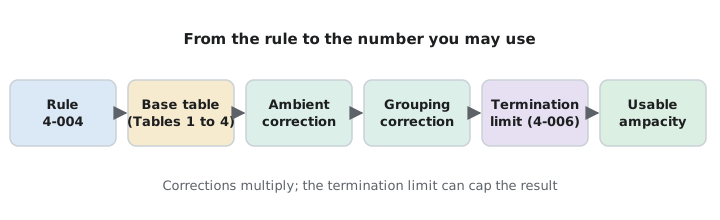
Conductor ampacity is the classic case. Rule 4-004 governs the ampacity of conductors and directs you to the ampacity tables. Those tables, Tables 1 to 4, give values for copper and aluminum conductors in different installation conditions, such as in free air or in a raceway or cable with a small number of conductors. Rule 4-004 also tells you when correction factors apply, such as for ambient temperature and for more conductors in a raceway or cable than the table assumes. Rule 4-006 deals with the temperature limitations at terminations, which can limit the ampacity you may actually use. The rule, the table and the correction factors work together.
| Table or group | What it gives (in general terms) | Rule that usually sends you there |
|---|---|---|
| Tables 1 to 4 | Ampacities of copper and aluminum conductors in different conditions | Rule 4-004 |
| Table 5A | Correction factors for ambient temperature | Rule 4-004 |
| Table 5C | Correction factors when there are more conductors than the base table assumes | Rule 4-004 |
| Table 19 | Conditions of use for wires and cables | Rules in Sections 4 and 12 |
| Tables 6 and 8 | Conductor dimensions and maximum conduit fill | Rules on raceway fill in Section 12 |
| Tables 11A and 11B | Conditions of use for flexible cords (split from the former Table 11 in 2024) | Rules in Section 4 |
| Table 16 | Minimum sizes of bonding conductors | Rules in Section 10 |
| Table 17 | Sizes of grounding conductors | Rules in Section 10 |
| Table D3 (Appendix D) | Distances that keep voltage drop within limits | Rule 8-102 and design practice |
Reading a table: title, headings, notes
Before you read a single value, read three things: the table's title, its column and row headings, and its notes. The title tells you the conditions the table assumes, such as the conductor material, the installation method, the number of conductors and the ambient temperature. The headings tell you what each column and row represents, such as conductor size and insulation temperature rating. The notes, printed below or beside the table, add conditions, limits and exceptions that can change the value you take from the table.
Notes are where many candidates lose marks. A note might limit the ampacity of the smallest conductor sizes regardless of what the table says, tell you that a correction must be applied in a particular case, or say that the table does not apply to certain cables. Denise insists that her students read the notes of any table they use on every single question until it becomes automatic. It feels slow at first. After a few weeks it takes seconds, and it stops a common source of errors.
| Size (illustrative) | 60 C column | 75 C column | 90 C column |
|---|---|---|---|
| size A | 18 | 22 | 25 |
| size B | 24 | 29 | 33 |
| size C | 33 | 40 | 45 |
| size D | 45 | 54 | 61 |
Look at the invented table. To read it, you need to know which conductor size you have and which temperature column applies. The temperature column depends on the insulation rating of the conductor, but the termination temperature limits in Rule 4-006 may force you to use a lower column even if the conductor is rated higher. That is a rule changing what the table appears to say, and it is one of the most common traps on ampacity questions.
Applying correction factors
The base ampacity tables assume particular conditions. When your installation differs, correction factors adjust the value. The two you will use most are for ambient temperature, when conductors are in a space hotter than the table assumes, and for the number of conductors, when more current-carrying conductors are grouped together than the table assumes. The corrections multiply: you take the base value and multiply by each factor that applies.
Worked problem
Correcting an illustrative ampacity
Using only the invented table above: a size C conductor with 90 C insulation runs through an attic where the ambient temperature is high. Assume an illustrative ambient correction factor of 0.82 and an illustrative grouping factor of 0.80 for the number of conductors in the cable. What is the corrected ampacity before any termination check?
Show solution
- Read the base value: size C in the 90 C column of the invented table is 45 A.
- Apply the ambient factor: 45 times 0.82 = 36.9 A.
- Apply the grouping factor: 36.9 times 0.80 = 29.52 A.
- Round down to a sensible working value: about 29.5 A.
- Then check termination limits (Rule 4-006 in the real Code), which may cap the usable value at the 60 C or 75 C column.
Answer: About 29.5 A from the invented values; in the real Code, use the actual table values and then check termination limits.
Priya keeps a small calculator script for this kind of chain so she can check her hand working while she studies. The numbers in it are the invented ones from this lesson. Change them to try other combinations.
base = {  # invented values for practice only, not from the Code
    'A': {'60': 18, '75': 22, '90': 25},
    'B': {'60': 24, '75': 29, '90': 33},
    'C': {'60': 33, '75': 40, '90': 45},
    'D': {'60': 45, '75': 54, '90': 61},
}

def corrected(size, insulation, factors):
    value = base[size][insulation]
    for f in factors:
        value = value * f
    return round(value, 1)

def usable(size, insulation, termination, factors):
    after = corrected(size, insulation, factors)
    cap = base[size][termination]
    return min(after, cap)

print('Corrected, size C, 90 C insulation:', corrected('C', '90', [0.82, 0.80]), 'A')
print('Usable with 75 C terminations:', usable('C', '90', '75', [0.82, 0.80]), 'A')
print('Usable with 60 C terminations, no corrections:', usable('C', '90', '60', []), 'A')Corrected, size C, 90 C insulation: 29.5 A Usable with 75 C terminations: 29.5 A Usable with 60 C terminations, no corrections: 33 A
Look at what the script shows. With the corrections applied, the 90 C value falls below the 75 C cap, so the corrected value governs. Without corrections, the 60 C termination limit governs instead. Real exam questions mix these effects deliberately. Work through every step in order, write the intermediate numbers down, and only then compare the result with the answer choices.
Interpolation and rounding
Tables give values at specific points, such as particular conductor sizes or particular temperatures. Real installations sometimes fall between those points. Do not assume you may interpolate between table rows. Read the rule and the table notes to see whether interpolation is permitted and how. Similarly, do not round in your own favour. If a rule says a conductor must have an ampacity of not less than a certain value, and your corrected value is slightly below it, the conductor does not comply. Exam answer choices are often built around the result a careless rounder would get.
| Situation | Safe approach |
|---|---|
| Value falls between two table rows | Check the rule and notes; if interpolation is not permitted, use the more conservative row |
| Corrected ampacity slightly below the required value | The conductor does not comply; choose the next size |
| Two correction factors apply | Multiply by both; do not add or average them |
| A table note limits small conductor sizes | Apply the note even if the table value is higher |
| Termination rating lower than insulation rating | Use the termination limit from the lower column |
Diagrams
The diagrams follow the tables. The ones candidates use most show the configurations of receptacles and attachment plugs: the shape and arrangement of the slots and pins for each voltage and current rating, with the CSA configuration number. When a question asks which receptacle configuration is required for a particular circuit, or whether a plug matches a receptacle, the diagrams are where you look. Other diagrams illustrate particular rules. Like the tables, the diagrams are referred to by rules, and the rule tells you when the diagram applies.
For exam purposes, it helps to know the general pattern of the configuration numbers: the first part relates to the voltage and system type, and the second to the current rating, with suffixes for receptacle and plug. You do not need to memorize the shapes, but you do need to know how to find a configuration quickly. Tab the diagrams page and practise looking up two or three configurations until you can do it in under thirty seconds.
New and changed tables in the 2024 edition
Each edition revises some tables. The 2024 edition recognizes conductors sized in square millimetres and adds a table for them in support of Section 4. It splits the former table on flexible cords into Tables 11A and 11B. It deletes Table 38, which was used for certain load calculations. It also removes the word allowable from most references to ampacity throughout the Code. If you studied from an older book or older practice questions, these changes can trip you up. A question that mentions Table 11 without a letter, or Table 38, is a sign that the source material is out of date.
| 2024 change | What to do in your book |
|---|---|
| New table for conductors sized in mm2 | Tab it and note the rule in Section 4 that refers to it |
| Former Table 11 split into 11A and 11B | Tab both; update any notes that say Table 11 |
| Table 38 deleted | Cross out old references in study material; check Section 8 for the replacement method |
| Allowable removed from most ampacity wording | Do not be thrown by older questions using the old term |
A method for table questions
Put all of this together and you have a method you can apply to any table question. Identify the rule that governs the situation. Read it, including any subrules that set conditions. Go to the table it names. Read the title, the headings and the notes. Find the base value. Apply each correction factor that the rule requires. Check any limiting rule, such as termination temperatures. Compare the result with the requirement, without rounding in your favour. Only then look at the answer choices.
Marcus tries the method on a practice question at the Tuesday session and complains that it takes three minutes. Denise times him a week later on a similar question: seventy seconds, correct. The method is slow only until it is a habit, and it is far faster than guessing, backtracking and guessing again.
Common mistakes
MistakeUsing a table without reading the rule that sends you there.
InsteadStart from the rule; it decides which table and conditions apply.
MistakeSkipping the table notes.
InsteadNotes can limit or change values; read them every time.
MistakeAdding correction factors instead of multiplying.
InsteadMultiply the base value by each factor that applies.
MistakeUsing the insulation temperature column when terminations are rated lower.
InsteadTermination limits can force a lower column; check Rule 4-006.
MistakeStudying from material that mentions Table 11 or Table 38.
InsteadThese changed in 2024; Table 11 is now 11A and 11B, and Table 38 was deleted.
Summary and key terms
- Tables sit after the last section; rules tell you when and how to use them.
- Always read a table's title, headings and notes before taking a value.
- Correction factors for ambient temperature and number of conductors multiply the base ampacity.
- Termination temperature limits can cap the ampacity you may use.
- The 2024 edition added a mm2 conductor table, split Table 11 into 11A and 11B, and deleted Table 38.
- Ampacity table
- A table giving the current a conductor may carry in specified conditions.
- Correction factor
- A multiplier that adjusts a table value for conditions different from those the table assumes.
- Table note
- A condition or limit printed with a table that can change how it is used.
- Termination temperature limit
- The temperature rating of a connection point, which can limit usable ampacity.
- Configuration diagram
- A diagram showing the slot and pin arrangement of receptacles and plugs for each rating.
Practice problems
Work each problem on paper first, then reveal the answer to check.
Using the invented table, what is the base value for size B in the 75 C column?
Show answer
29 A (invented value).
An invented base value of 40 A has factors of 0.88 and 0.70. What is the corrected value?
Show answer
40 x 0.88 x 0.70 = 24.64 A, about 24.6 A.
Why might you use the 60 C column for a conductor with 90 C insulation?
Show answer
Because the terminations are rated only 60 C, which limits the usable ampacity.
A practice question refers to Table 38. What does that tell you?
Show answer
The material predates the 2024 edition, which deleted Table 38.
Where do you look for the slot pattern of a receptacle for a given rating?
Show answer
The configuration diagrams after the tables.
Lesson quiz · 5 questions
Score 60% or more to complete this lesson.
Create a free account to save your progress, take quizzes and earn a certificate.