
MELC-101 · Lesson 10 of 12 · 18 min
Changes in the 2024 edition
▶ Video coming soon A video version of this lesson is on the way.
Every new edition of the Code brings changes, and exam writers love them. A changed rule tests whether a candidate studied the current edition or relied on old habits, old notes and old practice questions. This lesson does two things. It shows you how to find and study the changes in any edition, a skill you will use every three years for the rest of your career. And it walks through the main changes in the 26th edition, the 2024 Code, so you know where to concentrate.
As always, this lesson describes changes in general terms and names the sections and tables involved. Read the actual rules in your own copy. The point is to know where to look, not to replace the Code.
How the Code shows what changed
The Code identifies changed text so that users can see what is new. The front matter of your copy explains how revisions are indicated, typically with a mark in the margin beside rules, subrules or tables that have changed since the previous edition. Find that explanation in your copy and learn the symbol. Then flip through the sections you use most and notice how many marks there are. It gives you a quick sense of which areas have moved.
Margin marks show that something changed, but not how much. A mark might indicate a reworded phrase with no practical effect or a completely new requirement. To understand a change, read the new rule carefully and, if you can, compare it with the previous edition. Many training providers and industry publications summarize the changes, and the CE Code Handbook explains the reasoning behind many of them. Use those summaries to guide your reading, but rely on the Code text itself for answers.
A method for studying changes
Changes are best studied systematically. Start with a reliable summary to get the list. Then, for each change, read the new rule in full, identify what it requires that the old rule did not, and think of an installation where the change makes a difference. Write a one-line note for each in your study notebook. Finally, check your province's adopting regulation for any amendment that affects the change; occasionally a province declines to adopt a national change or modifies it.
| Step | What you do | Output |
|---|---|---|
| 1 | Get a list of changes from a reliable summary | A checklist by section |
| 2 | Read each new or revised rule in your copy | Understanding of the current wording |
| 3 | Identify what is now required, permitted or prohibited that was not before | A one-line note per change |
| 4 | Picture an installation where the change matters | A concrete example you will remember |
| 5 | Check provincial amendments to the change | A flag if your province differs |
| 6 | Retire out-of-date notes and practice questions | Study material that matches the edition |
The main 2024 changes by section
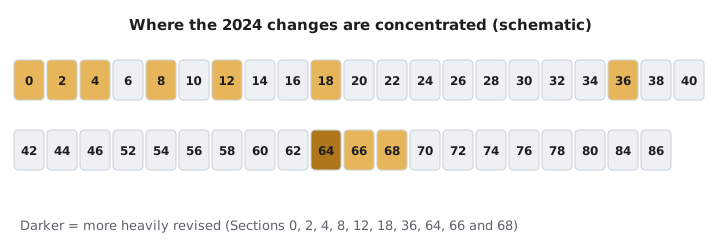
The 26th edition touched many parts of the Code. The table below lists major changes that are widely highlighted in summaries of the edition, organized by section. It is not a complete list. Use it as a map for your own reading.
| Section or part | Change (general description) | Why it matters |
|---|---|---|
| Section 0 | Revised voltage definitions as they apply to direct current | Battery and PV systems; which rules apply at a given DC voltage |
| Section 2 | New requirements to reduce arcing fault clearing times; clarified use of IP designations | Worker safety near large equipment; enclosure selection |
| Section 4 | Recognition of conductors sized in mm2, with a new table | Equipment and cable sized to international practice |
| Section 8 | Revised load calculations for electric vehicle supply equipment; Table 38 deleted | Services and feeders for buildings with EV charging |
| Section 12 | Updated sag and span requirements for overhead installations; new rules for non-metallic jacketed cable | Overhead runs and common cable types |
| Section 18 and Annex J18 | Substantially revised sealing requirements | Hazardous location installations |
| Section 36 | New rules for high-voltage couplers | Connections in high-voltage installations |
| Section 64 | Major revisions for energy storage and renewable energy, including a new subsection for residential occupancies and updated PV rules | Home batteries, solar and other on-site generation |
| Section 66 | GFCI protection required for receptacles in temporary outdoor installations such as tents | Events, fairs and temporary structures |
| Section 68 | New disconnecting means and bonding requirements for conductive pool infrastructure | Pools and their surrounding structures |
| Tables | Table 11 split into Tables 11A and 11B | Flexible cord conditions of use |
| Appendices | Appendix A annexes and index reinstated; Appendix K deleted | Finding standards; outdated references |
| Throughout | The word allowable removed from most references to ampacity | Older material uses different wording |
Energy storage and renewables: Section 64
Section 64 received some of the largest revisions in the 2024 edition. It covers renewable energy systems and energy storage systems, and the new edition reorganized and expanded its requirements, including a new subsection specifically for residential occupancies and updated photovoltaic rules. This reflects the rapid growth of home batteries and rooftop solar. For candidates, it means that older study material on PV and battery systems may be badly out of date, and it means Section 64 is a likely source of exam questions for some years.
On the Hartley Farms job, the owner wants a 40 kW rooftop PV array with battery storage. Priya's first step is to read the scope of Section 64 and the new residential subsection to decide which parts apply to a farm shop rather than a dwelling. Her second is to check how Section 64 interacts with Section 84, which deals with interconnection of power production sources, and with Section 8 for load and supply considerations. MELC-105 covers these installations in depth.
Electric vehicle loads: Section 8
The 2024 edition revised how electric vehicle supply equipment is treated in load calculations in Section 8, and deleted Table 38. EV charging is now a common addition to homes and multi-unit buildings, and the load it adds can be large compared with the rest of a dwelling. Questions about service and feeder sizing for buildings with EV chargers, and about load management systems, are likely. Read the Section 8 rules that mention electric vehicle supply equipment, and read Section 86 for the installation rules.
Riverbend Condos wants twenty chargers in its parkade. The building's existing service has limited spare capacity, so the board is considering a load management system that shares available capacity among chargers. Whether and how the Code allows the managed load to be used in the calculation is precisely the kind of question the revised Section 8 addresses. MELC-102 works through the calculations.
Pools: Section 68
The 2024 edition added disconnecting means and bonding requirements for conductive pool infrastructure. Bonding around pools has long been a critical safety topic, because water and bare skin make people especially vulnerable to small voltage differences. The new requirements extend the bonding approach to conductive parts of the pool infrastructure. Read the new rules and note how they relate to the general bonding requirements in Section 10.
Temporary outdoor installations: Section 66
Section 66 deals with amusement parks, midways, carnivals, film and television sets, and similar temporary or travelling installations. The 2024 edition requires ground fault circuit interrupter protection for receptacles in temporary outdoor installations such as tents. It is a short change, but exactly the kind of clear yes-or-no requirement that suits an exam question.
Wording changes that trip people up
Some changes affect wording more than requirements. Removing the word allowable from most ampacity references is an example. The requirement is not lessened, but questions written for older editions may use the old phrasing, and a candidate who searches the index or the text for the old term may not find it. Similarly, a reference to Table 11 without a letter, to Table 38, or to Appendix K is a sign that a question or note predates the 2024 edition.
| Old reference | In the 2024 edition |
|---|---|
| Table 11 | Tables 11A and 11B |
| Table 38 | Deleted; see the revised Section 8 method for EV loads |
| Appendix K | Deleted |
| Allowable ampacity | Mostly just ampacity |
Priya keeps a short list of these red flags taped inside the front cover of her study notebook. When a practice question uses one of them, she knows to check whether the answer still holds under the 2024 edition before trusting the answer key.
changes = [
    ('0', 'DC voltage definitions revised'),
    ('2', 'arcing fault clearing time; IP designations'),
    ('4', 'mm2 conductors and new table'),
    ('8', 'EV supply equipment loads; Table 38 deleted'),
    ('12', 'overhead sag and span; non-metallic jacketed cable'),
    ('18', 'sealing requirements revised (with Annex J18)'),
    ('36', 'high-voltage couplers'),
    ('64', 'energy storage and renewables, residential subsection, PV'),
    ('66', 'GFCI for temporary outdoor receptacles'),
    ('68', 'conductive pool infrastructure bonding and disconnect'),
]
general = {'0', '2', '4', '6', '8', '10', '12', '14', '16', '26'}
studied = {'0', '2', '8', '64'}

for sec, what in changes:
    group = 'general' if sec in general else 'supplementary'
    mark = 'done' if sec in studied else 'to do'
    print(('Section ' + sec).ljust(11), group.ljust(14), mark.ljust(6), what)
print(len(studied), 'of', len(changes), 'sections studied')Section 0 general done DC voltage definitions revised Section 2 general done arcing fault clearing time; IP designations Section 4 general to do mm2 conductors and new table Section 8 general done EV supply equipment loads; Table 38 deleted Section 12 general to do overhead sag and span; non-metallic jacketed cable Section 18 supplementary to do sealing requirements revised (with Annex J18) Section 36 supplementary to do high-voltage couplers Section 64 supplementary done energy storage and renewables, residential subsection, PV Section 66 supplementary to do GFCI for temporary outdoor receptacles Section 68 supplementary to do conductive pool infrastructure bonding and disconnect 4 of 10 sections studied
When the edition changes in the middle of your study
Code editions change every three years, and exam bodies switch to the new edition on their own schedule, usually some time after the province adopts it. If an edition changes while you are studying, find out which edition your exam will use and when the exam body will switch. Buy and tab the right book. If you have already tabbed the old edition, transfer your tabs section by section and use the change list to update your notes. It is a few evenings of work, and it is much better than discovering on exam day that your book does not match the questions.
Alberta adopted the 26th edition on April 1, 2025, so candidates studying in 2026 work from the 2024 Code. The next edition is expected in 2027, and its adoption in Alberta will follow some months later. If your exam date falls near a changeover, check with the exam body which edition applies on your date.
Changes the study group noticed
When the study group compares notes on the 2024 changes, each person has noticed different things, depending on the work they do. Priya, who does a lot of residential work, has spent most time on the revised EV supply equipment load calculations in Section 8 and the new residential subsection in Section 64, because homeowners ask about chargers and batteries every week. Marcus, from industrial work, has focused on the Section 2 arcing fault clearing time requirements and the Section 18 sealing changes. Gord, who still reviews permits, mentions that the removal of the word allowable from ampacity references caused confusion in some older office templates.
Denise's point is that each of them has a blind spot where they did not look. The exam covers all of it. She asks each person to teach the group the changes they know best, so that everyone hears every change at least once from someone who has thought about it in practice. It is a good model for any study group: divide the change list by experience, then teach each other.
Common mistakes
MistakeStudying from notes written for the 2021 edition without checking.
InsteadCompare against the 2024 text and retire outdated notes.
MistakeAssuming a margin mark means a major change.
InsteadRead the rule; some marks indicate minor rewording.
MistakeTrusting a practice answer that cites Table 38 or Table 11.
InsteadThese changed in 2024; recheck the answer in the current edition.
MistakeIgnoring Section 64 because PV seems specialized.
InsteadSection 64 was heavily revised and is a likely exam topic.
MistakeForgetting provincial changes to national revisions.
InsteadCheck whether your province amended or declined a national change.
Summary and key terms
- Revised text is marked in the margin; the front matter explains the symbol.
- Study changes systematically: list, read, note what is new, picture an installation, check amendments, retire old material.
- Major 2024 changes include Sections 0, 2, 4, 8, 12, 18, 36, 64, 66 and 68, plus table and appendix changes.
- References to Table 11, Table 38, Appendix K or allowable ampacity signal out-of-date material.
- Check which edition your exam uses, especially near a changeover.
- Margin mark
- A symbol beside text that has changed since the previous edition.
- Section 64
- The section for renewable energy and energy storage systems, heavily revised in 2024.
- EVSE
- Electric vehicle supply equipment, whose load treatment in Section 8 was revised in 2024.
- Conductive pool infrastructure
- Conductive parts of a pool structure, now covered by new bonding and disconnect rules.
- Changeover
- The period when an exam body or province moves from one edition to the next.
Practice problems
Work each problem on paper first, then reveal the answer to check.
A practice question refers to Appendix K. What should you suspect?
Show answer
That it was written for an edition before 2024, when Appendix K was deleted.
Which section was revised for residential energy storage and PV?
Show answer
Section 64.
What 2024 change applies to receptacles in temporary outdoor tents?
Show answer
GFCI protection is required (Section 66).
Name two Section 8 changes in 2024.
Show answer
Revised load calculations for EV supply equipment, and deletion of Table 38.
Your exam is three months after a new edition is published. What should you check?
Show answer
Which edition the exam body will use on your exam date.
Lesson quiz · 5 questions
Score 60% or more to complete this lesson.
Create a free account to save your progress, take quizzes and earn a certificate.