
MELC-101 · Lesson 8 of 12 · 22 min
Reading a rule precisely
▶ Video coming soon A video version of this lesson is on the way.
You can find the right rule and still get the question wrong. It happens when you read the rule the way you read a newspaper: quickly, for the general idea. Rules are not written for the general idea. They are written so that every word does a job, and the jobs are often hidden in small words such as shall, may, not less than, except and or. This lesson teaches a way of reading rules that catches those words every time.
Denise calls it reading like an inspector. An inspector who writes a deficiency has to be able to point to the exact words that the installation does not meet, so inspectors learn to read rules as a series of conditions and consequences. Candidates who learn the same habit stop losing marks on the questions that are designed to separate careful readers from fast ones.
To practise without reproducing the Code, this lesson uses invented rules. They are written in a style similar to the Code but are not Code text and must not be used for real work. Once you have the method, apply it to real rules in your own copy.
The words that decide outcomes
A small vocabulary carries most of the meaning in any rule. Learn exactly what each word does. Shall creates an obligation: the thing must be done. Shall not creates a prohibition. Permitted, or may, creates a permission: you are allowed to do the thing, but you do not have to. Except introduces a case that is taken out of the main requirement. Unless introduces a condition under which the requirement does not apply. Where introduces a condition under which the requirement does apply.
| Word or phrase | What it does | Effect on your answer |
|---|---|---|
| shall | Creates a requirement | Not doing it means non-compliance |
| shall not | Creates a prohibition | Doing it means non-compliance |
| permitted / may | Creates a permission | Allowed but not required; the alternative may also comply |
| except | Removes a case from the requirement | The excepted case follows different rules |
| unless | Sets a condition that switches the requirement off | If the condition is met, the requirement does not apply |
| where | Sets a condition that switches the requirement on | If the condition is not met, the requirement does not apply |
| notwithstanding | Overrides another rule | This rule applies even if the other rule says otherwise |
| subject to | Makes this rule yield to another | The other rule limits or conditions this one |
| in accordance with | Imports another rule or table | The referenced requirement becomes part of this one |
The difference between shall and may is tested constantly. If a rule says a method is permitted, an installation that uses a different method may still comply, as long as it meets the requirements that apply to it. If a rule says a method shall be used, the alternative does not comply. A question that asks whether something is required, versus whether it is allowed, is testing exactly this distinction.
Limits: not less than, not more than, and the boundaries
Numerical limits use phrases such as not less than, not more than, at least, not exceeding and greater than. These phrases decide what happens at the boundary. A value that equals a not-less-than limit complies. A value that equals a greater-than requirement does not. When a question gives a value exactly on the boundary, the wording of the rule is the whole answer.
| Phrase | Boundary value included? | Example with a limit of 10 |
|---|---|---|
| not less than 10 | Yes | 10 complies; 9.9 does not |
| at least 10 | Yes | 10 complies |
| not more than 10 | Yes | 10 complies; 10.1 does not |
| not exceeding 10 | Yes | 10 complies |
| more than 10 / greater than 10 | No | 10 does not meet a greater-than requirement |
| less than 10 | No | 10 does not meet a less-than requirement |
Lists of items: and versus or
Many subrules break into items (a), (b), (c). Whether all of the items must be met or any one of them is enough depends on the word that joins them, normally placed at the end of the second-last item. If it is and, every item must be met. If it is or, meeting any one item is sufficient. The joining word is easy to miss because it sits at the end of a line, often half a page below the start of the list. Train your eye to look for it before you read the items.
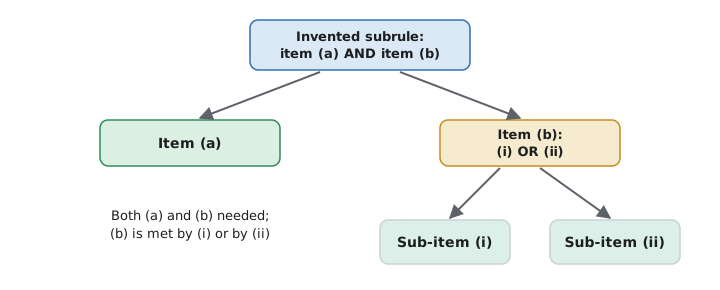
Lists can also be nested. An item can contain sub-items with their own joining word. A requirement might say that conditions (a) and (b) must both be met, where (b) itself can be met in either of two ways, (i) or (ii). Draw the structure as a small tree when a list is complicated. It takes twenty seconds and prevents misreading.
Exceptions and their position
Exceptions can appear in several places: within the same subrule, as a later subrule of the same rule, in a different rule that says notwithstanding, or in a supplementary section. A careful reader looks for all four. The common failure is to read subrule (1), find the requirement, and stop, when subrule (3) contains a permission that covers exactly the installation in the question. As Lesson 2 suggested, glance to the end of the rule before deciding.
| Where the exception is | How you find it |
|---|---|
| Within the same subrule | Words such as except or unless in the subrule itself |
| A later subrule of the same rule | Read to the end of the rule |
| A different rule using notwithstanding | Cross-references, the index, neighbouring rules |
| A supplementary section | Check whether the installation is in a special location or uses particular equipment |
A method for any rule
Here is the method in full. First, read the whole rule once, quickly, to see its shape: how many subrules, any lists, any cross-references. Second, identify the requirement words: shall, shall not, permitted. Third, mark the conditions: where, unless, except and any defined terms. Fourth, check lists for and or or. Fifth, follow cross-references and check for exceptions elsewhere. Sixth, apply the rule to the facts of the question, condition by condition. Only then pick the answer.
Practice with invented rules
The following rules are invented for practice. They are written in a Code-like style so you can apply the method, but they are not from the Code.
| Invented rule (practice only) | Text |
|---|---|
| Practice Rule P-1 | (1) Every widget box shall be accessible. (2) Notwithstanding Subrule (1), a widget box is permitted to be concealed where (a) it contains only splices; and (b) it is identified on the record drawings. |
| Practice Rule P-2 | (1) A gizmo shall be located not less than 1.5 m from a sink, unless it is protected by a shield. (2) Subrule (1) does not apply in a dry storage room. |
Worked problem
Applying the method to Practice Rule P-1
A widget box contains splices and a small control relay. It is concealed above a drywall ceiling and shown on the record drawings. Does it comply with Practice Rule P-1?
Show solution
- Shape: two subrules; subrule (2) has a list of two items joined by and.
- Requirement: subrule (1) says every widget box shall be accessible.
- Exception: subrule (2) permits concealment notwithstanding (1), but only where both items are met.
- Item (a): the box contains a relay as well as splices, so it does not contain only splices. Item (a) fails.
- Because the items are joined by and, failing (a) means the permission does not apply, so subrule (1) governs.
Answer: It does not comply: the box must be accessible, because it contains more than splices.
Worked problem
Applying the method to Practice Rule P-2
A gizmo is 1.5 m from a sink in a kitchen, with no shield. Another gizmo is 0.5 m from a sink in a dry storage room, with no shield. Which complies?
Show solution
- Requirement: subrule (1) says not less than 1.5 m, unless shielded.
- First gizmo: exactly 1.5 m. Not less than includes the boundary, so it complies.
- Second gizmo: 0.5 m and unshielded would fail subrule (1).
- But subrule (2) says subrule (1) does not apply in a dry storage room, which is where the second gizmo is.
- Both comply, the first by meeting the distance and the second because the requirement does not apply there.
Answer: Both comply: the first sits exactly on the boundary, and the second is in a location where subrule (1) does not apply.
The second example shows why you must read to the end. A candidate who stops after subrule (1) marks the storage room gizmo as non-compliant. The exam writer will have put that answer in the choices on purpose.
Priya writes the logic of Practice Rule P-1 as a small function. Turning a rule into code forces you to decide exactly what each word means, and it shows instantly whether a set of facts meets the rule.
def practice_rule_p1(accessible, only_splices, on_drawings):
    # Invented rule for practice, not Code text.
    if accessible:
        return 'complies with subrule (1)'
    if only_splices and on_drawings:
        return 'complies by the permission in subrule (2)'
    return 'does not comply'

cases = [
    ('box above lift-out ceiling tile', True, False, False),
    ('concealed, splices only, on drawings', False, True, True),
    ('concealed, splices and relay, on drawings', False, False, True),
    ('concealed, splices only, not on drawings', False, True, False),
]
for name, acc, splices, drawings in cases:
print(name.ljust(44), '->', practice_rule_p1(acc, splices, drawings))box above lift-out ceiling tile -> complies with subrule (1) concealed, splices only, on drawings -> complies by the permission in subrule (2) concealed, splices and relay, on drawings -> does not comply concealed, splices only, not on drawings -> does not comply
Reading the question as carefully as the rule
Exam questions are written with the same care as the rules, and the same method applies. Underline what the question asks: is it asking what is required, what is permitted, what is the minimum, or what does not comply? Note every fact that could trigger a condition: the location, the voltage, the type of building, whether equipment is accessible, whether it is a dwelling. A detail that seems like scene-setting is often the condition that switches a rule on or off.
| Question asks | What you are looking for |
|---|---|
| Which is required? | A shall requirement that applies to the facts |
| Which is permitted? | A permission, possibly alongside other compliant options |
| What is the minimum? | The not-less-than value, including the boundary |
| Which does not comply? | The option that fails a condition or prohibition |
| Which is the best description? | The option that matches the rule most completely |
Reading real rules
The invented rules in this lesson are deliberately simple. Real rules are longer, with more subrules, more cross-references and more defined terms. The method still works; it just takes a little longer the first few times. Choose three long rules from the sections you use most, perhaps the dwelling-unit demand load rule, a receptacle rule from Section 26 and a grounding rule from Section 10, and work through each one with the six steps. Draw the list structure as a tree. Mark the requirement words and conditions in pencil in your study notes, not in your exam book.
Then write a short scenario for each rule that the rule clearly covers, one it clearly does not, and one that sits on a boundary. Swap scenarios with a study partner and decide each one. Priya and Marcus do this every week, and they find that the boundary scenarios generate the best arguments. When they disagree, they go back to the wording, check the definitions and the Appendix B note, and usually find the word they had each read differently. Those arguments are exactly the thinking an exam question demands, done in advance, without the clock running.
Common mistakes
MistakeReading permitted as required.
InsteadA permission allows a method; other compliant methods may also be acceptable.
MistakeMissing the and or or at the end of a list.
InsteadFind the joining word before reading the items.
MistakeStopping at subrule (1).
InsteadRead to the end of the rule and check for exceptions elsewhere.
MistakeTreating a boundary value as failing a not-less-than limit.
InsteadNot less than and not more than include the boundary.
MistakeIgnoring scene-setting details in a question.
InsteadLocations, voltages and building types often trigger conditions.
Summary and key terms
- Shall creates a requirement, shall not a prohibition, and permitted or may a permission.
- Where, unless and except set conditions; notwithstanding overrides and subject to yields.
- Not less than and not more than include the boundary; greater than and less than do not.
- The word at the end of the second-last item, and or or, decides whether all or any items must be met.
- Read the whole rule, check for exceptions elsewhere, and apply conditions to the facts one by one.
- Requirement
- An obligation created by shall.
- Permission
- An allowance created by permitted or may; not an obligation.
- Condition
- A circumstance, introduced by where or unless, that decides whether a requirement applies.
- Exception
- A case removed from a requirement, introduced by except or in a later subrule or rule.
- Notwithstanding
- A word that makes a rule apply even where another rule says otherwise.
Practice problems
Work each problem on paper first, then reveal the answer to check.
A rule says a method is permitted. Does an installation using another method fail?
Show answer
Not necessarily; it complies if it meets the requirements that apply to it.
A limit says not more than 3 m. Does 3 m comply?
Show answer
Yes; not more than includes the boundary.
Items (a), (b) and (c) are joined by or. The installation meets only (b). Is the subrule met?
Show answer
Yes; or means any one item is enough.
Name four places an exception might be found.
Show answer
In the same subrule, in a later subrule, in another rule using notwithstanding, or in a supplementary section.
Using Practice Rule P-2, a gizmo is 1.0 m from a sink in a kitchen but has a shield. Does it comply?
Show answer
Yes; the unless condition (protected by a shield) switches off the distance requirement.
Lesson quiz · 5 questions
Score 60% or more to complete this lesson.
Create a free account to save your progress, take quizzes and earn a certificate.