
MELC-101 · Lesson 3 of 12 · 20 min
Section 0: definitions that decide answers
▶ Video coming soon A video version of this lesson is on the way.
Section 0 is the shortest route to a wrong answer if you skip it, and one of the quickest routes to a right answer if you use it well. It sets out the object and scope of the Code and then gives a long list of definitions. Those definitions are not a glossary for beginners. They are binding: when a defined word appears in a rule, it carries exactly the meaning Section 0 gives it, even if that meaning is narrower or broader than the way people use the word on site.
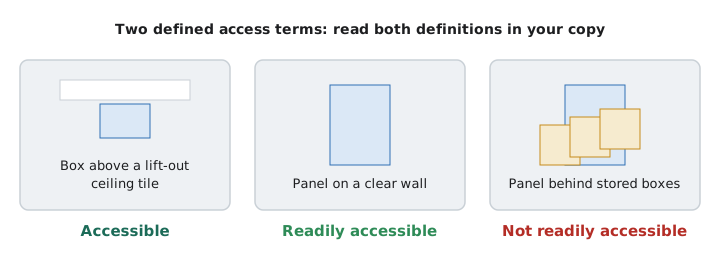
Denise opens her third session with a question that splits the room. A homeowner's main breaker panel is in a basement storage room behind a stack of boxes. Is the panel accessible? Marcus says yes, obviously: anyone can move the boxes. Priya hesitates. Denise smiles and sends them to Section 0, where the Code distinguishes between being accessible and being readily accessible. By the end of the evening the group has a new rule of their own: if a word in the question looks ordinary, check whether it is defined.
What Section 0 contains
Section 0 has three jobs. It states the object of the Code, which is to set minimum requirements for safety from shock and fire hazards in electrical installations. It states the scope, listing what the Code covers and what it does not. And it defines the terms used throughout the book. In the current edition, Section 0 also sets out how the general and supplementary sections relate to each other, which you met in Lesson 2.
The definitions are arranged alphabetically. Some are short, a single sentence. Others run to several sentences and include categories, such as the definitions related to voltage. A few defined terms are phrases rather than single words, which means you must look them up under their first word. A definition may also refer to another defined term, so reading one definition can send you to two or three others.
The scope deserves a careful read at least once, because some exam questions are really scope questions in disguise. If an installation is outside the scope of the Code, the Code's rules do not apply to it, though another standard or regulation may. Utility-owned generation, transmission and distribution, electric railway power circuits, aircraft and federally regulated ships are classic examples of exclusions. Mines and quarries are covered by their own CSA standard in addition to the Code. Know these boundaries so you do not spend minutes searching for a rule that does not exist.
Why definitions decide answers
Most rules apply only when certain conditions are met, and those conditions are often described with defined words. Change the meaning of one word and the rule applies to a different set of situations. That is why exam writers like questions that hinge on a definition: a candidate who reads the rule but not the definition will pick a plausible but wrong answer.
Consider three families of definitions that appear in exam questions all the time. The first is about access: how easily a person can reach a piece of equipment. The second is about location: whether a place is dry, damp or wet, and whether it is hazardous. The third is about the parts of the electrical system: service, feeder, branch circuit and the equipment at each point. Each family has words that sound interchangeable in conversation but have distinct meanings in the Code.
| Family | Terms to compare | What the distinction affects |
|---|---|---|
| Access | accessible, readily accessible | Where disconnecting means, panels and overcurrent devices may be located |
| Location | dry, damp, wet location; hazardous location | Which wiring methods, equipment ratings and enclosures are acceptable |
| System parts | service, consumer's service, feeder, branch circuit | Which rules apply to conductors, protection and equipment at each point |
| Earth connections | grounding, bonding | Two different purposes, two sets of sizing rules |
| Voltage | extra-low, low and high voltage | Which sections and protective measures apply |
| Buildings | dwelling unit, single dwelling | Which demand load and receptacle rules apply |
Access: accessible and readily accessible
In everyday speech, accessible means you can get to something. The Code uses two related defined terms, and you must read both in your own book. In broad terms, accessible describes something that is not permanently closed in by the structure or finish of a building and can be reached for inspection or work, even if you must remove a cover or open a door. Readily accessible is stricter: it describes something that can be reached quickly, without climbing over or moving obstacles and without using portable ladders or similar aids. Read the exact definitions in your book; the distinctions in the wording are what the exam tests.
Rules about disconnecting means and service equipment frequently require equipment to be readily accessible, while rules about junction boxes may only require them to be accessible. Applied to Denise's basement panel: if the panel is blocked by boxes that someone must move first, it fails a requirement that it be readily accessible, even though it might still meet a requirement that it be accessible. The defined words, not common sense, decide the question.
Location: dry, damp, wet and hazardous
Location definitions control which equipment and wiring methods you may use. The Code distinguishes dry locations, where moisture is not normally present; damp locations, which are exposed to moisture or condensation but not to saturation; and wet locations, where water can saturate equipment or materials, such as outdoors exposed to weather, underground, or in places washed down with hoses. Again, read the exact definitions: the examples and boundaries in the Code's wording are what count.
On the Clearview car wash job, the wash bay is plainly a wet location. The equipment room next to it is less obvious. It is enclosed and heated, but water mist and condensation reach it when the bay door opens. Is it damp or wet? The answer depends on the facts and on the definitions, and it determines whether the cable and boxes Priya planned are acceptable. This is exactly the kind of judgement the exam asks you to make from a written description.
Hazardous locations are a separate idea. A hazardous location is one where flammable gases, vapours, dusts or fibres may be present in quantities that could ignite. The general definition is in Section 0, but Section 18 gives the detailed classification system, with its own terms. Many supplementary sections have their own special terminology rule near the start, which adds definitions that apply only in that section. When you work in Section 18, 24, 64 or 86, look for that rule before you assume a word means what Section 0 says.
| Location type (paraphrased) | Typical examples | Effect on choices |
|---|---|---|
| Dry | Finished interior rooms of a house or office | Ordinary indoor wiring methods and equipment |
| Damp | Some basements, sheltered areas under canopies, cold rooms with condensation | Equipment and methods suitable for damp locations |
| Wet | Outdoors exposed to weather, underground, wash-down areas | Equipment and methods suitable for wet locations; extra protection |
| Hazardous | Fuel dispensing areas, grain dust areas, paint spray booths | Section 18 classification and approved equipment for the class or zone |
System parts: service, feeder, branch circuit
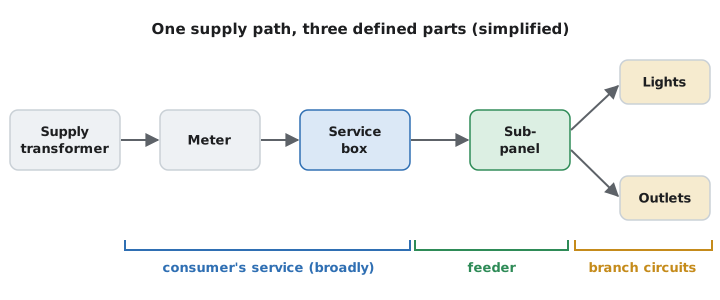
The words service, feeder and branch circuit describe successive parts of an electrical system, from the supply authority's conductors to the outlets. In broad terms, the service brings power from the supply authority to the building; the consumer's service is the part of the conductors and equipment owned by the customer from the supply point to the service box; feeders carry power from the service equipment to distribution panels; and branch circuits run from the final overcurrent device to the outlets. The precise boundaries are in Section 0, and the rules for each part are in different places: services in Section 6, loads in Section 8, conductors in Section 4 and protection in Section 14.
Getting these words right saves you from looking in the wrong section. A question about the conductors between a house's meter base and its main panel is about the consumer's service. A question about the cable from the main panel to a subpanel in the garage is about a feeder. A question about the circuit that supplies the kitchen counter receptacles is about a branch circuit. Each leads to different rules.
Grounding and bonding
Grounding and bonding are defined separately because they do different jobs. Grounding, in the Code's sense, is about a permanent connection to earth. Bonding is about connecting conductive parts together so that they are at the same potential and so that a fault current has a low-impedance path back to the source, allowing the overcurrent device to operate. The two are related and often achieved with the same hardware, but the rules for sizing a grounding conductor and a bonding conductor are different, and they use different tables. MELC-104 covers Section 10 in detail. For now, the lesson is simple: when a question says grounding, do not answer a bonding question.
Voltage categories
The Code sorts voltages into categories, and the category decides which rules apply. In broad terms, extra-low voltage is the lowest range, low voltage covers the ordinary distribution voltages used in most buildings, and high voltage is everything above that. For alternating current, the familiar boundaries are 30 volts and 750 volts. The 2024 edition revised the definitions as they apply to direct current, which matters for battery systems and photovoltaic arrays, so check the current wording rather than relying on what you learned in an earlier edition.
| Category | Typical installations | Where to look next |
|---|---|---|
| Extra-low voltage | Doorbells, thermostat wiring, some control circuits | Section 16 and the rules for Class 2 circuits |
| Low voltage | Ordinary 120/240 V and 347/600 V building systems | General sections |
| High voltage | Primary distribution inside large facilities | Section 36 |
Dwelling unit and single dwelling
Section 8's demand load rules and Section 26's receptacle rules use building words with exact meanings. A dwelling unit is, broadly, a set of rooms used as a self-contained residence, with cooking, sleeping and sanitary facilities. A single dwelling is a building that contains only one dwelling unit. On the Aspen Ridge bungalow, the basement suite has its own kitchen, bathroom and bedroom. That makes it a second dwelling unit, which changes how the loads are calculated and which receptacle rules apply in each unit. A question that describes a house with a secondary suite is almost always testing whether you recognize this.
Worked problem
A definition changes the answer
A question says: "A disconnecting means for a rooftop unit is mounted on the unit, reached by a fixed ladder through a roof hatch. Is it readily accessible?" Marcus says yes, because there is a permanent ladder. How should Priya approach it?
Show solution
- Identify the defined term: readily accessible.
- Open Section 0 and read the full definition, noting what it says about obstacles, ladders and other aids.
- Compare the facts: the person must climb a ladder and open a hatch before reaching the equipment.
- Check whether the rule that governs rooftop equipment disconnects has its own permission or exception for this arrangement.
- Decide on the basis of the definition and the specific rule together, not on whether the ladder is permanent.
Answer: Read the definition and the specific rule together; the answer depends on the wording, not on everyday usage.
Tyler notices something while the group works through these examples. Every time someone gets an answer wrong, it is because they read a word the way people use it on site. Denise nods. She has seen experienced electricians fail exams for exactly that reason. The habit that fixes it is almost mechanical: when a rule uses a word that could be defined, stop for ten seconds and check Section 0, then check whether the section you are in has its own terminology rule.
Common mistakes
MistakeUsing the everyday meaning of a defined word.
InsteadCheck Section 0 whenever a word in a rule might be defined.
MistakeTreating accessible and readily accessible as the same.
InsteadReadily accessible is a stricter test; read both definitions.
MistakeApplying Section 0 definitions inside Section 18 without checking.
InsteadSupplementary sections often have their own terminology rule; check it first.
MistakeConfusing grounding with bonding.
InsteadThey have different purposes and different sizing rules and tables.
MistakeTreating a basement suite as part of a single dwelling.
InsteadA self-contained suite is its own dwelling unit, which changes load and receptacle rules.
Summary and key terms
- Section 0 sets out the object, scope and binding definitions of the Code.
- A defined word in a rule has exactly the meaning Section 0 gives it.
- Key families of definitions cover access, location, system parts, grounding and bonding, voltage and dwellings.
- Supplementary sections often add special terminology for their own subject.
- Scope questions can be answered quickly by knowing what the Code excludes.
- Object
- The purpose of the Code: minimum requirements for safety from shock and fire.
- Scope
- The statement of what installations the Code covers and excludes.
- Readily accessible
- A defined, stricter form of access; read the full definition in your copy.
- Wet location
- A defined location where water can saturate equipment or materials.
- Branch circuit
- Broadly, the circuit beyond the final overcurrent device that supplies outlets.
- Dwelling unit
- Broadly, a self-contained residence with cooking, sleeping and sanitary facilities.
Practice problems
Work each problem on paper first, then reveal the answer to check.
A question asks about the cable from a house's main panel to a detached garage subpanel. Which defined term describes it?
Show answer
A feeder.
Why might a word mean something different in Section 18 than in Section 0?
Show answer
Section 18 has its own classification terms, and supplementary sections can define terms for their own use.
Name two installations outside the scope of the Code.
Show answer
For example utility-owned distribution systems and electric railway power circuits; also aircraft.
A house has a legal basement suite with its own kitchen. How many dwelling units is it?
Show answer
Two.
What edition change affects voltage definitions?
Show answer
The 2024 edition revised the voltage definitions as they apply to direct current.
Lesson quiz · 5 questions
Score 60% or more to complete this lesson.
Create a free account to save your progress, take quizzes and earn a certificate.