
MELC-101 · Lesson 2 of 12 · 21 min
Sections, rules, subrules and items
▶ Video coming soon A video version of this lesson is on the way.
Open the CE Code at random and you will see a page of numbered rules, each with a heading, divided into numbered and lettered parts. To a new apprentice it looks like a wall of text. To an experienced candidate it looks like a filing system, and that is exactly what it is. Every rule has an address, and the address tells you a great deal about where the rule lives and what it is likely to say. This lesson teaches you to read those addresses and to use the structure of the book to move around it quickly.
At Denise's second study session she hands out a sheet with twenty rule references and asks the group to say, without opening the book, which subject each one deals with. Marcus gets four right. Priya gets nine. Denise gets all twenty and then explains that she is not a genius: she simply knows how the numbering works. By the end of this lesson you should be able to do most of what she did.
The big picture: sections
The Code is divided into sections, and the sections carry even numbers: Section 0, Section 2, Section 4, and so on up to Section 86 in the current edition. The even numbering is a long-standing convention that leaves room between sections. Each section deals with one subject, such as conductors, services, grounding and bonding, wiring methods, motors or pools. When a new subject becomes important enough, a new section can be added in one of the gaps, and when a subject is folded into another section its number can be retired. Section 64, for example, now gathers renewable energy and energy storage systems that were once spread across separate sections.
The sections fall into two groups, and this is one of the most important structural ideas in the whole book. The general sections are Sections 0 to 16 and Section 26. They apply to all installations unless something more specific says otherwise. The supplementary sections are Section 18 and the sections that follow it, apart from 26. Each supplementary section deals with a particular kind of location, equipment or occupancy, and it supplements or amends the general sections for that situation.
| Group | Sections | What they do |
|---|---|---|
| General sections | 0 to 16, and 26 | Apply to every installation: definitions, general rules, conductors, services, circuit loading, grounding and bonding, wiring methods, protection and control, low-energy circuits, and installation of electrical equipment |
| Supplementary sections | 18 and higher (except 26) | Apply to particular locations, equipment or occupancies, and add to or change the general rules for those cases |
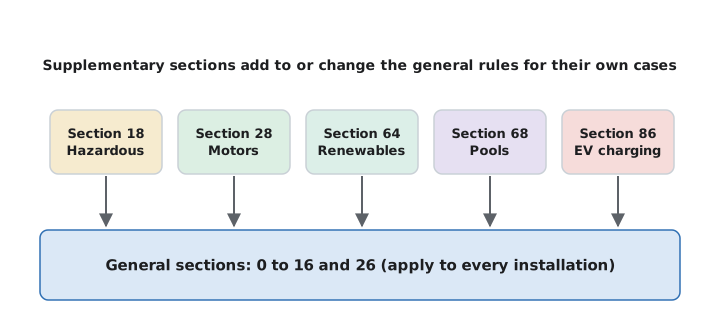
Why does this matter? Because the answer to a question about a special location usually needs both groups. Suppose a question asks about wiring in a commercial garage with fuel dispensing. The general wiring method rules in Section 12 still apply, but the supplementary section that deals with fuel dispensing and service stations adds requirements and changes some of the general ones. If you stop after Section 12, you will get the wrong answer. If you go straight to the supplementary section and ignore the general rules it does not change, you may also get it wrong. The skill is to start with the most specific section, then fall back to the general sections for anything it does not cover.
A map of the main sections
You do not need to memorize every section title, but you should know the main ones well enough to open the book at the right tab without thinking. The table below lists the sections that come up most often on master and contractor exams, using short descriptions. Check the full titles in your own copy and notice how they are worded; some are long because they cover several related kinds of installation.
| Section | Subject (short description) | Group |
|---|---|---|
| 0 | Object, scope and definitions | General |
| 2 | General rules | General |
| 4 | Conductors | General |
| 6 | Services and service equipment | General |
| 8 | Circuit loading and demand factors | General |
| 10 | Grounding and bonding | General |
| 12 | Wiring methods | General |
| 14 | Protection and control | General |
| 16 | Class 1 and Class 2 circuits | General |
| 26 | Installation of electrical equipment | General |
| 18 | Hazardous locations | Supplementary |
| 22 | Locations with corrosive liquids, vapours or excessive moisture | Supplementary |
| 24 | Patient care areas | Supplementary |
| 28 | Motors and generators | Supplementary |
| 32 | Fire alarm systems, smoke and carbon monoxide alarms, and fire pumps | Supplementary |
| 36 | High-voltage installations | Supplementary |
| 46 | Emergency power supply, unit equipment, exit signs and life safety systems | Supplementary |
| 62 | Fixed electric heating systems | Supplementary |
| 64 | Renewable energy and energy storage systems | Supplementary |
| 68 | Pools, tubs and spas | Supplementary |
| 76 | Temporary wiring | Supplementary |
| 84 | Interconnection of electric power production sources | Supplementary |
| 86 | Electric vehicle charging systems | Supplementary |
Note that motors, Section 28, is a supplementary section. Many people assume motors belong with the general rules because motors are everywhere. The Code treats them as particular equipment with their own requirements that modify the general conductor and overcurrent rules. That classification has practical consequences: when Section 28 gives a motor rule that differs from Section 4 or Section 14, the motor rule applies to the motor circuit.
Rules and their numbers
Inside each section, the requirements are set out as rules. A rule number has two parts joined by a hyphen. The first part is the section number. The second part is a three-digit number that places the rule within the section. So Rule 8-200 is in Section 8, and Rule 26-700 is in Section 26. When you see a rule number anywhere, in a question, an inspection report or a variance, the first part tells you which tab to open.
The second part is not a simple count. Within a section, rules are grouped by subject, and the groups usually start at round numbers. A section might use the 000s for its scope and general requirements, the 100s for one topic, the 200s for another, and so on, with gaps between rule numbers so new rules can be added later without renumbering the whole section. Many sections begin with a scope rule whose second part is 000, which tells you exactly what the section applies to. Reading the scope rule first is one of the best habits you can build, because it tells you immediately whether you are in the right place.
Each rule has a short heading in bold that summarizes what it covers. Headings are useful for scanning, but they are not part of the requirement, and they cannot be relied on to tell you everything the rule says. A rule headed with one subject can contain a subrule about something closely related. The only safe approach is to read the text of the rule, all of it.
Subrules, items and sub-items
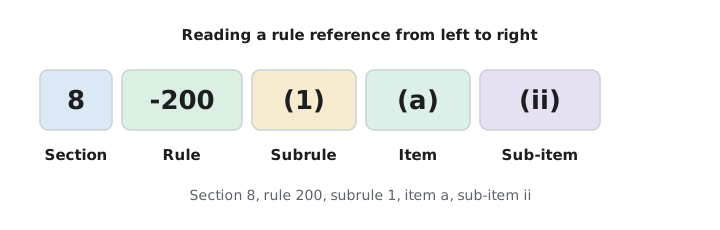
Longer rules are divided into subrules, numbered (1), (2), (3) and so on. A subrule is a complete requirement in itself, but it is read in the context of the whole rule. Subrules are often divided into items, lettered (a), (b), (c), and items can be divided again into sub-items, numbered with lower-case roman numerals (i), (ii), (iii). A full reference therefore looks like Rule 8-200(1)(a)(ii): Section 8, rule 200, subrule 1, item a, sub-item ii.
| Level | Looks like | Example reference | What it usually holds |
|---|---|---|---|
| Section | a number | Section 8 | One subject area |
| Rule | section-rule | Rule 8-200 | One requirement or closely related set of requirements, with a heading |
| Subrule | (1), (2) | Rule 8-200(1) | A complete requirement within the rule |
| Item | (a), (b) | Rule 8-200(1)(a) | A condition, a case or a step within the subrule |
| Sub-item | (i), (ii) | Rule 8-200(1)(a)(ii) | A further breakdown of an item |
The relationship between items matters. Items are often joined by the words and or or at the end of the second-last item. If the items are joined by and, all of them must be met. If they are joined by or, meeting any one is enough. It is easy to read straight past that one small word, especially when the items run over half a page. Lesson 8 returns to this in detail, because a surprising number of exam questions depend on it.
Subrules also have a typical order. The first subrule usually states the main requirement. Later subrules add conditions, give exceptions, or set out alternatives that are permitted in particular circumstances. If you read only subrule (1) and stop, you may miss a later subrule that permits exactly what the question describes. A good habit is to glance down to the end of the rule before deciding on an answer.
Cross-references
Rules refer to each other constantly. A rule might say that conductors must be sized in accordance with another rule, or that something is permitted except as required by a rule in a different section. These cross-references are part of the requirement. When a rule points you elsewhere, the rule you are pointed to becomes part of your answer. Cross-references are also one of the fastest ways to travel through the book: if you have found the right rule but not the detail you need, follow its references.
Cross-references between general and supplementary sections work in both directions. A supplementary section often says that its rules apply in addition to, or instead of, a named general rule. A general rule sometimes reminds you that a supplementary section has more requirements for a particular case. Following these links is how you assemble the full answer to a question that involves a special location or a particular piece of equipment.
Worked problem
Decoding a reference
An inspection report on the Hartley Farms grain-drying shop cites "Rule 28-106(1)". Without opening the book, what can Priya tell about the requirement, and where will she look?
Show solution
- The first part, 28, is the section: Section 28, motors and generators, a supplementary section.
- The second part, 106, places the rule in the early 100s of the section, the group dealing with conductors for motor circuits.
- The (1) means the report refers to the first subrule, usually the main requirement of the rule.
- She opens the motors tab, reads the scope rule of Section 28 to confirm it applies, then reads all of Rule 28-106, not just subrule (1).
Answer: It is a motor circuit conductor requirement in Section 28; read the whole of Rule 28-106 and check any rules it refers to.
Priya writes a small script to quiz herself on reading references. It splits a reference into its parts and says which group the section belongs to. It is a toy, but writing it forced her to state the structure precisely, which is the point. You can edit the list of references and run it again.
GENERAL = {0, 2, 4, 6, 8, 10, 12, 14, 16, 26}

def parse(ref):
    head, _, rest = ref.partition('(')
    section, rule = head.split('-')
    parts = [p.strip(')') for p in ('(' + rest).split('(') if p.strip(')')] if rest else []
    names = ['subrule', 'item', 'sub-item']
    info = {'section': int(section), 'rule': rule}
    for name, value in zip(names, parts):
        info[name] = value
    info['group'] = 'general' if int(section) in GENERAL else 'supplementary'
    return info

for ref in ['8-200(1)(a)(ii)', '28-106(1)', '26-700', '64-000']:
    d = parse(ref)
    detail = ', '.join(k + ' ' + str(d[k]) for k in ('subrule', 'item', 'sub-item') if k in d)
print(ref, '-> Section', d['section'], '(' + d['group'] + '), rule', d['rule'] + (', ' + detail if detail else ''))8-200(1)(a)(ii) -> Section 8 (general), rule 200, subrule 1, item a, sub-item ii 28-106(1) -> Section 28 (supplementary), rule 106, subrule 1 26-700 -> Section 26 (general), rule 700 64-000 -> Section 64 (supplementary), rule 000
Tables, diagrams and appendices in the structure
After the last section, the Code has a run of numbered tables, then diagrams, then the appendices. The tables are referred to by the rules: a rule tells you when to use a table, and the table gives you the values. The diagrams show things such as the configurations of receptacles and plugs. The appendices contain information that supports the rules, including Appendix B, which holds explanatory notes linked to particular rules. Lessons 5 and 6 cover these in depth. For now, notice that the tables are not inside the sections. A table used mainly by Section 4 sits in the table run at the back, with all the others.
The appendices are lettered. Some contain lists, some contain explanatory notes, some contain information for particular sections such as the alternative classification system for hazardous locations in Annex J18. The important structural point is that the appendices are informative unless a rule makes them mandatory. Appendix B can explain what a rule means, but it cannot add a requirement that the rule does not contain.
Common mistakes
MistakeReading only the bold heading of a rule.
InsteadHeadings summarize; the requirement is in the text, so read the whole rule.
MistakeStopping at Section 12 for a special location.
InsteadCheck whether a supplementary section adds to or changes the general rule for that location.
MistakeTreating motors as a general section.
InsteadSection 28 is supplementary and can modify the general conductor and overcurrent rules for motor circuits.
MistakeMissing the and or or that joins a list of items.
InsteadLook at the end of the second-last item to see whether all items or any one item must be met.
MistakeIgnoring a cross-reference because it points to another section.
InsteadA cross-referenced rule is part of the requirement; follow it.
Summary and key terms
- Sections are even-numbered from 0 to 86; each covers one subject.
- General sections (0 to 16 and 26) apply everywhere; supplementary sections (18 and higher, except 26) add to or change them for particular cases.
- A rule number is section-rule, such as 8-200; many sections start with a scope rule ending in 000.
- Rules divide into subrules (1), items (a) and sub-items (i); and/or between items decides whether all or any must be met.
- Tables, diagrams and appendices follow the sections; appendices are informative unless a rule makes them mandatory.
- General section
- One of Sections 0 to 16 and 26, which apply to all installations.
- Supplementary section
- A section from 18 upward (except 26) that supplements or amends the general sections for particular cases.
- Rule
- A numbered requirement, written as section-number hyphen rule-number.
- Subrule
- A numbered part of a rule, written (1), (2) and so on.
- Item
- A lettered part of a subrule, written (a), (b) and so on.
- Scope rule
- The rule at the start of a section stating what the section applies to.
Practice problems
Work each problem on paper first, then reveal the answer to check.
Which section group does Section 26 belong to, and why is that unusual?
Show answer
It is a general section, even though its number is higher than 18; the general sections are 0 to 16 plus 26.
Write out in words the reference 14-104(1)(b).
Show answer
Section 14, rule 104, subrule 1, item b.
A question involves wiring at a swimming pool. Which sections do you need?
Show answer
The supplementary section for pools, tubs and spas (68) first, then the general sections for anything it does not change.
Why do rule numbers within a section have gaps?
Show answer
So new rules can be added in a subject group without renumbering the section.
Can an Appendix B note create a requirement?
Show answer
No. Appendix B is informative; it explains the rules but cannot add requirements.
Lesson quiz · 5 questions
Score 60% or more to complete this lesson.
Create a free account to save your progress, take quizzes and earn a certificate.