
MELC-101 · Lesson 12 of 12 · 20 min
Timed code lookup practice
▶ Video coming soon A video version of this lesson is on the way.
Everything in this course comes together under time pressure. You know how the Code is structured, what the definitions do, where the general rules are, how to read tables and Appendix B, how to use the index, how to read a rule precisely, how to handle provincial changes and how to set up your book. This final lesson turns that knowledge into exam performance through timed practice: drills, a strategy for working through a paper, and a way of tracking your progress so that you know when you are ready.
It is week twelve of Priya's study plan. She has finished her content study and has two weeks of drills and three mock exams ahead. Denise's advice for these weeks is blunt: practise exactly the way you will be tested, with the book you will bring, at the desk size you will have, against the clock. Anything else is rehearsing for a different event.
Lookup drills
A lookup drill is a short question whose answer is a location in the Code: a section, a rule or a table. The goal is speed and accuracy in finding, not in answering a full technical question. Drills build the reflex of going straight to the right place. The table below is a set of twenty drills based on references used in this course. Time yourself on each, then check where you landed against the answer column. Do not just read the answers: find each one in your own book.
| Drill | Where to go |
|---|---|
| The current a conductor may carry in a raceway | Rule 4-004 and the ampacity tables (Tables 1 to 4) |
| Temperature limits at conductor terminations | Rule 4-006 |
| Correcting ampacity for a hot ambient | Rule 4-004 and Table 5A |
| Voltage drop limits | Rule 8-102, with Table D3 in Appendix D as a design aid |
| Maximum continuous loading of a circuit | Rule 8-104 |
| Minimum service or feeder for a single dwelling | Rule 8-200 |
| Demand load for an apartment building | Rule 8-202 |
| Rating of overcurrent devices protecting conductors | Rule 14-104 |
| Minimum size of a bonding conductor | Section 10 and Table 16 |
| Size of a grounding conductor | Section 10 and Table 17 |
| Conditions of use for a type of cable | Table 19 |
| Conditions of use for flexible cords | Tables 11A and 11B |
| Receptacle configuration for a given rating | The configuration diagrams after the tables |
| Whether uncertified equipment may be used | Rule 2-024 and the definition of approved in Section 0 |
| Clear space in front of a switchboard | Rule 2-308 |
| Permission to depart from a rule on one job | Rule 2-030 |
| Conductors for a single motor | Section 28, Rule 28-106 |
| Bonding around a swimming pool | Section 68 |
| Installing an EV charger | Section 86 (and Section 8 for loads) |
| A home battery with rooftop solar | Section 64 (and Section 84 for interconnection) |
Do the drills in a different order each time, and add your own. Better still, have a study partner write drills for you in plain language, without Code vocabulary, the way exam questions are written. Marcus writes Priya's drills as job-site descriptions: 'The new owner wants a plug for a welder in the shop. Which shape?' That forces her to translate before she searches, exactly as the exam will.
A strategy for the whole paper
On a full exam, the order in which you work matters almost as much as your lookup speed. A common and effective approach is to work in passes. In the first pass, answer every question you can answer quickly, either from knowledge or with a fast lookup, and mark any question that will take longer. In the second pass, work through the marked questions with full lookups, keeping an eye on your time budget. In the final minutes, check that every question has an answer, because a blank scores nothing and a guess may score something, unless your exam penalizes wrong answers, which most do not. Check your candidate information.
| Pass | What you do | Time guide (example) |
|---|---|---|
| First pass | Answer quick questions; mark slow ones with a symbol | About half the time |
| Second pass | Full lookups on marked questions, hardest last | Most of the remaining time |
| Final check | Make sure every question has an answer; revisit any you flagged as doubtful | The last 10 to 15 minutes |
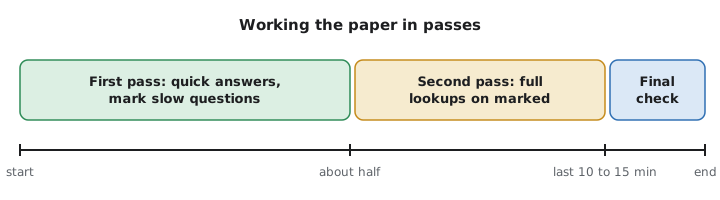
The passes protect you from the most common timing disaster: spending twenty minutes on a few hard questions early, then rushing the last twenty easy ones. They also give your mind time to work in the background. Many candidates find that a question that seemed impossible in the first pass is straightforward in the second, because a rule they read for a different question gave them the idea.
Handling the hard question
When a question is hard, separate the two kinds of difficulty. Sometimes you know which rule governs but the rule is complicated. Use the reading method from Lesson 8: requirement words, conditions, lists, cross-references, exceptions, facts. Sometimes you do not know which rule governs. Use the lookup routes from Lesson 7: section, index, table, and switch routes if one fails. If you are well over your time budget and still not close, choose your best answer, mark the question and move on.
Eliminating answer choices is often faster than finding the answer directly. If two choices contradict a rule you have just read, cross them out. If a choice uses an absolute word such as always or never and you know there are exceptions, it is often wrong. If two choices differ only at a boundary, the limit phrase in the rule decides between them. Even when you are not certain, narrowing four choices to two doubles your chance of a correct guess.
| Clue in the choices | What it suggests |
|---|---|
| Two choices contradict the rule | Eliminate both |
| Absolute words such as always or never | Often wrong if the rule has exceptions |
| Choices differ only at a boundary value | Check not less than versus greater than in the rule |
| One choice reflects the national rule, another a provincial amendment | For a provincial exam, check the amendment |
| A choice cites a deleted table or appendix | Likely wrong for the current edition |
Mock exams
Mock exams are full-length, timed practice papers taken in exam conditions: the right time limit, your prepared book, a permitted calculator, no phone, no interruptions. They test your stamina as well as your knowledge, which matters because a long open-book exam is tiring in a way that short drills are not. Take at least two or three, spaced a few days apart, and review each one carefully before taking the next.
The review is where most of the learning happens. For every question you got wrong, or got right by guessing, write down why. Was it a knowledge gap, a lookup failure, a misreading, a missed amendment, or a timing problem? The categories tell you what to fix in the days before the next mock.
| Error type | Example | Fix |
|---|---|---|
| Knowledge gap | Did not know the rule existed | Study that topic; add it to drills |
| Lookup failure | Knew the rule but could not find it in time | Drill that route; consider a tab |
| Misreading | Missed an except or an or | Practise the Lesson 8 method; highlight the word |
| Missed amendment | Answered from the national rule | Flag the amended rule |
| Timing | Ran out of time on the last questions | Use passes; enforce the time budget |
Worked problem
Reviewing a mock exam
Priya scores 68 out of 90 on her first mock. Of the 22 she missed, 5 were knowledge gaps, 8 were lookup failures, 6 were misreadings and 3 were questions she did not reach. Where should she focus before the second mock?
Show solution
- Add up the categories: 5 + 8 + 6 + 3 = 22, matching the questions missed.
- The largest category is lookup failures (8), so drilling the routes and tabs that failed comes first.
- Misreadings (6) are next; she reviews the reading method and highlights joining words and exceptions.
- Three unreached questions point to timing; she commits to the three-pass strategy.
- Knowledge gaps (5) get targeted study of the specific topics.
Answer: Lookup drills first, then precise reading, then timing, then the specific knowledge gaps.
Tracking readiness
Track your mock results and your drill times so you can see your progress and decide when you are ready. Priya records each mock's score and the time she had left, and her average drill time each week. The script below summarizes her three mocks. Change the numbers to your own results.
mocks = [
    # name, score, out of, minutes left at the end
    ('Mock 1', 68, 90, -6),
    ('Mock 2', 76, 90, 4),
    ('Mock 3', 81, 90, 12),
]
target = 0.80

for name, score, total, left in mocks:
    pct = score / total
    status = 'meets target' if pct >= target else 'below target'
    timing = 'finished with ' + str(left) + ' min spare' if left >= 0 else 'ran ' + str(-left) + ' min short'
    print(name, '|', score, 'of', total, '=', round(pct * 100), 'out of 100 |', status, '|', timing)

gain = mocks[-1][1] - mocks[0][1]
print('Improvement from first to last mock:', gain, 'questions')Mock 1 | 68 of 90 = 76 out of 100 | below target | ran 6 min short Mock 2 | 76 of 90 = 84 out of 100 | meets target | finished with 4 min spare Mock 3 | 81 of 90 = 90 out of 100 | meets target | finished with 12 min spare Improvement from first to last mock: 13 questions
Her trend is what Denise looks for: rising scores, and a shift from running out of time to finishing with time to spare. A pass mark is set by the exam body, so check your own; here Priya uses an 80 out of 100 personal target to give herself a margin over whatever the real pass mark is. When your mock scores are consistently above your target and you finish with review time, you are ready.
The last days before the exam
In the final days, stop adding new material. Do short drills to keep your speed, review your error log, and read the rules you got wrong in mocks one more time. Check that your book is complete and allowed, that you have a permitted calculator with fresh batteries, and that you know the exam location, start time and identification requirements. Sleep matters more than one more evening of study; a tired candidate misreads rules.
| Item | Check |
|---|---|
| Code book | Correct edition, tabbed, notes within the rules, frozen |
| Other documents | Only those allowed, current versions, tabbed |
| Calculator | Permitted model, tested, spare batteries |
| Identification and admission | As required by the exam body |
| Time plan | Budget per question and the three-pass strategy |
| Rest | A normal night's sleep before the exam |
On exam morning, Priya reads through her short list of red flags, the deleted tables and appendices, the words that change outcomes, and her province's flagged amendments, and then puts it away. In the exam room she opens her book, finds the index tab and the Section 8 tab once each to settle her hands, and starts the first pass. Whatever her result, she has done what this course set out to teach: she can find her way around the Code quickly, read it precisely and apply it with confidence.
The next course, MELC-102, builds on this foundation with the calculations that make up a large part of every master electrician exam: demand loads, conductor sizing, voltage drop, box fill, and transformer and motor sizing. Every calculation starts with finding the right rule and table, which you can now do.
A final word on confidence
Candidates often worry that open-book exams are designed to be impossible to finish. They are not. They are designed so that a candidate who knows the Code's structure, reads precisely and manages time can finish with a few minutes to spare. The drills, passes and mock exams in this lesson are how you become that candidate. Trust the process, keep your log honest, and judge your readiness by your results rather than by how you feel on a given evening.
Common mistakes
MistakeDoing drills without a timer.
InsteadTime every drill; speed is what you are building.
MistakeWorking the paper strictly in order.
InsteadUse passes: quick questions first, then the marked ones.
MistakeLeaving questions blank.
InsteadAnswer every question unless your exam penalizes wrong answers.
MistakeTaking mock exams without reviewing them.
InsteadClassify every error and fix the biggest category first.
MistakeStudying new material the night before.
InsteadReview, drill lightly, check your materials and sleep.
Summary and key terms
- Lookup drills build the reflex of going straight to the right section, rule or table.
- Work the paper in passes: quick answers, then marked questions, then a final check.
- Eliminate answer choices using rule wording, boundaries, amendments and outdated references.
- Take full mock exams in exam conditions and classify every error.
- You are ready when mock scores are consistently above your target and you finish with time to spare.
- Lookup drill
- A timed question whose answer is a location in the Code.
- Pass
- A run through the exam with a particular purpose, such as answering quick questions first.
- Mock exam
- A full-length, timed practice paper taken in exam conditions.
- Error log
- A record of mistakes classified by cause, used to plan further study.
- Readiness
- Consistent mock results above target with time left for review.
Practice problems
Work each problem on paper first, then reveal the answer to check.
Where would you go to find the minimum size of a bonding conductor?
Show answer
Section 10 and Table 16.
Where are the rules for installing an EV charger?
Show answer
Section 86, with Section 8 for the load calculation.
A mock shows most errors were misreadings. What should you practise?
Show answer
The precise reading method: requirement words, conditions, lists, exceptions; and highlight key words.
Why use a first pass for quick questions?
Show answer
To bank easy marks and avoid running out of time on easy questions at the end.
Priya scores 81 of 90 on a mock. What is that out of 100, rounded?
Show answer
About 90.
Lesson quiz · 5 questions
Score 60% or more to complete this lesson.
Create a free account to save your progress, take quizzes and earn a certificate.