
MELC-101 · Lesson 7 of 12 · 20 min
The index and fast lookup methods
▶ Video coming soon A video version of this lesson is on the way.
Knowing the Code's structure tells you where things should be. Finding a specific requirement in under a minute is a separate skill, and it is the one that most directly affects exam results. This lesson covers the three main ways into the book, how to use the index well, how to choose keywords, and how to measure and improve your own lookup speed. It is practical and repetitive by design: lookup speed comes from practice, not from reading about practice.
Priya starts a lookup log in week three of her study plan. Every time she looks something up during practice, she writes down what she was looking for, the route she took and how long it took. In the first week her average is just under four minutes. By the end of her fourteen-week plan it is under ninety seconds. The log, not any trick, is what made the difference: it showed her which routes worked and which wasted time.
Three ways into the book
There are three main routes to a requirement. The first is the section route: you know which section deals with the subject, you open that section, read its scope rule and scan the rule headings until you find the right rule. The second is the index route: you look up a keyword in the index at the back of the book, which lists rule numbers for each entry. The third is the table route: when the question is about a number, you go to the list of tables, find the right table, and use the rule that refers to it to check conditions.
| Route | Best when | Risk |
|---|---|---|
| Section route | You know which section governs the subject | Missing a rule in another section that also applies |
| Index route | The subject is specific or you do not know which section governs it | Choosing a keyword the index does not use |
| Table route | The answer is a number from a table | Using a table without its governing rule and notes |
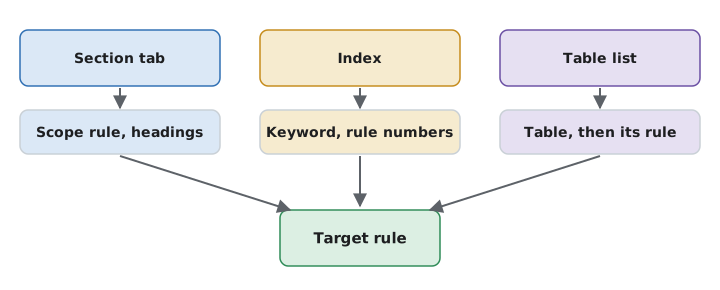
Experienced candidates switch between routes without thinking. If they know the section, they use the section route because it is fastest and shows them the neighbouring rules. If they are unsure, they use the index. If a question asks for a value, they go to the table and then confirm the rule. The worst approach is to pick one route and stick with it when it is not working. If you have spent a minute in a section without finding the rule, switch to the index.
How the index works
The index at the back of the Code lists subjects alphabetically, with the rule numbers where each subject is dealt with. Main entries are often broken into sub-entries. For example, a main entry for a type of equipment might have sub-entries for its installation, protection, grounding and location. Entries point to rules, tables, diagrams or appendices. Some entries send you to other entries with a see or see also reference, which is the index's way of saying that the Code uses a different term for what you looked up.
Spend twenty minutes reading the index the way you would read a book. You will notice the vocabulary the Code uses, which is not always the vocabulary used on site. You will see which subjects have long lists of rule numbers, which tells you they are spread across several sections, and which have only one or two. You will also find entries for things you did not know the Code addressed. That twenty minutes pays for itself many times over in the exam.
| Feature | What it looks like (described) | How to use it |
|---|---|---|
| Main entry | A subject, alphabetically placed | Start here with your keyword |
| Sub-entry | An indented aspect of the main subject | Narrow to the aspect your question is about |
| Rule numbers | References after an entry | Go to each; the first is not always the one you need |
| See reference | A pointer to a different term | Follow it; the Code uses that word instead |
| See also reference | A pointer to related entries | Check them when the first entry does not fully answer |
Choosing keywords
The most common reason an index search fails is a poor keyword. Questions are written in plain language, and the plain-language word may not be the one the Code uses. A question might say outlet when the Code uses receptacle for the device, or say garage heater when the relevant entries are under heating or space heating. A good habit is to ask: what is the thing, what is happening to it, and where is it? Then try the thing first, then the location, then the action.
| Question wording | Try first | Then try |
|---|---|---|
| Outlets in a bathroom | Receptacles (sub-entry for bathrooms) | Bathrooms; ground fault circuit interrupters |
| Cable buried under a driveway | Underground installations | Cables, depth; vehicular traffic |
| Panel in a closet | Panelboards, location | Clothes closets; working space |
| Heater in a pump house | Heating, fixed electric | Space heaters; damp locations |
| EV charger in a parkade | Electric vehicle charging | Garages; load calculations |
| Bonding a pool | Pools (bonding sub-entry) | Bonding |
Write down the keywords that worked and the ones that failed in your lookup log. After a few weeks you will notice patterns. Perhaps you always look under the location first and the Code usually files things under the equipment. Correcting that one habit can cut your average lookup time noticeably.
Following the trail
An index entry often lists several rule numbers. Do not stop at the first. Read the heading of each rule the entry lists and decide which matches the question. Once you are at a rule, use its cross-references and its neighbours. Rules on related topics are usually close together, so reading one rule above and one rule below the one you found often turns up a condition or exception that matters.
Worked problem
A lookup trail for the Riverbend Condos job
A practice question asks what limits apply to the location of an EV charger in a condo parkade where the floor is regularly wet from melting snow. Priya does not know immediately which rule governs.
Show solution
- She starts with the thing: the index entry for electric vehicle charging, which points to Section 86.
- She reads the scope rule of Section 86 to confirm it applies to the installation described.
- She scans the rule headings in Section 86 for location and protection requirements.
- She notices the wet floor and follows the trail to the rules on wet and damp locations and to the enclosure requirements in Section 2 and Section 22.
- She checks whether Section 86 modifies any of those general requirements before answering.
Answer: Start from the equipment in the index, confirm the section's scope, then follow cross-references for the location conditions.
Building speed: the lookup log
The lookup log is simple. For each practice lookup, write down the subject, the route you tried first, whether it worked, the route that finally worked, and the time. Once a week, look over the log. Which routes are fastest for you? Which subjects keep slowing you down? Which keywords failed? The answers tell you what to practise next week.
Priya keeps her log in a spreadsheet, but she also wrote a short script to summarize it. Here is a version with a small sample of her entries. You can add your own lines and run it again.
log = [
    # subject, first route, worked first time?, seconds
    ('dwelling demand load', 'section', True, 55),
    ('pool bonding', 'index', True, 70),
    ('working space', 'section', True, 40),
    ('cable in wet location', 'section', False, 210),
    ('ev charger load', 'index', True, 95),
    ('motor conductor size', 'section', True, 60),
    ('bonding conductor size', 'table', True, 45),
    ('heater in pump house', 'section', False, 240),
]

totals = {}
for subject, route, first_ok, secs in log:
    t = totals.setdefault(route, [0, 0, 0])
    t[0] += 1
    t[1] += secs
    t[2] += 1 if first_ok else 0

for route in sorted(totals):
    n, secs, ok = totals[route]
    print(route.ljust(8), 'lookups', n, '| average', round(secs / n), 's | worked first time', ok, 'of', n)

slow = [s for s, r, ok, secs in log if secs > 120]
print('Practise next week:', ', '.join(slow))index lookups 2 | average 82 s | worked first time 2 of 2 section lookups 5 | average 121 s | worked first time 3 of 5 table lookups 1 | average 45 s | worked first time 1 of 1 Practise next week: cable in wet location, heater in pump house
The sample tells a clear story. The section route is fast when it works, but when Priya guessed the wrong section for a location question she lost more than three minutes each time. The fix is not to abandon the section route, but to switch to the index sooner when a location is involved. Your log will tell you something different about your own habits, which is exactly why you keep it.
Time budgets
Exams have a fixed time and a fixed number of questions, so it helps to know your budget per question. Divide the time by the number of questions and subtract a margin for review. For example, if an exam allowed 180 minutes for 90 questions, the budget would be 2 minutes per question, and if you kept 20 minutes for review the working budget would fall to about 1.8 minutes. These numbers are an example only; use the figures in your own candidate information.
| Example exam (illustrative) | Total time | Questions | Review margin | Working budget per question |
|---|---|---|---|---|
| Exam A | 180 min | 90 | 20 min | about 1.8 min |
| Exam B | 240 min | 100 | 30 min | 2.1 min |
| Exam C | 150 min | 60 | 15 min | 2.25 min |
A budget changes how you handle a hard question. If a lookup has taken twice your budget and you are still not close, mark the question, choose your best answer, and move on. Come back to it in the review time. A single stubborn question should never cost you three easier ones at the end of the paper.
Drills
Lookup speed improves with short, frequent drills more than with long sessions. Ten lookups a day, timed, for a few weeks will do more than a weekend of reading. Mix the routes: some questions where the section is obvious, some where you must use the index, some that need a table. Have a study partner write questions for you, as Marcus and Priya do for each other, because questions you write yourself are too easy to find.
| Week | Drill focus | Target average |
|---|---|---|
| 1 to 2 | Section map: open the right section for 20 subjects | Under 30 s per subject |
| 3 to 4 | Index: find the rule for 10 plain-language questions a day | Under 3 min |
| 5 to 8 | Mixed routes, including tables and Appendix B | Under 2 min |
| 9 to 12 | Exam-style questions under time pressure | Within your budget |
| 13 to 14 | Full mock exams | Finish with review time to spare |
Speed without carelessness
Speed is the goal of this lesson, but speed that sacrifices accuracy is worthless. A fast lookup to the wrong rule scores nothing. The routes, keywords and logs in this lesson are about removing wasted time, such as searching the wrong section or flipping back and forth along the edge of the book, not about reading rules faster than you can understand them. Once you are at the right rule, slow down and read it with the care Lesson 8 describes.
Priya notices this in her own log. In week six her average lookup time drops sharply, but her accuracy on drills drops too, because she has started grabbing the first plausible rule rather than checking the index entry's other references. She adds a column to her log for whether the location she found was correct, and within a week her speed and accuracy are both improving again. Measure both, always.
Common mistakes
MistakeSticking with one route when it is not working.
InsteadIf a minute in a section has not found the rule, switch to the index.
MistakeSearching the index with site slang.
InsteadAsk what the thing is, where it is and what is happening; try the Code's terms.
MistakeStopping at the first rule number in an index entry.
InsteadCheck each listed rule's heading and choose the one that matches.
MistakeIgnoring neighbouring rules.
InsteadRead one rule above and below; conditions and exceptions are often nearby.
MistakeSpending ten minutes on one hard question.
InsteadMark it, give your best answer, and come back in review time.
Summary and key terms
- There are three routes into the Code: the section route, the index route and the table route.
- The index lists subjects with rule numbers, sub-entries and see references; read it once before the exam.
- Choose keywords by asking what the thing is, where it is and what is happening.
- A lookup log shows which routes and keywords work for you and where to practise.
- Set a time budget per question and move on when a lookup runs well over it.
- Section route
- Finding a rule by opening the governing section and scanning its rules.
- Index route
- Finding a rule by looking up a keyword in the index.
- Table route
- Going to a table for a value, then confirming the governing rule.
- See reference
- An index pointer to the term the Code uses instead.
- Lookup log
- A record of practice lookups, routes and times used to improve speed.
- Time budget
- The time available per question after allowing for review.
Practice problems
Work each problem on paper first, then reveal the answer to check.
A question asks about outlets in a laundry room. Which index entry would you try first?
Show answer
Receptacles, then look for a laundry-related sub-entry; then try laundry.
An exam allows 200 minutes for 100 questions and you keep 20 minutes for review. What is your working budget?
Show answer
180 minutes for 100 questions, 1.8 minutes per question.
Why read the rules just above and below the one you found?
Show answer
Related conditions, exceptions and permissions are often in neighbouring rules.
When is the table route the best first choice?
Show answer
When the answer is a number that comes from a table.
What should a lookup log record?
Show answer
The subject, the first route tried, whether it worked, the route that worked and the time.
Lesson quiz · 5 questions
Score 60% or more to complete this lesson.
Create a free account to save your progress, take quizzes and earn a certificate.