
MELC-101 · Lesson 6 of 12 · 21 min
Appendix B notes and Appendix information
▶ Video coming soon A video version of this lesson is on the way.
Behind the tables and diagrams sit the appendices, and many candidates barely open them. That is a mistake in both directions. Some candidates ignore Appendix B entirely and miss the explanations that make a confusing rule clear. Others treat Appendix B notes as if they were rules and choose answers based on guidance that has no mandatory force. This lesson sorts out what the appendices are, what each of the important ones is for, and how to use them quickly and correctly.
At the fifth study session, Tyler asks why the Code needs appendices at all. If something matters, why not put it in a rule? Denise gives a two-part answer. First, rules have to be short, precise and enforceable, which leaves no room for explanation, examples or background. Second, some useful information is not a requirement at all: lists of standards, tables of general data, alternative methods that a designer might find helpful. The appendices hold that material so that the rules can stay lean.
Informative, not mandatory
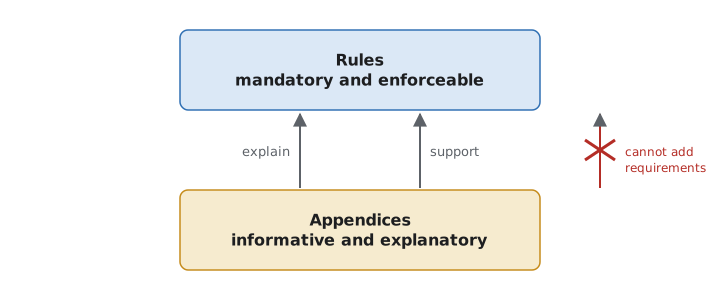
The single most important fact about the appendices is their status. In general, they are informative. They help you understand and apply the rules, but they do not add requirements of their own. A statement in an appendix cannot make something mandatory that the rules do not require, and it cannot permit something that the rules prohibit. Each appendix begins with a statement of its status; read that statement in your copy for each appendix you use, because the wording matters and there are some special cases, such as information a rule specifically incorporates.
On the exam, this distinction is tested directly and indirectly. A direct question might ask whether a particular Appendix B note is enforceable. An indirect question might describe an installation that follows a suggestion in Appendix B but violates a rule, or one that ignores an Appendix B suggestion while complying with every rule, and ask whether it complies. In both cases the rule decides, not the appendix.
Appendix B: notes on rules
Appendix B is the appendix you will use most. It contains explanatory notes linked to particular rules, arranged in the same order as the rules they explain. When a rule has an Appendix B note, the rule text says so, usually with a brief pointer such as a reference to Appendix B at the end of the rule or subrule. In Appendix B, the note is headed with the same rule number, so finding it is quick: note the rule number, flip to Appendix B, and run down the rule numbers until you reach it.
Appendix B notes do several kinds of work. Some explain the intent behind a rule, which helps when the wording could be read two ways. Some give examples of installations the rule is meant to cover. Some give calculation examples or methods. Some point to related rules, standards or other documents. Some describe acceptable ways to meet a performance requirement in the rule. None of them is a requirement in itself, but all of them help you understand what the requirement is.
| Kind of note | What it does | How it helps on the exam |
|---|---|---|
| Intent | Explains why the rule exists and what it is meant to achieve | Resolves which of two readings is correct |
| Examples | Describes situations the rule covers or does not cover | Lets you match the question's scenario to a known case |
| Calculation method | Shows how a calculation in the rule is carried out | Confirms your method on calculation questions |
| Cross-references | Points to related rules or standards | Leads you to the rest of the answer |
| Acceptable methods | Describes ways to meet a performance requirement | Shows what typically satisfies the rule |
Worked problem
Using an Appendix B note to settle a reading
A practice question asks whether a particular rule applies to an installation that is unusual but not clearly excluded. The rule's wording could be read narrowly or broadly, and two answer choices correspond to the two readings. The rule includes a pointer to Appendix B. What should Priya do?
Show solution
- Read the whole rule, including all subrules, and identify the words that allow two readings.
- Check Section 0 for any defined terms among those words.
- Follow the pointer to Appendix B and find the note headed with the same rule number.
- Read the note for statements of intent or examples that show whether this kind of installation is meant to be covered.
- Choose the answer that matches the rule as explained by the note, remembering the rule itself is the requirement.
Answer: Use the Appendix B note to understand which reading the rule intends, then answer on the basis of the rule.
How to use Appendix B quickly
Because Appendix B follows rule-number order, it is easy to use if you approach it from the rule. It is hard to use if you approach it from the subject, because a subject can be spread across several rules with notes scattered through the appendix. The efficient method is always: find the rule first, then go to its note. Many candidates mark the rules that have particularly useful Appendix B notes with a small symbol in the margin of the rule, so they know at a glance that an explanation is available. Lesson 11 covers what marking is allowed in exam books.
It is also worth reading Appendix B notes for the rules you use most, before the exam. Notes for the rules on dwelling-unit demand loads, voltage drop, conductor ampacity and grounding and bonding are often long and helpful. Reading them during study builds understanding; reading them for the first time during the exam costs time you may not have.
Other appendices worth knowing
Appendix B is not the only appendix you will use. The others vary in how often they appear on exams, but you should know what each important one contains so you can turn to it when you need it. The descriptions below are general; read the title and status statement of each appendix in your own copy.
| Appendix | General content | When you might use it |
|---|---|---|
| Appendix A | A list of the safety standards for electrical equipment referred to by the Code; the 2024 edition reinstated its annexes and an index | Identifying which product standard applies to a type of equipment |
| Appendix B | Notes explaining particular rules, in rule-number order | Understanding intent, examples and methods for a rule |
| Appendix D | Tabulated general information, including tables used in design such as voltage drop distance tables (Table D3) | Voltage drop and other design calculations |
| Annex J18 | An alternative classification system for hazardous locations, related to Section 18 | Questions about existing installations classified by the older class and division system |
| Other appendices | Information supporting particular sections or topics | Check the titles in your copy so you know what is there |
Appendix D is worth special mention because of Table D3, which gives distances for conductor sizes that keep voltage drop within limits for given currents. Rule 8-102 sets limits on voltage drop, and Table D3 offers a fast way to check whether a run is within them without calculating from first principles. Because Table D3 is in an appendix, read the conditions that go with it carefully; it is a convenient tool, not a substitute for the rule.
Annex J18 is a different kind of appendix. Section 18 classifies hazardous locations using a zone system for gases and vapours. Annex J18 provides requirements based on the older class and division system, which is still found in many existing installations. When a question describes an existing plant classified under the older system, Annex J18 is where the matching requirements are. The 2024 edition substantially revised sealing requirements in both Section 18 and Annex J18, so older notes and questions on sealing may be out of date.
The 2024 edition also deleted one appendix entirely, Appendix K. If your study material refers to Appendix K, check whether the information it cited has moved or been removed. This kind of change is easy to miss when you move from one edition to the next, which is why Lesson 10 is devoted to edition changes.
The Handbook is not an appendix
A common confusion is between Appendix B and the CE Code Handbook. The Handbook is a separate publication, CSA C22.1HB, that explains the reasoning behind many rules, often at greater length than Appendix B, with diagrams and examples. Like Appendix B, it is not mandatory. Unlike Appendix B, it is not part of the Code book, and exam rules usually do not allow you to bring it into the exam room. Use the Handbook for study, especially for rules you find hard to understand, but build your exam skills around the Code book itself, including its appendices.
| Feature | Appendix B | CE Code Handbook |
|---|---|---|
| Part of the Code book | Yes | No, separate publication |
| Mandatory | No | No |
| Organized by | Rule number | Section and rule, with commentary |
| Allowed in most exams | Yes, as part of the Code book | Usually not; check your candidate information |
| Best use | Quick explanation during the exam | Deeper study before the exam |
Appendices and provincial amendments
Provinces sometimes amend appendices as well as rules, or add their own explanatory material in bulletins and interpretation documents. In Alberta, electrical STANDATA documents interpret rules and explain how they are applied in the province. In Ontario, the Electrical Safety Authority publishes bulletins that explain how particular rules of the Ontario Electrical Safety Code are applied. These documents can be more important than Appendix B for a provincial exam, and some exams allow candidates to bring them. Lesson 9 covers this layer in detail.
The principle is the same as for Appendix B. Interpretive documents explain how a rule is applied; they do not create new rules unless the provincial law gives them that force. When a provincial document and Appendix B seem to say different things about how to apply a rule, the provincial document usually reflects how the rule is enforced in that province. For a provincial exam, that is often the answer the exam expects.
Priya builds a habit from this lesson that she uses for the rest of her study. Whenever she reads a rule that has an Appendix B pointer, she reads the note immediately and writes a single word in her study notebook to capture what kind of note it is: intent, example, method, reference or acceptable method. After a month she has a list of about sixty rules with useful notes, and she knows which ones are worth a quick look under exam pressure.
Appendix B in the study group
Denise runs one Tuesday session entirely on Appendix B. She gives each person five rules that have Appendix B notes and asks them to read the rule, predict what the note will say, and then read the note. The exercise is revealing. For some rules, the note says exactly what everyone expected and adds little. For others, the note explains a purpose that nobody had guessed, which changes how they read the rule. Marcus, for instance, had always read one of the dwelling-unit rules as applying only to new houses; the Appendix B note showed that its intent was broader.
The exercise also shows how varied the notes are in length. Some are a single sentence. Others run to a page or more, with examples and calculations. Long notes are worth reading during study, when there is time to absorb them, so that during the exam you remember the gist and can confirm a detail in seconds. Short notes are quick enough to read in the exam itself.
By the end of the session, the group agrees on a practical rule for exam day: if a question is about a rule with an Appendix B pointer, and you are uncertain after reading the rule twice, spend thirty seconds on the note. If the note settles it, answer. If it does not, rely on the rule and move on. Appendix B is a tool for resolving uncertainty, not a place to start your search.
Gord adds an inspector's perspective. When he was in the field, contractors sometimes quoted an Appendix B note to argue that an installation was acceptable. He always took the note seriously as an explanation of intent, but the decision was based on the rule. The same balance applies on the exam.
Common mistakes
MistakeTreating an Appendix B note as a requirement.
InsteadAppendix B is informative; the rule is the requirement.
MistakeSearching Appendix B by subject.
InsteadFind the rule first, then go to the note with the same rule number.
MistakeUsing Table D3 without reading its conditions.
InsteadCheck the conditions and remember Rule 8-102 sets the actual limits.
MistakeExpecting to bring the Handbook into the exam.
InsteadThe Handbook is a separate study aid; most exams do not allow it.
MistakeRelying on material that cites Appendix K.
InsteadAppendix K was deleted in 2024; check where any information went.
Summary and key terms
- Appendices are generally informative: they explain and support rules but do not add requirements.
- Appendix B holds notes on particular rules, in rule-number order, flagged by a pointer in the rule.
- Appendix A lists equipment standards; Appendix D holds general tables such as Table D3; Annex J18 covers the older hazardous location system.
- The 2024 edition reinstated Appendix A annexes, revised Annex J18 sealing and deleted Appendix K.
- The Handbook is a separate, non-mandatory study aid, usually not allowed in the exam.
- Informative appendix
- An appendix that explains or supports the rules without adding requirements.
- Appendix B
- Explanatory notes on particular rules, arranged by rule number.
- Appendix D
- Tabulated general information, including Table D3 on voltage drop distances.
- Annex J18
- Requirements based on the older class and division system for hazardous locations.
- Interpretation document
- A provincial document, such as a STANDATA or bulletin, explaining how rules are applied.
Practice problems
Work each problem on paper first, then reveal the answer to check.
A rule ends with a pointer to Appendix B. What do you do?
Show answer
Go to Appendix B and find the note headed with the same rule number, then read it alongside the rule.
Can an installation fail to comply because it ignored an Appendix B suggestion but met every rule?
Show answer
No; Appendix B is informative, so compliance depends on the rules.
Which appendix would help with voltage drop distances?
Show answer
Appendix D, Table D3, used alongside Rule 8-102.
An existing refinery is classified using classes and divisions. Where are the matching requirements?
Show answer
Annex J18, related to Section 18.
Why read Appendix B notes during study rather than only in the exam?
Show answer
They build understanding and show which notes are worth checking quickly under time pressure.
Lesson quiz · 5 questions
Score 60% or more to complete this lesson.
Create a free account to save your progress, take quizzes and earn a certificate.