
MELC-101 · Lesson 4 of 12 · 21 min
Section 2: general rules
▶ Video coming soon A video version of this lesson is on the way.
If Section 0 tells you what the words mean, Section 2 tells you the ground rules that apply to every installation before any other section has its say. It is a general section in the fullest sense. Its rules cover the administration of electrical work, the use of approved equipment, the marking of equipment, protection against injury and fire, the working space around equipment, and a range of installation basics that would otherwise have to be repeated in every other section.
Gord tells the study group that in thirty years of inspections, more of his deficiency notices cited Section 2 than any other section. Blocked panels, missing labels, equipment that was not approved, enclosures used outside their ratings: these are Section 2 problems, and they turn up on every kind of job. Exam writers know this, which is why a well-prepared candidate knows Section 2 nearly as well as Section 26.
How Section 2 is organized
Section 2 is long, and its rules are grouped by subject like every other section. Open your copy and look at the headings in order. Broadly, the early rules deal with administrative matters, such as permits, plans, inspection and the use of approved equipment. A later group deals with the marking of equipment. Another group covers protection of persons and property, including guarding of live parts and the use of enclosures. Others deal with maintenance, the working space around equipment, the protection of equipment in particular environments, and the flame-spread properties of wiring in buildings. Write the headings on a sheet as you go; it is a fast way to build a mental map of the section.
| Subject group (paraphrased) | What it deals with | Typical exam angle |
|---|---|---|
| Administration | Permits, plans, inspection, approval of equipment | Whether work may proceed and whether equipment may be used |
| Deviation or postponement | How the inspection authority may allow an alternative | Who can authorize a departure from a rule |
| Marking of equipment | Nameplate information and identification | What information must appear and where |
| Protection of persons and property | Guarding of live parts, enclosures, protective measures | Whether live parts are adequately guarded |
| Maintenance and operation | Keeping installations in safe condition | Responsibilities after installation |
| Enclosures and environment | Enclosure types, IP designations, corrosive and wet conditions | Whether an enclosure suits the location |
| Working space | Clear space around equipment for work and escape | Required depth, width, height and access |
| Fire safety of wiring | Flame spread properties of cables and wiring | Which cables may be used in which building types |
Administration: permits, plans and inspection
The Code contains rules about permits, plans and inspection, but this is one area where provincial and territorial law usually takes over. The legislation that adopts the Code often has its own permit system, sets out who may obtain a permit, and changes or replaces the Code's administrative rules. In Alberta, permits are obtained under the Safety Codes Act system, and holders of a Master Electrician Certificate of Competency are among those who may obtain electrical permits. The Ontario Electrical Safety Code has extensive Ontario-specific rules about notifications and inspections.
For the exam, the lesson is to know both layers. A national-level question about Section 2's administrative rules expects the Code's answer. A provincial exam may expect the provincial answer, which may be in an amendment or in separate legislation that you are allowed to bring. Lesson 9 shows how to keep the two layers straight.
Approved equipment
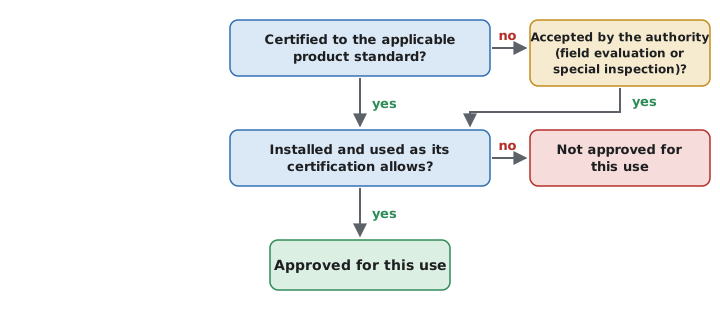
One of the most frequently tested ideas in Section 2 is that electrical equipment used in an installation must be approved. Rule 2-024 sets out this requirement. In general, approved equipment has been certified by an accredited certification organization as meeting the applicable product standard, usually a Part II standard, and carries that organization's mark. Provinces may also allow equipment to be approved through field evaluation or special inspection when it has not been certified in the usual way.
Approval has a second half that people forget: equipment must be installed and used in accordance with its certification. A device certified for dry locations is not approved for a wet location just because it carries a mark. A luminaire certified for a particular mounting method is approved only when mounted that way. Exam questions often describe certified equipment being used outside its listing and ask whether the installation complies.
Worked problem
Imported equipment on the Gaetz Avenue job
The dental clinic owner buys a dental chair with a built-in control panel online from overseas. It has no Canadian certification mark. The clinic wants Parkland Valley to connect it. What should Priya do?
Show solution
- Identify the governing requirement: equipment must be approved before use (Rule 2-024 and the definition of approved in Section 0).
- Check the chair, control panel and nameplate for the mark of an accredited certification organization.
- Finding none, she cannot treat it as approved by certification.
- Ask about field evaluation or special inspection, which many provinces accept as a route to approval for uncertified equipment.
- Do not connect it until the approval question is settled with the owner and the inspection authority.
Answer: Do not connect uncertified equipment; arrange field evaluation or special inspection, or replace it with approved equipment.
Marking of equipment
Rules in the 2-100 range deal with the information that must be marked on electrical equipment, such as the maker's name or trademark, the ratings in volts and amperes or watts, the frequency, and other information that the installer and inspector need. Other marking rules deal with identifying disconnecting means, circuits in panelboards and similar equipment so that a person can tell what each device controls. On site this is the difference between a panel directory that says 'kitchen counter, east' and one that says 'misc'.
Marking questions tend to be practical. A question might describe a panelboard with an incomplete directory and ask which rule is not met, or describe a disconnect that serves equipment out of sight and ask what marking is required. The answer is usually in Section 2, sometimes reinforced by a supplementary section with its own marking requirements.
Protection of persons and property
Section 2 contains the general requirements for guarding live parts so that people cannot accidentally contact them, and for protecting equipment from mechanical damage. Live parts are generally required to be enclosed or guarded unless they are in a room or space accessible only to qualified people. Equipment exposed to damage must be protected or located where damage is unlikely. These requirements are intentionally general. They give the inspection authority the basis to deal with hazards that no specific rule anticipated.
The 2024 edition added requirements aimed at reducing arcing fault clearing times for certain equipment. The idea is that the longer an arc lasts, the more energy it releases and the more severe the injury to a worker nearby. Measures that reduce the clearing time, such as particular protective settings or arc energy reduction systems, reduce that energy. This is a good example of how the Code responds to worker safety research, and new rules like this are popular exam material. Read the new requirements in your copy and note which equipment they apply to.
Enclosures and the environment
Enclosures must suit the environment they are installed in. The Code recognizes enclosure types and, as clarified in the 2024 edition, ingress protection designations, the IP codes that describe protection against solids and water. An enclosure suitable for a dry indoor location may fail quickly in a wash bay or a dusty grain-handling building. Section 2 sets the general expectation; supplementary sections such as Section 22 for corrosive and wet locations and Section 18 for hazardous locations set more specific requirements.
| Location (example) | Environmental concern | Enclosure question to ask |
|---|---|---|
| Office ceiling space | Dust, accidental contact | Is a general-purpose indoor enclosure enough? |
| Clearview car wash bay | Direct water spray, chemicals | Is the enclosure rated for hose-directed water and corrosion? |
| Hartley Farms grain shop | Combustible dust, moisture | Is the area classified? Is the enclosure suitable for dust? |
| Riverbend Condos parkade | Vehicle exhaust, road salt, impact | Is the enclosure suitable for damp, corrosive conditions and protected from impact? |
Working space around equipment
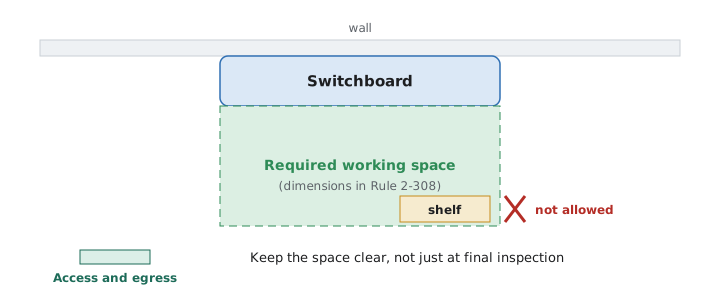
Rule 2-308 deals with the working space that must be kept clear around electrical equipment so that people can work on it safely and get away quickly if something goes wrong. It addresses the depth of clear space in front of equipment, its width and height, and access to and egress from the space, with stricter requirements as equipment gets larger or voltages higher. Look up the exact dimensions and conditions in your own copy rather than relying on figures you remember from earlier editions; working space rules are a common target for edition changes and for exam questions.
Working space is also a maintenance issue. A panel that had perfect clearance at final inspection can be boxed in by shelving a month later. In the basement panel example from Lesson 3, the problem was partly one of access and partly one of working space. Questions often describe a room layout and ask whether the space in front of a switchboard is adequate, or whether a second exit is needed.
Using Section 2 with the rest of the Code
Because Section 2 is general, its rules apply alongside the more specific rules elsewhere. A supplementary section may add to a Section 2 requirement, for example by requiring a higher degree of enclosure protection in a hazardous location, or it may modify one. When a question concerns a special location, check whether the supplementary section addresses the issue. If it does not, the Section 2 rule applies unchanged.
A practical way to remember this is to think of Section 2 as the background that is always there. Whatever else a question is about, it may also be about approval, marking, guarding, enclosures or working space. When you read a scenario on the exam, run a quick Section 2 check: is the equipment approved and used as certified, is it marked, are live parts guarded, is the enclosure suitable, and is there working space? That five-point check catches a surprising number of answers.
| Check | Ask yourself | Where to look |
|---|---|---|
| Approval | Is the equipment certified or accepted, and used as its certification allows? | Rule 2-024 and Section 0 definition of approved |
| Marking | Is the required information and identification present? | Marking rules in the 2-100 range |
| Guarding | Are live parts enclosed or guarded? | Protection of persons and property rules |
| Enclosure | Does the enclosure suit the environment? | Enclosure rules, IP designations, plus Sections 18 or 22 |
| Working space | Is there enough clear space and a way out? | Rule 2-308 |
Section 2 on the Aspen Ridge bungalow
Priya runs the five-point check on the Aspen Ridge bungalow before final inspection, the way she will run it on exam scenarios. Approval: every device and luminaire carries a certification mark, and the bathroom fan is rated for the shower enclosure it sits over. Marking: the panel directory in the main house names every circuit by room and use, and the suite's panel has its own directory. Guarding: the unfinished furnace room has no exposed live parts, and the temporary cover plates from rough-in are gone. Enclosure: the exterior receptacle by the patio has a cover suitable for a wet location while in use. Working space: here she finds a problem. The homeowner has built a storage shelf into the space in front of the suite's panel.
The shelf is a small thing, but it is exactly the kind of item an inspector writes up, and exactly the kind of detail an exam question hides in a description. Priya points it out to the owner, who moves the shelf to the opposite wall. Tyler asks why it matters when the panel can still be reached. Priya answers with the reasoning from Rule 2-308: working space is not only about reaching the equipment, it is about standing safely in front of it while working, and being able to step back or leave if something goes wrong.
On the exam, the same scenario might appear as a paragraph describing a basement suite, with the shelf mentioned in passing, and four answer choices about which rule is not met. A candidate who has practised the five-point check will spot it in seconds. A candidate who is focused on the suite's load calculation may never see it.
Common mistakes
MistakeAssuming a certification mark means the equipment is approved for any use.
InsteadApproval also requires installation and use in line with the certification.
MistakeAnswering a provincial administrative question with the national rule.
InsteadPermit and inspection rules are often replaced by provincial law; check your province.
MistakeQuoting working space dimensions from memory.
InsteadLook them up in the current edition; they change and have conditions.
MistakeForgetting Section 2 when a question is about a special location.
InsteadSection 2 still applies unless the supplementary section changes it.
MistakeIgnoring the 2024 arcing fault clearing time requirements.
InsteadNew rules are frequent exam topics; read them and note what equipment they cover.
Summary and key terms
- Section 2 sets the general ground rules that apply to every installation.
- Rule 2-024 requires approved equipment, installed and used as its certification allows.
- Marking rules require equipment information and identification of circuits and disconnects.
- Rule 2-308 deals with working space, which must be kept clear for work and escape.
- The 2024 edition added arcing fault clearing time requirements and clarified IP designations.
- Approved equipment
- Equipment certified to the applicable standard, or accepted by the inspection authority, and used as certified.
- Field evaluation
- An inspection of uncertified equipment that can lead to its acceptance.
- Working space
- The clear space required around electrical equipment for safe work and egress.
- IP designation
- An ingress protection code describing protection against solids and water.
- Arcing fault clearing time
- How long an arc lasts before protection interrupts it; shorter times mean less energy.
Practice problems
Work each problem on paper first, then reveal the answer to check.
Name the five quick Section 2 checks for any scenario.
Show answer
Approval, marking, guarding of live parts, enclosure suitability, and working space.
A luminaire certified for dry locations is installed under an open carport. What is the problem?
Show answer
It is not being used as its certification allows, so it is not approved for that location.
Who usually sets the permit system in practice?
Show answer
The province or territory, through the legislation that adopts the Code.
Why might working space requirements change between editions?
Show answer
They are revised in response to safety experience; always check the current edition.
What does the second digit of an IP code describe?
Show answer
Protection against water.
Lesson quiz · 5 questions
Score 60% or more to complete this lesson.
Create a free account to save your progress, take quizzes and earn a certificate.