
MELC-101 · Lesson 1 of 12 · 24 min
How the CE Code is written and adopted
▶ Video coming soon A video version of this lesson is on the way.
Every electrical installation in Canada is measured against one document more than any other: the Canadian Electrical Code, Part I, published by CSA Group as CSA C22.1. Electricians call it the CE Code, the code book, or simply the Code. If you are preparing for a master electrician or electrical contractor exam, the Code is not just something you have used on the job. It is the main reference you will carry into the exam room, and your result will depend heavily on how quickly and how accurately you can find your way around it.
This course is the first of six in the Canadian core of the master electrician exam prep program. It does not try to teach the content of every rule. The later courses do that: MELC-102 covers calculations, MELC-103 wiring methods and overcurrent protection, MELC-104 grounding and bonding, MELC-105 motors, hazardous locations and special installations, and MELC-106 the business side and exam strategy. This course teaches the skill that sits underneath all of them: knowing how the Code is built, how it becomes law, how to read it precisely, and how to find the right rule, table or note in a minute or two when the clock is running.
A note before we start. The CE Code is a copyrighted standard. This course never reproduces its wording, its tables or its diagrams. It names sections, rules and tables by number and explains what they deal with in plain language. Any numbers you see in worked examples are labelled as illustrative. You need your own copy of the current edition, and you should have it open beside you for every lesson. Reading about the Code without the book in front of you is like learning to drive from a manual: useful, but nothing like the real thing.
Meet the study group
The course follows a small group of people from Parkland Valley Electric Ltd., an electrical contractor in Red Deer, Alberta. Parkland Valley has eighteen people and does residential, light commercial and agricultural work across central Alberta. Its owner, Gord Tremblay, has held his Master Electrician Certificate for thirty years and plans to retire within three. The company needs another certificate holder so it can keep obtaining electrical permits after he steps back, and that is where our candidate comes in.
| Person | Role | Where they fit in |
|---|---|---|
| Priya Raman | Red Seal construction electrician, lead hand at Parkland Valley | The candidate. Five years as a journeyperson, strong on residential work, nervous about hazardous locations |
| Marcus Okafor | Journeyperson electrician at Parkland Valley | Priya's study partner. Industrial background from oil sands shutdowns, less sure of dwelling-unit rules |
| Denise Lafleur | Retired electrical safety codes officer | Twenty-two years as a municipal inspector. Runs a Tuesday-night study group for exam candidates |
| Gord Tremblay | Owner and Master Electrician | Wants a successor certificate holder; shares war stories from inspections |
| Tyler Chen | Third-year apprentice | Asks the questions every apprentice asks, which turn out to be good exam questions |
Priya has used the Code for eight years, but mostly in the way most electricians do: she knows the handful of rules that come up on residential jobs almost by heart, and she looks up the rest when an inspector or a foreman asks. At her first study session Denise gives the group a short test: ten questions, open book, fifteen minutes. Priya answers six. She knew the answers to two of the ones she missed but could not find the rules in time. That gap, between knowing and finding, is what this course closes.
What the CE Code is, and what it is not
The CE Code Part I is a safety standard for electrical installations. It sets the minimum requirements for installing and maintaining electrical equipment in buildings, structures and premises so that people are protected from shock and fire hazards. It covers work at all voltages, and its scope reaches beyond ordinary buildings to things such as factory-built relocatable structures and certain marine vessels that stay connected to shore power for long periods. It specifically leaves out some installations that are regulated in other ways, such as the generation, transmission and distribution systems owned by electric utilities, electric railway power circuits, and aircraft. Mines and quarries have their own CSA standard that works alongside it.
Three features of the Code shape how you should read it. First, it is a minimum standard. Meeting the Code means an installation is acceptable for safety, not that it is the best possible design. A good designer often goes further, for example by sizing conductors to limit voltage drop more than the Code requires. Second, it is a performance-oriented document written by consensus, so its rules are drafted to cover many kinds of installation at once. That is why so many rules contain conditions, exceptions and references to other rules. Third, it is an installation code. It tells you how to install and protect equipment. It does not tell you how to manufacture equipment; that is the job of the product standards.
| Document | What it covers | Who uses it most |
|---|---|---|
| CE Code Part I (CSA C22.1) | How electrical installations must be installed and protected | Electricians, contractors, designers, inspectors |
| CE Code Part II (the C22.2 series of product standards) | How electrical products must be built, tested and marked | Manufacturers, certification bodies |
| CE Code Part III (CSA C22.3 series) | Outside wiring: overhead and underground power and communication lines | Utilities, line contractors |
| CE Code Handbook (CSA C22.1HB) | Explanations of the reasoning behind the Part I rules | Learners, instructors, anyone interpreting a rule |
| Provincial or territorial regulation | Adopts the Code into law, with any amendments | Everyone working in that province or territory |
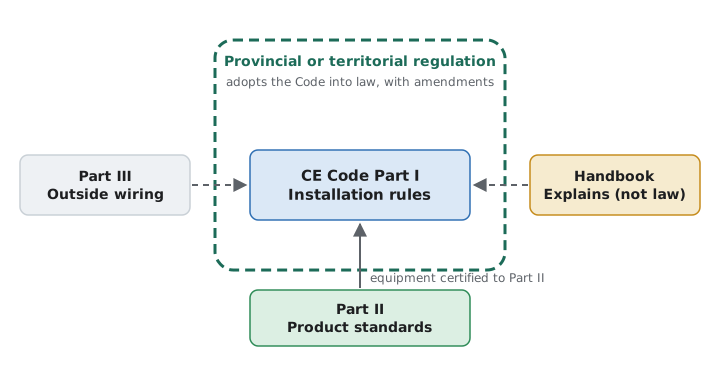
The link between Part I and Part II matters on the exam more often than people expect. Part I requires that electrical equipment be approved before it is used, and an approved product is one that has been certified to the applicable Part II standard by an accredited certification organization, or accepted in another way the provincial authority allows. When a question asks whether a piece of equipment may be installed, the first thing to establish is whether it is approved. Lesson 4 looks at the general rule that sets this requirement.
Who writes the Code
The CE Code is not written by government. It is developed by a technical committee of volunteers under CSA Group's standards development process, which is accredited by the Standards Council of Canada. The main committee is supported by subcommittees, each responsible for one or more sections of the Code. Members come from every part of the electrical industry: provincial and territorial regulators, electric utilities, manufacturers, contractors, designers, labour, insurers and other interested groups. The committee is balanced so that no single interest can dominate, and decisions are made by consensus.
Anyone can propose a change. A proposal, often called a subject, is submitted with the suggested new wording and the reasons for it. The responsible subcommittee studies it, may revise it, and makes a recommendation. The main committee then votes. Proposed changes are also published for public review so that people outside the committee can comment before they are final. Many of the changes in each edition start with a field problem: an inspector notices a type of fire or shock incident, a new technology arrives on the market, or installers find a rule impossible to apply in practice.
This process explains a habit you will notice in the Code's language. Because a rule must be acceptable to regulators, manufacturers, contractors and labour all at once, it is drafted carefully and often narrowly. Words such as shall, permitted and except have exact meanings, and a single word can change the outcome of a question. Lesson 8 is devoted to reading rules precisely, and it starts from this point: the wording was argued over by a committee, so it deserves to be read with care.
A new edition every three years
The Code is revised on a regular cycle, with a new edition published every three years. The current edition at the time of writing is the 26th edition, CSA C22.1:24, usually called the 2024 Code. Its technical content was approved at committee meetings in 2023, and it was published in 2024. The 25th edition was the 2021 Code, the 24th was the 2018 Code, and the next edition is expected in 2027. Each edition replaces the previous one completely; it is not a supplement.
| Edition | Designation | Common name |
|---|---|---|
| 24th | CSA C22.1-18 | 2018 CE Code |
| 25th | CSA C22.1-21 | 2021 CE Code |
| 26th | CSA C22.1:24 | 2024 CE Code (current at the time of writing) |
| 27th | expected 2027 | next edition |
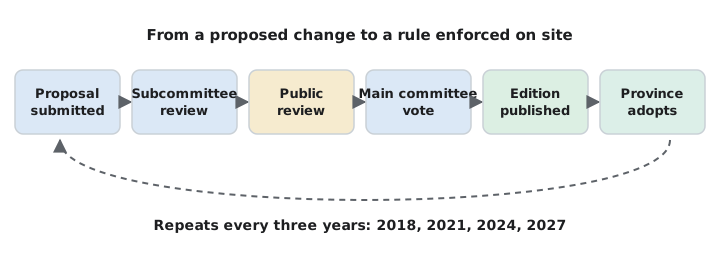
The edition date and the date the edition becomes law are not the same. A new edition has no legal force until a province or territory adopts it, and adoption usually comes some months after publication. During the gap, the previous edition remains the law. This creates a classic exam trap and a classic field trap. If a question says it is based on the edition in force in your province, you need to know which edition that is. On the job, the edition that applies to an installation is normally the one in force when the permit was issued, not the newest book on the shelf.
Alberta offers a good example of the gap. The 2024 edition was published in 2024, and Alberta declared the 26th edition in force on April 1, 2025. Work permitted before that date was generally inspected against the 2021 edition. Other provinces and territories adopted the 2024 edition on their own timelines, some with amendments. Your exam candidate guide will tell you which edition your exam is based on; check it before you buy or tab a book.
How the Code becomes law
On its own, the CE Code is just a standard. It becomes enforceable when a province or territory adopts it by reference in a regulation made under its electrical safety legislation. In Alberta the Code is adopted under the Safety Codes Act. In Ontario, the Ontario Electrical Safety Code, which is the CE Code with Ontario amendments, is adopted as a regulation and administered by the Electrical Safety Authority. British Columbia adopts it as the BC Electrical Code, administered by Technical Safety BC. Quebec incorporates it into Chapter V, Electricity, of its construction code. The other provinces and territories each have their own adopting legislation.
| Layer | Example in Alberta | What it does |
|---|---|---|
| Statute | Safety Codes Act | Creates the legal framework, the permit system and the authority to adopt codes |
| Regulation | The regulation that declares the CE Code in force | Names the edition that applies and any Alberta variations |
| The Code | CSA C22.1:24, 26th edition | The technical requirements |
| Interpretations and variances | Alberta electrical STANDATA and variances | Explain how rules are applied and authorize alternatives |
| Local enforcement | Accredited municipalities and agencies | Issue permits and carry out inspections |
Provinces may adopt the Code exactly as published, or with amendments that add, delete or change rules to suit local conditions. When an amendment exists, the amended rule is the law in that province, and an exam set by that province will expect the amended answer. Lesson 9 shows how to find amendments, interpretations and variances, and how to mark them in your book so they are impossible to miss under pressure.
Enforcement also differs. Some provinces run inspections directly through a provincial agency. Others delegate inspection to accredited municipalities or corporations. In Alberta, many municipalities are accredited to administer the electrical discipline, and electrical safety codes officers issue permits and inspect work in those areas. Whatever the system, the person who decides whether an installation complies is the inspection authority, often called the authority having jurisdiction. When the Code leaves something to the judgment of the inspection authority, it is that office's decision that counts.
What this means for the exam
Licensing exams for master electricians and electrical contractors across Canada share a common shape. They are usually open book, which means you may bring the edition of the Code the exam is based on, and often some related legislation, but only clean hard copies with limited notes. Ontario's Electrical Safety Authority, for example, allows candidates to bring the current Ontario Electrical Safety Code and the relevant legislation, and a non-programmable calculator, and checks the books for notes that go beyond clarifying the Code's own content. Other jurisdictions have similar rules. The details change, so always read the current candidate information for your exam.
Open book does not mean easy. The questions are designed so that a candidate who knows the Code well can find the answer, and a candidate who has to search from scratch will run out of time. Many questions combine two or three rules, or a rule and a table, or a rule and a definition. Some test whether you notice an exception. Others test whether you know that an amendment changes the national rule. The skills you will practise in this course are exactly the ones these questions reward.
| Skill | Lesson | Why it matters on the exam |
|---|---|---|
| Knowing where each subject lives | 2 | You go straight to the right section instead of searching |
| Applying definitions | 3 | Many answers turn on one defined word |
| Knowing the general rules | 4 | Section 2 applies to every installation and is tested often |
| Reading tables and their notes | 5 | Tables carry numbers; notes change them |
| Using Appendix B | 6 | Explains intent; not mandatory |
| Fast lookup | 7 | The index and your own aids save minutes per question |
| Precise reading | 8 | Exceptions and conditions decide close questions |
| Amendments | 9 | Your province may have changed the national rule |
| Edition changes | 10 | New rules are favourite exam topics |
| A tabbed book | 11 | Physical speed under pressure |
| Timed practice | 12 | Turns knowledge into exam performance |
Worked problem
Which edition applies?
Gord pulls a permit in Red Deer on February 10, 2025 for a shop addition. Rough-in inspection happens on May 2, 2025. Priya asks which edition of the Code the inspector will use. What is the usual answer, and what should she do to be sure?
Show solution
- The 2024 edition was declared in force in Alberta on April 1, 2025.
- The permit was issued on February 10, 2025, before that date, when the 2021 edition was still in force.
- The usual practice is that work is inspected against the edition in force when the permit was issued, so the 2021 edition normally applies.
- Transition arrangements are set by the province and can include specific provisions, so she should check the Alberta notice for the new edition or ask the safety codes officer.
Answer: Normally the 2021 edition, because the permit predates April 1, 2025; confirm against the province's transition notice or with the inspector.
Tyler asks a fair question at this point. If the Code changes every three years and each province adopts it differently, how can anyone keep up? Denise's answer is the theme of this course. You do not need to memorize the Code. You need a reliable map of how it is organized, a habit of reading every rule completely, and a way of checking your province's changes. With those, a new edition is a few weeks of updating, not a fresh start.
Common mistakes
MistakeAssuming the newest edition on the shelf is the law.
InsteadCheck which edition your province has declared in force, and which edition applies to the permit.
MistakeTreating the Handbook as part of the Code.
InsteadThe Handbook explains the rules but has no legal force; the Code and the provincial regulation govern.
MistakeIgnoring provincial amendments when answering exam questions.
InsteadLearn where your province publishes its amendments and mark them in your book.
MistakeThinking that meeting the Code means the design is optimal.
InsteadThe Code is a minimum safety standard; good design may exceed it.
MistakeBringing an annotated or photocopied book to the exam without checking the rules.
InsteadRead the candidate information; many exams allow only clean hard copies with limited notes.
Summary and key terms
- The CE Code Part I (CSA C22.1) is the national minimum safety standard for electrical installations; the current edition at the time of writing is the 26th, the 2024 Code.
- It is written by a balanced volunteer committee through CSA Group's accredited consensus process and revised every three years.
- Part II product standards certify equipment; Part I requires equipment to be approved and tells you how to install it.
- The Code becomes law only when a province or territory adopts it, sometimes with amendments; Alberta declared the 26th edition in force on April 1, 2025.
- Licensing exams are usually open book, but they reward fast, precise lookup more than memory.
- CE Code Part I
- CSA C22.1, the national installation safety standard for electrical work in Canada.
- Part II
- The C22.2 series of product standards used to certify electrical equipment.
- Approved
- Equipment that meets the applicable product standard and is certified or accepted as the province requires.
- Adoption
- The legal act by which a province or territory makes a Code edition enforceable.
- Amendment
- A provincial change that adds, deletes or modifies a national rule.
- Inspection authority
- The office that issues permits, inspects work and decides questions of compliance.
Practice problems
Work each problem on paper first, then reveal the answer to check.
Name the three parts of the CE Code and what each covers.
Show answer
Part I: installation of electrical equipment; Part II: product standards for equipment; Part III: outside wiring such as overhead and underground lines.
Why might a 2024 edition question have a different answer from a 2021 edition question?
Show answer
Each edition revises rules; a rule may have been added, changed or deleted between editions.
Which document has legal force in a province: the CE Code, the Handbook or the provincial regulation?
Show answer
The provincial regulation, which adopts the Code (with any amendments) into law. The Handbook has no legal force.
A product has no certification mark. What question should you ask before it is installed?
Show answer
Whether it is approved, meaning certified to the applicable Part II standard or accepted by the inspection authority.
Where would you find out which edition your exam is based on?
Show answer
In the current candidate information or exam guide from the body that runs the exam.
Lesson quiz · 5 questions
Score 60% or more to complete this lesson.
Create a free account to save your progress, take quizzes and earn a certificate.