
MELC-101 · Lesson 11 of 12 · 20 min
Building a tabbed and annotated code book
▶ Video coming soon A video version of this lesson is on the way.
On exam day your code book is your most important tool, and like any tool it works best when it is set up properly. A well-tabbed book opens at the right place on the first try. A book with sensible annotations reminds you of cross-references, amendments and traps at the moment you need them. A badly prepared book, with too many tabs, illegible notes or prohibited material, can slow you down or even get you turned away at the door. This lesson shows how to prepare a book that is fast, legal and yours.
Priya prepares her book over two weekends in week four of her study plan, once she knows the structure of the Code well enough to decide what deserves a tab. She uses it for every drill and every mock exam after that, adjusting it as she learns where she hesitates. By exam day the book feels like an extension of her hands.
Start with the rules for your exam
Before you put a single tab in your book, read the candidate information for your exam about what you may bring and how it may be marked. Rules differ between jurisdictions and change over time. Some exams allow tabs and highlighting but limit written notes; others allow notes only if they clarify the Code's own content. Ontario's Electrical Safety Authority, for example, allows the current Ontario Electrical Safety Code and relevant legislation in hard copy, allows notes that clarify concepts in the Code but not notes on other material, and checks candidates' materials. Your exam may be stricter or looser.
| Question to answer from your candidate information | Why it matters |
|---|---|
| Which edition of the Code is the exam based on? | Your tabs and notes must match it |
| Are printed copies of an electronic edition accepted? | Some exams accept only original hard copies or watermarked prints |
| Are tabs and highlighting allowed? | Usually yes, but confirm |
| What kind of handwritten notes are allowed? | Often limited to clarifying Code content; no worked answers |
| May you bring legislation, bulletins or interpretations? | If yes, prepare and tab them too |
| What calculator is allowed? | Often non-programmable only |
| Will materials be inspected? | Prohibited notes can mean losing the book or the attempt |
A tab plan
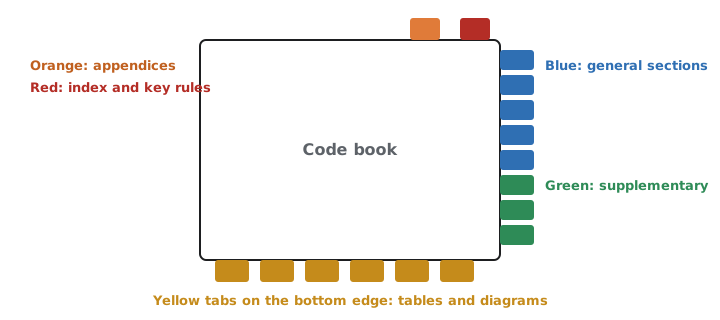
Tabs work best when they follow a plan. Random tabs added whenever you happen to look something up end up crowded, inconsistent and hard to read. A plan decides in advance what gets a tab, where the tab goes and what colour it is. Priya's plan, which follows Denise's advice, uses colour to show the structure of the book at a glance.
| Colour | What it marks | Example tabs |
|---|---|---|
| Blue | General sections (0 to 16 and 26) | Sections 0, 2, 4, 6, 8, 10, 12, 14, 16, 26 |
| Green | Supplementary sections she uses | Sections 18, 22, 28, 32, 46, 62, 64, 68, 86 |
| Yellow | Tables and diagrams | Tables 1 to 4, 5A, 5C, 8, 16, 17, 19, the receptacle diagrams |
| Orange | Appendices | Appendix B start, Appendix D, Annex J18 |
| Red | Index and frequently used rules | Index start, and key rules such as 8-200 and 26-700 |
Position matters as much as colour. Many candidates put section tabs down the side edge, table tabs along the bottom or top edge, and appendix tabs in a different position again, so that tabs of different kinds never overlap. Stagger tabs of the same kind so each is visible. Write the label on both sides of the tab so it can be read whether the book is open to the left or the right.
How many tabs?
More tabs are not always better. Each extra tab makes the edge of the book more crowded and makes each individual tab slightly harder to find. A useful rule of thumb is to tab what you look up often and what is hard to find, and nothing else. Sections are easy to find once you know their order, so some candidates tab only the sections they use most. Tables are harder to find because they are numbered in a long series, so they often deserve a tab each. Rules that are deep inside long sections, such as dwelling-unit demand loads or receptacle requirements, can justify their own tabs.
Priya ends up with about sixty tabs. Marcus tries eighty-five and finds he spends time hunting along a crowded edge, so he removes the tabs he has not used in two weeks of drills. That is a sensible test: if you have not used a tab in a fortnight of practice, it probably does not need to be there.
plan = {
    'blue (general sections)': 10,
    'green (supplementary sections)': 9,
    'yellow (tables and diagrams)': 18,
    'orange (appendices)': 4,
    'red (index and key rules)': 17,
}
used_last_two_weeks = {
    'blue (general sections)': 10,
    'green (supplementary sections)': 8,
    'yellow (tables and diagrams)': 15,
    'orange (appendices)': 3,
    'red (index and key rules)': 12,
}
total = sum(plan.values())
print('Tabs planned:', total)
for colour, n in plan.items():
    unused = n - used_last_two_weeks[colour]
    print(colour.ljust(32), n, 'tabs,', unused, 'not used in two weeks')
print('Candidates for removal:', sum(plan[c] - used_last_two_weeks[c] for c in plan))Tabs planned: 58 blue (general sections) 10 tabs, 0 not used in two weeks green (supplementary sections) 9 tabs, 1 not used in two weeks yellow (tables and diagrams) 18 tabs, 3 not used in two weeks orange (appendices) 4 tabs, 1 not used in two weeks red (index and key rules) 17 tabs, 5 not used in two weeks Candidates for removal: 10
Highlighting
Highlighting helps when it is sparing and consistent. Highlight the words that change outcomes, such as except, unless, not less than, and the joining and or or in long lists, and the defined terms that most often decide answers. Do not highlight whole rules. A page covered in highlighter is as hard to scan as a page with none. Some candidates use one colour for requirements and another for exceptions and conditions, matching the scheme from Lesson 8.
| Highlight | Why |
|---|---|
| except, unless, notwithstanding | Exceptions and overrides are easy to miss |
| and / or at the end of long lists | Decides whether all or any items must be met |
| Numerical limits with not less than / not more than | The boundary often decides the answer |
| Key defined terms in rules you use often | Reminds you to check Section 0 |
| Rules with useful Appendix B notes (a small symbol) | Reminds you an explanation exists |
Annotations
If your exam allows notes, keep them short, factual and tied to the Code's own content. Useful annotations include cross-references that the Code does not make obvious, such as a note beside a general rule pointing to a supplementary section that changes it for a special location; flags for provincial amendments with the amendment number; and reminders of related tables. Avoid anything that looks like a worked answer, a formula sheet copied from a study guide, or notes on material outside the Code, since these are exactly what exam rules usually prohibit.
| Annotation | Usually acceptable? | Comment |
|---|---|---|
| A cross-reference such as "see Section 68 for pools" | Often yes | Clarifies Code content |
| A provincial amendment flag with its number | Often yes | Check the rules for your exam |
| A note of which table a rule uses | Often yes | Clarifies Code content |
| A worked example of a calculation | Often no | Goes beyond clarifying the Code |
| Notes on business law or safety regulations | Often no | Outside the Code; bring the legislation itself if allowed |
| Answers to practice questions | No | Clearly prohibited |
Write neatly, in pencil or fine ink, and small enough not to obscure the Code text. An inspector of exam materials needs to see at a glance that your notes are acceptable. If you are unsure whether a note is allowed, leave it out.
Worked problem
Deciding what to annotate
Priya keeps missing that a general wiring rule she uses for the Clearview car wash job is modified by the supplementary section on wet and corrosive locations. What annotation, if any, should she add?
Show solution
- Check the exam rules: notes that clarify Code content are allowed; worked answers are not.
- A cross-reference beside the general rule, pointing to the relevant rule in Section 22, clarifies Code content.
- She writes a short note in the margin: the section and rule number to check for wet or corrosive locations.
- She does not add a description of the car wash or the answer to a practice question.
- She tests the note in her next drill to confirm it helps.
Answer: A short cross-reference to the supplementary rule, written beside the general rule, is useful and usually acceptable.
Other documents
If your exam allows legislation, interpretation documents or bulletins, prepare them with the same care as the Code. Tab the parts you use, flag the provisions that come up in questions, and make sure every copy is the current version. Keep them in the same order every time you study, so that in the exam room you reach for the right document without thinking. If loose documents are allowed, a binder clip or folder keeps them together and stops them sliding off a small exam desk.
Test and refine
A tabbed book is not finished when the last tab goes on. Use it for every drill and mock exam, and notice where you hesitate. A tab you keep missing may need to move or change colour. A rule you keep searching for may deserve a tab. A note you never read can come out. Priya makes small changes to her book every week until the final two weeks, then freezes it so that her hands learn exactly where everything is.
| Week | What Priya does to her book |
|---|---|
| 4 | Initial tab plan and tabbing over two weekends |
| 5 to 8 | Adds tabs for rules she searches for repeatedly; removes unused tabs |
| 9 to 12 | Adds amendment flags and cross-references; tests them in drills |
| 13 to 14 | Freezes the book; no more changes so her hands learn the positions |
Looking after the book
A code book takes a beating over months of study. Tabs come unstuck, pages crease, and the binding weakens. Use good-quality tabs that are rated to stay attached, reinforce heavily used tabs with clear tape if your exam allows, and store the book flat. Bring the book you have practised with to the exam; this is not the day to start with a fresh copy. If your exam requires an original printed copy, make sure the copy you have prepared meets that requirement well before exam day.
A quick test of your book
Once your book is prepared, give it a quick test. Have a study partner call out twenty locations at random: a section, a table, a rule, the start of Appendix B, the index. Open the book to each one as fast as you can and time the whole set. Repeat the test each week. If any single location takes noticeably longer than the others, that is a sign the tab is missing, poorly placed or hidden behind others.
Priya's first test takes just over four minutes for twenty locations. After two weeks of adjusting tabs and practising, it takes under ninety seconds. The improvement comes partly from the tabs and partly from her hands learning where things are, which is why freezing the book in the last two weeks matters. A tab that moves the night before the exam is a tab your hands no longer know.
Marcus makes one more discovery during these tests. He has been tabbing in a hurry and some tabs are labelled on one side only, so when the book is open to the back half he cannot read them. Relabelling both sides takes ten minutes and saves several seconds on every lookup in the back half of the book, where the tables and appendices are. Small details like this add up over a long exam.
Common mistakes
MistakeTabbing before reading the exam rules.
InsteadCheck what marking and documents are allowed first.
MistakeAdding tabs at random as you study.
InsteadFollow a plan with colours and positions.
MistakeTabbing everything.
InsteadTab what you use often and what is hard to find; remove unused tabs.
MistakeWriting worked answers or formula sheets in the margins.
InsteadKeep notes to short clarifications of Code content, if notes are allowed.
MistakeChanging the book the night before the exam.
InsteadFreeze it in the last two weeks so your hands learn the positions.
Summary and key terms
- Read the exam rules on books, notes and documents before preparing anything.
- Use a tab plan with consistent colours and positions for sections, tables, appendices and key rules.
- Tab what you use often and what is hard to find; about sixty tabs works for many candidates.
- Highlight sparingly: exceptions, joining words, limits and defined terms.
- Test the book in drills, refine it, then freeze it before the exam.
- Tab plan
- A predetermined scheme deciding what gets a tab, where and in what colour.
- Annotation
- A short handwritten note in the book, allowed only within the exam's rules.
- Cross-reference note
- A margin note pointing to a related rule the reader might otherwise miss.
- Freeze
- Stopping changes to the book in the final weeks so its layout becomes automatic.
Practice problems
Work each problem on paper first, then reveal the answer to check.
Name three things to check in your candidate information before tabbing.
Show answer
For example: the edition, whether tabs and highlighting are allowed, and what notes are allowed.
Why put table tabs on a different edge from section tabs?
Show answer
So different kinds of tab do not overlap and each is easy to see.
Marcus has 85 tabs and keeps hunting along the edge. What should he do?
Show answer
Remove tabs he has not used in recent drills.
Is a worked calculation in the margin usually acceptable?
Show answer
Usually not; notes are typically limited to clarifying Code content.
When should you stop changing your book?
Show answer
In the final two weeks before the exam.
Lesson quiz · 5 questions
Score 60% or more to complete this lesson.
Create a free account to save your progress, take quizzes and earn a certificate.