
LES-211 · Lesson 9 of 12 · 21 min
Privacy, publication bans and youth records
▶ Video coming soon A video version of this lesson is on the way.
Two days after the robbery, a parent in the Lindell towers posted a photo on a neighbourhood social media group showing Devon Hart being walked to a police car, with the caption 'This is the kid who robbed a boy at the park. Keep your kids away.' The post was shared more than two hundred times before the group's moderator took it down. Bell tells the class that the post was not posted by police, and that the parent who posted it may well have committed an offence under section 138 of the YCJA. But what police themselves may disclose about young people is tightly limited, and those limits follow a young person's records for years. This lesson covers publication bans, youth records and the sharing of information.
The publication ban in section 110
Section 110(1) prohibits publishing the name of a young person, or any other information related to a young person, if it would identify them as a young person dealt with under the Act. Publishing includes broadcasting and posting online. The ban applies to everyone, including media, police, parents and members of the public. Section 111 adds a separate ban on publishing information that would identify a young person as having been a victim of, or a witness in connection with, an offence committed or alleged to have been committed by a young person. Ben, as a young victim, is protected by section 111. Under section 138, contravening these provisions is an offence.
The ban has exceptions. Under section 110(2), it does not apply when a young person receives an adult sentence, or when a youth justice court lifts the ban after imposing a youth sentence for a violent offence under section 75, if the court is satisfied that publication is appropriate considering the purpose of the ban. Under section 110(4), a youth justice court judge, on application by a peace officer, can permit publication of identifying information for up to five days if there is reason to believe the young person is dangerous to others and publication is necessary to help apprehend them. Bill C-14, the Bail and Sentencing Reform Act passed in June 2026, adds a new power allowing police to publish such information without a court order in an urgent situation, if all of three criteria are met: the young person is an imminent danger and publication could help prevent serious bodily harm or death, publication is necessary to apprehend them, and a court order could not be obtained with reasonable diligence; a court order is needed for publication beyond 24 hours. Some of Bill C-14's YCJA amendments come into force on dates set by the government, so officers must check whether this power is in force before using it. And under section 110(3), a young person can publish their own information after turning 18, if they are not in custody.
Youth records and the access periods
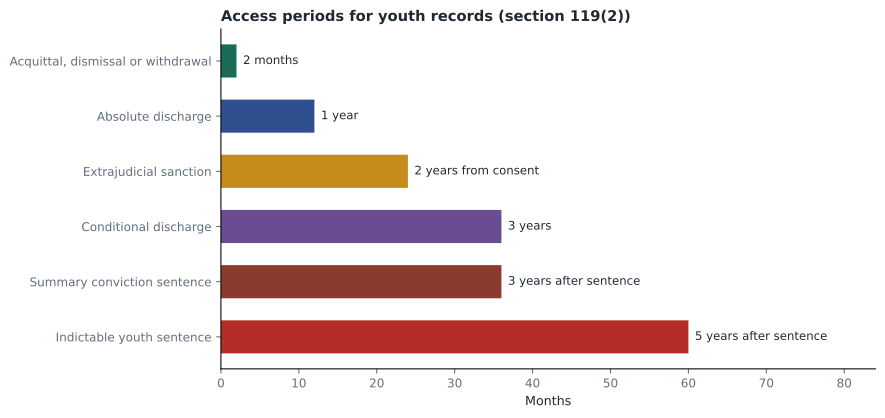
Part 6 controls who may keep and see youth records. Police, courts and government agencies may keep records under sections 114 to 116, but under section 118, no one may be given access to a record, and no information in it that would identify the young person may be disclosed, except as authorized by the Act. Section 119(1) lists the people who may have access during the access period, including the young person, their counsel and parents, the Attorney General, the victim, police for investigation or administration purposes, and others with a valid interest. When the access period ends, the record is closed: under section 119(2), that is two years after the young person consents to an extrajudicial sanction, two months after an acquittal or a dismissal or withdrawal, one year after an absolute discharge, three years after a conditional discharge, three years after the youth sentence is completed for a summary conviction offence, and five years after the youth sentence is completed for an indictable offence. If a young person commits a new offence during an access period, the period is extended. If they are convicted of an offence as an adult during the period, under section 119(9), the youth record is treated as an adult criminal record. Bill C-14 also amends some of the records provisions, including access to police investigation records, on dates to be set, so officers should follow their service's current guidance.
Noah's and Devon's records
Noah's record is an extrajudicial sanction record. It can be accessed by the people in section 119 for two years from the date he consented to the sanction, June 22, 2026, so until June 22, 2028. After that, it is closed. Because the sanction was completed, there is no finding of guilt. Devon's record is a youth sentence for robbery, an indictable offence. His probation ends on September 10, 2027, so the access period ends five years later, on September 10, 2032, as long as he commits no new offence. If he is convicted of an offence as an adult before then, his youth record will become part of his adult record.
# Compute when records close or can be sealed, using the cases' dates.
from datetime import date
def add_years(d, n):
    return d.replace(year=d.year + n)
def add_months(d, n):
    m = d.month - 1 + n
    return d.replace(year=d.year + m // 12, month=m - (m // 12) * 12 + 1)
ejs_consent = date(2026, 6, 22)
sentence_end = date(2027, 9, 10)
print("ca, Noah's sanction record closes:", add_years(ejs_consent, 2))
print("ca, Devon's indictable youth record closes:", add_years(sentence_end, 5))
print("us, Devon may apply to seal from:", add_months(sentence_end, 6))ca, Noah's sanction record closes: 2028-06-22 ca, Devon's indictable youth record closes: 2032-09-10 us, Devon may apply to seal from: 2028-03-10
Bell says date arithmetic like this is the kind of thing officers get wrong when they guess. Records units use systems that calculate access and sealing dates automatically, but officers should understand the rules well enough to know when a result looks wrong.
Sharing information about young people
The YCJA allows some sharing of information when it is needed for safety or rehabilitation. Under section 125(6), the provincial director, a youth worker, the Attorney General, a peace officer or any other person engaged in providing services to young persons may disclose information in a youth record to any professional or other person engaged in the supervision or care of the young person, including a representative of a school board or school, if the disclosure is necessary to ensure compliance with a court order, to ensure the safety of staff, students or other persons, or to facilitate the rehabilitation of the young person. Under section 125(7), the person who receives the information must keep it separate from other records, ensure no one else has access to it, and destroy it when it is no longer needed for the purpose. Bell used this provision to tell Eastgate Secondary's principal about the no-contact conditions in Devon's release, so the school could keep Devon and Ben apart, but did not give the principal any other details.
Desjardins emphasizes the officer's own conduct. Officers must not discuss youth cases with friends or family, post about them on social media, or confirm details to reporters. A casual comment at a community meeting that 'the Hart kid is the one who did the park robbery' could breach section 110 and section 118, and could also undermine the young person's rehabilitation and the community's trust in police. When the parent's social media post appeared, Port Ardent did not comment on it publicly. Ferreira contacted the group's moderator, who removed it, and Bell spoke to the parent who had posted it and explained the law; no charge was laid.
Records and a young person's future
Students often ask what a youth record actually means for a young person's future. Once the access period ends, a youth record is closed, and a young person applying for a job or a school does not have to disclose it; in general, a police records check for employment will not show a closed youth record. During the access period, the record is not part of the adult criminal record system, and most employers are not entitled to see it, although some government agencies and the young person themselves can. A vulnerable sector check, required for work with children or other vulnerable people, is governed by the Criminal Records Act and police policy, and can raise more complicated questions. Travel can also be affected: other countries' border officials may ask about arrests and charges, and Canada's youth record rules do not bind them.
Bell tells students that a young person's record is often a matter of how carefully officers wrote and filed it years earlier. A diversion entered as a charge, a warning recorded as an arrest, or a sealing order never applied to an officer's own notes can follow a person long after the law says it should not. He has twice in his career had to help a young adult correct a record that should have been closed or sealed: once when a warning had been entered in the wrong field of the records system, and once when an officer's working copy of a report was found in an old case folder years after the case was sealed. Desjardins adds that the reverse error matters too. A record that is closed or sealed too early, or entered under the wrong name, can deprive the next officer of information the law says they are entitled to see, such as a previous extrajudicial measure or diversion that should inform the next decision.
Information about young people and the media
High-profile youth cases attract intense media attention, and police communications staff have to balance the public's interest in information with the law. Police can usually confirm that an incident occurred, that young people have been arrested or charged, the general nature of the charges, and when a court appearance is scheduled, without identifying anyone. They can describe what the public should do, such as contacting police with information. They should not release details that, combined with other information, would identify the young person: their school, their exact street, a parent's name, a photograph or a distinctive description. In a small community, even the age and the neighbourhood can be identifying, and officers should think about what the details mean in context. When Port Ardent issued a short news release about the park robbery, it said only that two male youths had been arrested, that one had been released and one held for a hearing, and that the investigation was complete.
Desjardins notes that the YCJA's approach, which protects identity by default and opens it only in defined circumstances, is stricter than the approach in most American states, and that officers who move between jurisdictions, or read American news coverage of youth cases, should not assume the same rules apply here. In Canada, the ban attaches automatically, and no one needs to ask a court for it.
Worked problem
A request for information
A local reporter calls the station and asks for the names of the two teenagers arrested in the park robbery, saying the information is already on social media. A school principal calls the same day asking whether Devon is 'dangerous' and whether he should be suspended. How should the officer respond?
Show solution
- The reporter cannot be given any identifying information; section 110 prohibits publication and section 118 prohibits disclosure, whether or not the names are already online.
- The officer can confirm general information that does not identify the youths, such as that two teenagers were arrested and the case is before the court.
- The principal can be given information needed for safety or to ensure compliance with conditions, under section 125(6), such as the no-contact conditions, but not a general assessment of Devon's character or history.
- The suspension decision belongs to the school, under its own policies.
- Record what was disclosed, to whom and why.
Answer: Give the reporter nothing that identifies the youths; give the school only what safety and compliance require.
Common mistakes
MistakeOnce a young person's name is on social media, the ban no longer matters.
InsteadThe ban still applies to everyone, including police and media; repeating the name is still publishing.
MistakeYouth records are destroyed when the young person turns 18.
InsteadAccess periods depend on the outcome and run from the event, not from the young person's age.
MistakeA school can be told everything about a student's police contacts.
InsteadOnly what is needed for safety, compliance or rehabilitation, and the school must protect it.
MistakeThe rules on records only affect court staff.
InsteadPolice keep many of the records and must follow the access, sealing and disclosure rules.
Summary and key terms
- Section 110 bans publishing information identifying a young person dealt with under the Act; section 111 protects young victims and witnesses.
- Exceptions include adult sentences, lifted bans for violent offences, and court-approved publication for dangerous young persons at large; Bill C-14 adds an urgent police power when in force.
- Section 119 sets access periods from two months to five years depending on the outcome; after that the record is closed.
- A new adult conviction during the access period makes the youth record an adult record.
- Information may be shared with schools and caregivers only when needed for safety, compliance or rehabilitation.
- Officers must not discuss or post about youth cases.
- Publication ban
- A prohibition on publishing information that identifies a person.
- Youth record
- A record kept under Part 6 of the YCJA about a young person dealt with under the Act.
- Access period
- The time during which listed people may see a youth record.
- Closed record
- A youth record whose access period has ended.
- Section 125(6) disclosure
- Sharing information with schools or caregivers when needed for safety, compliance or rehabilitation.
- Section 111
- The ban on identifying young victims and witnesses.
Practice problems
Work each problem on paper first, then reveal the answer to check.
When does Noah's sanction record close?
Show answer
June 22, 2028, two years after he consented.
In the code example, when can or does Devon's record change status?
Show answer
His indictable youth record closes on September 10, 2032.
What did Bell tell the school principal, and why?
Show answer
Only the no-contact conditions, so the school could keep Devon and Ben apart.
Why can't an officer confirm a name that is already on social media?
Show answer
The confidentiality rules still bind the officer; repeating or confirming the name is a further disclosure.
Who may see a youth record during its access period?
Show answer
The people listed in section 119(1), including the young person, their counsel and parents, the Attorney General, the victim and police for listed purposes.
Lesson quiz · 5 questions
Score 60% or more to complete this lesson.
Create a free account to save your progress, take quizzes and earn a certificate.