
LES-211 · Lesson 5 of 12 · 20 min
Police contact with young people: communication, discretion and school settings
▶ Video coming soon A video version of this lesson is on the way.
At 4:43 p.m. on Thursday, May 14, 2026, a 911 call came from a woman walking her dog past Eastgate Park. A boy was sitting on the edge of the basketball court holding his elbow, and two older boys had just run off toward the Lindell Avenue towers. Ferreira and Constable Dev Malhotra arrived four minutes later. Ben Arsenault, fifteen, was shaking. His elbow was scraped and bleeding, and he kept saying, 'My mom's going to kill me, it's a new phone.' This lesson uses the first hour of that call to look at how officers communicate with young people, how they use discretion, and how contacts in schools differ from contacts on the street.
Talking with young people
Young people, whether victims, witnesses or suspects, are not simply adults with less experience. Several features of adolescent thinking affect how officers should communicate. Young people are more suggestible than adults, especially under stress and with authority figures; a leading question from a uniformed officer is more likely to shape their answer. They are more likely to say they understand when they don't, to agree in order to please or to end an uncomfortable conversation, and to focus on the immediate situation rather than on consequences. Their vocabulary is smaller, and words that officers use every day, like 'detained', 'consent' or 'statement', may mean little to them. Many young people who come into contact with police have additional challenges, including learning disabilities, attention deficit hyperactivity disorder, fetal alcohol spectrum disorder, autism, mental health problems or trauma, which are often not obvious.
Bell gives the class his rules for talking with young people. Get down to their level physically if you can: sitting or crouching instead of standing over them. Introduce yourself by name. Use short sentences and everyday words. Ask one question at a time and wait. Use open questions, such as 'Tell me what happened', before specific ones. Avoid questions that suggest an answer, such as 'He pushed you, didn't he?' Check understanding by asking the young person to explain back in their own words, not by asking 'Do you understand?' Tell them what will happen next. And remember that a teenager who is rude or sullen may be frightened.
Ferreira knelt beside Ben and told him her name. She asked if he was hurt anywhere else, and called for an ambulance to check his elbow. Then she asked him to tell her what happened, from when he got to the court. Ben said he had been shooting baskets alone when two boys he 'sort of knew from school' came over. One, taller, with a red jacket, asked to see his phone. When Ben said no, the taller one pushed him hard and he fell. The other one grabbed his backpack strap and held it while the taller one took the phone out of his hand. They ran toward Lindell. Ferreira asked open follow-up questions about each part, and only then asked specific questions about their clothing, height and what they said. She did not ask Ben whether either boy was someone she suspected, although the description fitted two teenagers she knew well from the youth basketball program.
Stops and detention of young people
There is no special power to stop young people. The same rules that apply to adults apply to youth: an officer may detain a person for investigation only if there are reasonable grounds to suspect that the person is connected to a particular crime and that detention is necessary, as students learned in earlier courses. But how a young person experiences a police encounter matters to whether they are detained. In R. v. Grant (2009), the Supreme Court of Canada held that a person is psychologically detained if a reasonable person in their circumstances would conclude they had no choice but to comply, and listed the person's age and minority status among the relevant factors. In R. v. Le (2019), the Court found that young men in a Toronto backyard were detained as soon as officers entered without permission and began questioning them, and held that the racial context, and the experiences of racialized communities with police, are relevant to how a reasonable person would perceive the encounter. Once a young person is detained, sections 10(a) and 10(b) of the Charter and section 25 of the YCJA apply.
Desjardins adds that young people, especially racialized youth in neighbourhoods with heavy police presence, often experience repeated stops that never lead to charges. Each one may be lawful on its own, but together they shape how a generation sees police. The community policing course covered the evidence on this. For youth officers, the practical lesson is that every contact either builds or spends trust, and that explaining the reason for a stop, and ending it as soon as the reason is gone, costs little.
Discretion and what shapes it
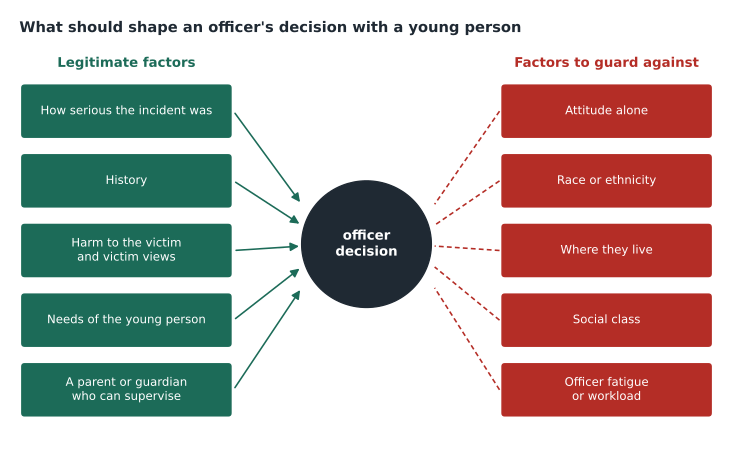
Most youth contacts involve discretion. Research on police decisions with young people has found that the seriousness of the offence and the young person's history are the strongest influences, as they should be. But other factors also play a role: the young person's demeanour, especially whether they are polite or hostile; the wishes of the complainant; whether a parent can be reached and seems able to supervise; and, in some studies, the young person's race and social class. Demeanour is a particular problem, because hostility toward police may reflect fear, past experiences or a disability rather than greater risk. Bell's unit tells officers to base decisions on the offence, the history, the victim's views and the young person's needs, and to be suspicious of any decision that rests mainly on attitude.
Use of force and restraint
Young people's size and age do not make them harmless, and officers sometimes need to use force with youth, including restraint and handcuffing. But the same principles of necessity and proportionality apply with special force. Restraint of a child or a small adolescent can cause injury, and positional asphyxia is a particular risk with prone restraint. Many services, including Port Ardent, have policies that require officers to consider the young person's age, size and any known disability, to use the minimum restraint necessary, and to remove handcuffs as soon as it is safe. Bell tells students that handcuffing a calm twelve-year-old in front of their classmates for a minor matter may be legal, but it will be remembered for years.
Police in schools
Schools are a frequent setting for youth contacts. Many Ontario school boards and police services have had school resource officer or school liaison officer programs, in which an officer is assigned to one or more schools to build relationships, give presentations and respond to incidents. These programs have been the subject of intense debate. Supporters argue they improve safety, build trust and allow problems to be dealt with early. Critics, including many Black and Indigenous students and parents, argue that a police presence makes some students feel watched and criminalized, and that it turns school discipline issues into police matters. In 2017 the Toronto District School Board ended its school resource officer program after a review that heard these concerns, and several other boards have ended or changed their programs since. Port Ardent replaced assigned school officers with a liaison model in which neighbourhood officers like Ferreira visit schools on request and attend community events.
Searches at school raise their own issues. In R. v. M.(M.R.) (1998), the Supreme Court of Canada held that a school official, such as a vice-principal, may search a student without a warrant if they have reasonable grounds to believe a school rule has been or is being broken and that evidence will be found, a lower standard than for police. But the Court also held that where the school official is acting as an agent of the police, the full Charter standards apply. Police who want a student searched cannot ask the principal to do it for them.
The next morning
By 9 p.m. on May 14, Ferreira's team had a strong lead. Ben's phone's location service, which his mother shared with police, had last shown the phone in the Lindell Avenue towers at 5:02 p.m., before it was turned off. Two witnesses at the basketball court described the same two boys. Ferreira believed they were Devon Hart, 17, and Noah Kessler, 16, who lived in the towers. The next morning, the vice-principal at Eastgate Secondary called Bell to say that Noah was at school and offered to bring him to the office so Bell could talk to him. Bell said no. He explained to the class: 'If I question a sixteen-year-old in the vice-principal's office, with the principal there and the door closed, he's going to feel he has no choice. That's a detention, and section 146 applies with full force. I'd rather do it properly at the station, with his mother and a lawyer available. And I don't want school to be the place where kids get arrested if I can avoid it.' Instead, Bell called Noah's mother, Karen Kessler, and asked her to bring Noah to the station after school. She agreed. What happened at the station is the subject of lesson 6.
# Check a youth unit's use of discretion for similar first-time thefts.
# Invented sample: each record is (group, outcome).
records = [("A", "warning")] * 34 + [("A", "referral")] * 10 + [("A", "charge")] * 2 + \
          [("B", "warning")] * 15 + [("B", "referral")] * 9 + [("B", "charge")] * 4
for g in ("A", "B"):
    sub = [o for grp, o in records if grp == g]
    share = sum(1 for o in sub if o == "warning") / len(sub)
print("group", g, "cases:", len(sub), "warned:", round(share, 2))group A cases: 46 warned: 0.74 group B cases: 28 warned: 0.54
In the invented sample, group A youth received a warning in about 0.74 of similar first-time thefts and group B youth in about 0.54. A gap like that does not prove bias by itself, because the cases may differ in ways the sample does not show, but it is exactly the kind of gap that should lead a supervisor to look at the files, as Port Ardent did in lesson 2.
Language, disability and the right support
Two kinds of support come up again and again in youth contacts. The first is language. When a young person or a parent has limited English, officers should use a professional interpreter, in person or by phone, as Ferreira did with Tariq Haidari's father. Officers should not use a child to interpret for their parents, or a sibling to interpret for a young suspect or victim: the child may not know the words, may soften or change what is said, and is placed in an impossible position. The second is disability. Many young people in contact with police have a diagnosed or undiagnosed condition that affects communication, memory or behaviour. Signs can include difficulty following more than one instruction, repeating the officer's words back, agreeing with everything, unusual reactions to noise or touch, or difficulty with time and sequence. When an officer suspects a disability, they should slow down, simplify, ask a parent or caregiver what helps, and record what they observed, because it may matter later to whether the young person understood their rights. Bell says the most useful question he ever learned is simply, 'Is there anything that makes it hard for you to talk with me right now?'
Worked problem
A difficult street contact
At 10 p.m. on a Friday, officers see three teenagers sitting on a wall outside a closed convenience store. There have been no recent calls about the store. When the officers approach and ask what they are doing, one 15-year-old swears at them and says they are only being stopped because they are Black. What should the officers consider?
Show solution
- They have no grounds to detain anyone: sitting on a wall is not an offence, and there is no report of a crime.
- The teenager's anger may reflect past experiences; it is not itself evidence of anything.
- They can explain calmly why they approached, for example that they were checking on the store, and that the youths are free to go about their business.
- If the officers block their way, demand identification or begin questioning, a court applying Grant and Le could find they were detained without grounds.
- Ending the contact politely is the best outcome; nothing is gained by escalating it.
Answer: Without grounds, the officers should explain themselves, leave the youths free to go, and avoid letting demeanour drive the encounter.
Common mistakes
MistakeYoung people understand rights and procedures if they say they do.
InsteadYoung people often say they understand to please or end the conversation; check understanding in their own words.
MistakeA school is a neutral place to question a student.
InsteadQuestioning a student in the principal's office can amount to a detention, triggering section 146 and the Charter.
MistakePolice can ask school staff to search a student for them.
InsteadIf school staff act as agents of police, the police standard applies.
MistakeA rude young person is a riskier young person.
InsteadDemeanour often reflects fear, past experiences or disability; decisions should rest on legitimate factors.
Summary and key terms
- Young people are more suggestible, more likely to agree to please and more likely to misunderstand legal terms; use plain words, open questions and check understanding.
- Detention of young people follows the same rules as for adults, but age and racial context shape whether a detention occurred (Grant, Le).
- Discretion should rest on the offence, history, harm to the victim and the young person's needs, not on demeanour or group membership.
- Use of force and restraint must account for a young person's age, size and any disability.
- School police programs are debated; Toronto ended its SRO program in 2017.
- R. v. M.(M.R.) allows school searches on reasonable grounds, but not when officials act as agents of police.
- Suggestibility
- The tendency to change an answer in response to leading questions or pressure.
- Discretion
- The officer's choice among lawful options.
- Demeanour
- A person's attitude and behaviour during a contact.
- School resource officer
- A police officer assigned to work in one or more schools.
- School-to-prison pipeline
- A term for the concern that school discipline practices push students into the justice system.
- Agent of the police
- A person, such as a school official, who acts at the direction of police and is held to police standards.
Practice problems
Work each problem on paper first, then reveal the answer to check.
Give three of Bell's rules for talking with young people.
Show answer
Introduce yourself; use short sentences and everyday words; ask open questions first; check understanding in their own words.
Why did Ferreira not ask Ben whether either boy was someone she suspected?
Show answer
It would be a suggestive question that could contaminate his account.
Why did Bell refuse to question Noah in the school office?
Show answer
He would feel he had no choice, making it a detention or custody, and Bell wanted to question him properly with his mother and counsel available, away from school.
In the code example, what share of group B cases received a warning?
Show answer
About 0.54.
Lesson quiz · 5 questions
Score 60% or more to complete this lesson.
Create a free account to save your progress, take quizzes and earn a certificate.