
LES-211 · Lesson 12 of 12 · 19 min
Capstone: reviewing the Eastgate Park robbery file
▶ Video coming soon A video version of this lesson is on the way.
For the final class, Desjardins and Bell bring the complete file on the Eastgate Park robbery: Ferreira's and Malhotra's notes from the scene, the 911 recording, Bell's interview recording and timeline, the release and bail documents, Gordon's decision memo on Noah, the pre-sentence report on Devon, the restorative conference agreement, the sentencing record, the victim services contact log, and the file on the older man Devon later disclosed. Port Ardent's youth unit reviews a sample of its completed files every quarter, using a ten-part checklist with two points for each part. Desjardins asks the students to review this file the same way, and then compares their scores with the unit's own review.
The review checklist
Each part of the checklist reflects a principle from this course. First response and investigation: was the scene handled properly, were the young witnesses and the victim interviewed in a way suited to their age, and was the evidence gathered efficiently? Victim care: were the victim and their family kept informed and supported throughout? Parental notice: were parents notified promptly and correctly under section 26? Statements: did any statements meet section 146? Release and detention: were release conditions reasonable and necessary under section 28.1, and was any detention justified under section 29? Choice of measures: were extrajudicial measures considered and used where adequate, and recorded? Court outcome: was the sentence consistent with sections 38 and 39? Timeliness: was the case resolved promptly? Privacy and records: were sections 110, 111, 118 and 125 respected? Wider harm: were signs of victimization or exploitation of the young persons recognized and acted on?
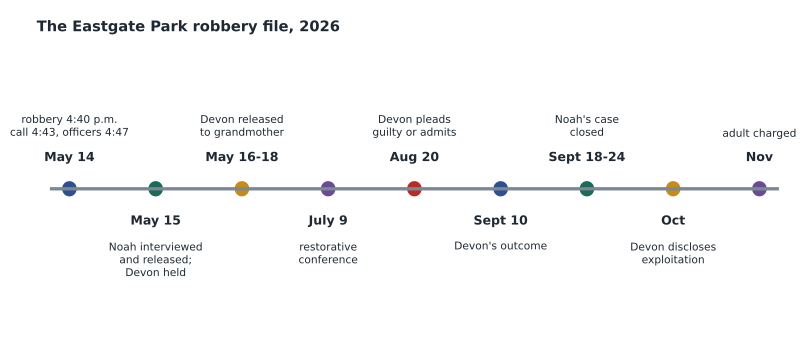
First response, victim care and parental notice
The students give first response full marks. Officers arrived four minutes after the call, put Ben's medical needs first, and took his account with open questions before specific ones. Ferreira's decision not to suggest the names of the suspects she had in mind protected the identification evidence. The phone location data was obtained quickly with Ben's mother's help, and the witnesses were interviewed separately that evening. Two points.
Victim care is more mixed. Nadia Brooks's work with Ben and his mother after the first week was excellent: regular contact, help with the school route, the victim impact statement and preparation for the restorative conference. But Claire Arsenault's first call to the station, on May 18, was not returned for three days, because it went to an officer who was on leave and no one checked the message. Bell's unit has since changed its practice so that every call from a victim's family in a youth case is logged and returned the same day by whoever is on duty. One point.
Parental notice receives full marks. Karen Kessler brought Noah to the station herself, and received written notice of his release conditions under section 26(2). Devon's grandmother, who was his guardian, was told of the arrest, the reason and the place of detention within an hour, and his father, whose address was unknown, was notified through his lawyer the next day. Two points.
Statements, release and the choice of measures
The statement section receives full marks. Bell's explanation of rights to Noah was adapted to him, checked in his own words and recorded, as L.T.H. requires; Noah consulted duty counsel in private; he chose to have his mother present; and the interview was non-coercive, with open questions and no promises. Devon's choice not to speak was respected. The decision not to question Noah at school was, in the students' view, one of the best decisions in the file. Two points.
Release and detention also receive full marks. Noah was released with only the conditions the case required. Holding Devon for a hearing was justified by the seriousness of the robbery, his history and the risk to the victim and witnesses, and the youth justice court found a less restrictive alternative with his grandmother, which worked: there were no breaches before the sentencing. Two points.
The choice of measures receives full marks, after a long class discussion. Some students argued that an extrajudicial sanction was too lenient for a robbery involving force against a younger boy. Others pointed to Gordon's reasons: Noah's limited role, his lack of history, his remorse, the corroboration of his account, his family's support, and above all Ben's own willingness to take part in a restorative process. Bell tells the class that the outcome matters too: Noah completed every part of the agreement, has had no further police contact, and Ben told Brooks that meeting him had helped him stop being afraid. Desjardins says the decision was within the range that the YCJA intends, and that reasonable people could have decided either way. Two points.
Court outcome, timeliness, privacy and wider harm
The court outcome for Devon receives full marks. The judge considered custody, which was available because robbery with force is a violent offence, but imposed the least restrictive sentence capable of holding him accountable, with intensive support, as sections 38 and 39 require. His school attendance since September has been about 0.86 of school days, compared with about 0.5 before the robbery, and his one curfew breach was dealt with by his youth worker without a charge. Two points. Timeliness also receives full marks: both cases were resolved within about four months, and the first decision on each was made within 24 hours. Two points.
Privacy and records receive full marks. The department did not identify either young person publicly, responded to the social media post appropriately, disclosed only the no-contact conditions to the school under section 125(6), and recorded Noah's sanction correctly so that its access period runs from his consent. Two points.
Wider harm is where the review is hardest on the file. In May, three possible indicators of exploitation were already recorded: Devon had money and new clothes his grandmother could not explain, Ferreira had noted him spending time with an older man in the towers, and his text to Noah said 'easy money'. No one connected them until Devon disclosed in October. Bell's unit has since added the exploitation screening questions from lesson 10 to every youth robbery and theft file involving phones or other easily resold goods. One point.
# The unit's review scores for the Eastgate Park robbery file (2 points each).
scores = {"first response": 2, "victim care": 1, "parental notice": 2, "statements": 2,
          "release and detention": 2, "choice of measures": 2, "court outcome": 2,
          "timeliness": 2, "privacy and records": 2, "wider harm": 1}
total = sum(scores.values())
print("total:", total, "out of", 2 * len(scores))
print("parts below full marks:", [k for k, v in scores.items() if v < 2])total: 18 out of 20 parts below full marks: ['victim care', 'wider harm']
The file scores 18 out of 20. The students' own scores ranged from 16 to 19, with most disagreement over victim care and the choice of measures. Bell says the unit's quarterly reviews average about 16, so this is a strong file, and that the two lost points are both about connections: a message that no one picked up, and three facts that no one put together.
What the file teaches
Desjardins closes the course by asking each student to write one sentence about what the file teaches. He reads a few aloud. 'The law treated Noah and Devon differently because they were different, not because one was luckier.' 'Most of the good decisions in this file were made in the first 24 hours.' 'A young person who offends can be a young person who is being harmed, and you have to look for it.' 'Being careful with a statement protects the kid and the case.' 'The victim was a kid too.'
Bell adds his own. He tells the students that in nine years in the youth services unit, the cases he remembers are not the ones that went to court. They are the ones where a young person, years later, stopped him in the street to say they had finished school, or got a job, or become a parent. 'Most of the kids you deal with are going to grow out of it,' he says. 'Your job is to hold them to account without getting in the way of that. For the few who won't grow out of it on their own, your job is to make sure the right people are working with them, early. And for every one of them, your job is to remember they're kids.'
| Principle | Where the file shows it |
|---|---|
| Diminished moral blameworthiness and a separate system | Both teenagers were dealt with under youth law, with outcomes suited to their age and roles |
| Extrajudicial measures where adequate | Mia warned, Tariq referred, Noah diverted after a careful decision |
| Enhanced procedural protection | Rights explained in plain language and checked; questioning away from school |
| Least restrictive effective response | Release with only necessary conditions; community sentence with intensive support for Devon |
| Timely intervention | First decisions within 24 hours; outcomes within four months |
| Repair of harm and victims' rights | Restorative conference, restitution and a victim impact statement |
| Seeing the whole young person | Exploitation recognized late; practice changed as a result |
A second reviewer
Port Ardent's practice is that every reviewed file is scored by a second reviewer who did not work on it, to check that the checklist is being applied consistently. For the Eastgate Park file, the second reviewer was a sergeant from the major crime unit. She agreed on eight of the ten parts. She gave the choice of measures one point rather than two, because she thought the decision to divert Noah should have been made after a formal risk assessment rather than on Gordon's and Bell's judgment, and she gave victim care two points, because she weighted the excellent work after the first week more heavily than the missed call. Her total was also 18, but for different reasons. Desjardins tells students that agreement on the total can hide disagreement on the parts, which is why reviews look at each part, and that the disagreement about Noah is a healthy one: it reflects a real question about how much structured assessment should support discretionary decisions in serious youth cases. The unit's response was to add a short structured risk screen to every file in which an extrajudicial sanction is considered for a violent offence, so that the next decision like Gordon's rests on both judgment and a consistent tool.
Worked problem
Reviewing a weaker file
In another file, a 13-year-old was arrested at school for punching a classmate, causing a bloody nose. The school liaison officer questioned him in the vice-principal's office for 30 minutes before his mother was called. He was handcuffed in the hallway in front of other students. He was charged with assault and released with a curfew, a ban on using social media and a requirement to attend school. Three months later the charge was still before the court. How would this file score on the checklist?
Show solution
- Statements: questioning in the vice-principal's office before his mother was called likely breached section 146; he was detained and not given a reasonable opportunity to consult counsel and a parent.
- Use of force: handcuffing a 13-year-old in front of classmates for a fight that was over is hard to justify and harms trust.
- Choice of measures: a first, minor assault by a 13-year-old should have been considered for extrajudicial measures under sections 4 and 6.
- Release conditions: the social media ban and curfew are not obviously connected to the risk, contrary to section 28.1.
- Timeliness: three months with no resolution undermines the link between act and consequence.
Answer: This file would score poorly on statements, use of force, choice of measures, release conditions and timeliness, even if the facts of the assault were clear.
Common mistakes
MistakeA file that ends in a conviction or adjudication is a successful file.
InsteadSuccess means lawful, fair and proportionate decisions that hold the young person accountable and support their rehabilitation, whatever the outcome.
MistakeReviews are about finding someone to blame.
InsteadReviews find patterns, such as unreturned messages or missed indicators, and change practice.
MistakeDiverting a robbery is never justified.
InsteadIt is unusual but can be within the law when the young person's role, history and the victim's wishes support it.
MistakeOnce a case is closed, police have no further role.
InsteadPolice may still need to act on new information, such as exploitation, and must follow records and sealing rules.
Summary and key terms
- The review checklist covers first response, victim care, parental notice, statements, release, choice of measures, court outcome, timeliness, privacy and wider harm.
- The Eastgate Park file scored 18 out of 20: strong on statements, measures and timeliness, weaker on victim follow-up and recognizing exploitation.
- Noah and Devon received different responses because their roles, histories and needs differed.
- Most of the decisive decisions were made in the first 24 hours.
- Recognizing that a young offender may also be a victim is part of a complete investigation.
- Reviews improve practice by finding connections that were missed.
- File review
- A structured examination of a completed case file against a checklist.
- Least restrictive response
- The lightest response that will achieve the purpose.
- Practice change
- A change in procedure made because a review found a gap.
- Wider harm
- Victimization or exploitation of the young person that may lie behind an offence.
- Restorative conference
- A facilitated meeting of the person harmed, the young person and supporters to repair harm.
- Timeliness
- Making decisions and resolving cases promptly.
Practice problems
Work each problem on paper first, then reveal the answer to check.
Which two parts of the checklist lost a point, and why?
Show answer
Victim care, because a family's call went unreturned for three days; wider harm, because exploitation indicators were not connected until October.
In the code example, what was the total score?
Show answer
18 out of 20.
What practice changes did the unit make after this file?
Show answer
Same-day callbacks for victims' families and exploitation screening questions on youth robbery and theft files.
Why do the students consider the decision not to question Noah at school one of the best in the file?
Show answer
Questioning there would have been a detention without the section 146 protections in place, and would have made school the place of arrest.
Lesson quiz · 5 questions
Score 60% or more to complete this lesson.
Create a free account to save your progress, take quizzes and earn a certificate.