
LES-211 · Lesson 6 of 12 · 20 min
Statements from young persons: section 146
▶ Video coming soon A video version of this lesson is on the way.
Karen Kessler brought her son Noah to the Port Ardent police service building at 4:25 p.m. on Friday, May 15. He was sixteen, tall for his age, and had not been in trouble with police before. Bell met them in the lobby, introduced himself, and told Noah directly that he was investigating the robbery of a fifteen-year-old's phone in Eastgate Park the day before, that he believed Noah had been there, and that Noah was under arrest for robbery. He then took them to a soft interview room, with a couch, a table and recording equipment. Desjardins tells the class that the next forty minutes, before Noah said a word about the park, are what this lesson is about.
Why young persons get special rules
Statements are often the most important evidence in youth cases, and young people are particularly vulnerable when questioned by police. They are more suggestible, more likely to waive their rights without understanding them, more likely to focus on getting out of the room than on long-term consequences, and more likely to give a false confession under pressure. Parliament responded with section 146 of the YCJA, which goes well beyond the Charter and the common law confessions rule. Section 146 applies to oral and written statements made by a young person to a peace officer or other person in authority on the arrest or detention of the young person, or in circumstances where the officer has reasonable grounds for believing the young person has committed an offence. It applies even if the young person is not detained, once the officer has those reasonable grounds.
The four requirements of section 146(2)
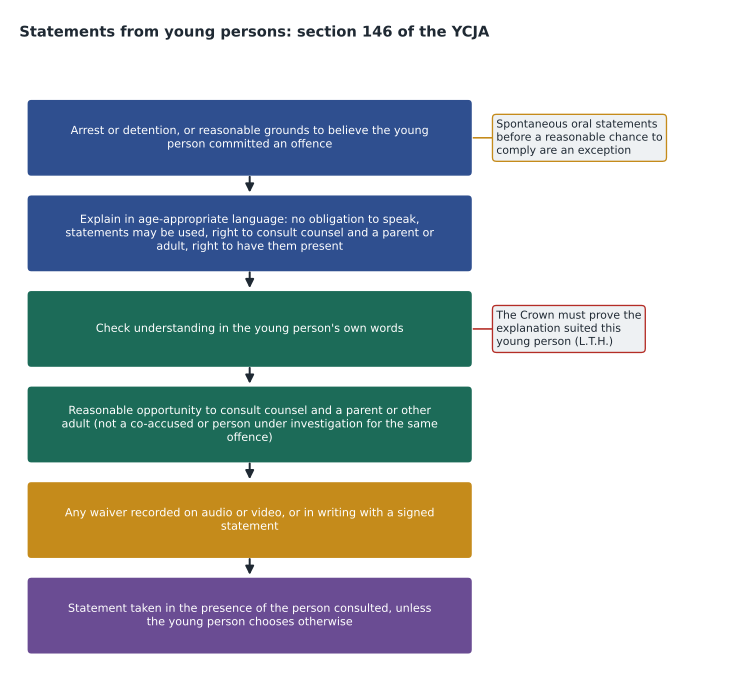
Under section 146(2), a statement covered by the section is inadmissible against the young person unless four requirements are met. First, the statement must be voluntary, in the same sense as under the common law confessions rule. Second, before the statement was made, the person to whom it was made must have clearly explained to the young person, in language appropriate to their age and understanding, that they are under no obligation to make a statement; that any statement may be used as evidence in proceedings against them; that they have the right to consult counsel and a parent or other person; and that any statement must be made in the presence of the counsel and any other person consulted, unless the young person desires otherwise. Third, the young person must have been given a reasonable opportunity to consult counsel and a parent, or in the absence of a parent, an adult relative, or in their absence any other appropriate adult chosen by the young person, as long as that person is not a co-accused or under investigation for the same offence. Fourth, if the young person consulted any of these people, they must have been given a reasonable opportunity to make the statement in that person's presence.
In R. v. L.T.H. (2008), the Supreme Court of Canada held that the Crown must prove beyond a reasonable doubt that the explanation required by section 146(2)(b) was given in language appropriate to the particular young person's age and understanding. The officer cannot simply read a standard form; they must adapt the explanation to the young person in front of them. The Court also held that a young person can validly waive their rights only if they understood them and the consequences of giving them up, and that the Crown bears the burden of proving a valid waiver. In practice, this means officers must be able to show, ideally on video, how they explained each right and how they checked that the young person understood.
Waiver, spontaneous statements and irregularities
Under section 146(4), a young person may waive the right to consult counsel or a parent, or to have them present, but the waiver must be recorded on audio or video, or made in writing and include a statement signed by the young person that they have been informed of the right being waived. Under section 146(5), a waiver that is not in proper form because of a technical irregularity may still be found valid if the court is satisfied the young person was informed of their rights and voluntarily waived them. Under section 146(3), the requirements in paragraphs (b) to (d) do not apply to oral statements made spontaneously by the young person before the officer has had a reasonable opportunity to comply with them. A young person who blurts out 'I only held the bag, Devon took the phone' as soon as the officer walks in may have made an admissible spontaneous statement, but an officer who asks a question first cannot rely on that exception. Under section 146(6), a court may admit a statement despite a technical irregularity in complying with paragraphs (b) to (d) if admitting it would not bring into disrepute the principle that young persons are entitled to enhanced procedural protection.
Bell points out that the person chosen to be present is not always a parent, and the choice belongs to the young person. Under section 146(2)(c), if no parent is available, the young person can consult an adult relative, and if none is available, any appropriate adult they choose, as long as that person is not a co-accused or under investigation for the same offence. That last condition matters: an older friend who was also in the park cannot serve as the adult. Officers should also watch for signs that the adult in the room is pressuring the young person. A parent who says, 'Just tell him what you did so we can go home,' may make a statement less reliable, and the officer should pause and remind both of them that the young person does not have to say anything.
Noah's statement
Bell used Port Ardent's plain-language youth rights form, which breaks each right into a short sentence. He read the first one: 'You do not have to say anything to me about what happened.' Then he asked Noah to tell him in his own words what that meant. Noah said, 'I don't have to talk to you.' Bell asked, 'And if you decide not to talk, what happens?' Noah said, 'Nothing, I guess.' Bell went through each right the same way, including the right to talk to a lawyer for free right now, and the right to have his mother or another adult with him. Noah said he wanted to talk to a lawyer. Bell called duty counsel and left Noah alone in the room on the phone for twelve minutes, from 4:41 to 4:53 p.m. When Bell returned, Noah said he wanted to tell his side and wanted his mother to stay. Bell confirmed on video that Noah had spoken to a lawyer, that he understood he still did not have to say anything, and that he wanted his mother present
Bell started with an open question: 'Tell me about yesterday afternoon, from when you got out of school.' Noah said Devon had texted him at lunch saying 'easy money at the court later'. He thought Devon meant selling something. When they got to the park, Devon went up to Ben and asked to see his phone. When Ben said no, Devon shoved him. Noah said he grabbed Ben's backpack strap 'without thinking' because Devon told him to hold him. Devon took the phone and they ran to Devon's building. Noah said he did not know where the phone was now and had not got any money. He cried when Bell asked how he thought Ben felt. The interview ended at 5:48 p.m. Bell did not suggest any answers, did not tell Noah what other evidence the police had until after his account, and did not make any promises.
Devon Hart was arrested at 7:10 that evening at his grandmother's apartment in the Lindell towers. He was advised of his rights under section 25 and section 146, consulted duty counsel, and declined to make a statement. Bell honoured that and asked no questions about the robbery. Officers searching the apartment with his grandmother's consent, and later with a warrant for his room, found Ben's phone, switched off, inside a sneaker box.
# Build an interview timeline from the recording log and check that the
# rights explanation and consultation came before any question about the incident.
log = [("16:31", "rights explanation begins"), ("16:41", "consultation begins"),
       ("16:53", "consultation ends"), ("16:56", "rights confirmed on video"),
       ("17:05", "first question about the park"), ("17:48", "interview ends")]
t = {e: int(h[:2]) * 60 + int(h[3:]) for h, e in log}
print("consultation minutes:", t["consultation ends"] - t["consultation begins"])
print("rights before questions:", t["rights confirmed on video"] < t["first question about the park"])
print("questioning minutes:", t["interview ends"] - t["first question about the park"])consultation minutes: 12 rights before questions: True questioning minutes: 43
The log shows that the explanation of rights and the consultation came before any question about the offence, and that questioning lasted 43 minutes. Bell tells the class that a timeline like this, built from the recording, is the first thing he puts in a youth statement file, because it answers the defence's first questions.
Statements to people other than police
Section 146 applies to statements made to a peace officer or to any other person in authority. A person in authority is someone the young person reasonably believes can influence the prosecution, such as a police officer, a Crown prosecutor or, in some circumstances, a school principal, youth worker or custody staff member who is working with police. A vice-principal who questions a student about a stolen phone on their own, for school discipline, may not be a person in authority; one who questions the student at the request of police, or with an officer in the room, very likely is. Under section 146(7), a youth justice court may also exclude a statement made under duress imposed by someone who is not a person in authority, such as an older gang member, if the young person shows the duress. Bell's rule for his officers is simple: if you want to use what a young person says in court, get it yourself, properly, with the protections in place, and do not ask anyone else to get it for you.
Corroborating a young person's statement
Because young people are more vulnerable to false confessions, investigators should treat a youth admission as something to be checked, not as the end of the investigation. The best corroboration is information that only the offender would know and that the police did not reveal, or evidence the statement leads police to, such as stolen property or a witness. Noah's account was corroborated in several ways: Devon's text at lunch, which police later obtained from Noah's phone with his and his mother's consent, matched his description; the witnesses' descriptions of who pushed and who held the strap matched; and the phone was found in Devon's room. Bell notes that the statement also helped Noah. His account that he had not planned the robbery and had acted on Devon's instruction, supported by the text, was one of the reasons the Crown was willing to consider an extrajudicial sanction for him, as lesson 8 explains. A statement taken fairly can protect a young person as much as it incriminates them.
Worked problem
A statement at risk
A 14-year-old is arrested for a break-in. The officer reads the standard youth rights form quickly in the cruiser and asks, 'You understand all that?' The boy says 'Yeah.' At the station, the officer says, 'Your mom's on her way, but we can get this done before she gets here if you want.' The boy agrees and admits the break-in. What problems are there?
Show solution
- Reading a form quickly and asking 'You understand?' does not show the explanation was in language appropriate to this young person's age and understanding, as L.T.H. requires.
- Suggesting they finish before his mother arrives discourages him from consulting or having a parent present.
- Any waiver of the right to consult a parent had to be recorded or in writing under section 146(4); there is no proper waiver here.
- The statement is at serious risk of being excluded, and its reliability is doubtful.
- The officer should have explained each right in plain language, checked understanding in the boy's own words, and waited for his mother.
Answer: The statement would likely be inadmissible under section 146; the shortcut defeated the purpose of the protections.
Common mistakes
MistakeReading a rights form is enough.
InsteadL.T.H. requires an explanation in language appropriate to the particular young person, and the Crown must prove it.
MistakeSection 146 applies only after arrest.
InsteadIt also applies when the officer has reasonable grounds to believe the young person committed an offence.
MistakeAny adult can be the person present.
InsteadThe adult cannot be a co-accused or under investigation for the same offence.
MistakeA parent's presence guarantees a statement is reliable.
InsteadA parent can pressure a child; the officer must watch for it and remind the young person of their rights.
Summary and key terms
- Section 146 sets four requirements: voluntariness, an age-appropriate explanation, a reasonable opportunity to consult counsel and a parent or adult, and the chance to have them present.
- L.T.H. requires the Crown to prove beyond a reasonable doubt that the explanation suited the young person.
- Waivers must be recorded or in writing with a signed statement, under section 146(4).
- Spontaneous oral statements before a reasonable opportunity to comply are an exception.
- Young people are overrepresented among proven false confessions, so careful, recorded, non-coercive interviews protect both the young person and the case.
- Watch for pressure from adults in the room, including parents.
- Person in authority
- Someone, such as a police officer, whom the young person reasonably believes can influence the prosecution.
- Age-appropriate language
- Wording that suits the particular young person's age and understanding.
- Waiver
- A young person's decision to give up a right, such as consulting counsel.
- Spontaneous statement
- A statement made without prompting before police have a chance to explain rights.
- Totality of the circumstances
- An assessment of all relevant factors together, including age, experience and the setting.
- False confession
- An admission by a person who did not commit the offence.
Practice problems
Work each problem on paper first, then reveal the answer to check.
Why did Bell ask Noah to explain each right in his own words?
Show answer
To show and check that Noah understood, rather than just agreeing.
Who can serve as the adult under section 146(2)(c) if no parent is available?
Show answer
An adult relative, or any other appropriate adult chosen by the young person who is not a co-accused or under investigation for the same offence.
In the code example, how long did questioning last?
Show answer
43 minutes.
Why did Bell not question Devon?
Show answer
Devon declined to make a statement after consulting counsel, and Bell honoured his choice.
Lesson quiz · 5 questions
Score 60% or more to complete this lesson.
Create a free account to save your progress, take quizzes and earn a certificate.