
LES-211 · Lesson 7 of 12 · 21 min
Arrest, notice to parents and pretrial detention
▶ Video coming soon A video version of this lesson is on the way.
By 9 p.m. on May 15, Port Ardent had two teenagers in custody for the same robbery and had to make two different decisions. Noah Kessler was at the station with his mother, had given a full account, had no history and had a stable home. Devon Hart had declined to speak, was on a youth sentence of probation for a theft in 2025, and had an outstanding charge of failing to comply with a curfew condition, and Ben's phone had been found in his room. This lesson covers what the law requires when a young person is arrested: telling parents, deciding whether to release, and the special limits on holding young people in custody before trial.
Telling parents
Section 26 of the YCJA requires that, when a young person is arrested and detained in custody pending their appearance in court, the officer in charge must, as soon as possible, give or cause to be given to a parent, orally or in writing, notice of the arrest, the reason for it and the place of detention. When a young person is released on an appearance notice, summons or undertaking, notice must be given in writing to a parent. If no parent is known or available, notice may be given to an adult relative or another appropriate adult known to the young person who is likely to assist them. The notice requirement exists so that parents can support the young person, help them get counsel, and take part in decisions about release. Failing to notify a parent does not automatically invalidate proceedings, but it can affect the admissibility of statements and the court's view of the police conduct, and it breaches the principle in section 3(1)(c)(iii) that parents should be involved.
Bell notes that parental notification raises hard cases. Some young people do not want their parents called, sometimes for good reasons, such as abuse at home or a parent's violent temper. Some parents cannot be found. Some are the victim, as in a case of a young person who assaults a parent. In those cases the officer must still notify someone appropriate, and should consider whether child protection services need to be involved. 'Notifying a parent is about getting the young person support,' Bell says. 'If the parent is the danger, you find another adult and you call children's aid.'
Release by police
Most young people who are arrested are released by police without a court appearance, on an appearance notice or an undertaking, just like adults. The Criminal Code release provisions apply to young persons. But section 28.1, added in 2019, requires that any condition imposed on a young person be reasonable having regard to the circumstances of the offence and necessary to ensure attendance in court, the safety of victims and witnesses, or public safety, and that a condition not be imposed to address a child protection, mental health or other social need. Bell says the most common error he sees is a long list of standard conditions, like a curfew, school attendance and a ban on cell phones, applied to every young person regardless of the case. Each condition is a chance to breach.
Noah was released by Bell that evening on an undertaking with two conditions: no contact with Ben Arsenault, directly or indirectly, and no contact with Devon Hart except in the presence of a lawyer. Bell did not impose a curfew or school conditions; Noah had never missed school and his mother was clearly able to supervise him. He gave Karen Kessler written notice under section 26(2). Devon was another matter. Bell decided to hold him for a bail hearing, because of the seriousness of the robbery, his outstanding charge and his breach history, and because Ben and several witnesses lived in the same building.
Pretrial detention under section 29
Section 29 sets out the strictest limits on pretrial detention anywhere in Canadian criminal law. Under section 29(1), a youth justice court judge or justice shall not detain a young person in custody as a substitute for appropriate child protection, mental health or other social measures. Under section 29(2), detention is permitted only if three conditions are all met. First, the young person must be charged with a serious offence, which the Act defines as an indictable offence for which the maximum punishment is imprisonment for five years or more, or, if not, their history must indicate a pattern of outstanding charges or findings of guilt. Second, the judge must be satisfied, on a balance of probabilities, of one of three grounds: that there is a substantial likelihood the young person will not appear in court; that detention is necessary for the protection or safety of the public, including victims and witnesses, having regard to all the circumstances, including a substantial likelihood that the young person will commit a serious offence if released; or, for a serious offence only, where the first two grounds do not apply, that there are exceptional circumstances that warrant detention to maintain confidence in the administration of justice. Third, the judge must be satisfied that no condition or combination of conditions of release would reduce the risk sufficiently. Under section 29(3), the burden of proof is on the Attorney General, which means the Crown must justify detention, not the young person justify release.
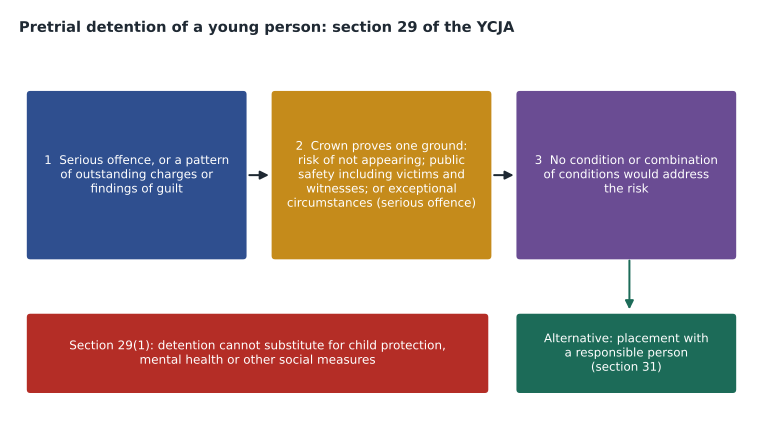
Section 31 offers an alternative that is often decisive: a young person who would otherwise be detained may be placed in the care of a responsible person, such as a grandparent, if the court is satisfied that the person is willing and able to take care of and exercise control over the young person, and the young person is willing to be placed in that person's care. The responsible person undertakes in writing to take care of the young person, ensure their attendance in court and comply with any other conditions. A responsible person who wilfully fails to comply with the undertaking commits an offence.
Section 30 adds that a young person who is detained must generally be held separate and apart from adults, in a place of temporary detention designated by the province. Port Ardent's youth holding area has separate cells and an entrance that does not pass the adult cells; officers must log the time a young person enters and leaves and any contact with adult prisoners, which should be none.
Devon's hearing
Devon's bail hearing was held the next morning, Saturday, May 16, in youth court. Assistant Crown Attorney Leah Gordon argued for detention on the public safety ground: the robbery involved violence against a younger boy, Devon had an outstanding charge and a breach history, and the victim and witnesses lived in his building. Duty counsel Paul Mbeki proposed that Devon live with his grandmother, Evelyn Hart, in a different tower, under section 31. Mrs. Hart testified that she was retired, at home all day, and willing to sign the undertaking. The judge found that robbery was a serious offence and that the public safety ground was engaged, but that the risk could be adequately addressed by conditions: placement with Mrs. Hart as a responsible person, a curfew from 9 p.m. to 6 a.m. unless with her, no contact with Ben, Noah or the two witnesses, and no attendance at Eastgate Park. The judge also ordered that Devon attend school, because he had been suspended twice that year and had stopped going. Gordon noted afterward that the judge had considered the school condition carefully under section 28.1: it was connected to the risk, because the robbery happened after Devon left school at lunch.
# Deadlines after a youth arrest (invented times). Python's datetime handles
# day changes; times are local.
from datetime import datetime, timedelta
arrest = datetime(2026, 5, 15, 19, 10)
ca_deadline = arrest + timedelta(hours=24)     # appearance before a justice
oh_deadline = arrest + timedelta(hours=72)     # Ohio detention hearing outer limit
days = ["Mon", "Tue", "Wed", "Thu", "Fri", "Sat", "Sun"]
for label, d in (("24-hour limit:", ca_deadline), ("72-hour limit:", oh_deadline)):
print(label, days[d.weekday()], d.isoformat(" ", "minutes"))24-hour limit: Sat 2026-05-16 19:10 72-hour limit: Mon 2026-05-18 19:10
In Canada, a person who is arrested and not released must be brought before a justice without unreasonable delay and, where a justice is available, within 24 hours, under section 503 of the Criminal Code, which applies to young persons; Devon's Saturday morning hearing was well inside that limit. Bell tells students to put the deadline in their notes at the time of arrest, not to calculate it later.
Fingerprints, photographs and searches
The Identification of Criminals Act applies to young persons, through section 113 of the YCJA, so police may fingerprint and photograph a young person who is charged with, or has been convicted of, an indictable offence, including a hybrid offence, in the same circumstances as an adult. Young persons cannot be fingerprinted or photographed under the Act simply because they received an extrajudicial measure. Fingerprints and photographs taken from young persons are youth records, governed by the access rules in Part 6 and the time limits in section 119, which lesson 9 explains; they are not simply added to the adult criminal records system. DNA orders under the Criminal Code can be made against young persons found guilty of designated offences, and the DNA data bank applies the youth record time limits to them. Bell tells students that identification records of young people are among the most sensitive records a police service keeps, and that the officer who takes them is responsible for following the rules about them.
Searches of young people who are arrested follow the same law as for adults: a search incident to arrest must be for officer safety, to prevent escape or to find evidence of the offence. But strip searches of young people require particular care. In R. v. Golden (2001), the Supreme Court of Canada held that strip searches are inherently humiliating and degrading, and are justified only where there are reasonable grounds to believe they are necessary to find weapons or evidence related to the reason for the arrest, conducted in a manner that respects dignity, usually at the station, by officers of the same gender. Port Ardent policy requires a supervisor's approval before any strip search of a person under 18, and the reason must be recorded. Devon was not strip searched; a pat-down search for weapons on arrest found only his house key and a bus pass.
Holding a young person at the station
While a young person waits at the station for a parent, a lawyer's call, a transfer to a youth detention centre or a release decision, the officers responsible for them must remember that they have a vulnerable person in their care. Young people should be checked frequently and their condition recorded. They should be offered water, food at mealtimes and use of a washroom, and allowed to call a parent or lawyer. Signs of intoxication, injury, self-harm risk or medical problems must be acted on quickly, and Port Ardent policy requires medical assessment for any young person who appears intoxicated. Bell says that, in his experience, the young people most at risk in police custody are not the loud ones but the quiet ones who say nothing and stare at the wall. He checks on them most often.
Desjardins ends the class with a reminder about time. Every hour a young person spends in a police station or detention centre is an hour away from school, family and the routines that keep them out of trouble. The law's deadlines are maximums, not targets. An officer who finishes the paperwork quickly, calls the parent early and gets a release decision made in the evening rather than the next morning is applying the principles of the YCJA as surely as one who knows every section by heart. Bell agrees, and adds that the same urgency applies to telling the victim's family what has happened: Claire Arsenault learned of the arrests from Ferreira within an hour.
Worked problem
A detention decision
A 15-year-old is arrested at 11 p.m. for breaking into a parked car and taking a laptop. She has no previous charges. Her mother tells the officer she does not want her home because they had a big fight that morning and she has run away three times this year. The officer is worried she will run away again and end up somewhere dangerous. Should she be held for a hearing?
Show solution
- Under section 29(1), she cannot be detained as a substitute for child protection or other social measures; concern for her safety at home is a child protection matter.
- Theft from a vehicle is not a serious offence under the Act's definition in most cases, and she has no pattern of outstanding charges or findings of guilt, so the first condition of section 29(2) is likely not met.
- The officer should look for another responsible adult, such as a relative, and contact child protection services if no safe placement can be found.
- She can be released with appropriate notice and conditions, or placed with a responsible adult.
- The officer's worry is legitimate, but the response is protection, not detention.
Answer: Detention would be unlawful here; the officer should involve child protection services and find a safe place for her to stay.
Common mistakes
MistakeA young person can be held because there is nowhere safe for them to go.
InsteadSection 29(1) prohibits detention as a substitute for child protection or other social measures.
MistakeThe more release conditions, the safer.
InsteadSection 28.1 requires each condition to be reasonable and necessary; unnecessary conditions create breaches.
MistakeA parent who cannot be reached means the young person cannot be released.
InsteadAnother appropriate adult can be notified and may be able to take responsibility.
MistakeThe young person must prove they should be released.
InsteadUnder section 29(3), the Crown must justify detention.
Summary and key terms
- Section 26 requires notice to a parent as soon as possible after arrest and detention, and written notice on release.
- Section 28.1 requires release conditions to be reasonable and necessary, not used to meet social needs.
- Section 29 permits detention only for a serious offence or a pattern of charges or findings, on a specified ground, with no adequate conditions, and the Crown bears the burden.
- Detention cannot substitute for child protection, mental health or other social measures.
- Section 31 allows placement with a responsible person who signs an undertaking.
- Young people held in custody must be kept separate from adults.
- Appearance notice
- A document requiring a person to attend court on a set date.
- Undertaking
- A promise by an accused to attend court and comply with conditions.
- Serious offence
- Under the YCJA, an indictable offence with a maximum of five years or more.
- Responsible person
- An adult who undertakes in writing to care for and control a young person released under section 31.
- Pretrial detention
- Holding an accused in custody before trial.
- Separate and apart
- The requirement that detained young persons be kept away from adults.
Practice problems
Work each problem on paper first, then reveal the answer to check.
Why did Bell release Noah without a curfew?
Show answer
Noah had no history, had never missed school, and his mother could clearly supervise him; unnecessary conditions only create breaches.
What three conditions must all be met for detention under section 29(2)?
Show answer
A serious offence or pattern of charges or findings; one of the three grounds proved by the Crown; and no adequate conditions of release.
In the code example, when did the 24-hour limit fall?
Show answer
Saturday, May 16, at 19:10.
Why was the school condition connected to the risk in Devon's case?
Show answer
The robbery happened after Devon left school at lunch.
Lesson quiz · 5 questions
Score 60% or more to complete this lesson.
Create a free account to save your progress, take quizzes and earn a certificate.