
LES-211 · Lesson 11 of 12 · 19 min
Prevention and early intervention: what works for young people
▶ Video coming soon A video version of this lesson is on the way.
In June, a month after the robbery, a city councillor proposed bringing a 'scared straight' program to Eastgate: groups of teenagers who had been in trouble would spend a day at the provincial correctional facility, where inmates would describe prison life in frightening detail. 'Show them where they're headed,' the councillor said at a community meeting. Ferreira, who was at the meeting, asked to speak. 'I understand why that sounds right,' she said. 'But every good study of those programs has found they make kids more likely to offend, not less.' This lesson is about what the evidence says works to prevent youth offending, what does not, and what police can contribute.
Why good intentions are not enough
Youth crime prevention has a long history of popular programs that turned out not to work, or to cause harm. Scared Straight and similar 'juvenile awareness' programs are the best-known example. A Campbell Collaboration systematic review led by Anthony Petrosino, updated in 2013, combined randomized trials of these programs and found that participants were more likely to offend afterward than similar young people who did not take part. The reasons are debated: the programs may glamorize prison, bring at-risk youth together, or simply fail to address why they offend. Military-style boot camps for young offenders, popular in the 1990s, were found in reviews to have little or no effect on reoffending. The original version of the DARE drug education program, delivered by police officers in schools, did not reduce drug use in most evaluations, which led to its redesign.
Desjardins draws two lessons. First, programs should be judged by evidence of their effects, not by how sensible or tough they sound. Second, bringing together groups of high-risk young people can make things worse, an effect researchers call deviancy training, so programs need to be designed with care. He points students to registries that summarize the evidence: Public Safety Canada's crime prevention resources and the Blueprints for Healthy Youth Development registry, which rate programs by the quality of their evidence.
Risk, need and responsivity
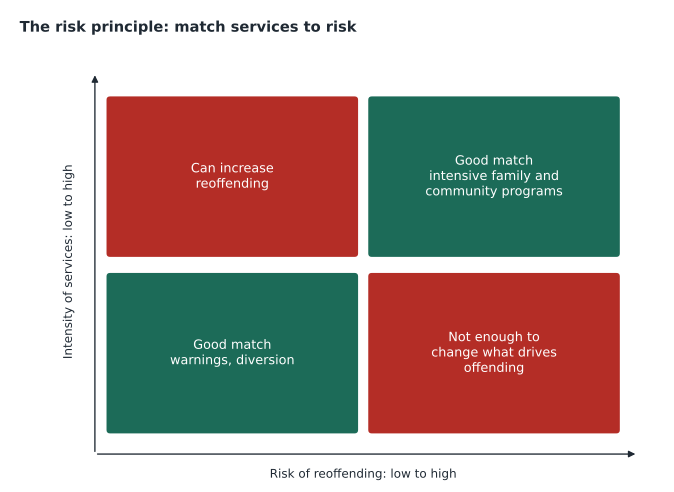
One of the most useful frameworks in youth corrections is the risk-need-responsivity model developed by Canadian psychologists Don Andrews and James Bonta. The risk principle says that the intensity of services should match the young person's risk of reoffending: intensive services for high-risk youth, and minimal intervention for low-risk youth. The need principle says that services should target the factors that actually drive offending and can be changed, called criminogenic needs, such as antisocial attitudes, antisocial peers, family problems, school failure and substance use. The responsivity principle says that services should be delivered in ways that fit the young person's learning style, abilities, culture and motivation, usually through cognitive-behavioural and skill-building methods.
The risk principle explains a finding that surprises many students: giving intensive programs to low-risk youth can increase their reoffending. It mixes them with higher-risk peers and disrupts the parts of their lives, such as school, family and pro-social friends, that are keeping them out of trouble. This is one reason the extrajudicial measures and diversion in lesson 4 work: for most young people, a light response that keeps them connected to normal life is the right dose. It also explains why Noah and Devon needed such different responses.
Programs with strong evidence
Several kinds of programs have consistently good evidence. Family-based programs for high-risk adolescents are among the strongest. Multisystemic Therapy sends therapists into the home to work with the young person, family, school and peers on the specific problems driving behaviour, and Functional Family Therapy works with families over a few months to improve communication and parenting; both have been tested in many trials in several countries with reductions in reoffending and out-of-home placements. Early childhood and school programs, such as nurse home visiting for at-risk first-time mothers and classroom behaviour programs like the Good Behavior Game, show long-term effects on later offending, although the benefits appear years after the program. Cognitive-behavioural programs that teach young people to recognize risky situations, manage anger and solve problems have reduced reoffending in many evaluations, including in custody and community settings.
Other approaches have more mixed but promising evidence. Mentoring programs, such as Big Brothers Big Sisters, have modest positive effects on behaviour, strongest when relationships last at least a year and mentors are well supported. Summer jobs programs for teenagers in high-violence neighbourhoods have reduced violent-crime arrests in some randomized trials, including a well-known Chicago study. After-school programs can reduce offending during the high-risk afternoon hours, but only when they are well attended and structured, not simply drop-in. And community-wide approaches such as Communities That Care, which help local coalitions choose evidence-based programs to address their own risk factors, have shown reductions in delinquency in a randomized trial across several states.
| Approach | Evidence | Notes |
|---|---|---|
| Scared Straight and juvenile awareness | Harmful: increases offending | Should not be used |
| Boot camps | Little or no effect | Popular in the 1990s |
| Diversion for low-risk youth | Equal or lower reoffending than formal processing | Lesson 4 |
| Multisystemic Therapy, Functional Family Therapy | Strong: reduced reoffending and placements | For high-risk youth and families |
| Cognitive-behavioural programs | Good: reduced reoffending | Community and custody settings |
| Mentoring | Modest positive effects | Long, well-supported relationships work best |
| Summer jobs in high-violence areas | Promising: reduced violent-crime arrests in some trials | Effects vary by program |
| Structured after-school programs | Mixed: depends on attendance and structure | Targets high-risk hours |
What police can do
Police are not therapists, and most effective youth programs are run by families, schools, health services and community organizations. But police contribute in several ways. They make the first decisions that determine whether a young person is diverted or drawn deeper into the system, and they can make sure those decisions follow the evidence. They can refer young people and families to the programs that fit, if they know what is available. They can take part in coordinated responses, such as the Eastgate Situation Table that students saw in the community policing course, where police, schools, health and social services meet weekly to respond to people at acutely elevated risk before a crisis. They can address places as well as people: the community policing course showed how lighting, design and management of spaces like Eastgate Park can reduce opportunities for crime. And they can build relationships with young people outside enforcement, through programs like the youth basketball league Ferreira runs.
Bell is careful about that last point. Police-run youth programs are good for relationships and trust, but they are not a substitute for evidence-based programs delivered by trained staff, and their effects on offending have rarely been measured. 'Basketball doesn't stop a kid from robbing someone,' he says. 'Devon came to basketball. What basketball does is give a kid an adult who knows their name and will notice when something's wrong. That's worth a lot. It's not therapy.'
After the robbery
At the community meeting, Ferreira proposed an alternative to the councillor's idea. The Eastgate Situation Table had already discussed the park. The plan that emerged had four parts: new lighting on the path between the park and the Lindell towers, which the city installed in August; extending the community centre's supervised evening program to 9 p.m. on weekdays during the summer; a referral pathway for families to the region's Functional Family Therapy team for teenagers with repeated police contact; and a summer jobs placement program for 30 Eastgate teenagers, funded by the city and two local businesses. Tariq Haidari's mural was painted on the field house that summer. Ben Arsenault started playing basketball again in August, in the evening program.
The councillor's scared straight proposal was withdrawn. Desjardins tells students that this kind of moment, when a frightened community wants something to be done and a popular idea is on the table, is where police can do the most good or the most harm. Speaking up for evidence takes some courage. Ferreira did it calmly, acknowledged why the idea appealed, and offered something better.
# Reading a simple program evaluation (invented numbers).
# Rearrest within 12 months for similar youth randomly assigned.
groups = {"program": (200, 46), "comparison": (200, 62)}   # (youth, rearrested)
rates = {g: r / n for g, (n, r) in groups.items()}
for g, rate in rates.items():
    print(g, "rearrest rate:", round(rate, 2))
diff = rates["comparison"] - rates["program"]
print("absolute reduction:", round(diff, 2))
print("relative reduction:", round(diff / rates["comparison"], 2))program rearrest rate: 0.23 comparison rearrest rate: 0.31 absolute reduction: 0.08 relative reduction: 0.26
In the invented evaluation, the program group was rearrested at a rate of 0.23 and the comparison group at 0.31: an absolute reduction of 0.08, or a relative reduction of about a quarter. Desjardins teaches students to ask three questions about any evaluation they hear about: was there a fair comparison group, ideally by random assignment; how big was the effect, in absolute terms; and has it been replicated somewhere else?
After a first contact: keeping the door open
Prevention does not stop once a young person has come to police attention. The months after a first contact are a window in which the right response can make later offending less likely. Several practices help. Follow-up matters: a call to the family a few weeks after a warning or referral, to ask how things are going, signals that someone noticed. Connection to school is protective, so officers and youth workers should help young people stay in school rather than adding conditions that push them out of it. Pro-social activities and adults matter, which is why programs like the Eastgate evening program and the art program that worked with Tariq Haidari are worth supporting. And families often need help themselves: parents of teenagers in trouble may be struggling with work, health, housing or their own past contact with the justice system, and a referral for the family can do more than a referral for the young person alone.
Prevention also needs to fit communities. For Indigenous young people, programs led by Indigenous organizations, grounded in culture, language and connection to land and community, have been central to efforts to reduce overrepresentation, and the YCJA's emphasis on the needs of Aboriginal young persons applies to prevention as much as to sentencing. Desjardins reminds students that the community policing course showed how trust is built: by showing up, keeping promises and sharing decisions. Youth crime prevention depends on the same things.
Worked problem
Evaluating a proposal
A school principal proposes that police officers give a one-time assembly to all grade 9 students about the consequences of crime, including videos of real arrests and a talk from a young man who served time for robbery. He asks the youth unit to take part. How should the unit respond?
Show solution
- A single assembly is unlikely to change behaviour; one-time awareness sessions have little evidence of effect.
- Content designed to frighten students resembles juvenile awareness programs, which have been found to increase offending.
- A talk by a person with lived experience can be valuable if it is part of a structured program, but should not glamorize or frighten.
- The unit could offer instead to help connect the school with evidence-based programs, and to support relationships through regular, low-key contact.
- The unit should explain its reasons respectfully and offer an alternative.
Answer: Decline the fear-based assembly, explain the evidence, and offer to help with approaches that work.
Common mistakes
MistakeShowing young people prison deters them.
InsteadScared Straight programs increase offending.
MistakeMore intensive programs are always better.
InsteadIntensive programs for low-risk youth can increase reoffending; match intensity to risk.
MistakePolice youth programs prevent crime on their own.
InsteadThey build relationships and trust; evidence-based programs need trained staff.
MistakeIf a program sounds sensible, it probably works.
InsteadPrograms must be judged by rigorous evidence; many popular ones failed.
Summary and key terms
- Scared Straight programs increase offending, and boot camps have little effect.
- The risk-need-responsivity model matches service intensity to risk, targets changeable criminogenic needs, and uses methods that fit the young person.
- Family-based programs like Multisystemic Therapy and Functional Family Therapy, early childhood and school programs, and cognitive-behavioural programs have strong evidence.
- Mentoring, summer jobs and structured after-school programs have promising but more mixed evidence.
- Police contribute through diversion decisions, referrals, coordinated responses, place-based prevention and relationships.
- Judge programs by fair comparisons, effect sizes and replication.
- Juvenile awareness program
- A program that exposes young people to prison life to deter them, such as Scared Straight.
- Risk principle
- The principle that service intensity should match the risk of reoffending.
- Criminogenic needs
- Changeable factors linked to offending, such as antisocial peers and attitudes.
- Deviancy training
- The reinforcement of antisocial behaviour when high-risk young people are grouped together.
- Multisystemic Therapy
- An intensive home-based program addressing a young person's family, school and peers.
- Randomized trial
- An evaluation in which participants are randomly assigned to a program or comparison group.
Practice problems
Work each problem on paper first, then reveal the answer to check.
Why did Ferreira oppose the scared straight proposal?
Show answer
Evaluations have found such programs increase offending.
What does the risk principle say?
Show answer
Match the intensity of services to the young person's risk: intensive for high risk, minimal for low risk.
In the code example, what was the absolute reduction in rearrest?
Show answer
0.08.
Name the four parts of the Eastgate plan.
Show answer
Path lighting, extended evening program, Functional Family Therapy referrals, and summer jobs.
Lesson quiz · 5 questions
Score 60% or more to complete this lesson.
Create a free account to save your progress, take quizzes and earn a certificate.