
LES-211 · Lesson 3 of 12 · 20 min
The Youth Criminal Justice Act: purpose and principles
▶ Video coming soon A video version of this lesson is on the way.
Desjardins hands out a copy of the Youth Criminal Justice Act's preamble and section 3 and asks the students to underline every word that would not appear in a law about adults. They find words like 'guidance', 'rehabilitation', 'reintegration', 'diminished moral blameworthiness', 'enhanced procedural protection', 'timely intervention' and 'the involvement of families'. 'Those words are instructions,' he says. 'When you deal with a young person, the Act tells you what you are supposed to be trying to do. If you can't explain your decision in the Act's language, you probably made the wrong one.'
The structure of the Act
The YCJA is a federal statute; it applies across Canada, but the provinces and territories run the youth justice courts, the youth custody facilities and probation, and design the programs for extrajudicial measures. The Act is organized in parts. Part 1 deals with extrajudicial measures, the subject of the next lesson. Part 2 deals with organization of the youth criminal justice system, including youth justice courts and conferences. Part 3 covers judicial measures: the right to counsel, notice to parents, pretrial detention and the trial process. Part 4 covers sentencing, Part 5 custody and supervision, and Part 6 publication, records and information. The Criminal Code applies to young persons except where it is inconsistent with the YCJA, so the offences themselves, and most police powers, are the same as for adults.
Under section 13, youth justice courts are designated by the provinces; in Ontario, most youth cases are heard in the Ontario Court of Justice, and some of the most serious go to the Superior Court of Justice. Youth trials are usually heard by a judge alone, but a young person charged with murder, or facing a possible adult sentence, can elect trial by judge and jury.
The declaration of principle in section 3
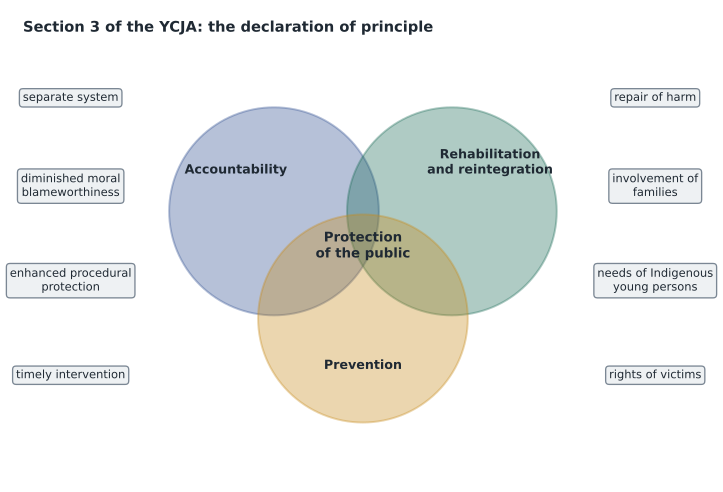
Section 3(1)(a) states that the youth criminal justice system is intended to protect the public by holding young persons accountable through measures proportionate to the seriousness of the offence and the degree of responsibility of the young person; promoting their rehabilitation and reintegration into society; and supporting the prevention of crime by referring young persons to programs or agencies in the community to address the circumstances underlying their offending behaviour. Protection of the public was made an express purpose by the 2012 amendments; before that, the Act said the system was intended to prevent crime, rehabilitate young persons and ensure meaningful consequences, which would lead to long-term protection of the public.
Section 3(1)(b) sets out the principle that the youth system must be separate from the adult system and based on the principle of diminished moral blameworthiness, and must emphasize rehabilitation and reintegration, fair and proportionate accountability consistent with the greater dependency and reduced maturity of young persons, enhanced procedural protection, timely intervention that reinforces the link between the offending behaviour and its consequences, and promptness and speed by persons responsible for enforcing the Act, given young persons' perception of time. Section 3(1)(c) says measures should reinforce respect for societal values, encourage repair of harm done, be meaningful to the individual young person given their needs and level of development, involve parents and the extended family and community where appropriate, respect differences, and respond to the needs of Aboriginal young persons and young persons with special requirements. Section 3(1)(d) gives special rights to young persons, victims and parents: young persons have rights and freedoms in their own right, including the right to be heard; victims should be treated with courtesy, compassion and respect and informed about the proceedings; and parents should be informed and encouraged to support their children.
Bell points to the phrase 'timely intervention'. 'Teenagers live in a different time scale,' he says. 'If a fifteen-year-old does something in May and goes to court in February, the court date has nothing to do with what he did. He's a different kid by then. The Act says we have to move fast, and that applies to police too. If I sit on a file for two months, I've failed the principle.'
Enhanced procedural protection
Because young people are less able than adults to understand and protect their rights, the YCJA adds protections on top of those in the Charter. Section 25 gives a young person the right to retain and instruct counsel without delay at every stage, and requires police who arrest or detain a young person to advise them of that right; if the young person cannot obtain counsel, the court must direct that counsel be appointed, often through legal aid. Section 26 requires police to give notice to a parent as soon as possible when a young person is arrested and detained, a requirement covered in lesson 7. Section 146 provides special rules for the admissibility of statements, covered in lesson 6. Section 32 requires the court to make sure an unrepresented young person understands the charge and the consequences of a plea. And the privacy provisions in Part 6 protect the young person's identity, covered in lesson 9.
Desjardins notes that these protections often require police to do more than they would with an adult, not less. 'With an adult, telling them they have a right to a lawyer is usually enough,' he says. 'With a young person, you have to make sure they understood it, in language that fits their age and understanding. The Act calls it enhanced protection, and the courts take that word seriously.' He also reminds students that section 3(1)(d)(i) says young persons have rights 'in their own right', which means that a parent cannot waive a young person's rights for them.
| Principle | What it means for police |
|---|---|
| Separate system based on diminished moral blameworthiness | Do not treat a young person as a small adult; apply the YCJA, not habits from adult cases |
| Timely intervention and promptness | Move files quickly; delays weaken the link between act and consequence |
| Enhanced procedural protection | Explain rights in age-appropriate language and confirm understanding |
| Involvement of families | Notify parents promptly and involve them in decisions where appropriate |
| Repair of harm and victims' rights | Keep victims informed and look for ways the young person can make amends |
| Needs of Indigenous young persons | Consider culturally appropriate programs and community involvement |
Parents, victims and the community
Youth justice gives parents a role that adult justice does not. Parents usually must be notified when a young person is arrested or detained, may be required to attend court, and are often central to decisions about release and diversion. Section 27 allows a youth justice court to order a parent to attend, and a parent who fails to attend without reasonable excuse can be found in contempt. But the Act does not make parents criminally responsible for their children's offences, and the young person's rights belong to the young person. Bell tells the class that the parent in the room is not always an ally. Some parents push their children to confess to make the problem go away; some are angry and humiliating; a few are themselves part of the problem. An officer has to watch for all of that.
Victims also have a defined place. The Canadian Victims Bill of Rights applies to youth cases, and section 3(1)(d)(ii) and (iii) of the YCJA give victims the right to be treated with courtesy, compassion and respect, to be informed about the proceedings and to be given an opportunity to participate and be heard. Under section 12, a victim of an offence dealt with by an extrajudicial sanction can ask for the identity of the young person and how the offence was dealt with. Claire Arsenault, Ben's mother, called the station twice in the week after the robbery to ask what was happening, and Bell admits that the first time, nobody called her back for three days. Students who took the victimology course will remember why that matters.
# Timeliness check for a unit's youth files: days from the incident to the first
# decision (warning, referral or charge). Figures are invented.
files = {"Y-0412": 3, "Y-0419": 11, "Y-0425": 2, "Y-0431": 46, "Y-0433": 7,
         "Y-0440": 5, "Y-0446": 28, "Y-0450": 1, "Y-0457": 9, "Y-0462": 4}
target = 14
late = sorted(f for f, d in files.items() if d > target)
days = sorted(files.values())
mid = (days[4] + days[5]) / 2
print("median days to decision:", mid)
print("files over", target, "days:", late)median days to decision: 6.0 files over 14 days: ['Y-0431', 'Y-0446']
Port Ardent's youth unit sets itself a target of a first decision within 14 days of the offence. In the invented sample, the median is 6 days, but two files took 28 and 46 days. Bell says the long ones are almost always files waiting for something: a victim to call back, a video to be reviewed, or an officer on leave. The fix is supervision, not more law.
How a case moves through the system
A youth case usually begins with a police decision. If the officer decides that an extrajudicial measure is not enough, they lay an information, or in some provinces, including British Columbia, Quebec and New Brunswick, recommend a charge to the Crown, which approves it. The young person may be released by police with an appearance notice or undertaking, or held for a judicial interim release hearing in youth justice court, as lesson 7 explains. At the first appearance, the young person and their counsel receive disclosure. The Crown reviews the file and may decide to withdraw the charge, offer an extrajudicial sanction, or proceed. Many cases end in a guilty plea; others go to trial. If the young person is found guilty, the court imposes a youth sentence, often after a pre-sentence report prepared by a youth worker, and sometimes after a conference of family, professionals and community members convened under section 19. Throughout, the young person's identity is protected by the publication ban in section 110.
Bell draws the process on the board and circles each point where someone makes a choice: the officer at the scene, the officer deciding whether to charge, the Crown deciding whether to proceed, the judge deciding on release, the young person deciding whether to plead, and the judge deciding the consequence. 'At every circle,' he says, 'the law tells the decision-maker to consider the less formal option first. That is the design. It only works if each person actually does it, and if each person records why.'
Officers in youth justice court
Officers testify in youth cases much as they do in adult cases, and the same rules of evidence apply. A few differences matter. Youth courts are usually smaller and quieter, and judges often speak directly to the young person in plain language, so an officer who uses jargon or sounds hostile stands out. The officer's notes about how rights were explained, who was contacted and when, and what the young person said in their own words, are often the centre of the hearing, because the special rules on counsel, parents and statements give the defence more to challenge. The publication ban means officers must not discuss the case, or the young person's identity, outside the proceedings, including with media and on social media. And because youth courts aim to move quickly, officers who are slow to provide reports or to appear can delay cases in ways that undermine the principle of timely intervention.
Worked problem
Applying section 3 to a decision
A 15-year-old with no record spray-paints a tag on the wall of the Eastgate Park field house. The cleanup costs the city 300 dollars. He admits it immediately when Constable Ferreira, who knows him from the youth basketball program, asks about it. His parents are cooperative. What do the principles suggest?
Show solution
- Accountability should be proportionate: the offence is minor property damage and he accepted responsibility at once.
- Repair of harm points toward cleaning the wall himself or helping with a community cleanup, and possibly paying part of the cost.
- Rehabilitation and prevention point toward involving his parents and the basketball program, which already gives him a positive adult connection.
- Timeliness means acting within days, while the link between the act and the consequence is clear.
- Section 4 presumes that extrajudicial measures are adequate for a non-violent first offence, so court would be hard to justify.
Answer: A quick, informal response focused on repair, with the family and the existing community connection, fits the principles; formal court action would not.
Common mistakes
MistakeThe YCJA has its own offences.
InsteadThe offences are in the Criminal Code; the YCJA changes the process and the consequences.
MistakeA parent can waive a young person's right to counsel.
InsteadThe rights belong to the young person; a parent cannot waive them on the child's behalf.
MistakeProtection of the public is not a goal of youth justice.
InsteadSince 2012, protection of the public is an express purpose in section 3(1)(a).
MistakeSpeed does not matter in youth cases as long as the outcome is right.
InsteadTimeliness is itself a principle, because delay weakens the link between act and consequence.
Summary and key terms
- The YCJA is a federal law administered by the provinces; the Criminal Code offences apply to young persons.
- Section 3 makes protection of the public the purpose, achieved through proportionate accountability, rehabilitation and prevention.
- The youth system is separate and based on diminished moral blameworthiness, enhanced procedural protection and timely intervention.
- Sections 25, 26, 32 and 146 give young persons extra protections around counsel, parental notice, pleas and statements.
- Parents have a defined role, but the rights belong to the young person.
- Victims have rights to be informed and heard in youth cases.
- Declaration of principle
- Section 3 of the YCJA, which sets out the purposes and principles of the youth system.
- Enhanced procedural protection
- Protections for young persons beyond those for adults, reflecting their reduced maturity.
- Youth justice court
- A court designated to hear cases under the YCJA.
- Timely intervention
- Acting promptly so that the consequence is clearly connected to the behaviour.
- Repair of harm
- Making amends to the victim or community for the damage caused.
- Due process
- Fair procedures, including notice, counsel and the chance to challenge evidence.
Practice problems
Work each problem on paper first, then reveal the answer to check.
Name the three ways section 3(1)(a) says the system protects the public.
Show answer
Holding young persons accountable proportionately, promoting rehabilitation and reintegration, and supporting crime prevention through community referrals.
In the code example, what was the median number of days to a first decision?
Show answer
6 days.
Why does Bell say the parent in the room is not always an ally?
Show answer
Some parents pressure the child to confess, some are humiliating, and some are part of the problem.
Which section gives a victim of an extrajudicial sanction the right to ask how the offence was dealt with?
Show answer
Section 12.
Lesson quiz · 5 questions
Score 60% or more to complete this lesson.
Create a free account to save your progress, take quizzes and earn a certificate.