
LES-211 · Lesson 1 of 12 · 20 min
Why youth justice is different: adolescence, responsibility and history
▶ Video coming soon A video version of this lesson is on the way.
Professor Desjardins opens the course with two photographs on the screen. The first shows the basketball court in Eastgate Park on a bright afternoon, a backpack lying near the fence. The second shows a school photo of a boy of about sixteen, his face blurred. 'On a Thursday afternoon in May,' Desjardins says, 'a fifteen-year-old named Ben Arsenault was knocked to the ground on that court and his phone was taken. Two teenagers were involved. One was sixteen and had never been in trouble with police. The other was seventeen and had been before a youth justice court twice. By the end of this course you will know how Port Ardent police service, the Crown, the court and the community dealt with both of them, and why the law treated them so differently from adults who did the same thing.'
He introduces his co-instructor for the course, Constable Marcus Bell, who has spent nine years in the youth services unit and three years before that as a school liaison officer at Eastgate Secondary School. Bell tells the class that most of his work is not arrests. 'I spend my days deciding what to do with young people who have done something wrong, and most of the time the right answer is not court. The hard part is knowing when it is.' Students who took the community policing course will also recognize Constable Grace Ferreira, the Eastgate neighbourhood officer, who knew both teenagers before the robbery and will appear throughout the course.
Who counts as a young person
In Canada, the Youth Criminal Justice Act (YCJA) applies to young persons aged 12 to 17 at the time of the alleged offence. Under section 13 of the Criminal Code, no person can be convicted of an offence committed while under 12, so a child under 12 who causes harm is dealt with by parents, schools and, where needed, child protection services, not by the criminal law. A person who turns 18 after the offence is still dealt with under the YCJA for that offence, because what matters is the age when it was committed.
Desjardins points out that the dividing line is a legal choice. Nothing magical happens to a person on their eighteenth birthday. But the law has to draw a line somewhere, and the choice reflects a judgment that adolescents differ from adults in ways that matter for responsibility, for punishment and for how the state should respond.
Adolescence and responsibility
Research in developmental psychology and neuroscience over the last thirty years has strengthened an idea that parents and teachers have always known: adolescents are not simply small adults. Several differences are well established. Adolescents are more likely than adults to take risks, especially in the presence of peers. They are more sensitive to immediate rewards and less focused on long-term consequences. Their ability to control impulses, plan ahead and resist pressure is still developing, and the parts of the brain involved in self-regulation continue to mature into the early or mid-twenties. Under stress, in emotionally charged situations, adolescents' decision-making differs most from adults', even though in calm conditions their reasoning about simple choices can look much like an adult's.
Desjardins is careful about what this research does and does not show. It does not show that teenagers cannot tell right from wrong, or that they are not responsible for what they do. A sixteen-year-old who pushes another boy to the ground and takes his phone knows it is wrong. What the research supports is that young people are, on average, less blameworthy than adults for the same act, because their judgment and self-control are less mature, and that they have a greater capacity to change. Both points have shaped the law.
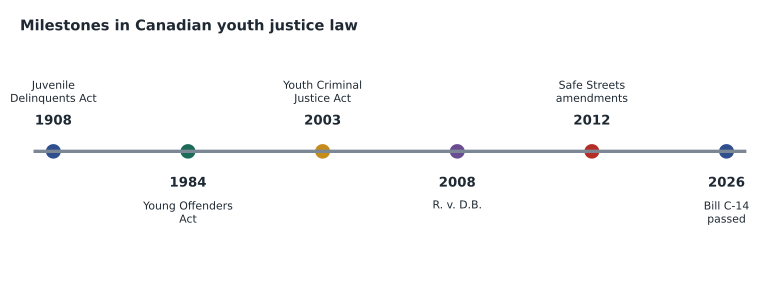
In R. v. D.B. (2008), the Supreme Court of Canada held that young people are entitled to a presumption of diminished moral blameworthiness or culpability, and that this presumption is a principle of fundamental justice protected by section 7 of the Charter. The Court struck down provisions that had placed the onus on young persons to show why they should not receive an adult sentence for certain offences. The YCJA itself states, in section 3, that the youth justice system must be separate from the adult system and must be based on the principle of diminished moral blameworthiness.
The age-crime curve
One of the most consistent findings in criminology is the age-crime curve. When police-reported offending is plotted by age, it rises steeply through the early teenage years, peaks in the late teens or early twenties, and then declines. The exact peak varies by offence, coming earlier for property crime and somewhat later for violent crime, but the shape is found across countries and decades. Most young people who commit offences stop on their own as they mature, find work, form relationships and take on responsibilities. Criminologists call this process desistance.
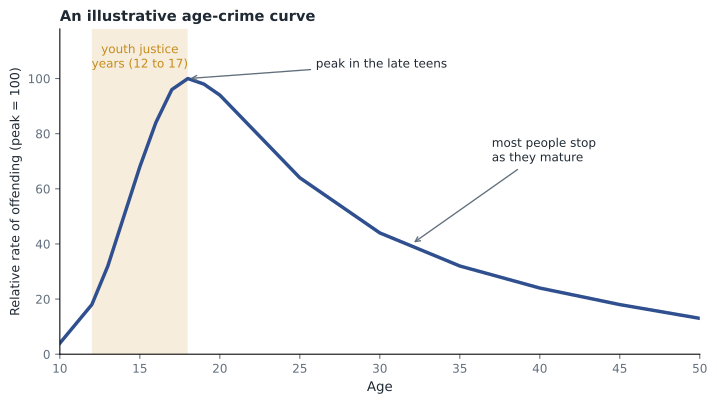
The curve has two practical lessons for officers. First, a large share of young people who come into contact with police will never come into contact with them again, especially if the first contact is handled well. Second, there is a much smaller group whose offending starts early, often before the teenage years, and persists. Researchers such as Terrie Moffitt distinguished between adolescence-limited and life-course-persistent patterns, and later research has shown that the picture is more varied than two groups, but the core idea remains useful: the right response to a first-time teenage shoplifter is not the right response to a young person with a long history of violence and serious problems at home and at school. Youth justice law tries to make room for both.
Bell adds a third lesson from his own experience. Formal processing can itself make things worse. Being charged, going to court, missing school for hearings and being labelled as a young offender can push a young person toward peers who offend and away from school and family. Studies comparing similar young people who were diverted with those who were formally processed have often found equal or lower reoffending among those diverted, especially for low-risk youth. That evidence is one of the main reasons both countries emphasize diversion, which lessons 4 and 11 explore.
From the Juvenile Delinquents Act to the YCJA
Canada's first youth justice law was the Juvenile Delinquents Act of 1908. It treated young people who broke the law as misdirected children in need of help and guidance, and gave juvenile courts wide discretion to do what they thought was in the child's best interests. In practice, that discretion often meant few procedural protections, indeterminate committals to training schools, and punishment for behaviour such as truancy or 'sexual immorality' that would not have been an offence for an adult. The Young Offenders Act of 1984 replaced it. The YOA set a uniform age range of 12 to 17, gave young people the procedural rights of adults including the right to counsel, and tried to balance responsibility with special needs. Over time, however, Canada came to have one of the highest youth custody rates in the Western world, and many young people were sent to court and to custody for minor offences.
The Youth Criminal Justice Act came into force on April 1, 2003. It was designed to reduce the use of courts and custody for less serious offences, to make sure that the most serious offences received meaningful consequences, and to give clearer direction to police, Crowns and judges. It created a framework of extrajudicial measures, restricted pretrial detention and custody, and set out detailed principles. The Safe Streets and Communities Act of 2012 amended the YCJA to make protection of the public an express goal, to allow judges to consider denunciation and specific deterrence in sentencing, and to make it easier to detain young people charged with violent offences before trial. In June 2026, Parliament passed the Bail and Sentencing Reform Act (Bill C-14), which includes further YCJA amendments, such as allowing police to publish the identity of a dangerous young person in an urgent situation without a court order; some of those changes come into force on dates set by the government, so officers must check which are in effect.
Terms used in this course
The YCJA uses its own vocabulary, and officers should use it correctly in notes and reports. The person is a young person, not a juvenile delinquent or young offender, although the last term is still common in conversation. Cases are heard in a youth justice court. A young person found guilty receives a youth sentence. The Act also refers to youth workers, who supervise young people on probation, and to youth records, which are governed by special access rules.
| Adult criminal system | Youth system under the YCJA |
|---|---|
| Accused | Young person |
| Trial | Trial in youth justice court |
| Conviction | Finding of guilt |
| Sentence | Youth sentence |
| Probation officer | Youth worker |
| Criminal record | Youth record with limited access periods |
What police add, and what they decide
Police are usually the first part of the justice system that a young person meets, and their decisions shape everything after. An officer who responds to a call involving a teenager decides whether an offence has been committed, whether to take any action at all, whether to warn, refer or arrest, whether to hold the young person or release them, how to question them, and what to tell their parents and the victim. Section 6 of the YCJA requires police, before starting judicial proceedings, to consider whether it would be sufficient to take no further action, warn the young person, administer a caution or refer them to a community program. Bell tells the class that these decisions are where a youth officer earns their pay.
Desjardins writes three goals on the board that will run through the course: accountability, rehabilitation and protection. Young people must be held accountable for the harm they cause, in ways that are meaningful to them and to the people they harmed. The response should help them stop offending and grow into law-abiding adults. And the public, including victims like Ben Arsenault, must be protected. 'These goals do not always point the same way,' Desjardins says. 'Most of this course is about how to balance them when they don't.'
# Illustrative age-crime curve: relative offending rate by age (peak = 100).
# Values are invented for teaching; the shape follows the research.
rates = {12: 18, 13: 32, 14: 50, 15: 68, 16: 84, 17: 96, 18: 100, 19: 98,
         20: 94, 22: 82, 25: 64, 30: 44, 35: 32, 40: 24, 50: 13}
peak_age = max(rates, key=rates.get)
youth = [rates[a] for a in range(12, 18)]
print("peak age:", peak_age)
print("average relative rate, ages 12-17:", round(sum(youth) / len(youth), 1))
print("rate at 30 compared with peak:", round(rates[30] / rates[peak_age], 2))peak age: 18 average relative rate, ages 12-17: 58.0 rate at 30 compared with peak: 0.44
In this illustrative curve, the rate at 30 is less than half the rate at the peak. Real curves vary by country, offence and year, but the pattern of a late-teen peak followed by decline is robust. Desjardins reminds students that a curve like this describes groups, not individuals: it does not tell an officer what any particular young person will do.
Worked problem
Applying the principles to a first contact
A 14-year-old with no previous police contact is caught by a store security guard taking a phone case worth 20 dollars from a pharmacy on Mercer Street. She is calm, apologetic and gives her name and address. Her mother can be reached by phone. The store wants the item back and does not want to go to court. What should the responding officer consider?
Show solution
- The young person is within the youth justice system because of her age at the time of the offence.
- The offence is minor, non-violent and a first contact, so the research and the law both point toward an informal response.
- Section 6 of the YCJA requires the officer to consider no further action, a warning, a caution or a referral before starting judicial proceedings, and section 4 presumes extrajudicial measures are adequate for a non-violent first offence.
- Accountability can still be meaningful: returning the item, an apology to the store, and a conversation with her mother about what happened.
- The officer should record what was done, so that if there is another contact, the next officer knows about this one.
Answer: A warning or referral, with the parent involved and the store's wishes taken into account, is likely the right response; court would add little and could do harm.
Common mistakes
MistakeYoung people are not responsible for what they do.
InsteadYoung people are responsible, but on average less blameworthy than adults for the same act, and more capable of change.
MistakeMost teenagers who offend become adult criminals.
InsteadMost stop offending as they mature; a much smaller group persists, and responses should distinguish between them.
MistakeBeing tough on first-time youth offenders deters them.
InsteadFormal processing of low-risk youth often produces equal or higher reoffending than diversion.
MistakeThe YCJA applies to anyone under 18 when they are charged.
InsteadIt applies to offences committed at ages 12 to 17, whatever the person's age when charged.
Summary and key terms
- The YCJA applies to offences committed by young persons aged 12 to 17; no one can be convicted for an act committed under 12.
- Adolescents take more risks, are more influenced by peers and have less developed self-control, especially under stress, but they still know right from wrong.
- R. v. D.B. (2008) made the presumption of diminished moral blameworthiness a principle of fundamental justice.
- Offending peaks in the late teens and declines; most young people desist on their own.
- Formal processing can increase reoffending for low-risk youth, which is why diversion is emphasized.
- Police decisions at first contact shape the whole case.
- Young person
- A person aged 12 to 17 at the time of an alleged offence, under the YCJA.
- Diminished moral blameworthiness
- The principle that young people are, on average, less culpable than adults for the same act.
- Age-crime curve
- The pattern in which offending rises in adolescence, peaks in the late teens and declines with age.
- Desistance
- The process by which people stop offending.
- Diversion
- Dealing with an offence outside the formal court process.
- Parens patriae
- The idea of the state acting as a parent, which shaped the early juvenile courts.
Practice problems
Work each problem on paper first, then reveal the answer to check.
Name two ways adolescent decision-making differs from adults', according to developmental research.
Show answer
More risk-taking in the presence of peers; less developed impulse control and focus on long-term consequences.
In the code example, what was the peak age?
Show answer
18.
What did R. v. D.B. (2008) decide?
Show answer
That young people are entitled to a presumption of diminished moral blameworthiness, a principle of fundamental justice.
Why can formal processing harm low-risk youth?
Show answer
It can disrupt school and family, label the young person and push them toward peers who offend.
Lesson quiz · 5 questions
Score 60% or more to complete this lesson.
Create a free account to save your progress, take quizzes and earn a certificate.