
LES-211 · Lesson 4 of 12 · 21 min
Extrajudicial measures: warnings, cautions and referrals
▶ Video coming soon A video version of this lesson is on the way.
On a Saturday in March, a security guard at the pharmacy on Mercer Street stopped a 13-year-old named Mia Castellano at the door with a pair of wireless earbuds worth 45 dollars in her jacket pocket. She burst into tears. When Constable Ferreira arrived, Mia gave her name and address at once, said she had wanted the earbuds because everyone in her class had them, and begged the officer not to tell her mother. Ferreira called her mother anyway, who arrived twenty minutes later. Bell uses the case to open this lesson. 'What Ferreira did next,' he says, 'is the most common decision in youth policing, and the law has a lot to say about it.'
Part 1 of the YCJA
Part 1 of the Youth Criminal Justice Act creates a structured set of alternatives to court called extrajudicial measures. Section 4 states the principles: extrajudicial measures are often the most appropriate and effective way to address youth crime; they allow for effective and timely interventions focused on correcting offending behaviour; they are presumed to be adequate to hold a young person accountable if the young person has committed a non-violent offence and has not previously been found guilty of an offence; and they should be used if they are adequate to hold the young person accountable, even if the young person has been dealt with by extrajudicial measures before or has been found guilty before. Section 5 sets out their objectives: to provide an effective and timely response, to encourage young persons to acknowledge and repair the harm, to encourage families and the community to be involved, to give victims an opportunity to participate, and to respect the rights and freedoms of young persons in a way that is proportionate to the seriousness of the offence.
Section 6 makes these principles a duty for police. Before starting judicial proceedings, or taking any other measures under the Act, a police officer shall consider whether it would be sufficient to take no further action, warn the young person, administer a caution if a program has been established, or, with the young person's consent, refer the young person to a program or agency in the community that may assist them not to commit offences. A failure to consider these options does not invalidate a charge that is laid, but services take the duty seriously, and Port Ardent requires officers to record on every youth file which measures they considered and why they rejected any that were not used.
The range of options
The options form a ladder, from the lightest response to the heaviest. An officer should normally start at the bottom and move up only when a lower rung is not enough to hold the young person accountable.
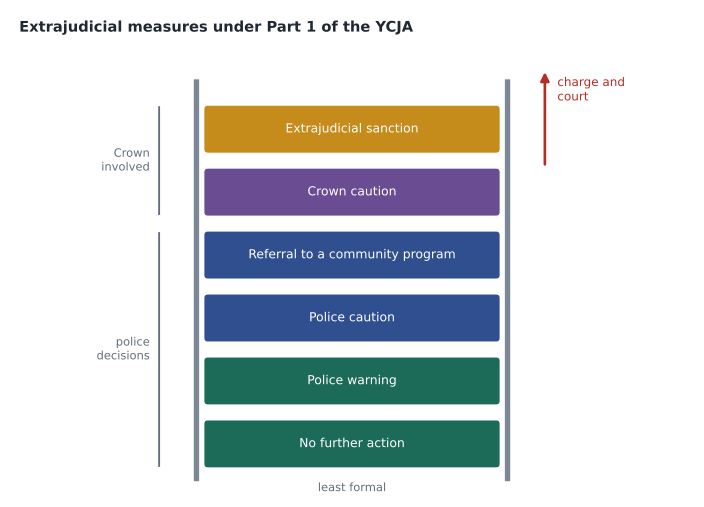
No further action is appropriate when the behaviour is trivial or has already been dealt with, for example by parents or a school. A warning is an informal, usually verbal, statement by the officer that the behaviour was wrong and could lead to charges. A police caution is more formal; under section 7 it is available only where the province has established a police caution program, and it often takes the form of a letter to the young person and their parents, or a meeting at the station. A referral, under section 6, sends the young person, with their consent, to a community program, such as a restorative justice program, a mental health or addiction service, a recreation program or a culturally specific program for Indigenous youth. A Crown caution, under section 8, is like a police caution but given by a Crown prosecutor after the file reaches them, where a program exists. An extrajudicial sanction, under section 10, is the most formal measure and is covered below.
Bell says the most important question is not which rung to choose but what the young person needs to stop. A referral to a program that does not fit is worse than a good warning. And a referral to a program with a six-month waiting list is not timely intervention. Port Ardent keeps an up-to-date list of programs with their current waiting times, and youth officers are expected to check it before promising anything to a family.
Mia and Tariq
Ferreira sat with Mia and her mother in the pharmacy's back office. She explained what Mia had done and why it was theft, that she could be charged under the Criminal Code but that the officer had decided a warning was enough this time, and that the warning would be recorded, so that if there was another incident, the next officer would know. Mia apologized to the store manager and returned the earbuds. Her mother said she would deal with it at home. The whole contact took forty minutes. Ferreira's notes recorded the facts, the options she considered, her reasons, and that the store manager agreed with the outcome.
The second case was more complicated. In April, a 15-year-old named Tariq Haidari spray-painted a large tag on the wall of the Eastgate Park field house. He had arrived in Canada two years earlier with his family as refugees from Afghanistan, and was struggling at school. When Ferreira spoke with him and his father, with an interpreter on the phone, he admitted the tag and said older boys had dared him. The cleanup would cost the city about 300 dollars. Ferreira considered a warning but thought it would not be enough: the damage was significant, and Tariq seemed to be drifting toward a group of older boys she was worried about. She also thought court would do more harm than good. She referred him, under section 6, to the community youth program run out of the Eastgate community centre, in partnership with the Port Ardent Newcomer Centre, where settlement counsellor Nadia Rahimi worked with him and his family. The agreement had three parts: Tariq would help the city crew repaint the field house wall, he would join the centre's after-school art program, which runs a legal mural project, and he would meet Rahimi weekly for two months.
Three months later, Tariq had finished all three parts. His mural design, a mountain range and a basketball hoop, was one of four chosen for a wall in the park. Ferreira closed the file with a note of the outcome. Desjardins asks the class what made the referral work. Students point to the fit between the program and what Tariq needed, the involvement of his family in their own language, the speed of the response, and the repair of the specific harm he caused.
Extrajudicial sanctions
An extrajudicial sanction under section 10 is used only if the young person cannot be adequately dealt with by a warning, caution or referral because of the seriousness of the offence, the nature and number of previous offences, or other aggravating circumstances. It must be part of a program authorized by the province, and the person considering it must be satisfied that it is appropriate, having regard to the needs of the young person and the interests of society. The young person must, having been informed of the sanction, fully and freely consent to it; must have been advised of the right to counsel and given a reasonable opportunity to consult counsel; and must accept responsibility for the act or omission that forms the basis of the offence. The Crown must be satisfied that there is sufficient evidence to proceed with the prosecution and that the prosecution is not barred at law. A sanction cannot be used if the young person denies participating in the offence or wants the charge dealt with by the youth justice court.
The sanction's protections are important. Under section 10(4), an admission or acceptance of responsibility made to be considered for an extrajudicial sanction is not admissible in evidence against the young person in any civil or criminal proceedings. Under section 9, evidence that a young person has received an extrajudicial measure, or an admission made in connection with it, cannot be used in youth court to prove prior offending. Under section 10(5), if the young person totally complies with the sanction, the youth justice court shall dismiss the charge; if they partially comply, the court may dismiss it if it considers the prosecution unfair, having regard to the circumstances and the young person's performance. Under section 11, the parent must be told of the sanction, and under section 12, the victim may ask for the young person's identity and how the offence was dealt with. Records of extrajudicial sanctions can be accessed for two years after the young person consents to the sanction, under section 119(2)(a).
Noah Kessler, the sixteen-year-old in the Eastgate Park robbery, would eventually be dealt with by an extrajudicial sanction, even though robbery is a serious offence. Lesson 8 explains why the Crown agreed to it, and lesson 12 reviews whether it was the right decision.
# Program waiting times shape whether a referral is "timely".
# Port Ardent's list (invented): program -> current wait in days.
programs = {"restorative justice": 9, "youth art program": 3,
            "substance use program": 41, "mentoring": 62, "anger management group": 18}
limit = 21
ok = sorted(p for p, w in programs.items() if w <= limit)
print("referrals possible within", limit, "days:", ok)
print("longest wait:", max(programs, key=programs.get), programs[max(programs, key=programs.get)], "days")referrals possible within 21 days: ['anger management group', 'restorative justice', 'youth art program'] longest wait: mentoring 62 days
With a three-week standard for timely intervention, only three of the five programs on Port Ardent's invented list are realistic options. Bell says the mentoring program's two-month wait is the single biggest gap in the city's youth services, and that the unit reports it to the city every quarter.
Restorative and culturally specific programs
Many of the referrals youth officers make are to restorative justice programs. In a restorative process, a trained facilitator brings together the young person, the person harmed, and family and community members, with everyone's consent, to talk about what happened, who was affected and what should be done to repair the harm. The young person hears directly how their actions affected someone, and the person harmed gets answers and a say in the outcome. Agreements often include an apology, repair or payment for damage, and steps the young person will take, such as community service or attending a program. Students who took the victimology course saw a restorative meeting between Ruth Lindqvist and the young man who broke into her store. Research on restorative justice for young people has generally found high satisfaction among victims and modest reductions in reoffending, with the best results for cases involving a direct victim.
For Indigenous young people, referrals to programs run by or with Indigenous communities are especially important, and section 3(1)(c)(iv) of the YCJA requires measures to respond to the needs of Aboriginal young persons. Programs may include circles with Elders, land-based programs and family group conferencing. When the community policing course visited Nimkii Bay, Sergeant Paul Keeshig described the community's youth circle, which takes referrals from his service and from Port Ardent for young people from the community. Bell's advice is to know the programs personally. 'Visit them,' he says. 'Meet the staff. If you can tell a parent exactly what happens on the first night, they are far more likely to agree.'
What a good diversion record contains
Because diversion leaves the young person with no court record, the police record is often the only trace of what happened. A good record identifies the young person and the parent contacted, describes the offence and the evidence briefly, lists the options the officer considered, states the reasons for the measure chosen, records the victim's views, and notes the outcome, such as whether a referral was completed. Under section 115, police may keep records of extrajudicial measures, and section 119(4) limits who may see records of measures other than sanctions to police and Crowns deciding on future measures, conference participants and officers investigating an offence. Records like these let the next officer see that a warning was already given, and they let supervisors check whether measures are being used consistently.
Worked problem
Choosing a measure
A 16-year-old with one previous police warning for shoplifting is caught taking 80 dollars' worth of clothing from a store, with a friend. He admits it but shrugs and says the store can afford it. His father is angry and wants the police to 'teach him a lesson'. The store wants the clothing back. What should the officer consider?
Show solution
- The presumption in section 4(c) still applies: the offence is non-violent and he has not been found guilty before; a previous warning is not a finding of guilt.
- A second warning may not be enough, given the previous warning and his attitude, so a referral to a program, such as a restorative justice program that brings him face to face with the store's staff, may be more effective.
- The father's anger is understandable, but the measure should be proportionate to the offence, not to the parent's frustration.
- The friend should be dealt with separately on his own history.
- Record the options considered and the reasons.
Answer: A referral to a restorative or accountability program is likely proportionate; formal charges would be hard to justify for a non-violent second contact.
Common mistakes
MistakeExtrajudicial measures are only for first offences.
InsteadSection 4(d) says they should be used whenever adequate, even if the young person has been dealt with before.
MistakeAn extrajudicial sanction is the same as a guilty plea.
InsteadThe young person accepts responsibility, but this is not a plea and cannot be used against them in court.
MistakeA referral is always better than a warning.
InsteadA referral that does not fit the young person's needs, or has a long wait, can be worse than a good warning.
MistakeIf no charge is laid, nothing needs to be written down.
InsteadEvery measure must be recorded so the next officer knows the history.
Summary and key terms
- Section 4 presumes extrajudicial measures are adequate for a non-violent offence by a young person with no prior finding of guilt.
- Section 6 requires police to consider no further action, a warning, a caution or a referral before starting judicial proceedings.
- The options form a ladder from no further action to the most formal measure; start low and move up only when needed.
- Extrajudicial sanctions require a provincial program, informed consent, advice about counsel, acceptance of responsibility and sufficient evidence.
- Admissions made for a sanction are inadmissible, and full compliance means the charge is dismissed.
- Measures must fit the young person's needs, be timely and be recorded.
- Extrajudicial measures
- Measures other than judicial proceedings used to deal with a young person who has committed an offence.
- Police warning
- An informal statement by an officer that the behaviour was wrong and could lead to charges.
- Caution
- A more formal warning given by police or the Crown under an established program.
- Referral
- Sending a young person, with consent, to a community program.
- Extrajudicial sanction
- The most formal extrajudicial measure, used through a provincial program with the young person's consent.
- Accepting responsibility
- Acknowledging the act that forms the basis of the offence, which is required for an extrajudicial sanction but is not a guilty plea.
Practice problems
Work each problem on paper first, then reveal the answer to check.
Why did Ferreira warn Mia rather than refer her?
Show answer
It was a first, minor, non-violent offence; Mia accepted responsibility, returned the item, and her mother was involved.
Name the three parts of Tariq's referral agreement.
Show answer
Repaint the wall with the city crew, join the art program, and meet Rahimi weekly for two months.
In the code example, which programs could take a referral within 21 days?
Show answer
Anger management group, restorative justice and the youth art program.
What happens under section 10(5) if a young person totally complies with an extrajudicial sanction?
Show answer
The youth justice court shall dismiss the charge.
Lesson quiz · 5 questions
Score 60% or more to complete this lesson.
Create a free account to save your progress, take quizzes and earn a certificate.