
LES-211 · Lesson 9 of 12 · 20 min
Confidentiality, juvenile records, sealing and expungement
▶ Video coming soon A video version of this lesson is on the way.
Two days after the robbery, a parent in the Lindell towers posted a photo on a neighborhood social media group showing Devon Hart being walked to a police car, with the caption 'This is the kid who robbed a boy at the park. Keep your kids away.' The post was shared more than two hundred times before the group's moderator took it down. Bell tells the class that the post was not posted by police, and that the parent who posted it did something the police could not lawfully do. But what police themselves may disclose about young people is tightly limited, and those limits follow a young person's records for years. This lesson covers confidentiality, juvenile records, sealing and expungement.
Why juvenile records are protected
Juvenile records are protected because the purposes of the juvenile system, rehabilitation above all, would be undermined if a teenager's mistakes followed them into adulthood. A public juvenile record can affect college admissions, scholarships, employment, housing and military service, long after the young person has changed. Ohio, like most states, makes juvenile court records generally confidential, allows courts to close juvenile hearings to the public, and provides for sealing and expungement of records. Police reports about juveniles are also protected: Ohio's public records law exempts many law enforcement investigatory records, and Port Ardent's policy is not to release the name or identifying details of any juvenile suspect or victim, except as required by law or court order.
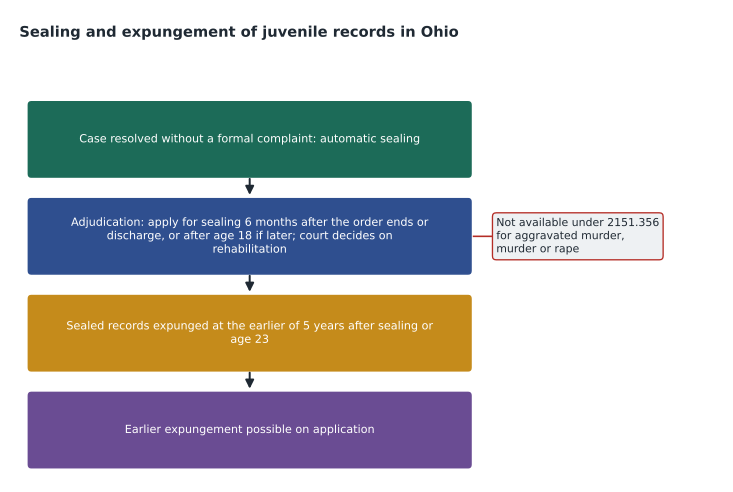
Ohio's sealing law, Revised Code 2151.356, takes two forms. Some sealing is automatic: the court must promptly seal records when a child was referred to the court for an alleged delinquent or unruly act and the case was resolved without a formal complaint, when a complaint was dismissed after a trial or the child was found not delinquent and the court finds the harm of disclosure outweighs any public benefit, and in some other cases. When a child was taken into custody but no complaint was filed and the child was not referred to the court, the law enforcement agency must deliver its records to the court for sealing, other than fingerprint and DNA records. Other sealing is by application or on the court's own motion: a person adjudicated delinquent can apply six months after the order arising from the adjudication ends or after unconditional discharge from the Department of Youth Services, or, if 18 or older, after the later of turning 18 or that six-month point. The court may seal if it finds the person has been rehabilitated to a satisfactory degree, after notifying the prosecutor. Records of adjudications for aggravated murder, murder and rape cannot be sealed under this section.
What sealing and expungement do
When records are sealed, Ohio law treats the proceedings as if they never occurred, the records are kept separately and may be inspected only in limited circumstances listed in the statute, and the person may generally answer questions on applications as if the case never happened. Under Revised Code 2151.358, sealed records must be expunged, which means destroyed, at the earlier of five years after the sealing order or the person's 23rd birthday, and the person may apply for earlier expungement. Police departments that receive a sealing order must remove the records from their general files and handle them as the order requires. Port Ardent's records unit tracks sealing orders and notifies the officers involved, and officers who keep personal notes must follow the same order.
Noah's and Devon's records
Noah's case was resolved without a formal complaint, so under Revised Code 2151.356(B) the court must seal its records, and the department must deliver any records it holds to the court for sealing, other than fingerprints and DNA. Devon's case ended in an adjudication for robbery. His community control ends on September 10, 2027. He will be 18 by then, so he can apply for sealing six months later, from March 10, 2028, and the court will decide whether he has been rehabilitated to a satisfactory degree. Once sealed, his records must be expunged at the earlier of five years after the sealing order or his 23rd birthday.
# Compute when records close or can be sealed, using the cases' dates.
from datetime import date
def add_years(d, n):
    return d.replace(year=d.year + n)
def add_months(d, n):
    m = d.month - 1 + n
    return d.replace(year=d.year + m // 12, month=m - (m // 12) * 12 + 1)
ejs_consent = date(2026, 6, 22)
sentence_end = date(2027, 9, 10)
print("ca, Noah's sanction record closes:", add_years(ejs_consent, 2))
print("ca, Devon's indictable youth record closes:", add_years(sentence_end, 5))
print("us, Devon may apply to seal from:", add_months(sentence_end, 6))ca, Noah's sanction record closes: 2028-06-22 ca, Devon's indictable youth record closes: 2032-09-10 us, Devon may apply to seal from: 2028-03-10
Bell says date arithmetic like this is the kind of thing officers get wrong when they guess. Records units use systems that calculate access and sealing dates automatically, but officers should understand the rules well enough to know when a result looks wrong.
Sharing information about juveniles
Ohio law allows juvenile courts and agencies to share information with schools, child welfare agencies and service providers in specified situations, such as when a child is adjudicated for certain offenses and the school must be notified, or when agencies are working together on a case plan. Officers should share only what the purpose requires and only with people who have a legitimate need. Bell told Eastgate High's principal about the no-contact conditions in Devon's release, so the school could keep Devon and Ben apart, but did not give the principal any other details.
Desjardins emphasizes the officer's own conduct. Officers must not discuss youth cases with friends or family, post about them on social media, or confirm details to reporters. A casual comment at a community meeting that 'the Hart kid is the one who did the park robbery' could breach confidentiality rules and department policy, and could also undermine the young person's rehabilitation and the community's trust in police. When the parent's social media post appeared, Port Ardent did not comment on it publicly. Ferreira contacted the group's moderator, who removed it, and Bell spoke to the parent who had posted it and explained why identifying a juvenile online could put the child at risk and interfere with the case.
Records and a young person's future
Students often ask what a youth record actually means for a young person's future. Because sealing treats the proceedings as if they never occurred, a person whose juvenile record has been sealed can generally answer no when asked on an application whether they have been arrested or adjudicated, with some exceptions in the statute for specific purposes, such as some law enforcement and child care positions. Unsealed juvenile records can turn up in background checks and can affect college applications, financial aid, military enlistment, professional licenses, public housing and immigration. Juvenile records can also matter in later adult cases, for example in sentencing. This is one reason Ohio law makes sealing automatic for some cases and lets courts seal on their own motion, and why advocates encourage young people to apply as soon as they are eligible.
Bell tells students that a young person's record is often a matter of how carefully officers wrote and filed it years earlier. A diversion entered as a charge, a warning recorded as an arrest, or a sealing order never applied to an officer's own notes can follow a person long after the law says it should not. He has twice in his career had to help a young adult correct a record that should have been closed or sealed: once when a warning had been entered in the wrong field of the records system, and once when an officer's working copy of a report was found in an old case folder years after the case was sealed. Desjardins adds that the reverse error matters too. A record that is closed or sealed too early, or entered under the wrong name, can deprive the next officer of information the law says they are entitled to see, such as a previous extrajudicial measure or diversion that should inform the next decision.
Information about young people and the media
High-profile youth cases attract intense media attention, and police communications staff have to balance the public's interest in information with the law. Police can usually confirm that an incident occurred, that young people have been arrested or charged, the general nature of the charges, and when a court appearance is scheduled, without identifying anyone. They can describe what the public should do, such as contacting police with information. They should not release details that, combined with other information, would identify the young person: their school, their exact street, a parent's name, a photograph or a distinctive description. In a small community, even the age and the neighborhood can be identifying, and the department's public information officer should review any release involving a juvenile. When Port Ardent issued a short news release about the park robbery, it said only that two male youths had been arrested, that one had been released and one held for a hearing, and that the investigation was complete.
Desjardins notes that juvenile court openness varies widely among states. In some states, hearings for serious offenses are open to the public and the media by law; in others, including Ohio for most purposes, juvenile courts may close hearings and keep records confidential, and the judge decides questions of public access case by case, weighing the child's interests against the public's. Some states publish the names of juveniles charged with the most serious offenses; Ohio courts generally do not, unless the case is transferred to adult court, where the ordinary rules of open courts and public records apply. A child bound over to adult court therefore loses much of the confidentiality the juvenile system provides, which is one reason transfer decisions are taken so seriously. Officers who move between jurisdictions, or read news coverage from other states, should not assume the same rules apply in Ohio, and should ask the department's legal adviser when in doubt.
Worked problem
A request for information
A local reporter calls the station and asks for the names of the two teenagers arrested in the park robbery, saying the information is already on social media. A school principal calls the same day asking whether Devon is 'dangerous' and whether he should be suspended. How should the officer respond?
Show solution
- The reporter cannot be given the names; department policy and the confidentiality of juvenile proceedings prohibit it, whether or not the names are already online.
- The officer can confirm general information that does not identify the youths, such as that two teenagers were arrested and the case is before the court.
- The principal can be told what the school needs for safety or to enforce conditions, such as the no-contact conditions, but not Devon's history.
- The suspension decision belongs to the school, under its own policies.
- Record what was disclosed, to whom and why.
Answer: Give the reporter nothing that identifies the youths; give the school only what safety and compliance require.
Common mistakes
MistakeOnce a juvenile's name is on social media, confidentiality no longer matters.
InsteadOfficers must still not confirm or repeat it; confidentiality obligations are not lifted by someone else's breach.
MistakeJuvenile records disappear automatically at 18.
InsteadSealing depends on the outcome and timing; most adjudications require an application, and expungement follows sealing.
MistakeA school can be told everything about a student's police contacts.
InsteadOnly what is needed for safety, compliance or rehabilitation, and the school must protect it.
MistakeThe rules on records only affect court staff.
InsteadPolice keep many of the records and must follow the access, sealing and disclosure rules.
Summary and key terms
- Juvenile court records are generally confidential, and police should not release juveniles' identities.
- Some sealing is automatic, including cases resolved without a formal complaint.
- A person adjudicated delinquent can apply for sealing six months after the order ends, or after age 18 if later.
- Sealed records are expunged at the earlier of five years after sealing or age 23.
- Information may be shared with schools and caregivers only when needed for safety, compliance or rehabilitation.
- Officers must not discuss or post about youth cases.
- Confidentiality
- The protection of juvenile records and proceedings from public disclosure.
- Sealing
- Removing records from general access and treating the proceedings as if they did not occur.
- Automatic sealing
- Sealing required without an application, such as for cases resolved without a complaint.
- Expungement
- Destruction of sealed records.
- Rehabilitated to a satisfactory degree
- The test a court applies on an application to seal.
- Sealing order
- A court order that agencies holding the records must follow.
Practice problems
Work each problem on paper first, then reveal the answer to check.
Why must Noah's records be sealed?
Show answer
Because his case was resolved without a formal complaint, under Revised Code 2151.356(B).
In the code example, when can or does Devon's record change status?
Show answer
He may apply to seal from March 10, 2028.
What did Bell tell the school principal, and why?
Show answer
Only the no-contact conditions, so the school could keep Devon and Ben apart.
Why can't an officer confirm a name that is already on social media?
Show answer
The confidentiality rules still bind the officer; repeating or confirming the name is a further disclosure.
What happens to a juvenile's confidentiality if the case is transferred to adult court?
Show answer
Much of it is lost, because the ordinary rules of open courts and public records apply in adult court, which is one reason transfer decisions are taken so seriously.
Lesson quiz · 5 questions
Score 60% or more to complete this lesson.
Create a free account to save your progress, take quizzes and earn a certificate.