
LES-211 · Lesson 8 of 12 · 20 min
Youth justice court, youth sentences and adult sentences
▶ Video coming soon A video version of this lesson is on the way.
Two weeks after the robbery, Bell sat down with Assistant Crown Attorney Leah Gordon to go through the file. 'Same robbery, two teenagers,' Gordon said. 'One is going to court. The other, I'm thinking about diversion. I want to hear what you think before I decide.' Bell had expected that. Robbery is one of the most serious offences young people commit, and an extrajudicial sanction for a robbery is unusual. This lesson follows both cases through the court process and explains the sentencing options, and the rules for the rare cases in which a young person receives an adult sentence.
Why Noah received an extrajudicial sanction
Gordon's reasons, which she wrote on the file, are a good example of the principles in action. Noah was sixteen with no previous police contact. His role was real but limited: he held the backpack strap on Devon's instruction, did not plan the robbery, did not push Ben, and got nothing from it. He gave a full, voluntary account, corroborated by Devon's text and the witnesses. His remorse appeared genuine. His mother was supportive and he was doing well at school. Most important, Ben and his mother, after talking with Nadia Brooks of Victim Services Port Ardent, said they would be willing to take part in a restorative conference if Noah wanted to apologize in person. Under section 10, an extrajudicial sanction may be used for any offence if a warning, caution or referral would not be adequate and the other conditions are met. Gordon was satisfied there was sufficient evidence, that Noah accepted responsibility, and that he had consulted counsel and consented. She noted that holding him accountable through a sanction, including facing Ben, would be more meaningful than a court process that would take months.
The conference was held on July 9 at the Eastgate community centre, led by a trained facilitator, with Noah and his mother, Ben and his mother, Bell and a youth worker. Ben told Noah he had been afraid to go to the park since May and had stopped playing basketball. Noah apologized and said he had not been able to stop thinking about it. The agreement had four parts: a written apology, 30 hours of community service at the community centre's youth program, payment of 85 dollars toward the cost of Ben's torn jacket from Noah's summer job, and a commitment to attend the centre's program on peer pressure. Noah completed everything by September 18. Under section 10(5), the youth justice court dismissed the robbery charge on September 24.
Devon's case in youth justice court
Devon's case went a different route. Gordon decided that an extrajudicial sanction would not be adequate: Devon had planned the robbery, used force against a younger boy, had a prior finding of guilt and an outstanding charge, and had not accepted responsibility. On his lawyer's advice, he pleaded guilty to robbery on August 20, 2026. The court ordered a pre-sentence report under section 40, prepared by youth worker Anita Shah, which described Devon's family history, his school suspensions, a recent loss of contact with his father, and his relationships with an older group of young men. Shah recommended a community sentence with intensive support.
Purpose and principles of youth sentencing
Section 38(1) states that the purpose of sentencing is to hold a young person accountable for an offence through the imposition of just sanctions that have meaningful consequences for the young person and that promote their rehabilitation and reintegration into society, thereby contributing to the long-term protection of the public. Section 38(2) sets out principles: the sentence must not be greater than the punishment for an adult in similar circumstances; it must be similar to sentences for similar young persons in the region; it must be proportionate to the seriousness of the offence and the degree of responsibility of the young person; all available sanctions other than custody that are reasonable should be considered, with particular attention to Aboriginal young persons; and the sentence must be the least restrictive capable of achieving the purpose, the most likely to rehabilitate the young person, and promote a sense of responsibility and an acknowledgement of the harm done. Since 2012, section 38(2)(f) has allowed the court to consider denouncing unlawful conduct and deterring the young person, but general deterrence of others is not a purpose of youth sentencing.
Section 42(2) lists the youth sentences available, from least to most serious, and section 39 restricts custody. A court may not commit a young person to custody unless the young person has committed a violent offence; has failed to comply with non-custodial sentences; has committed an indictable offence for which an adult could receive more than two years and has a history that indicates a pattern of findings of guilt; or, in exceptional cases, the aggravating circumstances are such that a non-custodial sentence would be inconsistent with the purpose and principles. Even then, the court must consider all alternatives raised at the sentencing hearing and impose custody only if no reasonable alternative, or combination of alternatives, would achieve the purpose.
| Youth sentence | Key features |
|---|---|
| Reprimand | A stern lecture from the judge; the lightest sentence |
| Absolute or conditional discharge | Finding of guilt without a conviction; conditional discharge has conditions |
| Fine, compensation or restitution | Fine up to 1,000 dollars; payment or return of property to the victim |
| Community or personal service | Up to 240 hours |
| Probation | Up to two years, with conditions |
| Intensive support and supervision | Closer supervision and support in the community |
| Deferred custody and supervision | Up to six months served in the community; breach can lead to custody |
| Custody and supervision | Generally up to two years, or three for offences with a maximum of life; longer for murder |
On September 10, the judge sentenced Devon. Robbery with force against a person is a violent offence, so custody was available under section 39(1)(a). Gordon asked for a deferred custody and supervision order of four months followed by probation, emphasizing denunciation and the effect on Ben. Defence counsel asked for probation. The judge considered the pre-sentence report, Devon's age, the guilty plea, his grandmother's supervision since May without any breach, and the principle that the least restrictive sentence capable of achieving the purpose should be imposed. She imposed 12 months of probation with intensive support and supervision, conditions of school attendance, counselling arranged by Shah, no contact with Ben, Noah or the witnesses, and a 9 p.m. curfew for the first four months, plus 60 hours of community service and restitution of 85 dollars toward Ben's jacket. She told Devon directly, in plain language, that the sentence was his chance and that a breach could bring him back before her.
Adult sentences
For the most serious offences, the Crown can apply for a young person to receive an adult sentence. Under section 64, the Attorney General may apply if the young person was 14 or older at the time of the offence, and the offence is one for which an adult could receive more than two years. The trial is still held in youth justice court, but if the young person is found guilty, the court must decide whether to impose an adult sentence. Under section 72, the court imposes an adult sentence only if it is satisfied that the presumption of diminished moral blameworthiness or culpability of the young person is rebutted, and that a youth sentence would not be of sufficient length to hold the young person accountable. The onus is on the Crown, a consequence of R. v. D.B. The maximum youth sentence for first-degree murder is ten years, with no more than six in custody, so adult sentence applications arise mainly in murder and other very serious cases. If an adult sentence is imposed, the young person's identity may be published and the sentence is served under adult rules, though usually in a youth facility until age 18.
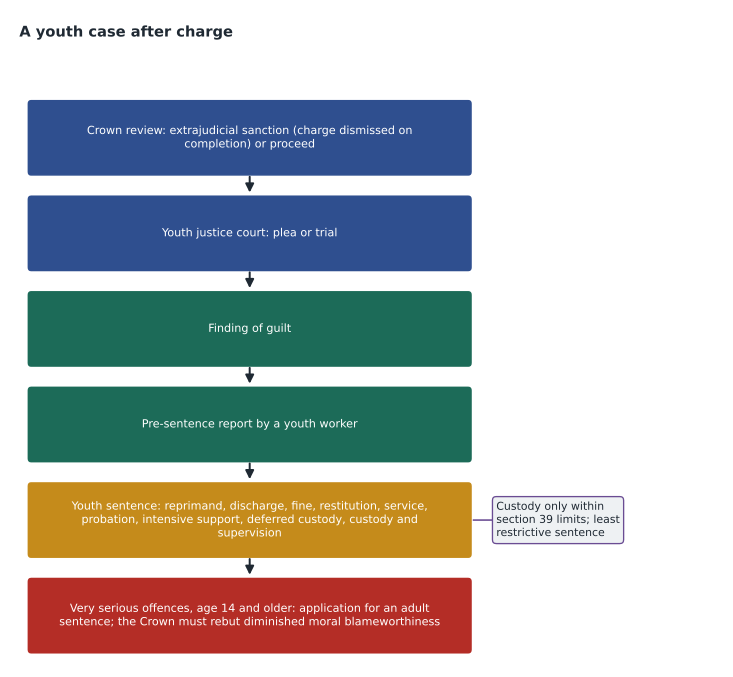
Desjardins asks why the law makes the step to adult treatment so difficult. Students point to the developmental research, the evidence that young people in adult prisons are at higher risk of victimization and reoffending, and the principle that young people deserve a chance to change. Bell adds that officers play a role here too: in serious cases, the police file, including the young person's statements and the circumstances of the offence, will be examined closely at any adult sentence hearing, so accuracy and completeness matter even more than usual.
# Compare the time from the robbery to the final outcome for the two cases.
from datetime import date
robbery = date(2026, 5, 14)
outcomes = {"Noah: diversion completed": date(2026, 9, 18),
            "Devon: sentence or disposition": date(2026, 9, 10)}
for k, d in outcomes.items():
print(k, "-", (d - robbery).days, "days after the robbery")Noah: diversion completed - 127 days after the robbery Devon: sentence or disposition - 119 days after the robbery
Both cases were resolved within about four months, which Gordon and Bell consider good for a youth robbery. Desjardins reminds students that four months is a long time in a teenager's life, and that the principle of timely intervention is about the young person's perception, not the system's.
Victims at sentencing
Ben and his mother were kept informed throughout both cases by Nadia Brooks. Before Devon's sentencing, Brooks helped Ben write a short victim impact statement, which the judge received under the Criminal Code provisions that apply in youth court. Ben wrote that he had stopped going to the park, that he checked over his shoulder walking home from school, and that he wanted Devon to understand 'it wasn't just a phone'. He did not ask for any particular sentence. The judge referred to the statement when explaining the sentence and the no-contact conditions. Bell says that officers sometimes forget that the victim of a youth offence is often another young person, with parents who are frightened and angry, and that keeping them informed is part of the job, not a favour.
When a young person does not comply
Sentences and agreements only work if there are consequences for not following them, but the response to non-compliance should be proportionate too. Failing to comply with a youth sentence is an offence under section 137 of the YCJA, but the Act encourages alternatives to charging, and section 59 allows a youth justice court to review a non-custodial sentence and change it, including by adding conditions or, in some cases, imposing a more serious sentence. Youth workers usually try to address minor breaches, such as a missed appointment, with a warning or by adjusting the plan before involving police. A deferred custody and supervision order can be converted to custody if the young person breaches a condition. Bell tells students that when they come across a young person on community supervision, such as Devon breaking his curfew, they should contact the youth worker or probation officer, who knows the young person and can often deal with the situation more effectively than a new charge. In the months after his sentence, Devon missed curfew once, by forty minutes, in October; Shah dealt with it by meeting with him and his grandmother and adding a check-in call, and no charge was laid.
Worked problem
Is custody available?
A 15-year-old is found guilty of breaking into three garages and stealing tools. He has one previous finding of guilt for theft, which resulted in probation that he completed without problems. No one was hurt. The Crown asks for custody to deter others in the neighbourhood. What does the law say?
Show solution
- General deterrence of others is not a purpose of youth sentencing; section 38(2)(f) allows only specific deterrence of the young person.
- The offences are not violent, he complied with his previous non-custodial sentence, and one previous finding may not amount to a pattern, so section 39(1) may not permit custody at all.
- Restitution or compensation for the tools, and community service, would address the harm.
- Probation with closer supervision could respond to the escalation.
- Custody would be hard to justify.
Answer: Custody is likely unavailable or inappropriate; a community sentence with restitution is the proportionate response.
Common mistakes
MistakeAn extrajudicial sanction can never be used for a violent offence.
InsteadSection 10 allows a sanction for any offence where the conditions are met and lesser measures would not be adequate.
MistakeYouth sentences can be used to deter other young people.
InsteadGeneral deterrence is not a purpose; only denunciation and specific deterrence may be considered.
MistakeA young person who receives an adult sentence is tried in adult court.
InsteadThe trial stays in youth justice court; only the sentence changes.
MistakePolice have no role after charges are laid.
InsteadThe police file is central to sentencing and transfer decisions, so it must be accurate and complete.
Summary and key terms
- Extrajudicial sanctions can be used even for serious offences when the conditions are met; Noah's robbery charge was dismissed after he completed one.
- Section 38 sets the purpose of youth sentencing as accountability with meaningful consequences that promote rehabilitation, contributing to long-term protection of the public.
- Section 39 restricts custody to violent offences, failure to comply, a pattern of findings with a serious offence, or exceptional cases.
- Courts must consider all reasonable alternatives to custody and impose the least restrictive effective sentence.
- Adult sentences require the Crown to rebut the presumption of diminished moral blameworthiness under section 72.
- Accurate police files matter at every stage.
- Pre-sentence report
- A report by a youth worker on the young person's background and circumstances, used in sentencing.
- Youth sentence
- A sentence imposed under section 42 of the YCJA.
- Deferred custody and supervision order
- A sentence of up to six months served in the community, with custody possible on breach.
- Intensive support and supervision
- A probation-like sentence with closer supervision and support.
- Adult sentence
- A sentence under the Criminal Code imposed on a young person after the presumption is rebutted.
- Specific deterrence
- Discouraging the particular young person from reoffending.
Practice problems
Work each problem on paper first, then reveal the answer to check.
Give three reasons Gordon decided Noah's case could be diverted.
Show answer
No history; limited role on Devon's instruction; full corroborated account and remorse; supportive family; victim willing to take part in a conference.
Under section 39(1), name two situations in which custody is available.
Show answer
A violent offence; failure to comply with non-custodial sentences; a serious indictable offence with a pattern of findings; exceptional cases.
In the code example, how many days after the offence was Devon's case resolved?
Show answer
119 days.
Why did the judge make the school condition part of Devon's sentence?
Show answer
His school absence was connected to the robbery, and school attendance supports rehabilitation.
Lesson quiz · 5 questions
Score 60% or more to complete this lesson.
Create a free account to save your progress, take quizzes and earn a certificate.