
LES-211 · Lesson 8 of 12 · 20 min
Adjudication, disposition and transfer to adult court
▶ Video coming soon A video version of this lesson is on the way.
Two weeks after the robbery, Bell sat down with assistant prosecutor Leah Gordon to go through the file. 'Same robbery, two teenagers,' Gordon said. 'One is going to court. The other, I'm thinking about diversion. I want to hear what you think before I decide.' Bell had expected that. Robbery is one of the most serious offenses young people commit, and diversion for a robbery is unusual. This lesson follows both cases through the court process and explains the sentencing options, and the rules for the rare cases in which a young person is transferred to adult court.
Why Noah was diverted
Gordon's reasons, which she wrote on the file, are a good example of the principles in action. Noah was sixteen with no previous police contact. His role was real but limited: he held the backpack strap on Devon's instruction, did not plan the robbery, did not push Ben, and got nothing from it. He gave a full, voluntary account, corroborated by Devon's text and the witnesses. His remorse appeared genuine. His mother was supportive and he was doing well at school. Most important, Ben and his mother, after talking with Nadia Brooks of the department's victim advocate unit, said they would be willing to take part in a restorative conference if Noah wanted to apologize in person. Ohio law allows the prosecutor and the court's intake department to divert even serious cases where diversion is adequate to hold the child accountable. Gordon agreed with the intake department that the complaint would be held without being filed while Noah completed a 90-day diversion agreement, with dismissal on completion. She noted that holding him accountable through the agreement, including facing Ben, would be more meaningful than a court process that would take months.
The conference was held on July 9 at the Eastgate community center, led by a trained facilitator, with Noah and his mother, Ben and his mother, Bell and a youth worker. Ben told Noah he had been afraid to go to the park since May and had stopped playing basketball. Noah apologized and said he had not been able to stop thinking about it. The agreement had four parts: a written apology, 30 hours of community service at the community center's youth program, payment of 85 dollars toward the cost of Ben's torn jacket from Noah's summer job, and a commitment to attend the center's program on peer pressure. Noah completed everything by September 18. The diversion was recorded as successfully completed on September 22, no complaint was filed, and the intake department began the process to seal the records under Revised Code 2151.356(B).
Devon's case in juvenile court
Gordon filed a delinquency complaint alleging that Devon committed robbery, an act that would be a second-degree felony under Revised Code 2911.02 if committed by an adult, because he inflicted or attempted to inflict physical harm. She did not seek to transfer the case to adult court; robbery under 2911.02 is not one of the offenses that can lead to mandatory transfer, and Devon was not a realistic candidate for discretionary transfer. On his lawyer's advice, Devon admitted the allegation on August 20, 2026. Under Juvenile Rule 29, the magistrate addressed him personally to make sure he understood the allegation, the consequences of admitting it, and the rights he was giving up. The court ordered a pre-disposition investigation by probation officer Anita Shah, which described his family history, school suspensions, a recent loss of contact with his father, and his relationships with an older group of young men. Shah recommended community control with intensive supervision.
Juvenile dispositions
Ohio juvenile courts choose dispositions under Revised Code Chapter 2152, guided by the purposes in 2152.01. For a child adjudicated delinquent for an act that would be a felony, the court may commit the child to the legal custody of the Ohio Department of Youth Services for an indefinite term with a minimum period set by statute, which for a second-degree felony is one year, up to the child's 21st birthday. The court may also suspend the commitment and place the child on community control, the juvenile equivalent of probation, under 2152.19, with conditions such as supervision, school attendance, counseling, community service, curfew, electronic monitoring or placement in a community residential program. The court may also order restitution and fines under 2152.20. For the most serious cases, the prosecutor can seek a serious youthful offender disposition, a blended sentence combining a juvenile disposition with a stayed adult sentence that can be invoked if the child fails in the juvenile system.
Ohio's system of graduated sanctions means that, for most children adjudicated delinquent for the first time, the court will choose community control rather than commitment, and many courts use risk and needs assessments to match the level of supervision and services to the child. Commitment to the Department of Youth Services is reserved for the most serious and persistent cases, and Ohio's RECLAIM funding gives counties an incentive to keep children in community programs. The number of children committed to Department of Youth Services facilities has fallen greatly since the 1990s.
| Disposition | Key features |
|---|---|
| Dismissal or a warning after adjudication | Rare for serious cases; available for minor ones |
| Fines, restitution, community service | Under Revised Code 2152.20 and 2152.19 |
| Community control | Supervision with conditions such as school, counseling, curfew or electronic monitoring |
| Community residential placement | A program away from home but in the community |
| Suspended commitment | A Department of Youth Services commitment held over the child on condition of community control |
| Commitment to the Department of Youth Services | Indefinite term with a statutory minimum, up to age 21 |
| Serious youthful offender disposition | A juvenile disposition plus a stayed adult sentence |
On September 10, the court held the dispositional hearing. Gordon asked for a commitment to the Department of Youth Services, emphasizing the violence against a younger boy, Devon's prior adjudication and his pending violation. Defense counsel asked for community control. The judge considered the pre-disposition report, Devon's age, his admission, his compliance with home detention since May, and the purposes in 2152.01. He committed Devon to the Department of Youth Services for a minimum of one year, suspended the commitment, and placed him on 12 months of intensive community control, with conditions of school attendance, counseling arranged by Shah, no contact with Ben, Noah or the witnesses, and a 9 p.m. curfew for the first four months, plus 60 hours of community service and restitution of 85 dollars toward Ben's jacket. He told Devon directly, in plain language, that the suspended commitment meant a violation could send him to a state facility.
Transfer to adult court
For the most serious cases, the juvenile court can transfer a child to adult court, a process called bindover in Ohio. In Kent v. United States (1966), the Supreme Court held that a juvenile is entitled to a hearing, access to records and a statement of reasons before a transfer. Ohio has two kinds of bindover under Revised Code 2152.10 and 2152.12. Mandatory bindover applies to certain children 14 or older charged with the most serious offenses: for example, a child 16 or older charged with murder, aggravated murder or attempts, which the statute calls category one offenses, or a child 16 or older charged with a category two offense, such as aggravated robbery or rape, who either has a prior adjudication for a category one or two offense with a Department of Youth Services commitment or is alleged to have displayed, brandished, indicated possession of or used a firearm. Discretionary bindover applies to children 14 or older charged with a felony: after finding probable cause, the court orders an investigation and decides whether the child is amenable to care or rehabilitation in the juvenile system and whether community safety requires adult sanctions, weighing factors listed in the statute. In State v. Aalim (2017), the Supreme Court of Ohio upheld mandatory bindover. Ohio also allows reverse bindover in some mandatory cases, under 2152.121, if the adult court finds the child would not have been subject to mandatory transfer for the offense of conviction.
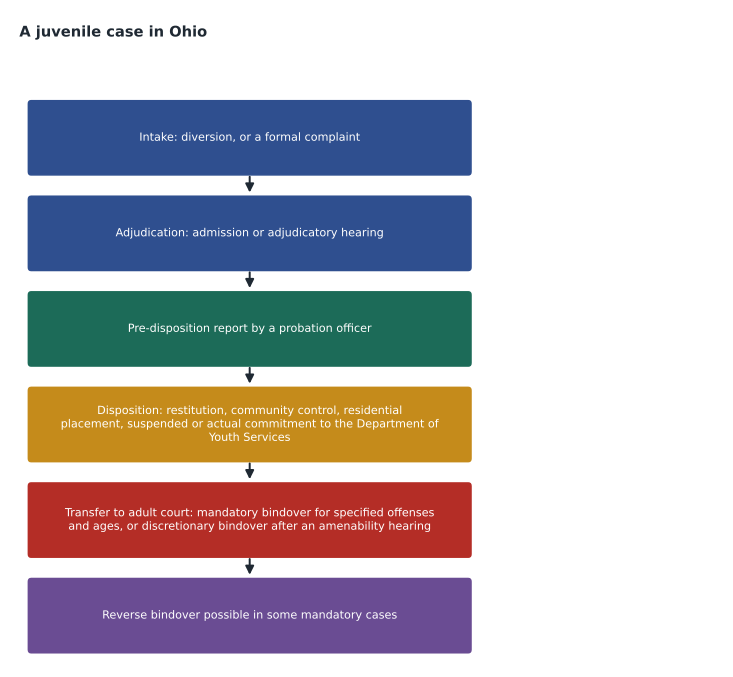
Desjardins asks why the law makes the step to adult treatment so difficult. Students point to the developmental research, the evidence that young people in adult prisons are at higher risk of victimization and reoffending, and the principle that young people deserve a chance to change. Bell adds that officers play a role here too: in serious cases, the police file, including the young person's statements and the circumstances of the offense, will be examined closely at any transfer hearing, so accuracy and completeness matter even more than usual.
# Compare the time from the robbery to the final outcome for the two cases.
from datetime import date
robbery = date(2026, 5, 14)
outcomes = {"Noah: diversion completed": date(2026, 9, 18),
            "Devon: sentence or disposition": date(2026, 9, 10)}
for k, d in outcomes.items():
print(k, "-", (d - robbery).days, "days after the robbery")Noah: diversion completed - 127 days after the robbery Devon: sentence or disposition - 119 days after the robbery
Both cases were resolved within about four months, which Gordon and Bell consider good for a youth robbery. Desjardins reminds students that four months is a long time in a teenager's life, and that the principle of timely intervention is about the young person's perception, not the system's.
Victims at sentencing
Ben and his mother were kept informed throughout both cases by Nadia Brooks. Before Devon's dispositional hearing, Brooks helped Ben write a short victim impact statement under Ohio's victims' rights law, which the court received at the hearing. Ben wrote that he had stopped going to the park, that he checked over his shoulder walking home from school, and that he wanted Devon to understand 'it wasn't just a phone'. He did not ask for any particular sentence. The judge referred to the statement when explaining the sentence and the no-contact conditions. Bell says that officers sometimes forget that the victim of a youth offense is often another young person, with parents who are frightened and angry, and that keeping them informed is part of the job, not a favor.
When a young person does not comply
Sentences and agreements only work if there are consequences for not following them, but the response to non-compliance should be proportionate too. A child who violates community control can be brought back before the juvenile court, which can modify the conditions, extend the period or, where a commitment to the Department of Youth Services was suspended, order the commitment to take effect. Probation officers usually try to address minor violations, such as a missed appointment, with a warning or a change to the plan before filing a violation. Bell tells students that when they come across a young person on community supervision, such as Devon breaking his curfew, they should contact the youth worker or probation officer, who knows the young person and can often deal with the situation more effectively than a new charge. In the months after his disposition, Devon missed curfew once, by forty minutes, in October; Shah dealt with it by meeting with him and his grandmother and adding a check-in call, and no charge was laid.
Worked problem
Is commitment appropriate?
A 15-year-old is found guilty of breaking into three garages and stealing tools. He has one previous finding of guilt for theft, which resulted in probation that he completed without problems. No one was hurt. The Crown asks for custody to deter others in the neighborhood. What does the law say?
Show solution
- Ohio's purposes in 2152.01 do not include general deterrence as such; the disposition should be graduated and commensurate with the conduct.
- Graduated sanctions point to stepping up community control rather than jumping to commitment for a non-violent second adjudication with good compliance.
- Restitution or compensation for the tools, and community service, would address the harm.
- Probation with closer supervision could respond to the escalation.
- Custody would be hard to justify.
Answer: Commitment would be hard to justify; community control with restitution is the proportionate response.
Common mistakes
MistakeDiversion is never available for a violent offense.
InsteadProsecutors and intake can divert serious cases where diversion is adequate, though it is less common.
MistakeJuvenile dispositions should be designed to send a message to the community.
InsteadDispositions must serve the statutory purposes and be commensurate with the conduct of the particular child.
MistakeAny child charged with a felony is automatically transferred to adult court.
InsteadOnly specified offenses and ages lead to mandatory bindover; others require an amenability hearing.
MistakePolice have no role after charges are laid.
InsteadThe police file is central to sentencing and transfer decisions, so it must be accurate and complete.
Summary and key terms
- Diversion can be used even for serious cases; Noah completed a 90-day agreement and no complaint was filed.
- Ohio dispositions follow graduated sanctions under Chapter 2152, from community control to commitment to the Department of Youth Services.
- For a felony, a Department of Youth Services commitment has a statutory minimum and can last to age 21, but is often suspended.
- Courts must consider all reasonable alternatives to custody and impose the least restrictive effective sentence.
- Transfer to adult court is mandatory for specified offenses and ages, and otherwise depends on an amenability hearing.
- Accurate police files matter at every stage.
- Adjudication
- The finding that a child is a delinquent child.
- Disposition
- The juvenile court's order after adjudication.
- Community control
- The juvenile equivalent of probation in Ohio.
- Bindover
- Transfer of a child's case from juvenile court to adult court in Ohio.
- Amenability hearing
- A hearing to decide whether a child can be rehabilitated in the juvenile system.
- Serious youthful offender disposition
- A blended sentence combining a juvenile disposition and a stayed adult sentence.
Practice problems
Work each problem on paper first, then reveal the answer to check.
Give three reasons Gordon decided Noah's case could be diverted.
Show answer
No history; limited role on Devon's instruction; full corroborated account and remorse; supportive family; victim willing to take part in a conference.
What is a suspended commitment?
Show answer
A Department of Youth Services commitment that is not carried out as long as the child complies with community control.
In the code example, how many days after the offense was Devon's case resolved?
Show answer
119 days.
Why did the judge make the school condition part of Devon's sentence?
Show answer
His school absence was connected to the robbery, and school attendance supports rehabilitation.
Lesson quiz · 5 questions
Score 60% or more to complete this lesson.
Create a free account to save your progress, take quizzes and earn a certificate.