
LES-211 · Lesson 7 of 12 · 19 min
Custody, notice to parents and juvenile detention
▶ Video coming soon A video version of this lesson is on the way.
By 9 p.m. on May 15, Port Ardent had two teenagers in custody for the same robbery and had to make two different decisions. Noah Kessler was at the station with his mother, had given a full account, had no history and had a stable home. Devon Hart had declined to speak, was on community control for a theft adjudication in 2025, and had a pending complaint for violating a curfew order, and Ben's phone had been found in his room. This lesson covers what the law requires when a young person is arrested: telling parents, deciding whether to release, and the special limits on holding young people in custody before trial.
Notifying parents
Ohio law requires officers who take a child into custody to notify the child's parent, guardian or custodian, and Juvenile Rule 7 requires the person in charge of the place where the child is held to make reasonable efforts to tell the parents where the child is, why they are held, and when the hearing will be. Parents must receive notice of the detention hearing, of the right to counsel, and of the child's right to remain silent. If a parent did not receive notice and did not appear or waive appearance, the court must promptly hold a rehearing. Beyond the legal requirement, involving a parent early helps the officer decide whether the child can be safely released, and gives the child an adult on their side.
Bell notes that parental notification raises hard cases. Some young people do not want their parents called, sometimes for good reasons, such as abuse at home or a parent's violent temper. Some parents cannot be found. Some are the victim, as in a case of a young person who assaults a parent. In those cases the officer must still notify someone appropriate, and should consider whether child protection services need to be involved. 'Notifying a parent is about getting the young person support,' Bell says. 'If the parent is the danger, you find another adult and you call children services.'
Release or detention
When a child is taken into custody in Ohio, the officer must either release the child to a parent or other suitable person, usually with a promise to bring the child to court, or bring the child to the juvenile court or a place of detention designated by the court. Revised Code 2151.31 and Juvenile Rule 7 limit detention. A child alleged to be delinquent may be held in a detention facility only if detention is required to protect the child from immediate or threatened harm, to protect the person or property of others from immediate or threatened harm, or because the child may abscond or be removed from the court's jurisdiction, has no parent or other person able to supervise and care for them, or an order requires it. Many Ohio counties use a validated screening tool at intake to help decide whether a child needs to be detained, and the juvenile court's intake officer, not the arresting officer, usually makes that decision.
Bell released Noah to his mother that evening, with a written promise to bring him to the juvenile court intake office the following week, and told them both that he would be referring the case to the court with a request that intake consider diversion. Devon was taken to the Lucas County Juvenile Detention Center, where intake staff screened him. Given the seriousness of the robbery, his pending violation, his current community control and the fact that Ben and several witnesses lived in the same building, intake staff decided he should be held for a detention hearing.
Detention hearings and their limits
A child held in detention must have a detention hearing promptly; under the juvenile rules, it must be held within 72 hours or by the next court day, whichever is earlier. At the hearing, the court decides whether continued detention is necessary under the criteria in the statute and rules, and must consider less restrictive alternatives, such as release to a parent with conditions, home detention or electronic monitoring. In Schall v. Martin (1984), the Supreme Court upheld a New York law allowing preventive detention of juveniles found to pose a serious risk of committing a crime before their hearing, holding that it served a legitimate purpose and that the procedures were adequate, including a prompt hearing and a limited period of detention. If a child is detained, the adjudicatory hearing must be held quickly; Ohio's bench card for detained youth notes that it must be held within 15 days of the complaint for a detained child, unless good cause is shown.
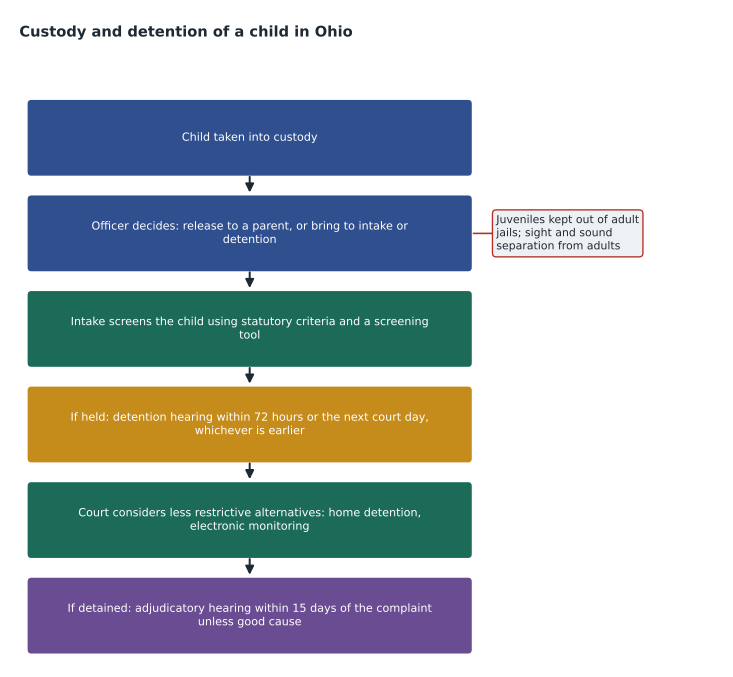
Ohio and the federal Juvenile Justice and Delinquency Prevention Act also limit where children may be held. Children held for delinquency generally must be held in a juvenile detention facility, not an adult jail. Under the JJDPA's jail removal requirement, juveniles may not be detained in adult jails or lockups, with a limited exception for brief processing or court-related holding, often described as the six-hour rule. Under the sight and sound separation requirement, any juvenile who is briefly held in an adult facility must be kept out of sight and sound of adult inmates. Ohio's bench card notes that traffic offenders and unruly children may be held in an adult facility for less than three hours for processing, and that Ohio requires separation beyond the range of touch, while federal law requires sight and sound separation. The 2018 Juvenile Justice Reform Act extended jail removal and separation to youth charged as adults who are awaiting trial.
Port Ardent's station has a separate juvenile holding room with its own entrance; officers must log the time a child enters and leaves, check on the child regularly, and keep the child out of sight and sound of adult prisoners.
Devon's hearing
Devon's detention hearing was held on Monday morning, May 18, before a magistrate of the Lucas County juvenile court. The assistant prosecutor, Leah Gordon, argued that continued detention was needed to protect the victim and witnesses, given the violence against a younger boy, Devon's pending violation and the fact that they lived in his building. His appointed counsel, Paul Mbeki, proposed release to his grandmother, Evelyn Hart, who lived in a different tower, on home detention with electronic monitoring. Mrs. Hart testified that she was retired, at home all day, and willing to supervise him. The magistrate released Devon to her on home detention with electronic monitoring, with conditions of no contact with Ben, Noah or the witnesses, no attendance at Eastgate Park, and school attendance. Gordon noted afterward that the school condition was connected to the risk, because the robbery happened after Devon left school at lunch.
# Deadlines after a youth arrest (invented times). Python's datetime handles
# day changes; times are local.
from datetime import datetime, timedelta
arrest = datetime(2026, 5, 15, 19, 10)
ca_deadline = arrest + timedelta(hours=24)     # appearance before a justice
oh_deadline = arrest + timedelta(hours=72)     # Ohio detention hearing outer limit
days = ["Mon", "Tue", "Wed", "Thu", "Fri", "Sat", "Sun"]
for label, d in (("24-hour limit:", ca_deadline), ("72-hour limit:", oh_deadline)):
print(label, days[d.weekday()], d.isoformat(" ", "minutes"))24-hour limit: Sat 2026-05-16 19:10 72-hour limit: Mon 2026-05-18 19:10
In Ohio, the detention hearing must be held within 72 hours or by the next court day, whichever is earlier, so the 72-hour figure is an outer limit; because the next court day after Devon's Friday evening arrest was Monday, his Monday morning hearing met both limits. Bell tells students to put the deadline in their notes at the time of arrest, not to calculate it later.
Fingerprints, photographs and searches
Ohio law, in Revised Code 2151.313, limits when police may fingerprint and photograph a child who is taken into custody, generally to children taken into custody for acts that would be felonies if committed by an adult, and sets rules on how those records are kept and when they must be destroyed or sealed. Officers should not routinely fingerprint and photograph every child they detain, as they might an adult, and should know their department's procedure for keeping juvenile identification records separate. DNA collection from juveniles is governed by Revised Code 2152.74, which requires DNA samples from children adjudicated delinquent for certain serious offenses. Bell tells students that identification records of young people are among the most sensitive records a police service keeps, and that the officer who takes them is responsible for following the rules about them.
Searches of young people who are arrested follow the same law as for adults: a search incident to arrest must be for officer safety, to prevent escape or to find evidence of the offense. But strip searches of young people require particular care. Courts treat strip searches as among the most intrusive searches, and juvenile detention facilities and police departments have detailed policies limiting when they may be done and how. Port Ardent policy requires a supervisor's approval before any strip search of a person under 18, and the reason must be recorded. Devon was not strip searched; a pat-down search for weapons on arrest found only his house key and a bus pass.
Holding a young person at the station
While a young person waits at the station for a parent, a lawyer's call, a transfer to a juvenile detention facility or a release decision, the officers responsible for them must remember that they have a vulnerable person in their care. Young people should be checked frequently and their condition recorded. They should be offered water, food at mealtimes and use of a washroom, and allowed to call a parent or lawyer. Signs of intoxication, injury, self-harm risk or medical problems must be acted on quickly, and Port Ardent policy requires medical assessment for any young person who appears intoxicated. Bell says that, in his experience, the young people most at risk in police custody are not the loud ones but the quiet ones who say nothing and stare at the wall. He checks on them most often.
Desjardins ends the class with a reminder about time. Every hour a young person spends in a police station or detention center is an hour away from school, family and the routines that keep them out of trouble. The law's deadlines are maximums, not targets. An officer who finishes the paperwork quickly, calls the parent early and gets a release decision made in the evening rather than the next morning is applying the principles of the juvenile code as surely as one who knows every section by heart. Bell agrees, and adds that the same urgency applies to telling the victim's family what has happened: Claire Arsenault learned of the arrests from Ferreira within an hour.
Worked problem
A detention decision
A 15-year-old is arrested at 11 p.m. for breaking into a parked car and taking a laptop. She has no previous charges. Her mother tells the officer she does not want her home because they had a big fight that morning and she has run away three times this year. The officer is worried she will run away again and end up somewhere dangerous. Should she be held for a hearing?
Show solution
- Detention is not a substitute for child welfare; concern for her safety at home is a matter for children services.
- The offense is a non-violent property offense and she has no history, so the detention criteria are unlikely to be met.
- The officer should look for another responsible adult, such as a relative, and contact child protection services if no safe placement can be found.
- She can be released with appropriate notice and conditions, or placed with a responsible adult.
- The officer's worry is legitimate, but the response is protection, not detention.
Answer: Detention would not be justified; the officer should involve children services and find a safe place for her to stay.
Common mistakes
MistakeA child can be held in detention because no one will take them home.
InsteadDetention is not a substitute for child welfare; children services must be involved.
MistakeThe more release conditions, the safer.
InsteadUnnecessary conditions create violations without improving safety.
MistakeA parent who cannot be reached means the young person cannot be released.
InsteadAnother appropriate adult can be notified and may be able to take responsibility.
MistakeJuveniles have no right to release before a hearing.
InsteadDetention requires a prompt hearing and must meet the statutory criteria, with less restrictive alternatives considered.
Summary and key terms
- Ohio requires reasonable efforts to notify parents of custody, the reason and the hearing.
- Officers release a child to a parent or bring them to intake or detention; intake usually decides on detention.
- A detention hearing must be held within 72 hours or by the next court day, whichever is earlier, and Schall v. Martin upheld preventive detention with safeguards.
- The JJDPA requires jail removal and sight and sound separation, extended in 2018 to youth charged as adults.
- Less restrictive alternatives include home detention and electronic monitoring.
- Young people held in custody must be kept separate from adults.
- Taking into custody
- The juvenile equivalent of arrest.
- Intake
- The juvenile court office that screens new cases and decides on detention and diversion.
- Detention hearing
- A prompt hearing to decide whether a child should remain in detention.
- Home detention
- Release to home with strict limits on leaving, often with electronic monitoring.
- Jail removal
- The JJDPA requirement keeping juveniles out of adult jails and lockups.
- Sight and sound separation
- Keeping juveniles out of sight and hearing of adult inmates.
Practice problems
Work each problem on paper first, then reveal the answer to check.
Why did Bell release Noah without a curfew?
Show answer
Noah had no history, had never missed school, and his mother could clearly supervise him; unnecessary conditions only create breaches.
Name two less restrictive alternatives to detention.
Show answer
Release to a parent with conditions, home detention, electronic monitoring.
In the code example, when did the 24-hour limit fall?
Show answer
Saturday, May 16, at 19:10.
Why was the school condition connected to the risk in Devon's case?
Show answer
The robbery happened after Devon left school at lunch.
Lesson quiz · 5 questions
Score 60% or more to complete this lesson.
Create a free account to save your progress, take quizzes and earn a certificate.