
LES-211 · Lesson 6 of 12 · 19 min
Questioning juveniles: Miranda, age and voluntariness
▶ Video coming soon A video version of this lesson is on the way.
Karen Kessler brought her son Noah to the Port Ardent police department building at 4:25 p.m. on Friday, May 15. He was sixteen, tall for his age, and had not been in trouble with police before. Bell met them in the lobby, introduced himself, and told Noah directly that he was investigating the robbery of a fifteen-year-old's phone in Eastgate Park the day before, that he believed Noah had been there, and that Noah was not free to leave and was being taken into custody for robbery. He then took them to a soft interview room, with a couch, a table and recording equipment. Desjardins tells the class that the next forty minutes, before Noah said a word about the park, are what this lesson is about.
Why questioning juveniles is different
Juveniles are particularly vulnerable when questioned by police. They are more suggestible than adults, more likely to waive their rights without understanding them, more likely to focus on getting out of the room than on consequences, and more likely to give false confessions. Studies of proven false confessions have found that juveniles are heavily overrepresented. The best-known example is the case of five teenagers convicted of the 1989 assault of a jogger in Central Park in New York, whose confessions were obtained after long interrogations; they were exonerated in 2002 when the real offender confessed and DNA confirmed it. The Supreme Court recognized these risks long before modern research, in Haley v. Ohio (1948), where it held that the confession of a 15-year-old boy questioned through the night without a lawyer or parent was involuntary.
Miranda and juveniles
The Miranda rules apply to juveniles in the same way as to adults: before custodial interrogation, a juvenile must be told of the right to remain silent, that anything said can be used against them, the right to an attorney, and the right to an appointed attorney if they cannot afford one. The juvenile may waive those rights only if the waiver is knowing, intelligent and voluntary. In Fare v. Michael C. (1979), the Supreme Court held that whether a juvenile's waiver is valid is decided on the totality of the circumstances, including the juvenile's age, experience, education, background and intelligence, and their capacity to understand the warnings and the consequences of waiving them. The Court also held that a 16-year-old's request to speak to his probation officer was not a request for a lawyer, and did not require questioning to stop. As lesson 5 explained, J.D.B. v. North Carolina (2011) held that a child's age is part of the analysis of whether they were in custody, so warnings may be required for a child in situations where an adult would not need them.
Ohio has no statute requiring a parent to be present when police question a juvenile, but Ohio courts treat the presence or absence of a parent, and whether the child was allowed to speak with one, as important factors in deciding whether a waiver and statement were voluntary. In State v. Barker (2016), the Supreme Court of Ohio held that the presumption of voluntariness in Revised Code 2933.81, which applies when a custodial interrogation is recorded, is unconstitutional as applied to juveniles; the state must prove that a juvenile's Miranda waiver was knowing, intelligent and voluntary and that the statement was voluntary, without the benefit of the presumption. Several states require that a parent or other interested adult be present, or that juveniles consult a lawyer before waiving, and a growing number prohibit officers from lying about evidence when questioning juveniles.
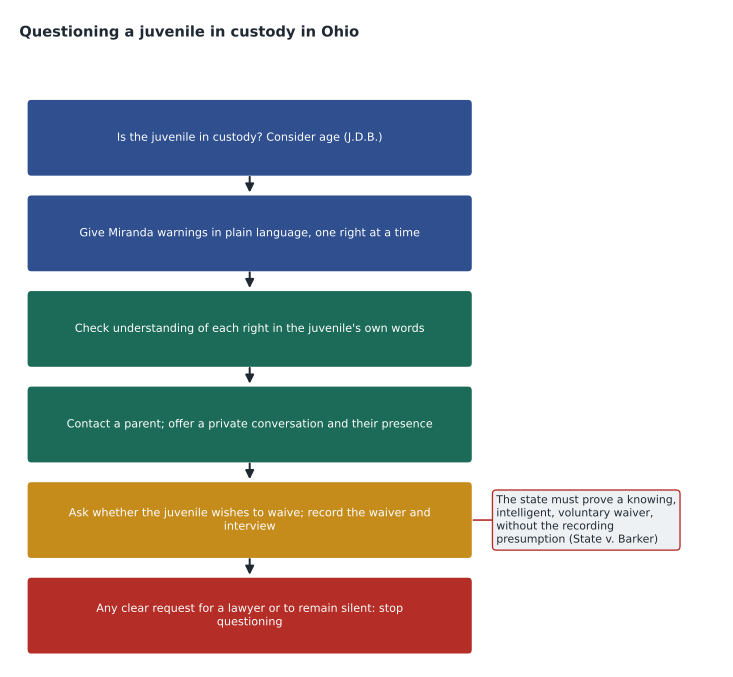
Port Ardent's juvenile interview policy
Port Ardent's policy, adopted after State v. Barker, goes beyond what the law requires. Before any custodial interview of a juvenile, officers must make reasonable efforts to contact a parent or guardian, tell the juvenile they may speak privately with that parent, and allow the parent to be present unless the juvenile objects or the parent is a suspect or a victim. Officers must use the department's plain-language juvenile rights form, which breaks each Miranda right into a short sentence, ask the juvenile to explain each right back in their own words, and record the whole interview from the warnings to the end. Officers may not lie about evidence, threaten consequences or suggest leniency. And any request to speak to a lawyer, a parent or 'someone', however phrased, is treated as a possible invocation and clarified before any further question.
Bell points out that the person chosen to be present is not always a parent, and the choice belongs to the young person. An older friend who was also in the park cannot serve as the supportive adult, and a parent who is angry and pushes the child to talk is not much help either. Officers should also watch for signs that the adult in the room is pressuring the young person. A parent who says, 'Just tell him what you did so we can go home,' may make a statement less reliable, and the officer should pause and remind both of them that the young person does not have to say anything.
Noah's statement
Bell used Port Ardent's plain-language youth rights form, which breaks each right into a short sentence. He read the first one: 'You have the right to stay silent. You don't have to answer my questions.' Then he asked Noah to tell him in his own words what that meant. Noah said, 'I don't have to talk to you.' Bell asked, 'And if you decide not to talk, what happens?' Noah said, 'Nothing, I guess.' Bell went through each right the same way, including the right to talk to a lawyer for free right now, and the right to have his mother or another adult with him. Noah said he wanted to talk to his mom first, alone. Bell left them in the room for twelve minutes, with the recording paused, from 4:41 to 4:53 p.m. When Bell returned, Noah said he wanted to tell his side and wanted his mother to stay. Bell confirmed on video each right again, and Noah signed the waiver part of the form, saying in his own words, 'I know I can stop and get a lawyer whenever I want.'
Bell started with an open question: 'Tell me about yesterday afternoon, from when you got out of school.' Noah said Devon had texted him at lunch saying 'easy money at the court later'. He thought Devon meant selling something. When they got to the park, Devon went up to Ben and asked to see his phone. When Ben said no, Devon shoved him. Noah said he grabbed Ben's backpack strap 'without thinking' because Devon told him to hold him. Devon took the phone and they ran to Devon's building. Noah said he did not know where the phone was now and had not got any money. He cried when Bell asked how he thought Ben felt. The interview ended at 5:48 p.m. Bell did not suggest any answers, did not tell Noah what other evidence the police had until after his account, and did not make any promises.
Devon Hart was taken into custody at 7:10 that evening at his grandmother's apartment in the Lindell towers. He was read the warnings from the juvenile form and said, 'I want a lawyer.' Bell stopped at once and asked no questions about the robbery. Officers searching the apartment with his grandmother's consent, and later with a warrant for his room, found Ben's phone, switched off, inside a sneaker box.
# Build an interview timeline from the recording log and check that the
# rights explanation and consultation came before any question about the incident.
log = [("16:31", "rights explanation begins"), ("16:41", "consultation begins"),
       ("16:53", "consultation ends"), ("16:56", "rights confirmed on video"),
       ("17:05", "first question about the park"), ("17:48", "interview ends")]
t = {e: int(h[:2]) * 60 + int(h[3:]) for h, e in log}
print("consultation minutes:", t["consultation ends"] - t["consultation begins"])
print("rights before questions:", t["rights confirmed on video"] < t["first question about the park"])
print("questioning minutes:", t["interview ends"] - t["first question about the park"])consultation minutes: 12 rights before questions: True questioning minutes: 43
The log shows that the explanation of rights and the consultation came before any question about the offense, and that questioning lasted 43 minutes. Bell tells the class that a timeline like this, built from the recording, is the first thing he puts in a youth statement file, because it answers the defense's first questions.
Statements to people other than police
The Miranda rules apply to questioning by law enforcement. A school administrator who questions a student about a school rule violation, without police involvement, is generally not required to give warnings. But when a school resource officer participates in or directs the questioning, or the administrator is acting at the request of police, courts may treat the questioning as police interrogation, and J.D.B. itself arose from questioning by an SRO and an investigator in a school conference room. Statements a child makes to a parent in the presence of police can also raise questions: if officers arrange the conversation to obtain admissions, a court may treat it as interrogation. Bell's rule for his officers is simple: if you want to use what a young person says in court, get it yourself, properly, with the protections in place, and do not ask anyone else to get it for you.
Corroborating a young person's statement
Because young people are more vulnerable to false confessions, investigators should treat a youth admission as something to be checked, not as the end of the investigation. The best corroboration is information that only the offender would know and that the police did not reveal, or evidence the statement leads police to, such as stolen property or a witness. Noah's account was corroborated in several ways: Devon's text at lunch, which police later obtained from Noah's phone with his and his mother's consent, matched his description; the witnesses' descriptions of who pushed and who held the strap matched; and the phone was found in Devon's room. Bell notes that the statement also helped Noah. His account that he had not planned the robbery and had acted on Devon's instruction, supported by the text, was one of the reasons the prosecutor was willing to consider diversion for him, as lesson 8 explains. A statement taken fairly can protect a young person as much as it incriminates them.
Worked problem
A statement at risk
A 14-year-old is arrested for a break-in. The officer reads the standard youth rights form quickly in the cruiser and asks, 'You understand all that?' The boy says 'Yeah.' At the station, the officer says, 'Your mom's on her way, but we can get this done before she gets here if you want.' The boy agrees and admits the break-in. What problems are there?
Show solution
- Reading the form quickly and asking 'You understand?' does little to show a knowing and intelligent waiver for a 14-year-old under Fare v. Michael C.
- Suggesting they finish before his mother arrives discourages him from consulting or having a parent present.
- Under Barker, the state will not benefit from any presumption of voluntariness, and the absence of his mother will weigh heavily.
- The statement is at serious risk of being excluded, and its reliability is doubtful.
- The officer should have explained each right in plain language, checked understanding in the boy's own words, and waited for his mother.
Answer: The statement would likely be suppressed; the shortcut defeated the purpose of the protections.
Common mistakes
MistakeReading a rights form is enough.
InsteadFor juveniles, courts look closely at whether the child actually understood; reading a form is rarely enough.
MistakeMiranda applies to juveniles only after formal arrest.
InsteadIt applies to custodial interrogation, and J.D.B. makes a child's age part of the custody test.
MistakeAny adult can be the person present.
InsteadA co-suspect cannot serve as the supportive adult, and an adult who pressures the child can undermine voluntariness.
MistakeA parent's presence guarantees a statement is reliable.
InsteadA parent can pressure a child; the officer must watch for it and remind the young person of their rights.
Summary and key terms
- Miranda applies to juveniles, and Fare v. Michael C. requires courts to assess waivers on the totality of the circumstances, including age and understanding.
- J.D.B. makes age part of the custody analysis.
- State v. Barker removed the recording presumption of voluntariness for juveniles in Ohio.
- A request for a probation officer is not a request for counsel, but good policy clarifies any ambiguous request.
- Young people are overrepresented among proven false confessions, so careful, recorded, non-coercive interviews protect both the young person and the case.
- Watch for pressure from adults in the room, including parents.
- Person in authority
- Someone, such as a police officer, whom the young person reasonably believes can influence the prosecution.
- Age-appropriate language
- Wording that suits the particular young person's age and understanding.
- Waiver
- A young person's decision to give up a right, such as consulting counsel.
- Spontaneous statement
- A statement made without prompting before police have a chance to explain rights.
- Totality of the circumstances
- An assessment of all relevant factors together, including age, experience and the setting.
- False confession
- An admission by a person who did not commit the offense.
Practice problems
Work each problem on paper first, then reveal the answer to check.
Why did Bell ask Noah to explain each right in his own words?
Show answer
To show and check that Noah understood, rather than just agreeing.
What did Fare v. Michael C. (1979) hold about a request to see a probation officer?
Show answer
It is not a request for a lawyer and does not require questioning to stop.
In the code example, how long did questioning last?
Show answer
43 minutes.
Why did Bell not question Devon?
Show answer
Devon asked for a lawyer, so questioning had to stop.
Lesson quiz · 5 questions
Score 60% or more to complete this lesson.
Create a free account to save your progress, take quizzes and earn a certificate.