
LES-211 · Lesson 4 of 12 · 20 min
Diversion: warnings, referrals and informal handling
▶ Video coming soon A video version of this lesson is on the way.
On a Saturday in March, a security guard at the pharmacy on Mercer Street stopped a 13-year-old named Mia Castellano at the door with a pair of wireless earbuds worth 45 dollars in her jacket pocket. She burst into tears. When Officer Ferreira arrived, Mia gave her name and address at once, said she had wanted the earbuds because everyone in her class had them, and begged the officer not to tell her mother. Ferreira called her mother anyway, who arrived twenty minutes later. Bell uses the case to open this lesson. 'What Ferreira did next,' he says, 'is the most common decision in youth policing, and the law has a lot to say about it.'
Why diversion
Diversion means dealing with a young person's offense outside formal juvenile court processing. It is not a single program but a set of decisions that can be made by police, prosecutors, court intake staff and judges. The Supreme Court of Ohio's juvenile diversion toolkit defines diversion as an intentional act redirecting a youth from formal juvenile justice processing, and Ohio Juvenile Rule 9(A) directs that, in all appropriate cases, formal court action should be avoided and other community resources used to deal with situations brought to the attention of the court. Diversion aims to hold young people accountable while avoiding the harms of formal processing, such as stigma, missed school and contact with peers who offend.
The evidence for diversion is strong for low-risk youth. A Campbell Collaboration systematic review by Petrosino and colleagues found that, on average, formally processing young people did not reduce later offending compared with diverting them, and in many studies it increased it. A meta-analysis by Wilson and Hoge found that diversion programs, especially those for low-risk youth, were associated with lower reoffending than formal processing. The Ohio toolkit cites research finding that low-risk youth who were diverted were much less likely to reoffend than similar youth who were formally processed, and that white youth were more often diverted than youth of color for similar offenses, which is a reason to apply diversion criteria consistently.
The range of options
The options form a ladder, from the lightest response to the heaviest. An officer should normally start at the bottom and move up only when a lower rung is not enough to hold the young person accountable.
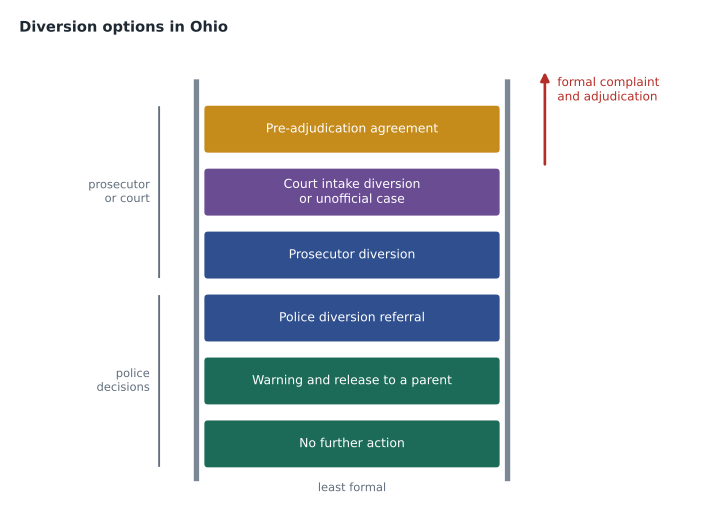
No further action is appropriate when the behavior is trivial or has already been dealt with by parents or a school. A warning and release to a parent is the most common informal response for a first minor offense; the officer explains that the behavior was wrong and could lead to a complaint, and records the contact. A police diversion referral sends the child, with the family's agreement, to a community program, such as a restorative justice program, mental health or substance use services, mentoring or a recreation program. Prosecutor diversion happens when the case is sent to the prosecutor, who agrees not to proceed if the child completes a program. Court diversion happens at intake: under Juvenile Rule 9, intake staff can resolve a case informally, sometimes called an unofficial case, with an agreement that the child will complete certain tasks, and no formal complaint goes forward if they do. After a complaint is filed, some courts also use pre-adjudication agreements, with dismissal of the complaint on completion.
Bell says the most important question is not which rung to choose but what the young person needs to stop. A referral to a program that does not fit is worse than a good warning. And a referral to a program with a six-month waiting list is not timely intervention. Port Ardent keeps an up-to-date list of programs with their current waiting times, and youth officers are expected to check it before promising anything to a family.
Mia and Tariq
Ferreira sat with Mia and her mother in the pharmacy's back office. She explained what Mia had done and why it was theft, that she could be referred to juvenile court on a complaint but that the officer had decided to warn and release her to her mother this time, and that the contact would be recorded. Mia apologized to the store manager and returned the earbuds. Her mother said she would deal with it at home. The whole contact took forty minutes. Ferreira's notes recorded the facts, the options she considered, her reasons, and that the store manager agreed with the outcome.
The second case was more complicated. In April, a 15-year-old named Tariq Haidari spray-painted a large tag on the wall of the Eastgate Park field house. He had arrived in the United States two years earlier with his family as refugees from Afghanistan, and was struggling at school. When Ferreira spoke with him and his father, with an interpreter on the phone, he admitted the tag and said older boys had dared him. The cleanup would cost the city about 300 dollars. Ferreira considered a warning but thought it would not be enough: the damage was significant, and Tariq seemed to be drifting toward a group of older boys she was worried about. She also thought court would do more harm than good. She referred him, through the department's police diversion program, to the community youth program run out of the Eastgate community center, in partnership with the Port Ardent Newcomer Center, where settlement counselor Nadia Rahimi worked with him and his family. The agreement had three parts: Tariq would help the city crew repaint the field house wall, he would join the center's after-school art program, which runs a legal mural project, and he would meet Rahimi weekly for two months.
Three months later, Tariq had finished all three parts. His mural design, a mountain range and a basketball hoop, was one of four chosen for a wall in the park. Ferreira closed the file with a note of the outcome. Desjardins asks the class what made the referral work. Students point to the fit between the program and what Tariq needed, the involvement of his family in their own language, the speed of the response, and the repair of the specific harm he caused.
Formal diversion agreements
More formal diversion agreements, whether through the prosecutor or court intake, usually have conditions similar to adult diversion. The child and a parent agree in writing to the terms, which may include an apology, restitution, community service, counseling or a program. Good practice, as described in the Ohio toolkit, is that diversion should involve an informal meeting rather than a court hearing, an individualized plan developed with the child and family, brief and evidence-based programming without fees, and a normal length of no more than about 90 days. Many programs require the child to accept responsibility, and the child should be told they can consult a lawyer before agreeing. A child who denies the offense must be allowed to have the case heard in court.
Ohio law gives completed diversion an important benefit. Under Revised Code 2151.356(B), when a person was referred to juvenile court for an alleged delinquent or unruly act and the case was resolved without a formal complaint, the court must promptly seal the records. When a child was taken into custody but no complaint was filed and the child was not referred to the court, the agency must send its records, other than fingerprints and DNA, to the court for sealing. Officers must therefore understand that a diverted case leaves a much smaller footprint than one that goes to adjudication, and should tell families so.
Noah Kessler, the sixteen-year-old in the Eastgate Park robbery, would eventually be dealt with by a formal diversion agreement, even though robbery is a serious offense. Lesson 8 explains why the prosecutor agreed to it, and lesson 12 reviews whether it was the right decision.
# Program waiting times shape whether a referral is "timely".
# Port Ardent's list (invented): program -> current wait in days.
programs = {"restorative justice": 9, "youth art program": 3,
            "substance use program": 41, "mentoring": 62, "anger management group": 18}
limit = 21
ok = sorted(p for p, w in programs.items() if w <= limit)
print("referrals possible within", limit, "days:", ok)
print("longest wait:", max(programs, key=programs.get), programs[max(programs, key=programs.get)], "days")referrals possible within 21 days: ['anger management group', 'restorative justice', 'youth art program'] longest wait: mentoring 62 days
With a three-week standard for timely intervention, only three of the five programs on Port Ardent's invented list are realistic options. Bell says the mentoring program's two-month wait is the single biggest gap in the city's youth services, and that the unit reports it to the city every quarter.
Restorative and culturally specific programs
Many of the referrals youth officers make are to restorative justice programs. In a restorative process, a trained facilitator brings together the young person, the person harmed, and family and community members, with everyone's consent, to talk about what happened, who was affected and what should be done to repair the harm. The young person hears directly how their actions affected someone, and the person harmed gets answers and a say in the outcome. Agreements often include an apology, repair or payment for damage, and steps the young person will take, such as community service or attending a program. Students who took the victimology course saw a restorative meeting between Ruth Lindqvist and the young man who broke into her store. Research on restorative justice for young people has generally found high satisfaction among victims and modest reductions in reoffending, with the best results for cases involving a direct victim.
For Native American young people, some tribes run their own diversion and peacemaking programs, and tribal courts have jurisdiction over many offenses by tribal members on tribal land. When the community policing course visited Nimkii Bay, students heard how the community's youth circle takes referrals for young people from the community. Culturally specific programs for Black and Latino youth, often run by community organizations, are also part of many cities' diversion options. Bell's advice is to know the programs personally. 'Visit them,' he says. 'Meet the staff. If you can tell a parent exactly what happens on the first night, they are far more likely to agree.'
What a good diversion record contains
Because diversion leaves the young person with no court record, the police record is often the only trace of what happened. A good record identifies the young person and the parent contacted, describes the offense and the evidence briefly, lists the options the officer considered, states the reasons for the measure chosen, records the victim's views, and notes the outcome, such as whether a referral was completed. In Ohio, records of cases resolved without a complaint are sealed, so the officer's notes must be accurate the first time; they will not be reviewed in court. Records like these let the next officer see that a warning was already given, and they let supervisors check whether measures are being used consistently.
Worked problem
Choosing a measure
A 16-year-old with one previous police warning for shoplifting is caught taking 80 dollars' worth of clothing from a store, with a friend. He admits it but shrugs and says the store can afford it. His father is angry and wants the police to 'teach him a lesson'. The store wants the clothing back. What should the officer consider?
Show solution
- The offense is non-violent and he has no previous adjudication; a previous warning does not rule out diversion.
- A second warning may not be enough, given the previous warning and his attitude, so a referral to a program, such as a restorative justice program that brings him face to face with the store's staff, may be more effective.
- The father's anger is understandable, but the measure should be proportionate to the offense, not to the parent's frustration.
- The friend should be dealt with separately on his own history.
- Record the options considered and the reasons.
Answer: A referral to a restorative or accountability program is likely proportionate; formal charges would be hard to justify for a non-violent second contact.
Common mistakes
MistakeExtrajudicial measures are only for first offenses.
InsteadDiversion can be used more than once when it is adequate; good practice does not limit it to first offenses.
MistakeAgreeing to diversion is the same as being adjudicated delinquent.
InsteadCompleted diversion leads to no adjudication, and records of cases resolved without a complaint are sealed.
MistakeA referral is always better than a warning.
InsteadA referral that does not fit the young person's needs, or has a long wait, can be worse than a good warning.
MistakeIf no charge is laid, nothing needs to be written down.
InsteadEvery measure must be recorded so the next officer knows the history.
Summary and key terms
- Ohio Juvenile Rule 9(A) directs that formal court action be avoided where appropriate and community resources used.
- Diversion can be done by police, prosecutors or court intake, and research shows it works at least as well as formal processing for low-risk youth.
- The options form a ladder from no further action to the most formal measure; start low and move up only when needed.
- Good diversion is brief, individualized, free to families and agreed in writing with the child and parent.
- Cases resolved without a complaint must be sealed under Revised Code 2151.356(B).
- Measures must fit the young person's needs, be timely and be recorded.
- Diversion
- Redirecting a young person from formal juvenile court processing.
- Release with a warning
- Telling a child the behavior was wrong and releasing them to a parent, with a record of the contact.
- Police diversion
- A referral by police to a community program instead of filing a complaint.
- Unofficial case
- A case resolved informally at court intake, without a formal complaint.
- Pre-adjudication agreement
- An agreement after a complaint is filed that leads to dismissal if the child completes it.
- Sealing
- Closing records from public view, required by Ohio law for cases resolved without a complaint.
Practice problems
Work each problem on paper first, then reveal the answer to check.
Why did Ferreira warn Mia rather than refer her?
Show answer
It was a first, minor, non-violent offense; Mia accepted responsibility, returned the item, and her mother was involved.
Name the three parts of Tariq's referral agreement.
Show answer
Repaint the wall with the city crew, join the art program, and meet Rahimi weekly for two months.
In the code example, which programs could take a referral within 21 days?
Show answer
Anger management group, restorative justice and the youth art program.
What does Revised Code 2151.356(B) require when a case is resolved without a complaint?
Show answer
The court must promptly seal the records.
Lesson quiz · 5 questions
Score 60% or more to complete this lesson.
Create a free account to save your progress, take quizzes and earn a certificate.