
LES-211 · Lesson 3 of 12 · 19 min
The juvenile court: jurisdiction, purpose and due process
▶ Video coming soon A video version of this lesson is on the way.
Desjardins hands out copies of Ohio Revised Code 2152.01 and the first page of In re Gault and asks the students to underline every word that would not appear in a law about adults. They find words like 'care', 'protection', 'mental and physical development', 'rehabilitate' and 'restore the victim', and in Gault, the Court's famous line that 'under our Constitution, the condition of being a boy does not justify a kangaroo court'. 'Those words are instructions,' he says. 'The juvenile court has a different purpose from the criminal court, but the young person in it still has rights. You need to understand both halves.'
Who hears juvenile cases
Each state has its own juvenile code and juvenile courts. In Ohio, each county's court of common pleas has a juvenile division, and some larger counties, including Lucas County, have a separate juvenile court. Ohio's juvenile law is spread across two chapters of the Revised Code: Chapter 2151, which deals with abused, neglected and dependent children, unruly children and the general structure of the juvenile court, and Chapter 2152, which deals with delinquent children and juvenile traffic offenders. The Ohio Rules of Juvenile Procedure govern how cases move through the court. The offenses themselves are the same as for adults: a child is delinquent if they commit an act that would be a crime if committed by an adult.
Juvenile courts in Ohio hear three main kinds of cases relevant to police. Delinquency cases involve acts that would be crimes for adults. Unruly cases involve status offenses, conduct that is prohibited only for children, such as habitual truancy, running away or disobeying parents. Juvenile traffic offender cases involve traffic violations. There is no jury in juvenile court; the judge or a magistrate decides the case.
The purposes of Ohio juvenile dispositions
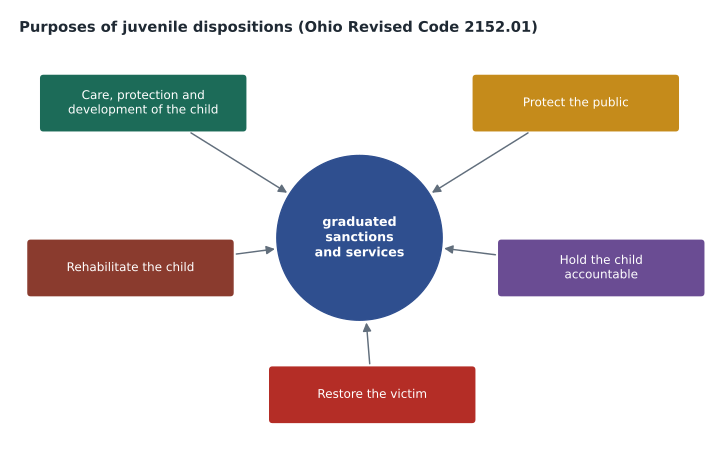
Revised Code 2152.01 states that the overriding purposes of juvenile dispositions are to provide for the care, protection and mental and physical development of children, to protect the public interest and safety, to hold the offender accountable for their actions, to restore the victim, and to rehabilitate the offender. These purposes are to be achieved by a system of graduated sanctions and services. Dispositions must be reasonably calculated to achieve the purposes, commensurate with the seriousness of the conduct and its impact on the victim, and consistent with dispositions for similar acts by similar offenders. The law also says dispositions shall not be based on the race, ethnic background, gender or religion of the child.
Juvenile courts are often described as having two faces. One is the traditional rehabilitative face: the court is supposed to understand the child, address the causes of the behavior and act in the child's interest. The other is the accountability face: the court holds the child responsible and protects the community. The modern Ohio statute includes both, and officers will see both in the way cases are handled. A juvenile court hearing still looks very different from an adult trial. The language is different, as lesson 1 showed, hearings are usually smaller and less formal, and the judge has a wide range of dispositions, from a warning to commitment to the Department of Youth Services.
Bell points to the phrase 'graduated sanctions'. 'Graduated sanctions means the response should step up as the behavior does, and step down when it stops. The first response to a first offense should usually be the lightest one that works. If you jump to the heaviest tool first, you have nowhere to go.'
Due process in juvenile court
In the 1960s the Supreme Court decided several cases that transformed juvenile court. In Kent v. United States (1966), the Court held that before a juvenile court waives jurisdiction and transfers a child to adult court, the child is entitled to a hearing, access to records and a statement of reasons. In In re Gault (1967), 15-year-old Gerald Gault had been committed to a state industrial school, potentially until 21, for making an obscene phone call, an offense for which an adult would have faced a small fine or two months in jail. He had no notice of the charges, no lawyer and no chance to confront the neighbor who complained. The Court held that juveniles in delinquency proceedings that could lead to confinement have the rights to notice of the charges, to counsel, including appointed counsel if they cannot afford one, to confront and cross-examine witnesses, and the privilege against self-incrimination.
In In re Winship (1970), the Court held that the prosecution must prove delinquency beyond a reasonable doubt, the same standard as in adult criminal trials. In McKeiver v. Pennsylvania (1971), however, the Court held that juveniles do not have a constitutional right to a jury trial, because juvenile court was still different enough from criminal court. Later, in Schall v. Martin (1984), the Court upheld preventive detention of juveniles who posed a serious risk of committing another crime before their hearing, with procedural safeguards; lesson 7 returns to detention. Ohio's statutes and Juvenile Rule 4 give children the right to counsel at all stages, and Ohio courts have held that a child may waive counsel only after meaningful consultation with a parent or other adult and only if the waiver is knowing, intelligent and voluntary.
| Case or rule | What it means for police |
|---|---|
| Kent v. United States (1966) | Transfer to adult court requires a hearing and reasons; police reports may be part of the record |
| In re Gault (1967) | Juveniles have rights to notice, counsel, confrontation and against self-incrimination |
| In re Winship (1970) | Delinquency must be proved beyond a reasonable doubt, so evidence must meet the same standard as for adults |
| McKeiver v. Pennsylvania (1971) | No constitutional right to a jury in juvenile court |
| Schall v. Martin (1984) | Preventive detention is allowed with safeguards |
| Revised Code 2152.01 | Dispositions must serve care, protection, accountability, victim restoration and rehabilitation |
Parents, victims and the community
Youth justice gives parents a role that adult justice does not. Parents usually must be notified when a young person is arrested or detained, may be required to attend court, and are often central to decisions about release and diversion. Ohio law allows juvenile courts to require parents to attend hearings and, in some cases, to participate in treatment or pay restitution, and parents can face consequences for failing to attend or for contributing to a child's delinquency. But the child's rights belong to the child, and a parent's wishes do not replace the child's own decisions about counsel or statements. Bell tells the class that the parent in the room is not always an ally. Some parents push their children to confess to make the problem go away; some are angry and humiliating; a few are themselves part of the problem. An officer has to watch for all of that.
Victims also have a defined place. Ohio's victims' rights provisions, including Marsy's Law in the Ohio Constitution, apply to juvenile cases, and the purposes of dispositions in Revised Code 2152.01 include restoring the victim. Victims have the right to be informed of and present at proceedings and to be heard at disposition. Claire Arsenault, Ben's mother, called the station twice in the week after the robbery to ask what was happening, and Bell admits that the first time, nobody called her back for three days. Students who took the victimology course will remember why that matters.
# Timeliness check for a unit's youth files: days from the incident to the first
# decision (warning, referral or charge). Figures are invented.
files = {"Y-0412": 3, "Y-0419": 11, "Y-0425": 2, "Y-0431": 46, "Y-0433": 7,
         "Y-0440": 5, "Y-0446": 28, "Y-0450": 1, "Y-0457": 9, "Y-0462": 4}
target = 14
late = sorted(f for f, d in files.items() if d > target)
days = sorted(files.values())
mid = (days[4] + days[5]) / 2
print("median days to decision:", mid)
print("files over", target, "days:", late)median days to decision: 6.0 files over 14 days: ['Y-0431', 'Y-0446']
Port Ardent's youth unit sets itself a target of a first decision within 14 days of the offense. In the invented sample, the median is 6 days, but two files took 28 and 46 days. Bell says the long ones are almost always files waiting for something: a victim to call back, a video to be reviewed, or an officer on leave. The fix is supervision, not more law.
How a case moves through the system
In Ohio, a case usually begins when police take a child into custody or issue a summons, and then refer the case to the juvenile court by filing a complaint, or send it to the court's intake department. Intake staff, working under Juvenile Rule 9, screen the case and decide whether it can be handled informally, through diversion or an unofficial case, or whether a formal complaint should proceed. If the child is held, a detention hearing must take place promptly. At the adjudicatory hearing, the prosecutor must prove the allegations beyond a reasonable doubt, or the child may admit them. If the child is adjudicated delinquent, the court holds a dispositional hearing and chooses a disposition, often after a social history or pre-disposition report prepared by a probation officer. For serious cases, the prosecutor can ask the court to transfer the case to adult court, as lesson 8 explains.
Bell draws the process on the board and circles each point where someone makes a choice: the officer at the scene, the officer deciding whether to charge, the intake officer and prosecutor deciding whether to proceed, the judge deciding on release, the young person deciding whether to plead, and the judge deciding the consequence. 'At every circle,' he says, 'the law tells the decision-maker to consider the less formal option first. That is the design. It only works if each person actually does it, and if each person records why.'
Officers in juvenile court
Officers testify in youth cases much as they do in adult cases, and the same rules of evidence apply. A few differences matter. Youth courts are usually smaller and quieter, and judges often speak directly to the young person in plain language, so an officer who uses jargon or sounds hostile stands out. The officer's notes about how rights were explained, who was contacted and when, and what the young person said in their own words, are often the center of the hearing, because the special rules on counsel, parents and statements give the defense more to challenge. Juvenile proceedings and records are confidential under Ohio law, so officers must not discuss the case, or the child's identity, outside the proceedings, including with media and on social media. And because youth courts aim to move quickly, officers who are slow to provide reports or to appear can delay cases in ways that undermine the principle of timely intervention.
Worked problem
Applying the purposes of juvenile dispositions
A 15-year-old with no record spray-paints a tag on the wall of the Eastgate Park field house. The cleanup costs the city 300 dollars. He admits it immediately when Constable Ferreira, who knows him from the youth basketball program, asks about it. His parents are cooperative. What do the principles suggest?
Show solution
- Accountability should be proportionate: the offense is minor property damage and he accepted responsibility at once.
- Repair of harm points toward cleaning the wall himself or helping with a community cleanup, and possibly paying part of the cost.
- Rehabilitation and prevention point toward involving his parents and the basketball program, which already gives him a positive adult connection.
- Timeliness means acting within days, while the link between the act and the consequence is clear.
- Graduated sanctions mean starting with the lightest effective response, such as a referral to a diversion program, rather than a complaint.
Answer: A quick, informal response focused on repair, with the family and the existing community connection, fits the principles; formal court action would not.
Common mistakes
MistakeJuvenile court uses different offenses from adult court.
InsteadA delinquent act is an act that would be a crime for an adult; the court and process differ.
MistakeA parent can waive a child's right to counsel in juvenile court.
InsteadThe rights belong to the young person; a parent cannot waive them on the child's behalf.
MistakeJuvenile court only cares about the child's welfare.
InsteadOhio's statute lists protecting the public and holding the child accountable alongside the child's care and rehabilitation.
MistakeSpeed does not matter in youth cases as long as the outcome is right.
InsteadTimeliness is itself a principle, because delay weakens the link between act and consequence.
Summary and key terms
- Ohio juvenile courts hear delinquency, unruly and juvenile traffic cases under Revised Code Chapters 2151 and 2152.
- Revised Code 2152.01 lists care and development, public safety, accountability, restoring the victim and rehabilitation.
- Juvenile court has both a rehabilitative and an accountability face.
- Kent, Gault and Winship gave juveniles due process rights; McKeiver held there is no right to a jury.
- Parents have a defined role, but the rights belong to the young person.
- Victims have rights to be informed and heard in youth cases.
- Graduated sanctions
- A system in which responses increase with the seriousness and persistence of behavior.
- Enhanced procedural protection
- Protections for young persons beyond those for adults, reflecting their reduced maturity.
- Unruly child
- A child who commits a status offense, such as habitual truancy or running away.
- Timely intervention
- Acting promptly so that the consequence is clearly connected to the behavior.
- Repair of harm
- Making amends to the victim or community for the damage caused.
- Due process
- Fair procedures, including notice, counsel and the chance to challenge evidence.
Practice problems
Work each problem on paper first, then reveal the answer to check.
What did In re Gault (1967) decide?
Show answer
That juveniles facing possible confinement have rights to notice, counsel, confrontation and against self-incrimination.
In the code example, what was the median number of days to a first decision?
Show answer
6 days.
Why does Bell say the parent in the room is not always an ally?
Show answer
Some parents pressure the child to confess, some are humiliating, and some are part of the problem.
Which Ohio constitutional provision gives victims rights in juvenile cases?
Show answer
Marsy's Law.
Lesson quiz · 5 questions
Score 60% or more to complete this lesson.
Create a free account to save your progress, take quizzes and earn a certificate.