
LAWC-314 · Lesson 9 of 12 · 18 min
Barrister review: civil, criminal, family and public law
▶ Video coming soon A video version of this lesson is on the way.
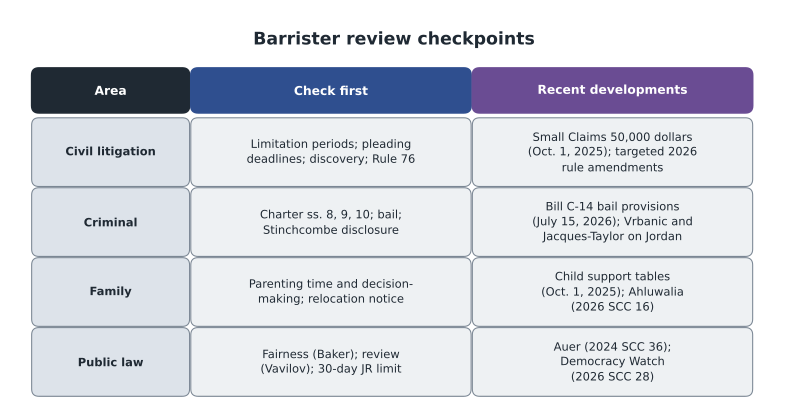
This lesson and the next are review lessons. Rideout reminds the class that they have already taken courses in each area and that the goal now is different: to see the law the way a new practitioner meets it, as a set of deadlines, tests and decisions on a real file. Each section summarizes what entry-level barristers most need to know, with recent developments as of late 2026, and ends with a short problem. Professors from the earlier courses join for parts of the lesson: Tobias Renaud for civil procedure, Ruth Castellano for criminal law and Nadia Ferreira for family law.
Civil litigation
Renaud begins with the deadline that ends more claims than any other: the limitation period. Under Ontario's Limitations Act, 2002, the basic limitation period is two years from the day the claim was discovered, meaning the day the claimant knew or ought to have known of the injury, its cause, the defendant's involvement and that a proceeding would be appropriate. The ultimate limitation period is fifteen years from the act or omission, subject to exceptions. Some statutes impose shorter notice periods, such as the sixty-day notice to an occupier or snow contractor for slip-and-fall claims on snow and ice under section 6.1 of the Occupiers' Liability Act, which the class met in LAWC-104 in the Ingram v. Corwin Plaza Holdings file.
An action is usually started by issuing a statement of claim, which must generally be served within six months. A defendant served in Ontario generally has twenty days to deliver a statement of defence. Both parties must disclose every relevant document in their power, possession or control in an affidavit of documents, agree on a discovery plan and attend examinations for discovery, subject to the limits on discovery time in the Rules. Claims up to 200,000 dollars proceed under the simplified procedure in Rule 76, which since 2020 has had no jury and limited discovery. The Small Claims Court limit rose to 50,000 dollars on October 1, 2025.
Summary judgment under Rule 20 is available where there is no genuine issue requiring a trial. In Hryniak v. Mauldin, 2014 SCC 7, the Supreme Court called for a culture shift toward proportionate, timely and affordable procedures and held that a motion judge may use expanded fact-finding powers to decide a case on the record where that would be fair and just. Settlement offers under Rule 49 have costs consequences if a party does better or worse than an offer it refused. Costs generally follow the event on a partial indemnity scale, with substantial indemnity reserved for special circumstances.
The rules are changing. The Civil Rules Review's Phase 2 Final Policy Report of December 15, 2025 proposed a new framework with front-loaded evidence and a reduced role for oral discovery, and in May 2026 the province announced a staged approach starting with targeted amendments. Some amendments are already in force, including changes in 2026 on where proceedings may be commenced and transferred, new appeal forms, and the certification of quotations in factums and expert reports from September 1, 2026, but the full new rules were not in force in late 2026. Candidates should learn the rules in force and watch for changes.
Practice problem: A client slipped on ice outside a strip mall eleven weeks ago and has just called. Renaud asks what the first two issues are. The class identifies the sixty-day notice under the Occupiers' Liability Act, which has already passed, so the lawyer must consider whether the client had a reasonable excuse and whether the defendants were prejudiced; and the two-year limitation period, which must be diarized.
Criminal law and procedure
Castellano focuses on what a new defence lawyer or Crown needs on the first day in court. On arrest, the Charter guarantees freedom from unreasonable search and seizure in section 8, from arbitrary detention in section 9, and the rights in section 10 to be informed promptly of the reasons for arrest or detention and to retain and instruct counsel without delay and be informed of that right. Evidence obtained in breach of the Charter may be excluded under section 24(2) if its admission would bring the administration of justice into disrepute, applying the three lines of inquiry from R. v. Grant, 2009 SCC 32.
Bail is the first hearing most accused people face. The default under the Criminal Code is release at the earliest reasonable opportunity on the least onerous conditions, under the principle of restraint, with detention justified only on the primary, secondary or tertiary grounds. Some situations reverse the onus, requiring the accused to show why detention is not justified. Bill C-14, the Bail and Sentencing Reform Act, received royal assent on June 15, 2026, and its bail provisions came into force on July 15, 2026. Among other things, it added reverse onus situations, changed how restraint and the ladder principle apply in reverse onus cases and tightened the rules on sureties. New practitioners must use the amended provisions.
The Crown must disclose all relevant information in its possession, whether inculpatory or exculpatory, under R. v. Stinchcombe, [1991] 3 SCR 326. Under R. v. Jordan, 2016 SCC 27, delay is presumptively unreasonable if it exceeds eighteen months for cases tried in provincial court and thirty months for cases in superior court, after deducting delay caused by the defence. In R. v. Vrbanic, 2026 SCC 19, and R. v. Jacques-Taylor, 2026 SCC 20, the Supreme Court confirmed that the ceilings and the remedy of a stay remain, held that there is no residual discretion to avoid a stay where the ceiling is exceeded without exceptional circumstances, and clarified how complexity and delay caused by co-accused are treated.
Practice problem: A client charged with assault was released on conditions, including no contact with the complainant, his former partner. He tells his lawyer that she has been texting him to talk about their children and asks whether he can reply. The class's answer: no, not without a variation, because replying would breach the release order; the lawyer should advise him of that, explain the risk of a new charge, and, if appropriate, seek a variation through the Crown or the court, possibly allowing communication through a third party about the children.
Family law
Ferreira reviews the vocabulary first, because it changed. Since the Divorce Act amendments of March 1, 2021, the federal statute speaks of parenting time and decision-making responsibility rather than custody and access, makes the best interests of the child the only consideration in parenting orders, with primary consideration to the child's physical, emotional and psychological safety, security and well-being, requires courts to consider family violence, and sets out a notice and decision framework for relocation. In Barendregt v. Grebliunas, 2022 SCC 22, the Supreme Court addressed relocation, emphasizing the child's best interests, the significance of family violence and the deference owed to trial judges.
Child support is set by the Federal Child Support Guidelines and their tables. Updated tables, based on 2023 tax rules, came into force on October 1, 2025, and the change in the tables can be a ground for varying an existing order. In Ontario, married spouses who separate share the value of property acquired during the marriage through the equalization of net family property under the Family Law Act; unmarried spouses have no statutory property regime and rely on trust and unjust enrichment claims. Spousal support is decided under the Divorce Act or the Family Law Act, with the Spousal Support Advisory Guidelines widely used to set ranges. In Anderson v. Anderson, 2023 SCC 13, the Supreme Court upheld an informal domestic agreement, emphasizing respect for parties' agreements while remaining alert to vulnerabilities.
In Ahluwalia v. Ahluwalia, 2026 SCC 16, decided in May 2026, a majority of the Supreme Court, in reasons by Justice Kasirer, recognized a tort of intimate partner violence addressing a pattern of abusive and controlling conduct, upholding a damages award of 100,000 dollars; Justice Karakatsanis concurred and three Justices dissented. Ferreira tells the class that family violence now runs through every part of family practice: parenting, relocation, support, property and the safety of the client.
Practice problem: A separated mother wants to move from Corwin to Ottawa with her eight-year-old for a new job. The father has regular parenting time. Under the Divorce Act framework, what must she do first? Give written notice of the proposed relocation to the father at least sixty days before the move, in the required form, with the information the Act requires, and then either reach agreement or apply to the court, which will decide based on the child's best interests and the relocation factors.
Public law
Rideout covers public law herself. Most administrative law work begins with two questions: was the process fair, and was the decision reasonable? Procedural fairness depends on the context, using the factors from Baker v. Canada, [1999] 2 SCR 817, including the nature of the decision, the statutory scheme, its importance to the person affected, legitimate expectations and the agency's own choices of procedure. Under Canada (Minister of Citizenship and Immigration) v. Vavilov, 2019 SCC 65, the presumptive standard of review of the merits is reasonableness, with correctness for constitutional questions, general questions of central importance to the legal system and questions about the boundaries between administrative bodies, and for questions on statutory appeals the appellate standards apply. In 2024, the Supreme Court held in Auer v. Auer, 2024 SCC 36, that Vavilov also governs review of the validity of subordinate legislation.
In Ontario, applications for judicial review are heard by the Divisional Court and must generally be started within thirty days of the decision, under an amendment to the Judicial Review Procedure Act in force since July 8, 2020, although the court may extend the time. In Democracy Watch, 2026 SCC 28, the Supreme Court held that legislation cannot entirely oust judicial review for legality. Charter claims against government action use the familiar structure: is a right infringed, and if so, is the limit justified under section 1, applying the Oakes test of a pressing and substantial objective, rational connection, minimal impairment and proportionality.
Practice problem: A client's licence to operate a daycare was revoked by a provincial director without a hearing, eighteen days ago. What should the lawyer check immediately? Whether there is a statutory appeal, which may change the route and the standard of review; whether judicial review is available and the thirty-day limit, which leaves only twelve days; and whether the process was fair given the importance of the decision to the client.
Worked problem
A barrister-style examination question
Rideout gives the class a question in examination style: 'A client was served in Ontario with a statement of claim on March 2. On March 18 she brings it to a lawyer. She has a counterclaim against the plaintiff for damage caused two and a half years ago, which she first noticed on April 1 last year. What should the lawyer do first?' The options are: (a) deliver a statement of defence and counterclaim by the deadline, having checked whether the counterclaim is out of time; (b) start a separate action for the counterclaim next year; (c) ask the plaintiff to discontinue; (d) wait for an examination for discovery.
Show solution
- Identify the deadline: a defendant served in Ontario generally has twenty days to deliver a defence, so the defence is due around March 22; the lawyer must act immediately or obtain an extension.
- Identify the limitation issue on the counterclaim: the damage occurred two and a half years ago but was discovered on April 1 last year, so under the discoverability rule the two-year period may still be running.
- Eliminate (b): delay risks the limitation period and wastes the opportunity to counterclaim in the same action.
- Eliminate (c) and (d): neither protects the client's position or meets the deadline.
- Choose (a), and advise the client in writing about the deadlines and the limitation analysis.
Common mistakes
MistakeUsing custody and access as the terms in a Divorce Act parenting application.
InsteadSince March 1, 2021, the Act uses parenting time and decision-making responsibility.
MistakeApplying the pre-2026 bail provisions to a release hearing in late 2026.
InsteadThe bail provisions of Bill C-14 came into force on July 15, 2026, adding reverse onus situations and other changes.
MistakeAssuming judicial review in Ontario can be started at any time within a reasonable period.
InsteadThe Judicial Review Procedure Act generally requires an application within thirty days, subject to extension.
MistakeTreating the Civil Rules Review's proposed new framework as in force.
InsteadOnly targeted amendments were in force in late 2026; candidates must use the current Rules of Civil Procedure.
Practice problems
Work each problem on paper first, then reveal the answer to check.
What did R. v. Vrbanic and R. v. Jacques-Taylor (2026) decide about Jordan?
Show answer
They confirmed the Jordan ceilings and the stay remedy, held there is no residual discretion to avoid a stay where the ceiling is exceeded without exceptional circumstances, and clarified treatment of complexity and co-accused delay.
What is the Small Claims Court limit in Ontario, and since when?
Show answer
50,000 dollars, since October 1, 2025.
Under Vavilov, when is correctness the standard of review?
Show answer
For constitutional questions, general questions of central importance to the legal system as a whole, and questions about the jurisdictional boundaries between administrative bodies, and where the legislature has provided a statutory appeal for questions of law.
Summary and key terms
- Civil: two-year basic and fifteen-year ultimate limitation periods, pleadings deadlines, discovery obligations, Rule 76 up to 200,000 dollars, Small Claims up to 50,000 dollars, Hryniak on summary judgment.
- Criminal: Charter rights on arrest, Grant on exclusion, bail under restraint as amended by Bill C-14 from July 15, 2026, Stinchcombe disclosure and Jordan delay as confirmed in 2026.
- Family: Divorce Act terminology and relocation rules since 2021, updated child support tables from October 1, 2025, equalization, and family violence throughout.
- Public law: Baker fairness factors, Vavilov review, a thirty-day limit for judicial review in Ontario and the Oakes test under section 1.
- Review every area as a practitioner meets it: deadlines first, then tests, then advice.
- Discoverability
- The rule that a limitation period runs from when the claim was or ought to have been discovered.
- Simplified procedure
- Ontario's streamlined procedure under Rule 76 for claims up to 200,000 dollars.
- Reverse onus
- A bail situation in which the accused must show why detention is not justified.
- Decision-making responsibility
- The Divorce Act term for responsibility for significant decisions about a child.
- Equalization of net family property
- The Ontario regime that shares the value of property acquired during marriage on separation.
- Reasonableness review
- The presumptive standard of judicial review of administrative decisions under Vavilov.
Lesson quiz · 5 questions
Score 60% or more to complete this lesson.
Create a free account to save your progress, take quizzes and earn a certificate.