
LAWC-314 · Lesson 6 of 12 · 19 min
Practice skills
▶ Video coming soon A video version of this lesson is on the way.
Rideout begins the skills lesson by handing out a page with one paragraph on it: a voicemail transcript from a fictional client named Wendolyn Pacheco, who says that her landlord has changed the locks on her bakery, that she has a catering order due Saturday, and that she does not know what to do. 'You have fifteen minutes before she arrives,' Rideout says. 'What do you need to know, what do you need to do before she walks in, and what will you say in the first two minutes?' The class discovers that the first two minutes are hard. This lesson covers the core practice skills that licensing bodies identify as entry-level competencies: interviewing and advising, research, writing, drafting, negotiation and advocacy.
Competence as a professional duty
Skills are not optional extras. The Rules of Professional Conduct, following the Model Code, require a lawyer to perform all legal services to the standard of a competent lawyer, and define competence to include not only knowledge of the law but the skills to apply it: investigating facts, identifying issues, advising the client on options, implementing the chosen course of action, communicating effectively, managing the practice and recognizing the limits of one's own ability. A lawyer who takes on a matter without the necessary competence must either acquire it without undue delay, risk or expense to the client, or decline or refer the matter. The quality of service rule adds duties to be timely, responsive and courteous. Licensing assessments, whether Ontario's examinations or PREP's Capstone Evaluation, are built around these definitions.
Interviewing
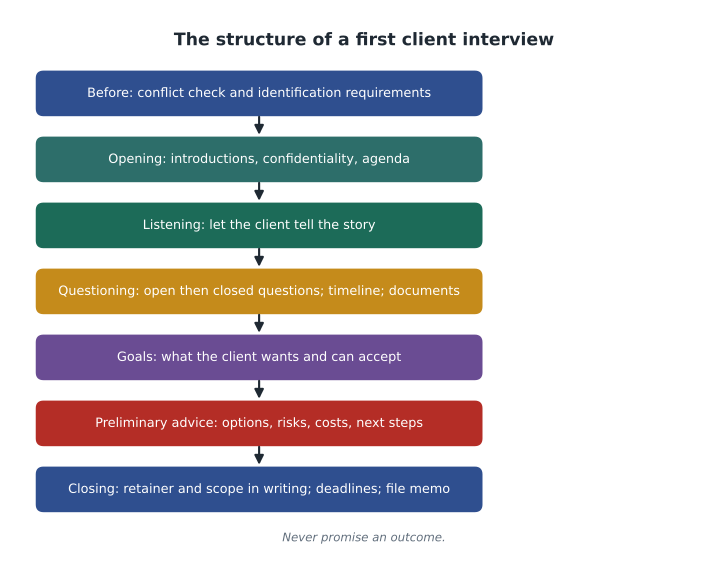
Good interviews have a structure, but the structure should not be visible to the client. Before the meeting, the lawyer runs a conflict check on the client and the other parties named, and confirms that the client identification and verification rules can be met. At the start of the meeting, the lawyer explains who they are, that what the client says is confidential, and what the meeting will cover. Then the lawyer listens. Clients often tell their story out of order, and the urge to interrupt with questions is strong, but a client who is allowed to finish usually reveals what matters most to them, which is not always what the lawyer expected.
After the story, the lawyer fills gaps with questions, moving from open questions ('Tell me about the lease') to closed ones ('Did you receive a written notice before the locks were changed?'). A timeline on paper helps both of them. The lawyer identifies documents to collect and other people who know the facts. Then the lawyer asks about goals: what does the client want, what would be an acceptable outcome, and what are the constraints of time, money and relationships? Wendolyn wants her bakery back by Saturday. She also wants to stay in the location, which means she does not want a war with her landlord.
Preliminary advice comes next, framed honestly. A lawyer may not know the answer at a first meeting and should say so, while explaining the options, the risks and the likely costs and what will happen next. Promises of outcome are never appropriate. The meeting ends with clarity about the retainer: whether the lawyer is acting, the scope of the work, how fees will be charged and what the client must do. The lawyer confirms all of this in writing, usually in an engagement letter, and writes a memo to the file the same day.
Advising
Advice is the core of a lawyer's job, and the hardest skill to learn because it combines law, facts and judgment. Good advice answers the client's question first and explains afterwards. It sets out the options with their likely consequences, including the option of doing nothing, and gives the lawyer's recommendation with reasons. It identifies the risks in terms the client can weigh, avoids false precision about chances of success, and tells the client what decisions are theirs to make. A client who is told 'you have a reasonable argument, but there is a real risk of losing and the cost of finding out will be substantial' is better served than one told 'you have a sixty-five percent chance' by a lawyer who has no real basis for the number.
Advice must also be candid. The Rules of Professional Conduct require a lawyer to be honest and candid when advising clients, and a lawyer who tells clients only what they want to hear does them harm. Rideout's version is blunt: 'If your client is going to lose, the kindest thing you can do is tell them early.'
Research
LAWC-104 taught the class how to research. In practice the constraints change. The question is usually framed by a client's problem rather than a professor's assignment, the time available is short, and the answer must be right. Rideout recommends a routine: write down the question in one sentence; start with a reliable secondary source, such as a practice text or a current law society resource, to get the shape of the law; go to the primary sources, the statute and the leading cases, and read them; check that each authority is still good law and that the statute is current; and record what was searched, where and when.
Generative AI has changed research without changing the duty. The tools can summarize, suggest search terms and draft, but they can also invent cases and misstate holdings, and courts have sanctioned lawyers who relied on fabricated authorities. In Zhang v. Chen, 2024 BCSC 285, the British Columbia Supreme Court ordered a lawyer who filed material citing non-existent cases generated by ChatGPT to personally pay costs, and stressed that AI is no substitute for professional expertise. In Ontario, the Rules of Civil Procedure were amended effective December 1, 2024 to require counsel to certify the authenticity of every authority cited in a factum, and further amendments in force September 1, 2026 require certification of the accuracy of quotations in factums and expert reports. The Federal Court requires a declaration when AI has been used to generate content in a filed document. Every authority must be found and read by a person before it is relied on.
Writing
Legal writing in practice is written for a busy reader: a client, a partner, a judge, opposing counsel. The reader wants the answer, then the reasons, then the details. A memo to a supervising lawyer should begin with the question and a short answer, followed by the facts that matter, the analysis and a recommendation. A letter to a client should be written in plain language, without jargon, and should tell the client what they need to do and by when. A letter to opposing counsel should be civil and precise, because it may end up as an exhibit in court.
Rideout's editing checklist is short. Does the first paragraph tell the reader what they most need to know? Is every paragraph about one thing? Could a sentence be shorter? Is every defined term used the same way throughout? Are dates, names and numbers correct? Would I be comfortable if the judge read it?
Drafting
Drafting contracts, wills, pleadings and corporate documents is a distinct skill. The drafter writes for a future reader who may be hostile: an opposing party looking for ambiguity, a court interpreting the words years later, a beneficiary unhappy with a will. Good drafting uses plain language, defines terms once and uses them consistently, avoids saying the same thing two ways, and checks every cross-reference. Precedents save time but are dangerous when used without thought, because a clause that was right for one deal may be wrong for the next. Every precedent should be read in full and adapted to the facts.
Negotiation
Most legal disputes end in settlement, and most transactions are negotiated, so negotiation is a daily skill. Preparation matters most. The lawyer should know the client's interests, not only their stated position; the client's best alternative to a negotiated agreement and that of the other side; the range of possible outcomes; and the client's walk-away point, confirmed in instructions before the negotiation. The interest-based approach popularized by Roger Fisher and William Ury in Getting to Yes encourages negotiators to separate the people from the problem, focus on interests rather than positions, look for options that serve both sides and use objective criteria. Positional bargaining still has a place, particularly in money disputes, and a good negotiator can use both.
Negotiation has ethical limits. A lawyer must not knowingly mislead the other side about a material fact, must not make threats of criminal or regulatory proceedings to gain a civil advantage, and must not settle without the client's authority. Every agreement should be confirmed in writing promptly, with a clear record of what was agreed.
Advocacy
Advocacy is persuasion before a decision maker. Oral advocacy at a motion or a hearing depends on knowing the record thoroughly, leading with the strongest point, answering the judge's questions directly when they are asked, and conceding what must be conceded. Written advocacy in a factum follows the same principles. Above all, the advocate's duty to the client is limited by the duty to the court: a lawyer must not mislead the court, must disclose binding authority that is directly against the client's position if the other side has not, and must treat the tribunal with candour and respect. LAWC-311 developed these skills in detail.
Back to Wendolyn
With fifteen minutes to prepare, the class decides that the lawyer should run a conflict check on Wendolyn and her landlord, pull a copy of the Commercial Tenancies Act provisions on re-entry and relief from forfeiture, and prepare to ask for the lease, any notices she received and her rent records. In the first two minutes, the lawyer should introduce themselves, explain confidentiality, and say: 'Tell me what happened, starting with the last time you paid rent.' Theo adds one more thing: ask whether she has the catering order in writing, because if the bakery stays locked, the lost profit may become part of the claim.
Practising the skills
Skills improve with deliberate practice and feedback, not with repetition alone. Rideout asks each student to choose one skill to work on during articling or their placement, to ask a supervisor for feedback on that skill specifically, and to keep a short note of what changed each time. Sophie chooses client letters; Arjun chooses negotiation; Theo, after years of preparing other lawyers' files, chooses advising clients directly.
Worked problem
Advising Wendolyn
Wendolyn Pacheco tells the lawyer that she fell two months behind in rent during a slow winter, that the landlord changed the locks on Tuesday after posting a notice on the door, and that she has offered to pay the arrears by Friday. Her catering order is worth about 4,000 dollars, and she wants to stay in the location. What advice should the lawyer give at the end of the first meeting?
Show solution
- Confirm the facts and documents needed: the lease, the notice, her payment history and any correspondence with the landlord.
- Explain the legal framework in plain language: a commercial landlord may be entitled to re-enter for non-payment of rent, and a tenant can ask the court for relief from forfeiture, usually on terms such as paying the arrears and costs.
- Set out options: negotiate with the landlord immediately, offering payment of arrears and costs in exchange for new keys; if the landlord refuses, consider an urgent application for relief from forfeiture; or, if she does not want to stay, negotiate an exit.
- Give a recommendation consistent with her goals: start with a prompt, civil negotiation, because she wants to keep the relationship, while preparing the court application in case it fails.
- Discuss costs and risks honestly, without promising an outcome, and identify the decisions that are hers.
- Confirm the retainer, scope and next steps in an engagement letter, and diarize the deadlines.
Common mistakes
MistakeInterrupting the client with questions before they have told their story.
InsteadListen first; the client's own account often reveals what matters most to them.
MistakeGiving a client a precise percentage chance of success without a real basis.
InsteadDescribe risks honestly in terms the client can weigh, and avoid false precision.
MistakeFiling a factum citing authorities produced by an AI tool without reading them.
InsteadEvery authority must be found and read; Ontario requires certification of the authenticity of authorities in factums.
MistakeSettling a matter because the terms seem good, without the client's instructions.
InsteadA lawyer must have the client's authority to settle and should confirm the instructions and the agreement in writing.
Practice problems
Work each problem on paper first, then reveal the answer to check.
What does the definition of competence in the Rules of Professional Conduct include besides knowledge of the law?
Show answer
Skills in investigating facts, identifying issues, advising on options, implementing the client's chosen course, communicating effectively, managing the practice and recognizing the limits of one's ability.
What did the court do in Zhang v. Chen, 2024 BCSC 285?
Show answer
It ordered a lawyer who filed material citing non-existent cases generated by ChatGPT to personally pay costs, stressing that AI is no substitute for professional expertise.
What should a negotiator prepare before a negotiation?
Show answer
The client's interests and position, the best alternatives to agreement for both sides, the range of outcomes, and the client's walk-away point confirmed in instructions.
Summary and key terms
- Competence under the Rules of Professional Conduct includes practice skills, not only legal knowledge.
- A first interview runs from conflict check and confidentiality through listening, questioning and goals to preliminary advice and a written retainer.
- Good advice answers first, sets out options and risks honestly and leaves the client's decisions to the client.
- Research must be verified by a person; Ontario requires certification of authorities and, from September 1, 2026, of quotations in factums and expert reports.
- Writing, drafting, negotiation and advocacy each have their own disciplines, all bounded by the duties of honesty and candour.
- Competence
- The professional standard requiring the knowledge, skills and attributes to perform legal services for a client.
- Engagement letter
- A letter confirming the retainer, its scope, the fees and the responsibilities of lawyer and client.
- Best alternative to a negotiated agreement
- The outcome a party will have if negotiation fails, which sets the value of any proposed deal.
- Interest-based negotiation
- An approach that focuses on the parties' underlying interests rather than their stated positions.
- Precedent
- In drafting, a previously used document adapted as a model for a new one.
- Duty of candour to the court
- The advocate's obligation not to mislead the tribunal and to disclose binding adverse authority not raised by the other side.
Lesson quiz · 5 questions
Score 60% or more to complete this lesson.
Create a free account to save your progress, take quizzes and earn a certificate.