
LAWC-314 · Lesson 3 of 12 · 19 min
Good character and the licensing application
▶ Video coming soon A video version of this lesson is on the way.
Ezra Ravel, the articling student at Pardee & Lowe whom the class met in Professional Responsibility, has agreed to talk to the class by video. In LAWC-214, the class discussed what Ezra should do after he told Maren Pellegrini that he had not disclosed a withdrawn assault charge from when he was nineteen. In this hypothetical, Ezra did what the class advised: he wrote to the Law Society, corrected his application, explained the circumstances and attached the court records showing that the charge was withdrawn after a diversion program. 'The worst part,' he tells the class, 'was the three weeks between sending the letter and hearing anything back. The second worst part was realizing I could have avoided all of it by reading the question properly the first time.' This lesson explains the good character requirement, what candidates must disclose and how the Law Society deals with concerns.
The requirement
Section 27 of the Law Society Act provides that it is a requirement for the issuance of every licence that the applicant be of good character. Every Canadian law society has an equivalent rule. The requirement is not a moral examination of the applicant's whole life. It asks whether the applicant, at the time of licensing, has the qualities the public is entitled to expect of a lawyer: honesty, integrity, respect for the law and the rights of others, and the capacity to be trusted with clients' affairs and money. Tribunals have described the test as a present one, not a test of perfection: the question is whether the applicant is of good character now, even if they were not at some time in the past.
The requirement exists to protect the public and to maintain public confidence in the profession. A lawyer is given access to confidential information, to clients' money and to the courts, and clients usually cannot check whether their lawyer is trustworthy. Licensing someone who is not trustworthy harms the client who is hurt, and it harms the reputation of every other lawyer.
What the application asks
The licensing application contains a series of good character questions. They cover matters such as criminal and provincial offence charges and convictions, including charges that were withdrawn, stayed or resolved by diversion; findings of academic misconduct; discipline by another professional body or employer; civil findings of fraud or dishonesty; bankruptcy and unpaid judgments; and any other circumstance that might reflect on character. The questions are broad on purpose. The candidate's job is not to decide whether a matter is serious enough to matter; it is to answer what is asked, fully and accurately, and to explain.
Ezra's mistake was common. He assumed that because his charge had been withdrawn, it did not count. The question asked whether he had ever been charged, not whether he had been convicted. Rideout tells the class that she has seen the same error with sealed youth records, pardoned or suspended convictions, academic misconduct findings that were 'only a warning', and traffic matters that turned out to be provincial offences. When in doubt, she says, disclose and explain. A disclosed matter is usually resolved with a letter. An undisclosed matter that later comes to light raises a second and more serious question: whether the candidate is honest.
Candour is itself character
The duty of candour runs through every decision in this area. The Law Society relies on applicants to tell the truth because it cannot investigate everyone. An applicant who conceals or misstates a matter shows the very trait the requirement is meant to screen out. In many good character cases, the original misconduct would not have prevented licensing; the concealment is what led to a hearing. The application itself warns that false or misleading information will result in the applicant not being licensed, and a lawyer who obtained a licence by misleading the Law Society can be disciplined for it after licensing.
Prompt voluntary correction weighs strongly in an applicant's favour. That is why the advice the class gave Ezra in LAWC-214 was the right advice: write to the Law Society as soon as the omission is discovered, explain how it happened, provide the documents, and do not minimize. An applicant who corrects an omission before anyone else discovers it is showing candour. An applicant who corrects it only after the Law Society has found out is showing something else.
The process
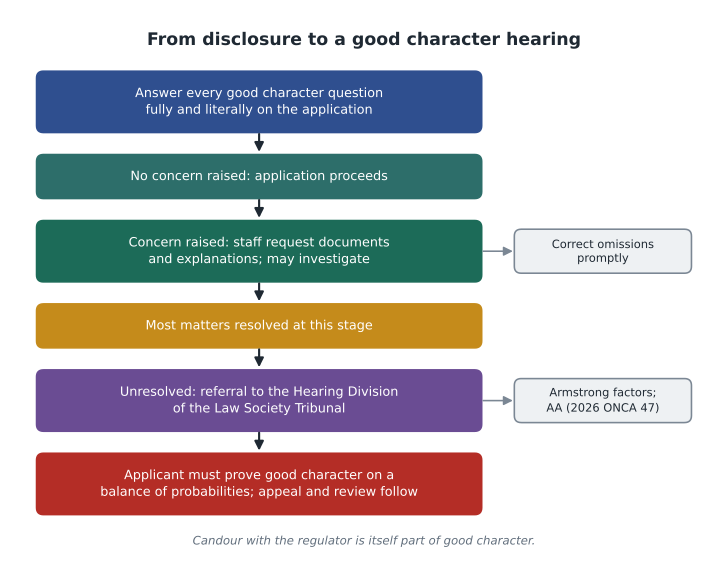
Most disclosures raise no concern, or are resolved after staff ask for documents and an explanation. Where a disclosure or other information raises a real question, the Law Society may investigate, and the candidate may be asked for court records, references, medical or treatment reports, and an interview. The candidate is entitled to know the concerns and to respond, and many candidates retain counsel at this stage. In Ezra's case, the Law Society asked for the court disclosure and diversion records, a letter from the agency that ran the program and two references; after reviewing them, it closed the file and his application proceeded.
If concerns remain after investigation, the Law Society may refer the application to the Hearing Division of the Law Society Tribunal for a good character hearing. At the hearing, the applicant bears the onus of proving good character on a balance of probabilities. The hearing is usually public, although the Tribunal can make confidentiality orders where the applicable test is met, for example to protect a vulnerable third party. The Hearing Division may find that the applicant is of good character, in which case the application proceeds, or that the applicant has not met the onus. Either the applicant or the Law Society may appeal to the Appeal Division, and further review lies in the courts.
The factors
Where the question is whether an applicant with past misconduct is now of good character, tribunals have relied on a set of factors associated with the 2009 decision in Armstrong v. Law Society of Upper Canada. They include the nature and duration of the misconduct; whether the applicant is remorseful; what rehabilitative efforts the applicant has made and whether they have succeeded; the applicant's conduct since the misconduct; and the time that has passed. Candour with the Law Society throughout the process is part of that later conduct.
In Law Society of Ontario v. AA, 2026 ONCA 47, released January 26, 2026, the Court of Appeal clarified how those factors are to be used. The applicant had committed very serious misconduct against children years earlier, abroad, and had not disclosed it on a first application in 2012; after the Law Society investigated, he withdrew that application in 2017 and reapplied in 2019. The Hearing Division applied the Armstrong factors, found remorse, successful rehabilitation and a low risk of reoffending, and found him of good character, with a condition that he be supervised when working with minors. The Appeal Division and the Divisional Court upheld that result. The Court of Appeal, in unanimous reasons by Sossin J.A., held that the decision was unreasonable.
The Court held that the good character requirement must be assessed in light of the overarching purposes of the statute, including public trust and confidence in licensees and in the profession. The Armstrong factors are relevant, but they are not to be applied mechanically, as a mere score card. A tribunal must step back and explain how its findings on the factors, weighed together, answer the real question, which is whether licensing the applicant is consistent with that public trust. The Hearing Division had not done so. The Court also held that the supervision condition could not be justified under the statute and was inconsistent with a finding of good character, because it implied that the applicant could not be trusted with the full responsibilities of a licence. The matter was sent back to the Hearing Division for reconsideration. Reports in April 2026 indicated that the applicant had sought leave to appeal to the Supreme Court of Canada.
The decision has prompted debate. Some commentators argue that it restores the public interest to the centre of licensing decisions. Others worry that an open-ended appeal to public confidence makes the test more subjective and less predictable for applicants with any past problem. There have also been broader calls to reform or even abolish the good character requirement, on the ground that the questions disproportionately burden applicants from communities that are more heavily policed, and that a forward-looking assessment of risk might serve the public better.
Other issues on the application
Academic misconduct findings deserve special care. Law students sometimes treat a finding of plagiarism or unauthorized collaboration as a private matter between them and the school. Licensing applications ask about it directly, and the Law Society may ask the school for the file. Candidates should keep copies of the decision and any record of the sanction completed. The same applies to discipline by another regulator: a nurse, engineer or police officer who becomes a lawyer must disclose findings from the earlier profession.
Financial history matters because lawyers handle trust money. A bankruptcy or unpaid judgment is not disqualifying in itself, but the Law Society will want to understand the circumstances and how the applicant has dealt with them. Candidates who are in financial difficulty should say so and explain their plan.
Health is a more delicate subject. Law societies have revised application questions over the years in response to concerns that questions about mental health discouraged candidates from seeking treatment. The current focus is on conduct and on whether any condition currently impairs the ability to practise, not on diagnosis. Rideout encourages anyone with a concern to read the current questions carefully, to seek confidential advice, and to remember that getting help is never a sign of bad character.
Ongoing obligations
The good character requirement does not end at licensing. Candidates must tell the Law Society promptly if anything changes while their application is pending, for example a new charge. Licensees must report certain events, such as criminal charges, to the Law Society, and conduct after licensing that would have prevented licensing can lead to discipline. Daniel notes that the same idea appears in Saskatchewan and in every PREP province: the form and the process differ, but the duty to tell the truth to your regulator is the same everywhere.
Worked problem
Sophie's academic warning
In first year, Sophie Tremblay-Hart submitted a research memo that reused two paragraphs from a memo she had written for a summer job without citing it. The school treated it as a minor academic integrity matter: a formal warning, no grade penalty, and a note on her internal file. She now reads a licensing question asking whether she has ever been the subject of a finding of academic misconduct. She thinks it was too small to count. What should she do?
Show solution
- Read the question literally: it asks about any finding of academic misconduct, not only serious ones or those with a penalty.
- Recognize that a formal warning recorded on her file is a finding, even if minor; leaving it out would be an inaccurate answer.
- Disclose it, with a short, factual explanation of what happened, what the school decided, and what she learned, without minimizing or arguing.
- Obtain and keep a copy of the school's decision letter so she can provide it if asked.
- Understand the stakes: the matter itself is unlikely to prevent licensing, but non-disclosure discovered later could raise a far more serious question about candour.
Common mistakes
MistakeAnswering a question about charges as if it asked only about convictions.
InsteadRead each question literally; withdrawn, stayed and diverted charges must be disclosed if the question asks about charges.
MistakeTreating the good character factors as a checklist to be scored.
InsteadUnder Law Society of Ontario v. AA, the factors must be weighed together in light of public trust and confidence in the profession.
MistakeWaiting until asked before correcting an omission.
InsteadPrompt voluntary correction, with documents and a candid explanation, weighs strongly in the applicant's favour.
MistakeAssuming the onus is on the Law Society to prove bad character.
InsteadAt a good character hearing, the applicant must prove good character on a balance of probabilities.
Practice problems
Work each problem on paper first, then reveal the answer to check.
What did the Court of Appeal decide in Law Society of Ontario v. AA, 2026 ONCA 47?
Show answer
That the Hearing Division's good character finding was unreasonable because it applied the Armstrong factors mechanically without stepping back to assess public trust and confidence in the profession, and that a supervision condition could not be justified; the matter was sent back for reconsideration.
Who bears the onus at a good character hearing, and to what standard?
Show answer
The applicant, on a balance of probabilities.
Why can concealment be more serious than the original misconduct?
Show answer
Because honesty with the regulator is itself a core part of good character; concealment shows the very trait the requirement screens for, and can lead to a hearing even where the underlying matter would not have.
Summary and key terms
- Section 27 of the Law Society Act requires every applicant for a licence to be of good character; the test is present character, not perfection.
- Applicants must answer the good character questions literally and fully; when in doubt, disclose and explain.
- Candour is itself part of good character, and prompt voluntary correction weighs in the applicant's favour.
- At a good character hearing, the applicant bears the onus on a balance of probabilities; the Armstrong factors guide the assessment of past misconduct.
- Law Society of Ontario v. AA, 2026 ONCA 47, requires tribunals to weigh the factors in light of public trust and confidence rather than mechanically.
- Good character
- The qualities of honesty, integrity and trustworthiness that a law society requires of every applicant for a licence.
- Duty of candour
- The obligation of an applicant or licensee to be truthful and complete in dealings with the regulator.
- Good character hearing
- A hearing before the Law Society Tribunal's Hearing Division to decide whether an applicant has proved good character.
- Armstrong factors
- The factors tribunals use to assess whether an applicant with past misconduct is now of good character, including remorse and rehabilitation.
- Diversion
- A program that allows a charge to be withdrawn if the accused completes conditions such as counselling, without a conviction.
- Confidentiality order
- An order limiting public access to information in a proceeding, made only where the legal test for departing from open proceedings is met.
Lesson quiz · 5 questions
Score 60% or more to complete this lesson.
Create a free account to save your progress, take quizzes and earn a certificate.